SUBSCRIBE TO OUR FREE NEWSLETTER
Daily news & progressive opinion—funded by the people, not the corporations—delivered straight to your inbox.
5
#000000
#FFFFFF
To donate by check, phone, or other method, see our More Ways to Give page.
Daily news & progressive opinion—funded by the people, not the corporations—delivered straight to your inbox.
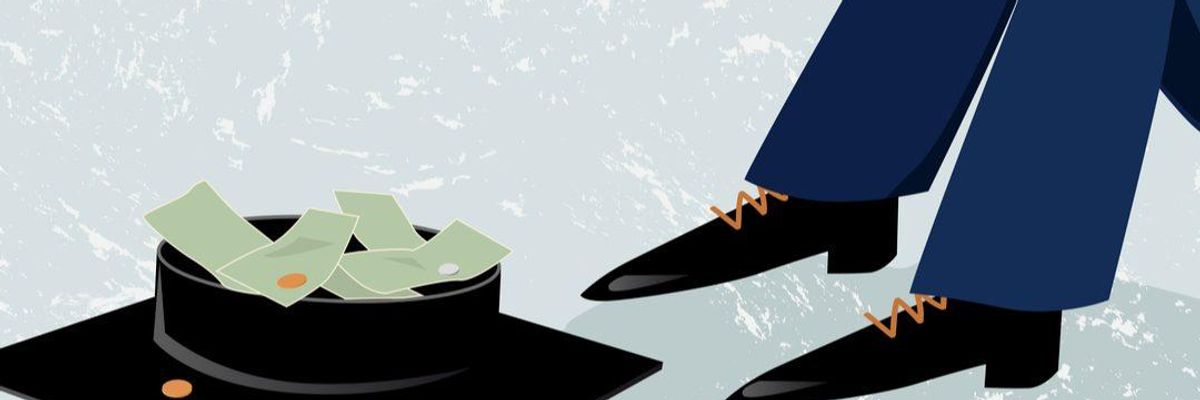
Even before the pandemic, the exorbitant cost of higher education was holding our country back. (Photo: Shutterstock)
After graduating from college last year, Hayat Rahmeto moved back in with her parents and planned to work two jobs to save money for law school. Then the pandemic hit. She lost one job, with Delta Airlines, and the prospects for finding another were bleak.
Fortunately, with her parents providing rent-free housing, Rahmeto realized she could afford to attend her local community college in Omaha, Nebraska, where she's now working on a paralegal certificate program.
It will cost Rahmeto about $6,000. "This is the cheapest, most cost effective way to find out if law school is what I really want to do with my life," Rahmeto told me.
Youth unemployment is sky-high, reaching over 20 percent for people aged 16 to 24 this June. Like Rahmeto, many other recent graduates may decide to continue their education instead of entering the job market.
With few jobs available under the current crisis, it's even more important to eliminate the financial barriers to continuing education.
But not all will have access to rent-free housing or a spare $6,000 for community college--nevermind the skyrocketing cost of traditional universities.
According to a 2018 study from the Levy Institute, the average cost of college tuition more than doubled as a share of median household income between 1990 and 2014. Including room and board, the average cost of college is more than a third of a typical household's earnings.
This helps explain today's aggregate student loan debt of $1.6 trillion.
These high costs are especially problematic for poor communities and people of color like Rahmeto, who make up a far larger share of heavily indebted borrowers than their share of the student population.
With few jobs available under the current crisis, it's even more important to eliminate the financial barriers to continuing education.
Senator Bernie Sanders has proposed a College for All plan that would eliminate tuition and fees at public four-year colleges, universities, and community colleges. Additionally, it would cancel student debt for 45 million Americans within six months and ensure low-income students can attend college debt-free.
Free college proposals have received support from a growing number of organizations, including the Poor People's Campaign.
In a "Moral Budget" proposal released with the Institute for Policy Studies, they point out that these investments benefit the whole country -- not just students. One California study they cite found that for every $1 invested in public colleges and universities, the state gained $4.50 due to reduced poverty, fewer arrests and incarcerations, and higher tax revenues.
Making college free for all students would also help erase the stigma of financial aid. Rahmeto, who was born in the United States to Ethiopian immigrant parents, said she often felt other students looked down on her for having financial aid as an undergraduate at Franklin and Marshall College in Lancaster, Pennsylvania.
"It's like, what, I'm sorry I wasn't born into a life where my parents could afford to pay 60-some thousand dollars a year," she said. "But why am I any less deserving than you? I worked even harder to get where I am now."
Even before the pandemic, the exorbitant cost of higher education was holding our country back. That's especially true now. Free college would allow young people who cannot find jobs now to learn new skills and knowledge that will better position them to join the labor market once the crisis is over.
Dear Common Dreams reader, It’s been nearly 30 years since I co-founded Common Dreams with my late wife, Lina Newhouser. We had the radical notion that journalism should serve the public good, not corporate profits. It was clear to us from the outset what it would take to build such a project. No paid advertisements. No corporate sponsors. No millionaire publisher telling us what to think or do. Many people said we wouldn't last a year, but we proved those doubters wrong. Together with a tremendous team of journalists and dedicated staff, we built an independent media outlet free from the constraints of profits and corporate control. Our mission has always been simple: To inform. To inspire. To ignite change for the common good. Building Common Dreams was not easy. Our survival was never guaranteed. When you take on the most powerful forces—Wall Street greed, fossil fuel industry destruction, Big Tech lobbyists, and uber-rich oligarchs who have spent billions upon billions rigging the economy and democracy in their favor—the only bulwark you have is supporters who believe in your work. But here’s the urgent message from me today. It's never been this bad out there. And it's never been this hard to keep us going. At the very moment Common Dreams is most needed, the threats we face are intensifying. We need your support now more than ever. We don't accept corporate advertising and never will. We don't have a paywall because we don't think people should be blocked from critical news based on their ability to pay. Everything we do is funded by the donations of readers like you. When everyone does the little they can afford, we are strong. But if that support retreats or dries up, so do we. Will you donate now to make sure Common Dreams not only survives but thrives? —Craig Brown, Co-founder |
After graduating from college last year, Hayat Rahmeto moved back in with her parents and planned to work two jobs to save money for law school. Then the pandemic hit. She lost one job, with Delta Airlines, and the prospects for finding another were bleak.
Fortunately, with her parents providing rent-free housing, Rahmeto realized she could afford to attend her local community college in Omaha, Nebraska, where she's now working on a paralegal certificate program.
It will cost Rahmeto about $6,000. "This is the cheapest, most cost effective way to find out if law school is what I really want to do with my life," Rahmeto told me.
Youth unemployment is sky-high, reaching over 20 percent for people aged 16 to 24 this June. Like Rahmeto, many other recent graduates may decide to continue their education instead of entering the job market.
With few jobs available under the current crisis, it's even more important to eliminate the financial barriers to continuing education.
But not all will have access to rent-free housing or a spare $6,000 for community college--nevermind the skyrocketing cost of traditional universities.
According to a 2018 study from the Levy Institute, the average cost of college tuition more than doubled as a share of median household income between 1990 and 2014. Including room and board, the average cost of college is more than a third of a typical household's earnings.
This helps explain today's aggregate student loan debt of $1.6 trillion.
These high costs are especially problematic for poor communities and people of color like Rahmeto, who make up a far larger share of heavily indebted borrowers than their share of the student population.
With few jobs available under the current crisis, it's even more important to eliminate the financial barriers to continuing education.
Senator Bernie Sanders has proposed a College for All plan that would eliminate tuition and fees at public four-year colleges, universities, and community colleges. Additionally, it would cancel student debt for 45 million Americans within six months and ensure low-income students can attend college debt-free.
Free college proposals have received support from a growing number of organizations, including the Poor People's Campaign.
In a "Moral Budget" proposal released with the Institute for Policy Studies, they point out that these investments benefit the whole country -- not just students. One California study they cite found that for every $1 invested in public colleges and universities, the state gained $4.50 due to reduced poverty, fewer arrests and incarcerations, and higher tax revenues.
Making college free for all students would also help erase the stigma of financial aid. Rahmeto, who was born in the United States to Ethiopian immigrant parents, said she often felt other students looked down on her for having financial aid as an undergraduate at Franklin and Marshall College in Lancaster, Pennsylvania.
"It's like, what, I'm sorry I wasn't born into a life where my parents could afford to pay 60-some thousand dollars a year," she said. "But why am I any less deserving than you? I worked even harder to get where I am now."
Even before the pandemic, the exorbitant cost of higher education was holding our country back. That's especially true now. Free college would allow young people who cannot find jobs now to learn new skills and knowledge that will better position them to join the labor market once the crisis is over.
After graduating from college last year, Hayat Rahmeto moved back in with her parents and planned to work two jobs to save money for law school. Then the pandemic hit. She lost one job, with Delta Airlines, and the prospects for finding another were bleak.
Fortunately, with her parents providing rent-free housing, Rahmeto realized she could afford to attend her local community college in Omaha, Nebraska, where she's now working on a paralegal certificate program.
It will cost Rahmeto about $6,000. "This is the cheapest, most cost effective way to find out if law school is what I really want to do with my life," Rahmeto told me.
Youth unemployment is sky-high, reaching over 20 percent for people aged 16 to 24 this June. Like Rahmeto, many other recent graduates may decide to continue their education instead of entering the job market.
With few jobs available under the current crisis, it's even more important to eliminate the financial barriers to continuing education.
But not all will have access to rent-free housing or a spare $6,000 for community college--nevermind the skyrocketing cost of traditional universities.
According to a 2018 study from the Levy Institute, the average cost of college tuition more than doubled as a share of median household income between 1990 and 2014. Including room and board, the average cost of college is more than a third of a typical household's earnings.
This helps explain today's aggregate student loan debt of $1.6 trillion.
These high costs are especially problematic for poor communities and people of color like Rahmeto, who make up a far larger share of heavily indebted borrowers than their share of the student population.
With few jobs available under the current crisis, it's even more important to eliminate the financial barriers to continuing education.
Senator Bernie Sanders has proposed a College for All plan that would eliminate tuition and fees at public four-year colleges, universities, and community colleges. Additionally, it would cancel student debt for 45 million Americans within six months and ensure low-income students can attend college debt-free.
Free college proposals have received support from a growing number of organizations, including the Poor People's Campaign.
In a "Moral Budget" proposal released with the Institute for Policy Studies, they point out that these investments benefit the whole country -- not just students. One California study they cite found that for every $1 invested in public colleges and universities, the state gained $4.50 due to reduced poverty, fewer arrests and incarcerations, and higher tax revenues.
Making college free for all students would also help erase the stigma of financial aid. Rahmeto, who was born in the United States to Ethiopian immigrant parents, said she often felt other students looked down on her for having financial aid as an undergraduate at Franklin and Marshall College in Lancaster, Pennsylvania.
"It's like, what, I'm sorry I wasn't born into a life where my parents could afford to pay 60-some thousand dollars a year," she said. "But why am I any less deserving than you? I worked even harder to get where I am now."
Even before the pandemic, the exorbitant cost of higher education was holding our country back. That's especially true now. Free college would allow young people who cannot find jobs now to learn new skills and knowledge that will better position them to join the labor market once the crisis is over.