SUBSCRIBE TO OUR FREE NEWSLETTER
Daily news & progressive opinion—funded by the people, not the corporations—delivered straight to your inbox.
5
#000000
#FFFFFF
To donate by check, phone, or other method, see our More Ways to Give page.
Daily news & progressive opinion—funded by the people, not the corporations—delivered straight to your inbox.
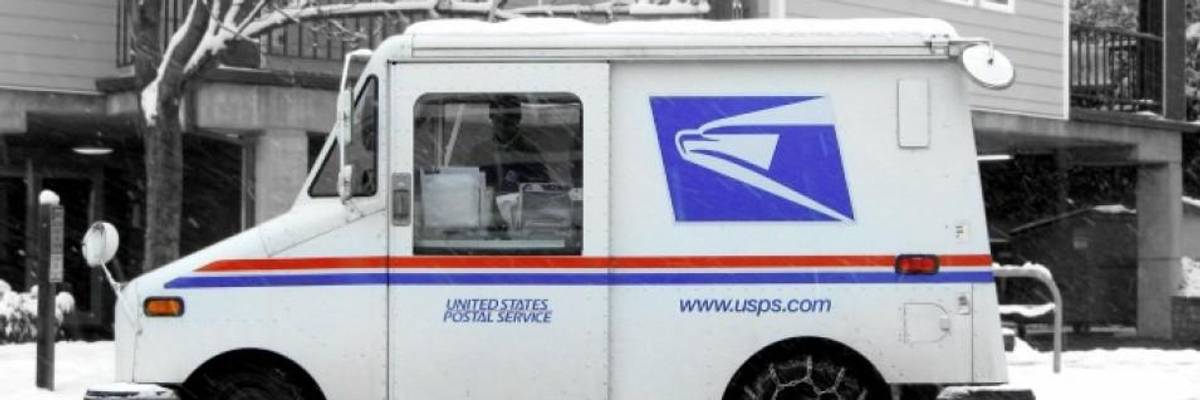
It's clear that the United States Postal Service provides tremendous service and value to seniors, not to mention millions of other Americans. (Photo: hobvias sudoneighm/flickr/cc)
For more than two centuries, the nation's postal service has bonded Americans scattered across a vast continent. To most of us, the U.S. mail is an essential institution. For American seniors, it is nothing less than a lifeline. Today's older Americans rely on the postal service for mail-order prescription medications, paying bills, casting ballots in our nation's elections, and keeping in touch with loved ones. The Coronavirus pandemic has only intensified seniors' dependence on the United States Postal Service (USPS).
How unfortunate, then, that President Trump--who claims to be a champion for seniors--shows open disdain for the postal service. It's no secret that USPS is in serious financial peril. Among other challenges, the postal service needs better cost control measures and is required by law to pre-fund 75 years of health care premiums for retired employees-- which no other U.S. employer is compelled to do. With its costs rising and revenue diminished (a situation aggravated by the COVID crisis), some projections suggest USPS could become insolvent as early as September if it doesn't get a sizable emergency cash infusion from the federal government.
Instead of helping, President Trump has rubbed salt in the wound by calling the postal service "a joke," opposing emergency funding, and installing a Republican donor with no relevant experience as Postmaster General. Meanwhile, Congress has made a limited effort to prop up USPS. The CARES Coronavirus relief act included a $10 billion loan for the postal service. The latest House-passed relief bill, the HEROES Act, includes $25 billion in emergency funding, but the postal service says it needs $75 billion to remain solvent. Unfortunately, some on Capitol Hill are hesitant to approve any new money - and the President is openly hostile to the idea.
Refusing to bolster the United States Postal Service in its time of need is nothing short of a betrayal of American seniors, who are more reliant upon the US Postal Service than any other age group. For many older citizens, there is no replacement for the U.S. Mail. According to the National Council on Aging, "41 percent of older Americans do not use the Internet at all, meaning more than 18 million seniors might be cut off from [services] they need most."
It does not seem politically wise for the President or his allies in Congress to undermine such a patently popular American institution. It is not an exaggeration to say that many seniors literally could not obtain their prescription medicines without mail service. Older Americans simply do not pick up medications from the pharmacy at the rate younger people do, especially during the Coronavirus crisis. In fact, the Postal Service delivered 1.2 billion prescriptions in 2019, including nearly all of the prescriptions for older veterans through the VA health system. Seniors in rural areas especially rely on mail order prescriptions. Many pharmacies outside of major urban areas have been forced to close due to the pandemic. Imagine these seniors suddenly cut off from their heart, asthma, blood pressure, or diabetes medications because the postal service is allowed to go bankrupt.
Older Americans also rely on the mail to exercise their right to vote--primarily due to health issues, disabilities, or lack of transportation. Again, this is especially true for rural voters, who tend to be older on average and may have difficulty reaching remote polling places. For these American seniors, voting by mail truly is the only option. Unfortunately, President Trump is waging a veritable war on mail-in voting, likely fearing that it will hurt his chances for re-election. He even threatened to withhold Coronavirus relief funding from Michigan and Nevada because they are expanding voting by mail.
For isolated seniors, the postal service also provides some of the only regular human interaction they experience during the course of the day or week. Casey Cep, the daughter of a longtime letter carrier, wrote in the New Yorker, "My mother is so close with the people who live along her route that they have always felt like second or third cousins to me." Cep says that her mother once rescued a senior on her route who had fallen and couldn't call for help. Fortunately, her mother is not unique; many postal workers fill that role. In fact, USPS offers a Carrier Alert program where letter carriers routinely monitor the well-being of elderly customers. That service, which helps to safeguard seniors in our communities, would disappear if USPS collapses.
Seniors also rely upon the mail to maintain crucial social contacts. That's 18 million seniors whose only means of communicating with friends and relatives, besides the telephone, is the U.S. mail. The demise of the postal service could harm seniors' sense of well-being. No responsible leader should allow that to happen.
Just as crucially, the postal service provides many seniors with a means of financial independence. USPS is one of the nation's major employers of older workers. As of last year, the postal service employed 50,000 workers aged 65 and older, and an additional 186,000 workers aged 55-64. 'Postal worker' is one of the most popular jobs for seniors, who often confront age discrimination or more arduous physical demands in other fields.
It's clear that the United States Postal Service provides tremendous service and value to seniors, not to mention millions of other Americans. According to a recent survey, more than 90% of the public (across party lines) has a positive view of the postal service--higher than any other government agency. It does not seem politically wise for the President or his allies in Congress to undermine such a patently popular American institution.
The president's attempt to undermine the postal service is more evidence of his indifference to the needs of older Americans. This includes the Trump administration's proposals to misuse Social Security funding for unrelated purposes, to slash Social Security Disability Insurance, to weaken traditional Medicare, and to eliminate federal grants for Meals on Wheels and home heating assistance for seniors. During the COVID crisis, the Trump administration has failed to help contain infection rates and deaths in nursing homes, while insisting that the country re-open as the virus continues to take a disproportionate toll on the elderly. What a terrible time, then, to threaten the lifeline that the U.S. mail provides to millions of older Americans. If "neither snow nor rain nor heat nor gloom of night" prevents the postal service from fulfilling so many of our seniors' needs, then neither should the President or the U.S. Congress.
Dear Common Dreams reader, It’s been nearly 30 years since I co-founded Common Dreams with my late wife, Lina Newhouser. We had the radical notion that journalism should serve the public good, not corporate profits. It was clear to us from the outset what it would take to build such a project. No paid advertisements. No corporate sponsors. No millionaire publisher telling us what to think or do. Many people said we wouldn't last a year, but we proved those doubters wrong. Together with a tremendous team of journalists and dedicated staff, we built an independent media outlet free from the constraints of profits and corporate control. Our mission has always been simple: To inform. To inspire. To ignite change for the common good. Building Common Dreams was not easy. Our survival was never guaranteed. When you take on the most powerful forces—Wall Street greed, fossil fuel industry destruction, Big Tech lobbyists, and uber-rich oligarchs who have spent billions upon billions rigging the economy and democracy in their favor—the only bulwark you have is supporters who believe in your work. But here’s the urgent message from me today. It's never been this bad out there. And it's never been this hard to keep us going. At the very moment Common Dreams is most needed, the threats we face are intensifying. We need your support now more than ever. We don't accept corporate advertising and never will. We don't have a paywall because we don't think people should be blocked from critical news based on their ability to pay. Everything we do is funded by the donations of readers like you. When everyone does the little they can afford, we are strong. But if that support retreats or dries up, so do we. Will you donate now to make sure Common Dreams not only survives but thrives? —Craig Brown, Co-founder |
For more than two centuries, the nation's postal service has bonded Americans scattered across a vast continent. To most of us, the U.S. mail is an essential institution. For American seniors, it is nothing less than a lifeline. Today's older Americans rely on the postal service for mail-order prescription medications, paying bills, casting ballots in our nation's elections, and keeping in touch with loved ones. The Coronavirus pandemic has only intensified seniors' dependence on the United States Postal Service (USPS).
How unfortunate, then, that President Trump--who claims to be a champion for seniors--shows open disdain for the postal service. It's no secret that USPS is in serious financial peril. Among other challenges, the postal service needs better cost control measures and is required by law to pre-fund 75 years of health care premiums for retired employees-- which no other U.S. employer is compelled to do. With its costs rising and revenue diminished (a situation aggravated by the COVID crisis), some projections suggest USPS could become insolvent as early as September if it doesn't get a sizable emergency cash infusion from the federal government.
Instead of helping, President Trump has rubbed salt in the wound by calling the postal service "a joke," opposing emergency funding, and installing a Republican donor with no relevant experience as Postmaster General. Meanwhile, Congress has made a limited effort to prop up USPS. The CARES Coronavirus relief act included a $10 billion loan for the postal service. The latest House-passed relief bill, the HEROES Act, includes $25 billion in emergency funding, but the postal service says it needs $75 billion to remain solvent. Unfortunately, some on Capitol Hill are hesitant to approve any new money - and the President is openly hostile to the idea.
Refusing to bolster the United States Postal Service in its time of need is nothing short of a betrayal of American seniors, who are more reliant upon the US Postal Service than any other age group. For many older citizens, there is no replacement for the U.S. Mail. According to the National Council on Aging, "41 percent of older Americans do not use the Internet at all, meaning more than 18 million seniors might be cut off from [services] they need most."
It does not seem politically wise for the President or his allies in Congress to undermine such a patently popular American institution. It is not an exaggeration to say that many seniors literally could not obtain their prescription medicines without mail service. Older Americans simply do not pick up medications from the pharmacy at the rate younger people do, especially during the Coronavirus crisis. In fact, the Postal Service delivered 1.2 billion prescriptions in 2019, including nearly all of the prescriptions for older veterans through the VA health system. Seniors in rural areas especially rely on mail order prescriptions. Many pharmacies outside of major urban areas have been forced to close due to the pandemic. Imagine these seniors suddenly cut off from their heart, asthma, blood pressure, or diabetes medications because the postal service is allowed to go bankrupt.
Older Americans also rely on the mail to exercise their right to vote--primarily due to health issues, disabilities, or lack of transportation. Again, this is especially true for rural voters, who tend to be older on average and may have difficulty reaching remote polling places. For these American seniors, voting by mail truly is the only option. Unfortunately, President Trump is waging a veritable war on mail-in voting, likely fearing that it will hurt his chances for re-election. He even threatened to withhold Coronavirus relief funding from Michigan and Nevada because they are expanding voting by mail.
For isolated seniors, the postal service also provides some of the only regular human interaction they experience during the course of the day or week. Casey Cep, the daughter of a longtime letter carrier, wrote in the New Yorker, "My mother is so close with the people who live along her route that they have always felt like second or third cousins to me." Cep says that her mother once rescued a senior on her route who had fallen and couldn't call for help. Fortunately, her mother is not unique; many postal workers fill that role. In fact, USPS offers a Carrier Alert program where letter carriers routinely monitor the well-being of elderly customers. That service, which helps to safeguard seniors in our communities, would disappear if USPS collapses.
Seniors also rely upon the mail to maintain crucial social contacts. That's 18 million seniors whose only means of communicating with friends and relatives, besides the telephone, is the U.S. mail. The demise of the postal service could harm seniors' sense of well-being. No responsible leader should allow that to happen.
Just as crucially, the postal service provides many seniors with a means of financial independence. USPS is one of the nation's major employers of older workers. As of last year, the postal service employed 50,000 workers aged 65 and older, and an additional 186,000 workers aged 55-64. 'Postal worker' is one of the most popular jobs for seniors, who often confront age discrimination or more arduous physical demands in other fields.
It's clear that the United States Postal Service provides tremendous service and value to seniors, not to mention millions of other Americans. According to a recent survey, more than 90% of the public (across party lines) has a positive view of the postal service--higher than any other government agency. It does not seem politically wise for the President or his allies in Congress to undermine such a patently popular American institution.
The president's attempt to undermine the postal service is more evidence of his indifference to the needs of older Americans. This includes the Trump administration's proposals to misuse Social Security funding for unrelated purposes, to slash Social Security Disability Insurance, to weaken traditional Medicare, and to eliminate federal grants for Meals on Wheels and home heating assistance for seniors. During the COVID crisis, the Trump administration has failed to help contain infection rates and deaths in nursing homes, while insisting that the country re-open as the virus continues to take a disproportionate toll on the elderly. What a terrible time, then, to threaten the lifeline that the U.S. mail provides to millions of older Americans. If "neither snow nor rain nor heat nor gloom of night" prevents the postal service from fulfilling so many of our seniors' needs, then neither should the President or the U.S. Congress.
For more than two centuries, the nation's postal service has bonded Americans scattered across a vast continent. To most of us, the U.S. mail is an essential institution. For American seniors, it is nothing less than a lifeline. Today's older Americans rely on the postal service for mail-order prescription medications, paying bills, casting ballots in our nation's elections, and keeping in touch with loved ones. The Coronavirus pandemic has only intensified seniors' dependence on the United States Postal Service (USPS).
How unfortunate, then, that President Trump--who claims to be a champion for seniors--shows open disdain for the postal service. It's no secret that USPS is in serious financial peril. Among other challenges, the postal service needs better cost control measures and is required by law to pre-fund 75 years of health care premiums for retired employees-- which no other U.S. employer is compelled to do. With its costs rising and revenue diminished (a situation aggravated by the COVID crisis), some projections suggest USPS could become insolvent as early as September if it doesn't get a sizable emergency cash infusion from the federal government.
Instead of helping, President Trump has rubbed salt in the wound by calling the postal service "a joke," opposing emergency funding, and installing a Republican donor with no relevant experience as Postmaster General. Meanwhile, Congress has made a limited effort to prop up USPS. The CARES Coronavirus relief act included a $10 billion loan for the postal service. The latest House-passed relief bill, the HEROES Act, includes $25 billion in emergency funding, but the postal service says it needs $75 billion to remain solvent. Unfortunately, some on Capitol Hill are hesitant to approve any new money - and the President is openly hostile to the idea.
Refusing to bolster the United States Postal Service in its time of need is nothing short of a betrayal of American seniors, who are more reliant upon the US Postal Service than any other age group. For many older citizens, there is no replacement for the U.S. Mail. According to the National Council on Aging, "41 percent of older Americans do not use the Internet at all, meaning more than 18 million seniors might be cut off from [services] they need most."
It does not seem politically wise for the President or his allies in Congress to undermine such a patently popular American institution. It is not an exaggeration to say that many seniors literally could not obtain their prescription medicines without mail service. Older Americans simply do not pick up medications from the pharmacy at the rate younger people do, especially during the Coronavirus crisis. In fact, the Postal Service delivered 1.2 billion prescriptions in 2019, including nearly all of the prescriptions for older veterans through the VA health system. Seniors in rural areas especially rely on mail order prescriptions. Many pharmacies outside of major urban areas have been forced to close due to the pandemic. Imagine these seniors suddenly cut off from their heart, asthma, blood pressure, or diabetes medications because the postal service is allowed to go bankrupt.
Older Americans also rely on the mail to exercise their right to vote--primarily due to health issues, disabilities, or lack of transportation. Again, this is especially true for rural voters, who tend to be older on average and may have difficulty reaching remote polling places. For these American seniors, voting by mail truly is the only option. Unfortunately, President Trump is waging a veritable war on mail-in voting, likely fearing that it will hurt his chances for re-election. He even threatened to withhold Coronavirus relief funding from Michigan and Nevada because they are expanding voting by mail.
For isolated seniors, the postal service also provides some of the only regular human interaction they experience during the course of the day or week. Casey Cep, the daughter of a longtime letter carrier, wrote in the New Yorker, "My mother is so close with the people who live along her route that they have always felt like second or third cousins to me." Cep says that her mother once rescued a senior on her route who had fallen and couldn't call for help. Fortunately, her mother is not unique; many postal workers fill that role. In fact, USPS offers a Carrier Alert program where letter carriers routinely monitor the well-being of elderly customers. That service, which helps to safeguard seniors in our communities, would disappear if USPS collapses.
Seniors also rely upon the mail to maintain crucial social contacts. That's 18 million seniors whose only means of communicating with friends and relatives, besides the telephone, is the U.S. mail. The demise of the postal service could harm seniors' sense of well-being. No responsible leader should allow that to happen.
Just as crucially, the postal service provides many seniors with a means of financial independence. USPS is one of the nation's major employers of older workers. As of last year, the postal service employed 50,000 workers aged 65 and older, and an additional 186,000 workers aged 55-64. 'Postal worker' is one of the most popular jobs for seniors, who often confront age discrimination or more arduous physical demands in other fields.
It's clear that the United States Postal Service provides tremendous service and value to seniors, not to mention millions of other Americans. According to a recent survey, more than 90% of the public (across party lines) has a positive view of the postal service--higher than any other government agency. It does not seem politically wise for the President or his allies in Congress to undermine such a patently popular American institution.
The president's attempt to undermine the postal service is more evidence of his indifference to the needs of older Americans. This includes the Trump administration's proposals to misuse Social Security funding for unrelated purposes, to slash Social Security Disability Insurance, to weaken traditional Medicare, and to eliminate federal grants for Meals on Wheels and home heating assistance for seniors. During the COVID crisis, the Trump administration has failed to help contain infection rates and deaths in nursing homes, while insisting that the country re-open as the virus continues to take a disproportionate toll on the elderly. What a terrible time, then, to threaten the lifeline that the U.S. mail provides to millions of older Americans. If "neither snow nor rain nor heat nor gloom of night" prevents the postal service from fulfilling so many of our seniors' needs, then neither should the President or the U.S. Congress.