SUBSCRIBE TO OUR FREE NEWSLETTER
Daily news & progressive opinion—funded by the people, not the corporations—delivered straight to your inbox.
5
#000000
#FFFFFF
To donate by check, phone, or other method, see our More Ways to Give page.
Daily news & progressive opinion—funded by the people, not the corporations—delivered straight to your inbox.
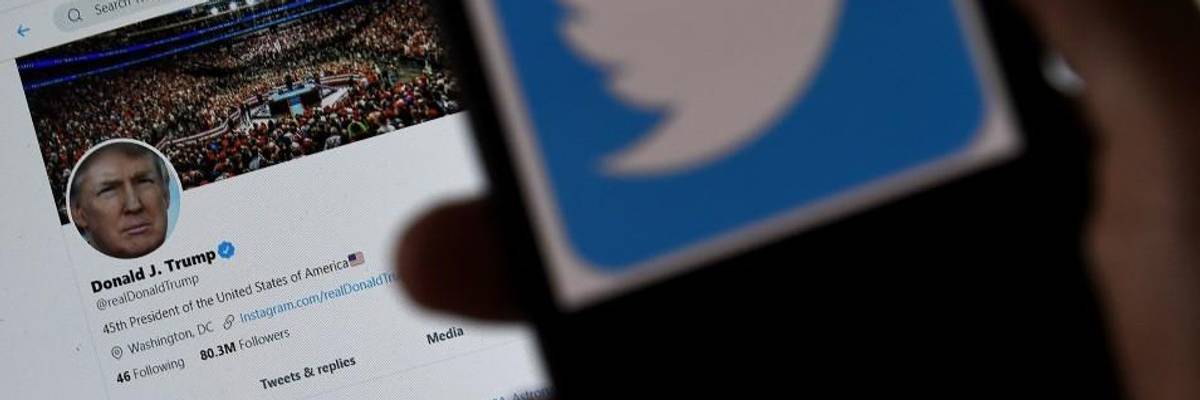
In this photo illustration, a Twitter logo is displayed on a mobile phone with President Trump's Twitter page shown in the background on May 27, 2020, in Arlington, Virginia. (Photo: Olivier Douliery/AFP via Getty Images)
On Thursday, President Trump took an ill-informed potshot at the U.S. Constitution in the form of an executive order purportedly designed to bring social media companies to the president's heel. In reality, the order's chief purpose is to soothe the president's ego. Its chief effect must not be to draw our attention away from bringing real accountability to companies that have violated our civil rights and damaged our democracy.
Issued in response to Twitter appending mild fact checks to a few of the president's tweets containing misinformation about voting, the order issues some tepid (and constitutionally questionable) directives to federal agencies. The Commerce department is tasked with petitioning the Federal Communications Commission for a rulemaking dealing with how much immunity platforms should have when they make content-moderation decisions. Complaints about political targeting are directed to the Federal Trade Commission. Federal agencies are asked to review their social media ad spending. But the meat of the order is hot-headed rhetoric about the First Amendment, designed to call criticism down on those the president believes are his enemies.
"All the sound and fury surrounding the order must not leave us too divided to fix some of the messes these companies have made entirely aside from those concerns."The order sparked a flurry of discussion surrounding what relationship internet platforms should have to freedom of speech, and some of those discussions are valuable. But all the sound and fury surrounding the order must not leave us too divided to fix some of the messes these companies have made entirely aside from those concerns.
Internet platforms have threatened our civil rights and privacy, stifled competition, and damaged our democracy. They have been called out and even sued for the way their system of targeting advertising limits fair access to housing, credit, and employment decisions. They continue to allow the spread of misinformation related to core democratic activities such as the census and voting by mail. Even when they do face consequences for privacy violations, those consequences fail to bring significant change. In addition, big tech platforms are under investigation for anti-competitive activity by multiple federal and state agencies, and by Congress.
There are solutions out there. Congress needs to pass a federal baseline privacy law that empowers states to think creatively about the solutions that work for their residents while providing some basic guardrails about how our private information can and cannot be used by corporations. Congress should also mandate more disclosure for political advertising on the internet. The FTC should scrutinize big tech mergers and anti-competitive behavior more carefully, and should impose real consequences for violations of our privacy. The platforms themselves should take steps to provide more transparency around how content is targeted, and they need to do more to curb misinformation on their sites.
"What's really dangerous about orders like this is that they feed erroneous opinions about what the U.S. Constitution is and what it does, in service of a mere political ploy."
Of course what's really dangerous about orders like this is that they feed erroneous opinions about what the U.S. Constitution is and what it does, in service of a mere political ploy. A great example from a few years ago was the so-called "Religious Freedom" executive order, which the president repeatedly and falsely claimed repealed the law that keeps 501(c)(3)s from engaging in partisanship. That order contained a lot of high-flying rhetoric designed to appeal to a segment of the president's base, but continues to fuel misunderstanding of what the law actually says, and even whether it remains in force at all. The executive order from early in Trump's presidency requiring that the infamous "wall" be built along the U.S. border with Mexico is another example of a purely performative, but nevertheless damaging, order. We can't lose sight of how damaging that kind of posturing is simply because it seems to happen so often.
We need real accountability for the damage online platforms have done to civil rights, competition and our democracy--not more hollow and inflammatory rhetoric.
Dear Common Dreams reader, It’s been nearly 30 years since I co-founded Common Dreams with my late wife, Lina Newhouser. We had the radical notion that journalism should serve the public good, not corporate profits. It was clear to us from the outset what it would take to build such a project. No paid advertisements. No corporate sponsors. No millionaire publisher telling us what to think or do. Many people said we wouldn't last a year, but we proved those doubters wrong. Together with a tremendous team of journalists and dedicated staff, we built an independent media outlet free from the constraints of profits and corporate control. Our mission has always been simple: To inform. To inspire. To ignite change for the common good. Building Common Dreams was not easy. Our survival was never guaranteed. When you take on the most powerful forces—Wall Street greed, fossil fuel industry destruction, Big Tech lobbyists, and uber-rich oligarchs who have spent billions upon billions rigging the economy and democracy in their favor—the only bulwark you have is supporters who believe in your work. But here’s the urgent message from me today. It's never been this bad out there. And it's never been this hard to keep us going. At the very moment Common Dreams is most needed, the threats we face are intensifying. We need your support now more than ever. We don't accept corporate advertising and never will. We don't have a paywall because we don't think people should be blocked from critical news based on their ability to pay. Everything we do is funded by the donations of readers like you. When everyone does the little they can afford, we are strong. But if that support retreats or dries up, so do we. Will you donate now to make sure Common Dreams not only survives but thrives? —Craig Brown, Co-founder |
On Thursday, President Trump took an ill-informed potshot at the U.S. Constitution in the form of an executive order purportedly designed to bring social media companies to the president's heel. In reality, the order's chief purpose is to soothe the president's ego. Its chief effect must not be to draw our attention away from bringing real accountability to companies that have violated our civil rights and damaged our democracy.
Issued in response to Twitter appending mild fact checks to a few of the president's tweets containing misinformation about voting, the order issues some tepid (and constitutionally questionable) directives to federal agencies. The Commerce department is tasked with petitioning the Federal Communications Commission for a rulemaking dealing with how much immunity platforms should have when they make content-moderation decisions. Complaints about political targeting are directed to the Federal Trade Commission. Federal agencies are asked to review their social media ad spending. But the meat of the order is hot-headed rhetoric about the First Amendment, designed to call criticism down on those the president believes are his enemies.
"All the sound and fury surrounding the order must not leave us too divided to fix some of the messes these companies have made entirely aside from those concerns."The order sparked a flurry of discussion surrounding what relationship internet platforms should have to freedom of speech, and some of those discussions are valuable. But all the sound and fury surrounding the order must not leave us too divided to fix some of the messes these companies have made entirely aside from those concerns.
Internet platforms have threatened our civil rights and privacy, stifled competition, and damaged our democracy. They have been called out and even sued for the way their system of targeting advertising limits fair access to housing, credit, and employment decisions. They continue to allow the spread of misinformation related to core democratic activities such as the census and voting by mail. Even when they do face consequences for privacy violations, those consequences fail to bring significant change. In addition, big tech platforms are under investigation for anti-competitive activity by multiple federal and state agencies, and by Congress.
There are solutions out there. Congress needs to pass a federal baseline privacy law that empowers states to think creatively about the solutions that work for their residents while providing some basic guardrails about how our private information can and cannot be used by corporations. Congress should also mandate more disclosure for political advertising on the internet. The FTC should scrutinize big tech mergers and anti-competitive behavior more carefully, and should impose real consequences for violations of our privacy. The platforms themselves should take steps to provide more transparency around how content is targeted, and they need to do more to curb misinformation on their sites.
"What's really dangerous about orders like this is that they feed erroneous opinions about what the U.S. Constitution is and what it does, in service of a mere political ploy."
Of course what's really dangerous about orders like this is that they feed erroneous opinions about what the U.S. Constitution is and what it does, in service of a mere political ploy. A great example from a few years ago was the so-called "Religious Freedom" executive order, which the president repeatedly and falsely claimed repealed the law that keeps 501(c)(3)s from engaging in partisanship. That order contained a lot of high-flying rhetoric designed to appeal to a segment of the president's base, but continues to fuel misunderstanding of what the law actually says, and even whether it remains in force at all. The executive order from early in Trump's presidency requiring that the infamous "wall" be built along the U.S. border with Mexico is another example of a purely performative, but nevertheless damaging, order. We can't lose sight of how damaging that kind of posturing is simply because it seems to happen so often.
We need real accountability for the damage online platforms have done to civil rights, competition and our democracy--not more hollow and inflammatory rhetoric.
On Thursday, President Trump took an ill-informed potshot at the U.S. Constitution in the form of an executive order purportedly designed to bring social media companies to the president's heel. In reality, the order's chief purpose is to soothe the president's ego. Its chief effect must not be to draw our attention away from bringing real accountability to companies that have violated our civil rights and damaged our democracy.
Issued in response to Twitter appending mild fact checks to a few of the president's tweets containing misinformation about voting, the order issues some tepid (and constitutionally questionable) directives to federal agencies. The Commerce department is tasked with petitioning the Federal Communications Commission for a rulemaking dealing with how much immunity platforms should have when they make content-moderation decisions. Complaints about political targeting are directed to the Federal Trade Commission. Federal agencies are asked to review their social media ad spending. But the meat of the order is hot-headed rhetoric about the First Amendment, designed to call criticism down on those the president believes are his enemies.
"All the sound and fury surrounding the order must not leave us too divided to fix some of the messes these companies have made entirely aside from those concerns."The order sparked a flurry of discussion surrounding what relationship internet platforms should have to freedom of speech, and some of those discussions are valuable. But all the sound and fury surrounding the order must not leave us too divided to fix some of the messes these companies have made entirely aside from those concerns.
Internet platforms have threatened our civil rights and privacy, stifled competition, and damaged our democracy. They have been called out and even sued for the way their system of targeting advertising limits fair access to housing, credit, and employment decisions. They continue to allow the spread of misinformation related to core democratic activities such as the census and voting by mail. Even when they do face consequences for privacy violations, those consequences fail to bring significant change. In addition, big tech platforms are under investigation for anti-competitive activity by multiple federal and state agencies, and by Congress.
There are solutions out there. Congress needs to pass a federal baseline privacy law that empowers states to think creatively about the solutions that work for their residents while providing some basic guardrails about how our private information can and cannot be used by corporations. Congress should also mandate more disclosure for political advertising on the internet. The FTC should scrutinize big tech mergers and anti-competitive behavior more carefully, and should impose real consequences for violations of our privacy. The platforms themselves should take steps to provide more transparency around how content is targeted, and they need to do more to curb misinformation on their sites.
"What's really dangerous about orders like this is that they feed erroneous opinions about what the U.S. Constitution is and what it does, in service of a mere political ploy."
Of course what's really dangerous about orders like this is that they feed erroneous opinions about what the U.S. Constitution is and what it does, in service of a mere political ploy. A great example from a few years ago was the so-called "Religious Freedom" executive order, which the president repeatedly and falsely claimed repealed the law that keeps 501(c)(3)s from engaging in partisanship. That order contained a lot of high-flying rhetoric designed to appeal to a segment of the president's base, but continues to fuel misunderstanding of what the law actually says, and even whether it remains in force at all. The executive order from early in Trump's presidency requiring that the infamous "wall" be built along the U.S. border with Mexico is another example of a purely performative, but nevertheless damaging, order. We can't lose sight of how damaging that kind of posturing is simply because it seems to happen so often.
We need real accountability for the damage online platforms have done to civil rights, competition and our democracy--not more hollow and inflammatory rhetoric.