SUBSCRIBE TO OUR FREE NEWSLETTER
Daily news & progressive opinion—funded by the people, not the corporations—delivered straight to your inbox.
5
#000000
#FFFFFF
To donate by check, phone, or other method, see our More Ways to Give page.
Daily news & progressive opinion—funded by the people, not the corporations—delivered straight to your inbox.
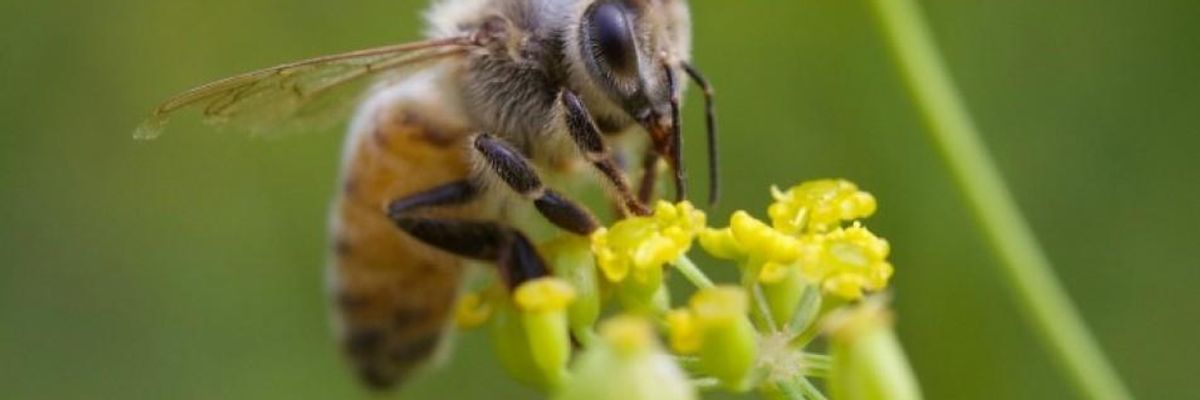
"Let us together as diverse species and diverse cultures and through poison free organic food and farming, rejuvenate the biodiversity of our pollinators and restore their sacredness," writes Dr. Vandana Shive on #WorldBeeDay. (Photo: Keith McDuffee/flickr/cc)
"If the bee disappeared off the face of the earth, man would only have four years left to live." -- Maurice Maeterlinck, The Life of the Bee
In the last 50 years agrotoxins have spread and are pushing bees to extinction.
The choices before humanity are clear, a Poison Free Future to save bees, farmers, our food and humanity. Or continue to use poisons, threatening our common future by walking blindly to extinction through the arrogance that we can substitute bees with artificial intelligence and robots.
"Robotic bees could pollinate plants in case of insect apocalypse," ran a recent Guardian headline reporting how Dutch scientists, "believe they will be able to create swarms of bee-like drones to pollinate plants when the real-life insects have died away."
"We see a crisis in 15 years where we don't have enough insects in the world to actually do pollination and most of our vitamins and fruits are gone," said Eylam Ran, CEO of Edete Precision Technologies for Agriculture. His company says its artificial pollinator can augment the labours of--and eventually replace--bees. Its system mirrors the work of the honey bee, beginning with a mechanical harvest of pollen from flowers and ending with a targeted distribution using LIDAR sensors, the same technology used in some self-driving cars."
There is no substitute for the amazing biodiversity and gifts of bees.
Every culture, every faith has seen the bees as teachers--of giving, of creating abundance, of creating the future of plants through pollination, and contributing to our food security and welfare. The next generation of seed is transformed into the next generation of seed only through the gift of the pollinator.
Navdanya's research has shown that more than 30% of the food we eat is produced by bees and pollinators.
Nature's economy is the gift economy. In every tradition the bee has been exemplified as a teacher in giving.
Buddhist texts note that from a multitude of living things, bees and other pollinating animals take what they need to survive without harming the beauty and vitality of their source of sustenance. For humans, to act in the manner of bees is an enactment of compassionate and conscious living.
St. John Chrysostom of the Catholic Church wrote, "The bee is more honored than other animals, not because she labors, but because she labors for others." (12th Homily)
In the Islamic tradition, the Quran's 16th chapter is titled 'The Bee.' This chapter is known to be the revelation of God.
In the Hindu tradition, there is a wonderful quote in the scripture Srimad Mahabhagavatam which reads, "Like a honey bee gathering honey from all type of flowers the wise men search everywhere for truth and see only good in all religions."
Let us together as diverse species and diverse cultures and through poison free organic food and farming, rejuvenate the biodiversity of our pollinators and restore their sacredness. We have the creative power to stop the sixth mass extinction and climate catastrophe without the need for these false technocratic solutions.
Dear Common Dreams reader, It’s been nearly 30 years since I co-founded Common Dreams with my late wife, Lina Newhouser. We had the radical notion that journalism should serve the public good, not corporate profits. It was clear to us from the outset what it would take to build such a project. No paid advertisements. No corporate sponsors. No millionaire publisher telling us what to think or do. Many people said we wouldn't last a year, but we proved those doubters wrong. Together with a tremendous team of journalists and dedicated staff, we built an independent media outlet free from the constraints of profits and corporate control. Our mission has always been simple: To inform. To inspire. To ignite change for the common good. Building Common Dreams was not easy. Our survival was never guaranteed. When you take on the most powerful forces—Wall Street greed, fossil fuel industry destruction, Big Tech lobbyists, and uber-rich oligarchs who have spent billions upon billions rigging the economy and democracy in their favor—the only bulwark you have is supporters who believe in your work. But here’s the urgent message from me today. It's never been this bad out there. And it's never been this hard to keep us going. At the very moment Common Dreams is most needed, the threats we face are intensifying. We need your support now more than ever. We don't accept corporate advertising and never will. We don't have a paywall because we don't think people should be blocked from critical news based on their ability to pay. Everything we do is funded by the donations of readers like you. When everyone does the little they can afford, we are strong. But if that support retreats or dries up, so do we. Will you donate now to make sure Common Dreams not only survives but thrives? —Craig Brown, Co-founder |
"If the bee disappeared off the face of the earth, man would only have four years left to live." -- Maurice Maeterlinck, The Life of the Bee
In the last 50 years agrotoxins have spread and are pushing bees to extinction.
The choices before humanity are clear, a Poison Free Future to save bees, farmers, our food and humanity. Or continue to use poisons, threatening our common future by walking blindly to extinction through the arrogance that we can substitute bees with artificial intelligence and robots.
"Robotic bees could pollinate plants in case of insect apocalypse," ran a recent Guardian headline reporting how Dutch scientists, "believe they will be able to create swarms of bee-like drones to pollinate plants when the real-life insects have died away."
"We see a crisis in 15 years where we don't have enough insects in the world to actually do pollination and most of our vitamins and fruits are gone," said Eylam Ran, CEO of Edete Precision Technologies for Agriculture. His company says its artificial pollinator can augment the labours of--and eventually replace--bees. Its system mirrors the work of the honey bee, beginning with a mechanical harvest of pollen from flowers and ending with a targeted distribution using LIDAR sensors, the same technology used in some self-driving cars."
There is no substitute for the amazing biodiversity and gifts of bees.
Every culture, every faith has seen the bees as teachers--of giving, of creating abundance, of creating the future of plants through pollination, and contributing to our food security and welfare. The next generation of seed is transformed into the next generation of seed only through the gift of the pollinator.
Navdanya's research has shown that more than 30% of the food we eat is produced by bees and pollinators.
Nature's economy is the gift economy. In every tradition the bee has been exemplified as a teacher in giving.
Buddhist texts note that from a multitude of living things, bees and other pollinating animals take what they need to survive without harming the beauty and vitality of their source of sustenance. For humans, to act in the manner of bees is an enactment of compassionate and conscious living.
St. John Chrysostom of the Catholic Church wrote, "The bee is more honored than other animals, not because she labors, but because she labors for others." (12th Homily)
In the Islamic tradition, the Quran's 16th chapter is titled 'The Bee.' This chapter is known to be the revelation of God.
In the Hindu tradition, there is a wonderful quote in the scripture Srimad Mahabhagavatam which reads, "Like a honey bee gathering honey from all type of flowers the wise men search everywhere for truth and see only good in all religions."
Let us together as diverse species and diverse cultures and through poison free organic food and farming, rejuvenate the biodiversity of our pollinators and restore their sacredness. We have the creative power to stop the sixth mass extinction and climate catastrophe without the need for these false technocratic solutions.
"If the bee disappeared off the face of the earth, man would only have four years left to live." -- Maurice Maeterlinck, The Life of the Bee
In the last 50 years agrotoxins have spread and are pushing bees to extinction.
The choices before humanity are clear, a Poison Free Future to save bees, farmers, our food and humanity. Or continue to use poisons, threatening our common future by walking blindly to extinction through the arrogance that we can substitute bees with artificial intelligence and robots.
"Robotic bees could pollinate plants in case of insect apocalypse," ran a recent Guardian headline reporting how Dutch scientists, "believe they will be able to create swarms of bee-like drones to pollinate plants when the real-life insects have died away."
"We see a crisis in 15 years where we don't have enough insects in the world to actually do pollination and most of our vitamins and fruits are gone," said Eylam Ran, CEO of Edete Precision Technologies for Agriculture. His company says its artificial pollinator can augment the labours of--and eventually replace--bees. Its system mirrors the work of the honey bee, beginning with a mechanical harvest of pollen from flowers and ending with a targeted distribution using LIDAR sensors, the same technology used in some self-driving cars."
There is no substitute for the amazing biodiversity and gifts of bees.
Every culture, every faith has seen the bees as teachers--of giving, of creating abundance, of creating the future of plants through pollination, and contributing to our food security and welfare. The next generation of seed is transformed into the next generation of seed only through the gift of the pollinator.
Navdanya's research has shown that more than 30% of the food we eat is produced by bees and pollinators.
Nature's economy is the gift economy. In every tradition the bee has been exemplified as a teacher in giving.
Buddhist texts note that from a multitude of living things, bees and other pollinating animals take what they need to survive without harming the beauty and vitality of their source of sustenance. For humans, to act in the manner of bees is an enactment of compassionate and conscious living.
St. John Chrysostom of the Catholic Church wrote, "The bee is more honored than other animals, not because she labors, but because she labors for others." (12th Homily)
In the Islamic tradition, the Quran's 16th chapter is titled 'The Bee.' This chapter is known to be the revelation of God.
In the Hindu tradition, there is a wonderful quote in the scripture Srimad Mahabhagavatam which reads, "Like a honey bee gathering honey from all type of flowers the wise men search everywhere for truth and see only good in all religions."
Let us together as diverse species and diverse cultures and through poison free organic food and farming, rejuvenate the biodiversity of our pollinators and restore their sacredness. We have the creative power to stop the sixth mass extinction and climate catastrophe without the need for these false technocratic solutions.