SUBSCRIBE TO OUR FREE NEWSLETTER
Daily news & progressive opinion—funded by the people, not the corporations—delivered straight to your inbox.
5
#000000
#FFFFFF
To donate by check, phone, or other method, see our More Ways to Give page.
Daily news & progressive opinion—funded by the people, not the corporations—delivered straight to your inbox.
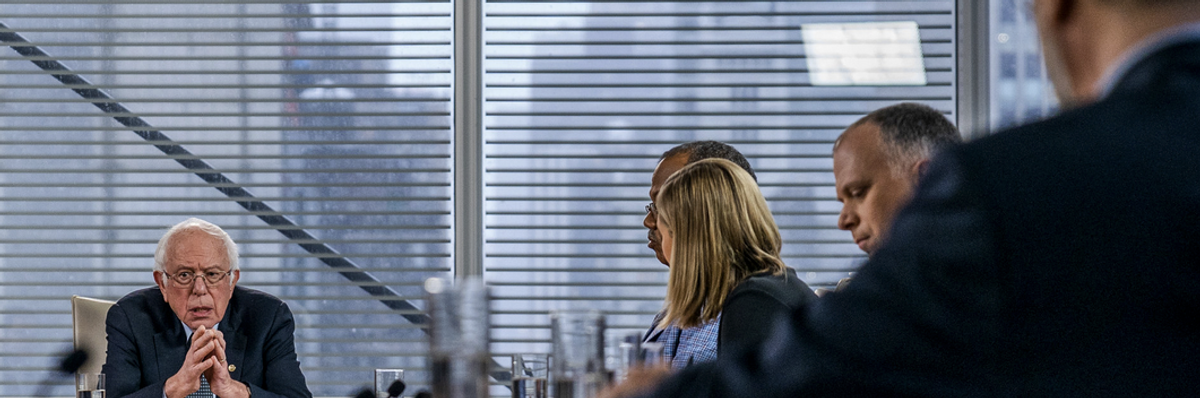
Senator Bernie Sanders during an interview with the editorial board of The New York Times in February, 2020. (Photo: Screengrab/NYT/Brittainy Newman)
It is the essence of American liberalism to trash radical dreams and then dance on them. And that's just what the New York Times did the day after Bernie Sanders bowed out of the Democratic race for the nomination. On that day, in a special editorial, the editors of the very same paper that disparaged his every move opined that America is divided and our democracy corrupt and launched a series promising to report on just the sort of transformative policies Sanders advocated.
"A great divide separates affluent Americans, who fully enjoy the benefits of life in the wealthiest nation on earth, from the growing portion of the population whose lives lack stability or any real prospect of betterment," they write.
In the Times' world, it's apparently ok to bemoan a society and an economy that privileges the rich over the poor, but it's unacceptable to run for the presidency on a promise to reverse those priorities.
"The United States has a chance to emerge from this latest crisis as a stronger nation, more just, more free, and more resilient. We must seize the opportunity," write the editors.
The words look pretty on the page, snug in among the Tiffany ads. But when a campaign seeks to seize not just opportunity but power--and spread it around--the same paper's reporters and headline writers called that campaign and the candidate leading it "threatening," "menacing" and "unelectable."
"The wealthy are particularly successful in blocking changes they don't like," the Times writes now, as if their own paper has played no role in that. On the eve of the decisive March 10th Midwest primaries, the week before which Sanders was leading in the polls, columnist Thomas Friedman redbaited Bernie for the umpteenth time, deliberately distorting democratic socialism as Stalinism and accusing Sanders of "demonizing the engines of capitalism and job creation."
The truth is, the New York Times, the paper of record of U.S. liberalism, likes the progressive pose. With gravitas, they write that out of the coronavirus crisis "there's a chance to build a better America."
But it didn't take a pandemic to wake 13 million Americans to that chance and to vote for it in 2016, or 2.1 million of them to contribute to that effort in this race. Those millions didn't need all this new, unnecessary death to hear the death knell sounding for status quo America. What they needed was a fairer chance against the establishment media.
Dear Common Dreams reader, It’s been nearly 30 years since I co-founded Common Dreams with my late wife, Lina Newhouser. We had the radical notion that journalism should serve the public good, not corporate profits. It was clear to us from the outset what it would take to build such a project. No paid advertisements. No corporate sponsors. No millionaire publisher telling us what to think or do. Many people said we wouldn't last a year, but we proved those doubters wrong. Together with a tremendous team of journalists and dedicated staff, we built an independent media outlet free from the constraints of profits and corporate control. Our mission has always been simple: To inform. To inspire. To ignite change for the common good. Building Common Dreams was not easy. Our survival was never guaranteed. When you take on the most powerful forces—Wall Street greed, fossil fuel industry destruction, Big Tech lobbyists, and uber-rich oligarchs who have spent billions upon billions rigging the economy and democracy in their favor—the only bulwark you have is supporters who believe in your work. But here’s the urgent message from me today. It's never been this bad out there. And it's never been this hard to keep us going. At the very moment Common Dreams is most needed, the threats we face are intensifying. We need your support now more than ever. We don't accept corporate advertising and never will. We don't have a paywall because we don't think people should be blocked from critical news based on their ability to pay. Everything we do is funded by the donations of readers like you. When everyone does the little they can afford, we are strong. But if that support retreats or dries up, so do we. Will you donate now to make sure Common Dreams not only survives but thrives? —Craig Brown, Co-founder |
It is the essence of American liberalism to trash radical dreams and then dance on them. And that's just what the New York Times did the day after Bernie Sanders bowed out of the Democratic race for the nomination. On that day, in a special editorial, the editors of the very same paper that disparaged his every move opined that America is divided and our democracy corrupt and launched a series promising to report on just the sort of transformative policies Sanders advocated.
"A great divide separates affluent Americans, who fully enjoy the benefits of life in the wealthiest nation on earth, from the growing portion of the population whose lives lack stability or any real prospect of betterment," they write.
In the Times' world, it's apparently ok to bemoan a society and an economy that privileges the rich over the poor, but it's unacceptable to run for the presidency on a promise to reverse those priorities.
"The United States has a chance to emerge from this latest crisis as a stronger nation, more just, more free, and more resilient. We must seize the opportunity," write the editors.
The words look pretty on the page, snug in among the Tiffany ads. But when a campaign seeks to seize not just opportunity but power--and spread it around--the same paper's reporters and headline writers called that campaign and the candidate leading it "threatening," "menacing" and "unelectable."
"The wealthy are particularly successful in blocking changes they don't like," the Times writes now, as if their own paper has played no role in that. On the eve of the decisive March 10th Midwest primaries, the week before which Sanders was leading in the polls, columnist Thomas Friedman redbaited Bernie for the umpteenth time, deliberately distorting democratic socialism as Stalinism and accusing Sanders of "demonizing the engines of capitalism and job creation."
The truth is, the New York Times, the paper of record of U.S. liberalism, likes the progressive pose. With gravitas, they write that out of the coronavirus crisis "there's a chance to build a better America."
But it didn't take a pandemic to wake 13 million Americans to that chance and to vote for it in 2016, or 2.1 million of them to contribute to that effort in this race. Those millions didn't need all this new, unnecessary death to hear the death knell sounding for status quo America. What they needed was a fairer chance against the establishment media.
It is the essence of American liberalism to trash radical dreams and then dance on them. And that's just what the New York Times did the day after Bernie Sanders bowed out of the Democratic race for the nomination. On that day, in a special editorial, the editors of the very same paper that disparaged his every move opined that America is divided and our democracy corrupt and launched a series promising to report on just the sort of transformative policies Sanders advocated.
"A great divide separates affluent Americans, who fully enjoy the benefits of life in the wealthiest nation on earth, from the growing portion of the population whose lives lack stability or any real prospect of betterment," they write.
In the Times' world, it's apparently ok to bemoan a society and an economy that privileges the rich over the poor, but it's unacceptable to run for the presidency on a promise to reverse those priorities.
"The United States has a chance to emerge from this latest crisis as a stronger nation, more just, more free, and more resilient. We must seize the opportunity," write the editors.
The words look pretty on the page, snug in among the Tiffany ads. But when a campaign seeks to seize not just opportunity but power--and spread it around--the same paper's reporters and headline writers called that campaign and the candidate leading it "threatening," "menacing" and "unelectable."
"The wealthy are particularly successful in blocking changes they don't like," the Times writes now, as if their own paper has played no role in that. On the eve of the decisive March 10th Midwest primaries, the week before which Sanders was leading in the polls, columnist Thomas Friedman redbaited Bernie for the umpteenth time, deliberately distorting democratic socialism as Stalinism and accusing Sanders of "demonizing the engines of capitalism and job creation."
The truth is, the New York Times, the paper of record of U.S. liberalism, likes the progressive pose. With gravitas, they write that out of the coronavirus crisis "there's a chance to build a better America."
But it didn't take a pandemic to wake 13 million Americans to that chance and to vote for it in 2016, or 2.1 million of them to contribute to that effort in this race. Those millions didn't need all this new, unnecessary death to hear the death knell sounding for status quo America. What they needed was a fairer chance against the establishment media.