SUBSCRIBE TO OUR FREE NEWSLETTER
Daily news & progressive opinion—funded by the people, not the corporations—delivered straight to your inbox.
5
#000000
#FFFFFF
To donate by check, phone, or other method, see our More Ways to Give page.
Daily news & progressive opinion—funded by the people, not the corporations—delivered straight to your inbox.
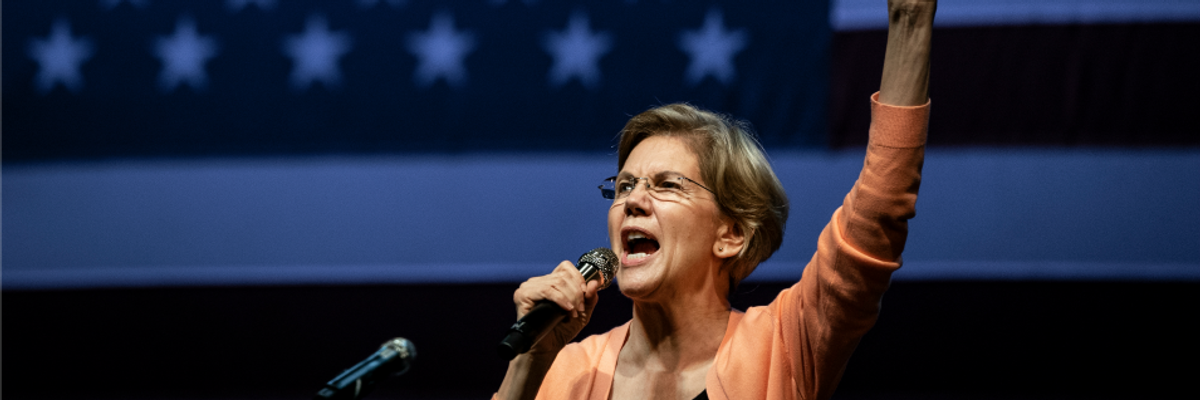
Democratic presidential candidate Sen. Elizabeth Warren (D-MA) speaks during a campaign rally at the Charleston Music Hall on February 26, 2020 in Charleston, South Carolina. South Carolina holds its Democratic presidential primary on Saturday, February 29. (Photo: Drew Angerer/Getty Images)
The night before Super Tuesday, Elizabeth Warren spoke to several thousand people in a quadrangle at East Los Angeles College. Much of her talk recounted the heroic actions of oppressed Latina workers who led the Justice for Janitors organization. Standing in the crowd, I was impressed with Warren's eloquence as she praised solidarity and labor unions as essential for improving the lives of working people.
Now, days later, with corporate Democrat Joe Biden enjoying sudden momentum and mega-billionaire Mike Bloomberg joining forces with him, an urgent question hovers over Warren. It's a time-honored union inquiry: "Which side are you on?"
How Warren answers that question might determine the 2020 Democratic presidential nomination. In the process, she will profoundly etch into history the reality of her political character.
"The urgency of Warren's decision can hardly be overstated."
Facing the fact that her campaign reached a dead end, Warren basically has two choices: While Bernie Sanders and Biden go toe to toe, she can maintain neutrality and avoid the ire of the Democratic Party's corporate establishment. Or she can form a united front with Sanders, taking a principled stand on behalf of progressive ideals.
For much of the past year, in many hundreds of speeches and interviews, Warren has denounced the huge leverage of big money in politics. And she has challenged some key aspects of corporate power. But now we're going to find out more about how deep such commitments go for her.
"After Warren's bleak performance in the Super Tuesday primaries, her associates, as well as those of Sanders and former vice president Joe Biden, say she is now looking for the best way to step aside," the Washington Post reported on Wednesday--and "there is no certainty she will endorse Sanders or anyone else."
A laudable path now awaits Warren. After winning just a few dozen delegates, she should join forces with Sanders--who has won more than 500 delegates and is the only candidate in a position to defeat Biden for the nomination.
The urgency of Warren's decision can hardly be overstated. Sanders and Biden are fiercely competing for votes in a half-dozen states with March 10 primaries including Michigan (with 125 delegates), Washington (89 delegates) and Missouri (68 delegates). A week later, primaries in four states--Arizona, Florida, Illinois and Ohio--will determine the allocation of 577 delegates.
In the midst of these pivotal election battles, Warren should provide a vehement endorsement of Sanders and swiftly begin to campaign for him. Choosing, instead, to stand on the sidelines would be a tragic betrayal of progressive principles.
"Here's the thing," Warren said in a speech to a convention of the California Democratic Party nine months ago. "When a candidate tells you about all the things that aren't possible, about how political calculations come first . . . they're telling you something very important--they are telling you that they will not fight for you."
We'll soon find out whether Elizabeth Warren will fight for us.
Dear Common Dreams reader, It’s been nearly 30 years since I co-founded Common Dreams with my late wife, Lina Newhouser. We had the radical notion that journalism should serve the public good, not corporate profits. It was clear to us from the outset what it would take to build such a project. No paid advertisements. No corporate sponsors. No millionaire publisher telling us what to think or do. Many people said we wouldn't last a year, but we proved those doubters wrong. Together with a tremendous team of journalists and dedicated staff, we built an independent media outlet free from the constraints of profits and corporate control. Our mission has always been simple: To inform. To inspire. To ignite change for the common good. Building Common Dreams was not easy. Our survival was never guaranteed. When you take on the most powerful forces—Wall Street greed, fossil fuel industry destruction, Big Tech lobbyists, and uber-rich oligarchs who have spent billions upon billions rigging the economy and democracy in their favor—the only bulwark you have is supporters who believe in your work. But here’s the urgent message from me today. It's never been this bad out there. And it's never been this hard to keep us going. At the very moment Common Dreams is most needed, the threats we face are intensifying. We need your support now more than ever. We don't accept corporate advertising and never will. We don't have a paywall because we don't think people should be blocked from critical news based on their ability to pay. Everything we do is funded by the donations of readers like you. When everyone does the little they can afford, we are strong. But if that support retreats or dries up, so do we. Will you donate now to make sure Common Dreams not only survives but thrives? —Craig Brown, Co-founder |
Norman Solomon is the national director of RootsAction.org and executive director of the Institute for Public Accuracy. The paperback edition of his latest book, War Made Invisible: How America Hides the Human Toll of Its Military Machine, includes an afterword about the Gaza war.
The night before Super Tuesday, Elizabeth Warren spoke to several thousand people in a quadrangle at East Los Angeles College. Much of her talk recounted the heroic actions of oppressed Latina workers who led the Justice for Janitors organization. Standing in the crowd, I was impressed with Warren's eloquence as she praised solidarity and labor unions as essential for improving the lives of working people.
Now, days later, with corporate Democrat Joe Biden enjoying sudden momentum and mega-billionaire Mike Bloomberg joining forces with him, an urgent question hovers over Warren. It's a time-honored union inquiry: "Which side are you on?"
How Warren answers that question might determine the 2020 Democratic presidential nomination. In the process, she will profoundly etch into history the reality of her political character.
"The urgency of Warren's decision can hardly be overstated."
Facing the fact that her campaign reached a dead end, Warren basically has two choices: While Bernie Sanders and Biden go toe to toe, she can maintain neutrality and avoid the ire of the Democratic Party's corporate establishment. Or she can form a united front with Sanders, taking a principled stand on behalf of progressive ideals.
For much of the past year, in many hundreds of speeches and interviews, Warren has denounced the huge leverage of big money in politics. And she has challenged some key aspects of corporate power. But now we're going to find out more about how deep such commitments go for her.
"After Warren's bleak performance in the Super Tuesday primaries, her associates, as well as those of Sanders and former vice president Joe Biden, say she is now looking for the best way to step aside," the Washington Post reported on Wednesday--and "there is no certainty she will endorse Sanders or anyone else."
A laudable path now awaits Warren. After winning just a few dozen delegates, she should join forces with Sanders--who has won more than 500 delegates and is the only candidate in a position to defeat Biden for the nomination.
The urgency of Warren's decision can hardly be overstated. Sanders and Biden are fiercely competing for votes in a half-dozen states with March 10 primaries including Michigan (with 125 delegates), Washington (89 delegates) and Missouri (68 delegates). A week later, primaries in four states--Arizona, Florida, Illinois and Ohio--will determine the allocation of 577 delegates.
In the midst of these pivotal election battles, Warren should provide a vehement endorsement of Sanders and swiftly begin to campaign for him. Choosing, instead, to stand on the sidelines would be a tragic betrayal of progressive principles.
"Here's the thing," Warren said in a speech to a convention of the California Democratic Party nine months ago. "When a candidate tells you about all the things that aren't possible, about how political calculations come first . . . they're telling you something very important--they are telling you that they will not fight for you."
We'll soon find out whether Elizabeth Warren will fight for us.
Norman Solomon is the national director of RootsAction.org and executive director of the Institute for Public Accuracy. The paperback edition of his latest book, War Made Invisible: How America Hides the Human Toll of Its Military Machine, includes an afterword about the Gaza war.
The night before Super Tuesday, Elizabeth Warren spoke to several thousand people in a quadrangle at East Los Angeles College. Much of her talk recounted the heroic actions of oppressed Latina workers who led the Justice for Janitors organization. Standing in the crowd, I was impressed with Warren's eloquence as she praised solidarity and labor unions as essential for improving the lives of working people.
Now, days later, with corporate Democrat Joe Biden enjoying sudden momentum and mega-billionaire Mike Bloomberg joining forces with him, an urgent question hovers over Warren. It's a time-honored union inquiry: "Which side are you on?"
How Warren answers that question might determine the 2020 Democratic presidential nomination. In the process, she will profoundly etch into history the reality of her political character.
"The urgency of Warren's decision can hardly be overstated."
Facing the fact that her campaign reached a dead end, Warren basically has two choices: While Bernie Sanders and Biden go toe to toe, she can maintain neutrality and avoid the ire of the Democratic Party's corporate establishment. Or she can form a united front with Sanders, taking a principled stand on behalf of progressive ideals.
For much of the past year, in many hundreds of speeches and interviews, Warren has denounced the huge leverage of big money in politics. And she has challenged some key aspects of corporate power. But now we're going to find out more about how deep such commitments go for her.
"After Warren's bleak performance in the Super Tuesday primaries, her associates, as well as those of Sanders and former vice president Joe Biden, say she is now looking for the best way to step aside," the Washington Post reported on Wednesday--and "there is no certainty she will endorse Sanders or anyone else."
A laudable path now awaits Warren. After winning just a few dozen delegates, she should join forces with Sanders--who has won more than 500 delegates and is the only candidate in a position to defeat Biden for the nomination.
The urgency of Warren's decision can hardly be overstated. Sanders and Biden are fiercely competing for votes in a half-dozen states with March 10 primaries including Michigan (with 125 delegates), Washington (89 delegates) and Missouri (68 delegates). A week later, primaries in four states--Arizona, Florida, Illinois and Ohio--will determine the allocation of 577 delegates.
In the midst of these pivotal election battles, Warren should provide a vehement endorsement of Sanders and swiftly begin to campaign for him. Choosing, instead, to stand on the sidelines would be a tragic betrayal of progressive principles.
"Here's the thing," Warren said in a speech to a convention of the California Democratic Party nine months ago. "When a candidate tells you about all the things that aren't possible, about how political calculations come first . . . they're telling you something very important--they are telling you that they will not fight for you."
We'll soon find out whether Elizabeth Warren will fight for us.