SUBSCRIBE TO OUR FREE NEWSLETTER
Daily news & progressive opinion—funded by the people, not the corporations—delivered straight to your inbox.
5
#000000
#FFFFFF
To donate by check, phone, or other method, see our More Ways to Give page.
Daily news & progressive opinion—funded by the people, not the corporations—delivered straight to your inbox.
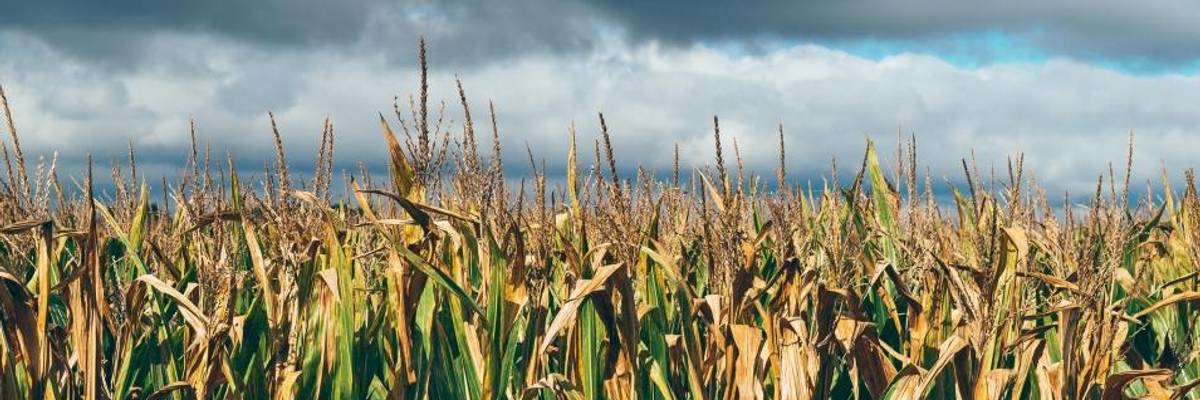
By far the most abundant commodity produced under the corporate-centric agriculture policy that's been in place for 50 years is not corn, cotton or cattle but stupidity. (Photo: Andrea Seaman/flickr/cc)
As we hurtle into the 2020s, the future of our food economy (and food itself) remains a fiercely contested competition between diametrically opposed visions: a negative pole consisting of the concentrated forces of corporate agriBusiness, which view the dinner plate strictly in terms of their own profit margins, and a positive polarity of family farmers, consumers, food artisans, environmentalists and other grassroots advocates of agriCulture, who envision our food future from the ethical perspective of sustainability and democratic control.
By far the most abundant commodity produced under the corporate-centric agriculture policy that's been in place for 50 years is not corn, cotton or cattle but stupidity.
Of course, in this Time of Trump, the corporate interests rule national policy. If there ever was any doubt about which vision the Trumpeteers would push, it was erased by the little-known fellow he appointed to head the Department of Agriculture: Sonny Perdue of Georgia. Hailing from the No. 1 peanut-producing state in the country, Sonny has proven to be the biggest goober of all. As chief of the agency created by former President Abraham Lincoln specifically to assist America's small farmers and rural communities, Perdue has been AWOL, blithely reclining in his ornate Washington office while farm prices have continued to plummet, bankruptcies have soared and farmer suicides have surged.
Bizarrely, this no-show has even found great hilarity in his constituents' crises. In August, when producers began publicly protesting the increasing financial pain that President Donald Trump's trade games with China were inflicting on them, their ag secretary responded with snark. "What do you call two farmers in a basement?" he asked at an ag industry gathering. "A whine cellar," he guffawed.
Then, in October, Perdue suddenly bared his corporate soul by impersonating Earl Butz. You might recall that Butz, former President Richard Nixon's secretary of agriculture, had infamously commanded family farmers to "get big or get out," warning them to "adapt" to the corporate-dictated food economy he was promoting, "or die." Likewise, appearing at a Wisconsin dairy industry expo, Perdue rose on his hind legs and smugly lectured the state's hard-hit farmers on the theoretical framework of Trumpenomics: "In America," he icily instructed, "the big get bigger, and the small go out." So there you have it--the Sonny & Donnie farm program boils down to two words: Adios, chumps!
By far the most abundant commodity produced under the corporate-centric agriculture policy that's been in place for 50 years is not corn, cotton or cattle but stupidity. While some years have been worse than others, Washington's overall policy approach has consistently exploited farmers, our land and water, agricultural workers, taxpayers, food quality and rural communities--all to further enrich the handful of monopolistic profiteers that now control both the policy and policymakers. And we're presently in year six of the worst farm crisis since the disastrous 1980s.
The most cohesive and comprehensive compilation of these solutions has come from Sen. Elizabeth Warren's plan for "a new farm economy," which offers the big structural changes necessary to, in her words, "break the stranglehold that giant agribusinesses have over our farm economy."
But hark! What light is this that glows on yon horizon? Why, it's some new policy ideas that are emanating not from corporate front groups, Congress or other bastions of the status quo but from the grassroots. Family farmers themselves have coalesced with other political outsiders and victims of Big Ag to put forth a complete overhaul of industrial agribusiness policies, supplanting them with sensible, democratic approaches to serve the common good. The most cohesive and comprehensive compilation of these solutions has come from Sen. Elizabeth Warren's plan for "a new farm economy," which offers the big structural changes necessary to, in her words, "break the stranglehold that giant agribusinesses have over our farm economy." Her proposals have literally percolated up from the grassroots, for her ag "brain trust" primarily consists of dirt farmers and rural advocates. In dozens of small gatherings across Iowa and elsewhere, these ground-level, hands-on experts have hammered out pragmatic ideas that really would work to produce a democratic and sustainable farm prosperity.
Building on the successful "supply management" approach of the New Deal, Warren's proposal stops the constant "overproduction of commodities," which keeps busting farm prices and is drastically straining our environment; cuts billions from taxpayer subsidies that mainly go to wealthy agribusiness operations; provides effective incentives to get farmers to convert swaths of their land from intensive production to conservation practices that mitigate climate change; strengthens and enforces anti-trust laws to break up and prevent ag monopolies that are bilking farmers; provides hands-on assistance to help farmers, workers and rural communities build local and regional systems to free them from dependence on multinational food giants; and purposefully expands opportunities for beginning, female and racially diverse farmers.
Just as corporate powers have spent half a century rigging the food economy to serve their selfish interest, so can we create a new one to serve the common interest. The place to start is with a plan: Visit Warren's website for her full farm plan.
Dear Common Dreams reader, It’s been nearly 30 years since I co-founded Common Dreams with my late wife, Lina Newhouser. We had the radical notion that journalism should serve the public good, not corporate profits. It was clear to us from the outset what it would take to build such a project. No paid advertisements. No corporate sponsors. No millionaire publisher telling us what to think or do. Many people said we wouldn't last a year, but we proved those doubters wrong. Together with a tremendous team of journalists and dedicated staff, we built an independent media outlet free from the constraints of profits and corporate control. Our mission has always been simple: To inform. To inspire. To ignite change for the common good. Building Common Dreams was not easy. Our survival was never guaranteed. When you take on the most powerful forces—Wall Street greed, fossil fuel industry destruction, Big Tech lobbyists, and uber-rich oligarchs who have spent billions upon billions rigging the economy and democracy in their favor—the only bulwark you have is supporters who believe in your work. But here’s the urgent message from me today. It's never been this bad out there. And it's never been this hard to keep us going. At the very moment Common Dreams is most needed, the threats we face are intensifying. We need your support now more than ever. We don't accept corporate advertising and never will. We don't have a paywall because we don't think people should be blocked from critical news based on their ability to pay. Everything we do is funded by the donations of readers like you. When everyone does the little they can afford, we are strong. But if that support retreats or dries up, so do we. Will you donate now to make sure Common Dreams not only survives but thrives? —Craig Brown, Co-founder |
As we hurtle into the 2020s, the future of our food economy (and food itself) remains a fiercely contested competition between diametrically opposed visions: a negative pole consisting of the concentrated forces of corporate agriBusiness, which view the dinner plate strictly in terms of their own profit margins, and a positive polarity of family farmers, consumers, food artisans, environmentalists and other grassroots advocates of agriCulture, who envision our food future from the ethical perspective of sustainability and democratic control.
By far the most abundant commodity produced under the corporate-centric agriculture policy that's been in place for 50 years is not corn, cotton or cattle but stupidity.
Of course, in this Time of Trump, the corporate interests rule national policy. If there ever was any doubt about which vision the Trumpeteers would push, it was erased by the little-known fellow he appointed to head the Department of Agriculture: Sonny Perdue of Georgia. Hailing from the No. 1 peanut-producing state in the country, Sonny has proven to be the biggest goober of all. As chief of the agency created by former President Abraham Lincoln specifically to assist America's small farmers and rural communities, Perdue has been AWOL, blithely reclining in his ornate Washington office while farm prices have continued to plummet, bankruptcies have soared and farmer suicides have surged.
Bizarrely, this no-show has even found great hilarity in his constituents' crises. In August, when producers began publicly protesting the increasing financial pain that President Donald Trump's trade games with China were inflicting on them, their ag secretary responded with snark. "What do you call two farmers in a basement?" he asked at an ag industry gathering. "A whine cellar," he guffawed.
Then, in October, Perdue suddenly bared his corporate soul by impersonating Earl Butz. You might recall that Butz, former President Richard Nixon's secretary of agriculture, had infamously commanded family farmers to "get big or get out," warning them to "adapt" to the corporate-dictated food economy he was promoting, "or die." Likewise, appearing at a Wisconsin dairy industry expo, Perdue rose on his hind legs and smugly lectured the state's hard-hit farmers on the theoretical framework of Trumpenomics: "In America," he icily instructed, "the big get bigger, and the small go out." So there you have it--the Sonny & Donnie farm program boils down to two words: Adios, chumps!
By far the most abundant commodity produced under the corporate-centric agriculture policy that's been in place for 50 years is not corn, cotton or cattle but stupidity. While some years have been worse than others, Washington's overall policy approach has consistently exploited farmers, our land and water, agricultural workers, taxpayers, food quality and rural communities--all to further enrich the handful of monopolistic profiteers that now control both the policy and policymakers. And we're presently in year six of the worst farm crisis since the disastrous 1980s.
The most cohesive and comprehensive compilation of these solutions has come from Sen. Elizabeth Warren's plan for "a new farm economy," which offers the big structural changes necessary to, in her words, "break the stranglehold that giant agribusinesses have over our farm economy."
But hark! What light is this that glows on yon horizon? Why, it's some new policy ideas that are emanating not from corporate front groups, Congress or other bastions of the status quo but from the grassroots. Family farmers themselves have coalesced with other political outsiders and victims of Big Ag to put forth a complete overhaul of industrial agribusiness policies, supplanting them with sensible, democratic approaches to serve the common good. The most cohesive and comprehensive compilation of these solutions has come from Sen. Elizabeth Warren's plan for "a new farm economy," which offers the big structural changes necessary to, in her words, "break the stranglehold that giant agribusinesses have over our farm economy." Her proposals have literally percolated up from the grassroots, for her ag "brain trust" primarily consists of dirt farmers and rural advocates. In dozens of small gatherings across Iowa and elsewhere, these ground-level, hands-on experts have hammered out pragmatic ideas that really would work to produce a democratic and sustainable farm prosperity.
Building on the successful "supply management" approach of the New Deal, Warren's proposal stops the constant "overproduction of commodities," which keeps busting farm prices and is drastically straining our environment; cuts billions from taxpayer subsidies that mainly go to wealthy agribusiness operations; provides effective incentives to get farmers to convert swaths of their land from intensive production to conservation practices that mitigate climate change; strengthens and enforces anti-trust laws to break up and prevent ag monopolies that are bilking farmers; provides hands-on assistance to help farmers, workers and rural communities build local and regional systems to free them from dependence on multinational food giants; and purposefully expands opportunities for beginning, female and racially diverse farmers.
Just as corporate powers have spent half a century rigging the food economy to serve their selfish interest, so can we create a new one to serve the common interest. The place to start is with a plan: Visit Warren's website for her full farm plan.
As we hurtle into the 2020s, the future of our food economy (and food itself) remains a fiercely contested competition between diametrically opposed visions: a negative pole consisting of the concentrated forces of corporate agriBusiness, which view the dinner plate strictly in terms of their own profit margins, and a positive polarity of family farmers, consumers, food artisans, environmentalists and other grassroots advocates of agriCulture, who envision our food future from the ethical perspective of sustainability and democratic control.
By far the most abundant commodity produced under the corporate-centric agriculture policy that's been in place for 50 years is not corn, cotton or cattle but stupidity.
Of course, in this Time of Trump, the corporate interests rule national policy. If there ever was any doubt about which vision the Trumpeteers would push, it was erased by the little-known fellow he appointed to head the Department of Agriculture: Sonny Perdue of Georgia. Hailing from the No. 1 peanut-producing state in the country, Sonny has proven to be the biggest goober of all. As chief of the agency created by former President Abraham Lincoln specifically to assist America's small farmers and rural communities, Perdue has been AWOL, blithely reclining in his ornate Washington office while farm prices have continued to plummet, bankruptcies have soared and farmer suicides have surged.
Bizarrely, this no-show has even found great hilarity in his constituents' crises. In August, when producers began publicly protesting the increasing financial pain that President Donald Trump's trade games with China were inflicting on them, their ag secretary responded with snark. "What do you call two farmers in a basement?" he asked at an ag industry gathering. "A whine cellar," he guffawed.
Then, in October, Perdue suddenly bared his corporate soul by impersonating Earl Butz. You might recall that Butz, former President Richard Nixon's secretary of agriculture, had infamously commanded family farmers to "get big or get out," warning them to "adapt" to the corporate-dictated food economy he was promoting, "or die." Likewise, appearing at a Wisconsin dairy industry expo, Perdue rose on his hind legs and smugly lectured the state's hard-hit farmers on the theoretical framework of Trumpenomics: "In America," he icily instructed, "the big get bigger, and the small go out." So there you have it--the Sonny & Donnie farm program boils down to two words: Adios, chumps!
By far the most abundant commodity produced under the corporate-centric agriculture policy that's been in place for 50 years is not corn, cotton or cattle but stupidity. While some years have been worse than others, Washington's overall policy approach has consistently exploited farmers, our land and water, agricultural workers, taxpayers, food quality and rural communities--all to further enrich the handful of monopolistic profiteers that now control both the policy and policymakers. And we're presently in year six of the worst farm crisis since the disastrous 1980s.
The most cohesive and comprehensive compilation of these solutions has come from Sen. Elizabeth Warren's plan for "a new farm economy," which offers the big structural changes necessary to, in her words, "break the stranglehold that giant agribusinesses have over our farm economy."
But hark! What light is this that glows on yon horizon? Why, it's some new policy ideas that are emanating not from corporate front groups, Congress or other bastions of the status quo but from the grassroots. Family farmers themselves have coalesced with other political outsiders and victims of Big Ag to put forth a complete overhaul of industrial agribusiness policies, supplanting them with sensible, democratic approaches to serve the common good. The most cohesive and comprehensive compilation of these solutions has come from Sen. Elizabeth Warren's plan for "a new farm economy," which offers the big structural changes necessary to, in her words, "break the stranglehold that giant agribusinesses have over our farm economy." Her proposals have literally percolated up from the grassroots, for her ag "brain trust" primarily consists of dirt farmers and rural advocates. In dozens of small gatherings across Iowa and elsewhere, these ground-level, hands-on experts have hammered out pragmatic ideas that really would work to produce a democratic and sustainable farm prosperity.
Building on the successful "supply management" approach of the New Deal, Warren's proposal stops the constant "overproduction of commodities," which keeps busting farm prices and is drastically straining our environment; cuts billions from taxpayer subsidies that mainly go to wealthy agribusiness operations; provides effective incentives to get farmers to convert swaths of their land from intensive production to conservation practices that mitigate climate change; strengthens and enforces anti-trust laws to break up and prevent ag monopolies that are bilking farmers; provides hands-on assistance to help farmers, workers and rural communities build local and regional systems to free them from dependence on multinational food giants; and purposefully expands opportunities for beginning, female and racially diverse farmers.
Just as corporate powers have spent half a century rigging the food economy to serve their selfish interest, so can we create a new one to serve the common interest. The place to start is with a plan: Visit Warren's website for her full farm plan.