SUBSCRIBE TO OUR FREE NEWSLETTER
Daily news & progressive opinion—funded by the people, not the corporations—delivered straight to your inbox.
5
#000000
#FFFFFF
To donate by check, phone, or other method, see our More Ways to Give page.
Daily news & progressive opinion—funded by the people, not the corporations—delivered straight to your inbox.
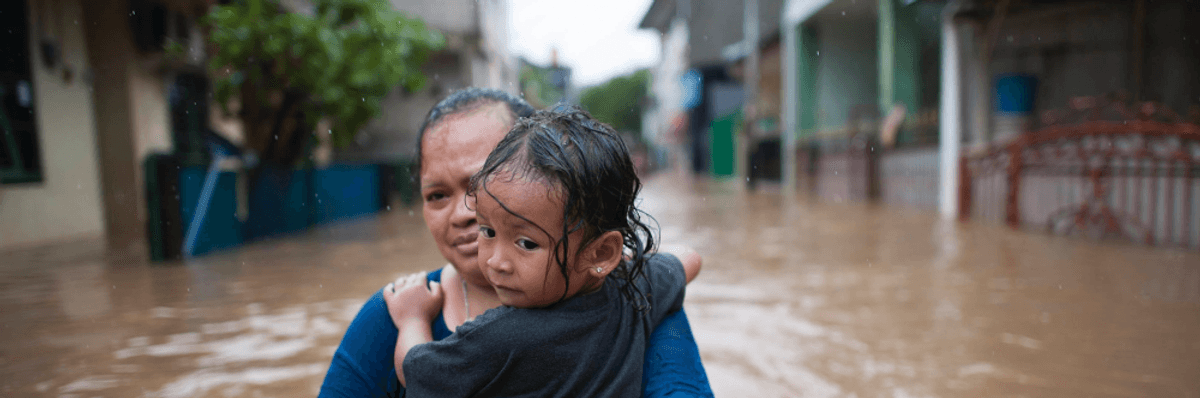
Woman and child in flood in Indonesia. (Photo: World Meteorological Organisation, Flickr/Climate Visuals)
It is unlawful for governments to return people seeking asylum from countries where the climate crisis threatens their lives, a landmark ruling by the UN Human Rights Committee has found.
The decision sets a 'global precedent', Amnesty International said yesterday in response to the ground-breaking asylum case.
The judgment is a result of a case brought forward in February 2016 against the government of New Zealand by Ioane Teitiota, a man from the Pacific nation of Kiribati, after authorities denied his claim of asylum as a 'climate refugee'.
Clear message
He was deported from New Zealand to Kiribati in September 2015. The UN Human Rights Committee delivered its decision on the case earlier this month.
Kate Schuetze, Amnesty International's Pacific Researcher, said: "The decision sets a global precedent.
"It says a state will be in breach of its human rights obligations if it returns someone to a country where - due to the climate crisis - their life is at risk, or in danger of cruel, inhuman or degrading treatment triggered.
"The message is clear: Pacific Island states do not need to be under water before triggering human rights obligations to protect the right to life.
"The Pacific Islands are the canary in the coal mine for climate induced migrants. Low-lying island states such as Kiribati and Tuvalu are only one or two metres above sea level.
"The people there are exposed to severe climate impacts today, including limited access to habitable land, clean drinking water and subsistence living.
"Governments must consider this dangerous reality and a heating planet's imminent threat to Pacific peoples' lives and livelihoods."
Ioane Teitiota
Teitiota says he faced land disputes and difficulties accessing safe drinking water in his home country as the result of the climate crisis, and therefore was forced to migrate with his family to New Zealand where he applied for refugee status after his visa expired in 2010.
He was denied asylum by New Zealand's Immigration and Protection Tribunal, the Court of Appeal and the Supreme Court.
He then took his case to the UN Human Rights Committee on the grounds that New Zealand violated his right to life under the International Covenant on Civil and Political Rights, by deporting him to Kiribati.
While the Committee found that Teitiota's deportation had not been unlawful because he didn't face an immediate danger to his life in Kiribati, it recognised that climate change represented a serious threat to the right to life and therefore decision-makers need to take this into account when examining challenges to deportation.
The Committee's decision suggests that future claims might be successful where the evidence shows "the effects of climate change in receiving states may expose individuals to a violation of their rights".
All states have the human rights duty to protect people from the harmful effects of the climate crisis, including displacement. It is therefore imperative that urgent action is taken to keep the temperature rise as low as possible and no higher than 1.5degC.
Court ruling
The full decision by the Committee is available here. It stated that: "Without robust national and international efforts, the effects of climate change in receiving states may expose individuals to a violation of their rights under articles 6 or 7 of the Covenant, thereby triggering the non-refoulement obligations of sending states."
Two Committee members formally dissented from the finding, and supported Teitiota's claim.
Duncan Laki Muhumuza, of Uganda, stated that the "conditions of life laid out by the author - resulting from climate change in the Republic of Kiribati, are significantly grave, and pose a real, personal and reasonably foreseeable risk of a threat to his life under Article 6(1) of the [International Convention on Civil and Political Rights].
"Moreover, the Committee needs to handle critical and significantly irreversible issues of climate change, with the approach that seeks to uphold the sanctity of human life."
This article is based on a press release from the Fondation Cartier pour l'art contemporain.
Dear Common Dreams reader, It’s been nearly 30 years since I co-founded Common Dreams with my late wife, Lina Newhouser. We had the radical notion that journalism should serve the public good, not corporate profits. It was clear to us from the outset what it would take to build such a project. No paid advertisements. No corporate sponsors. No millionaire publisher telling us what to think or do. Many people said we wouldn't last a year, but we proved those doubters wrong. Together with a tremendous team of journalists and dedicated staff, we built an independent media outlet free from the constraints of profits and corporate control. Our mission has always been simple: To inform. To inspire. To ignite change for the common good. Building Common Dreams was not easy. Our survival was never guaranteed. When you take on the most powerful forces—Wall Street greed, fossil fuel industry destruction, Big Tech lobbyists, and uber-rich oligarchs who have spent billions upon billions rigging the economy and democracy in their favor—the only bulwark you have is supporters who believe in your work. But here’s the urgent message from me today. It's never been this bad out there. And it's never been this hard to keep us going. At the very moment Common Dreams is most needed, the threats we face are intensifying. We need your support now more than ever. We don't accept corporate advertising and never will. We don't have a paywall because we don't think people should be blocked from critical news based on their ability to pay. Everything we do is funded by the donations of readers like you. When everyone does the little they can afford, we are strong. But if that support retreats or dries up, so do we. Will you donate now to make sure Common Dreams not only survives but thrives? —Craig Brown, Co-founder |
It is unlawful for governments to return people seeking asylum from countries where the climate crisis threatens their lives, a landmark ruling by the UN Human Rights Committee has found.
The decision sets a 'global precedent', Amnesty International said yesterday in response to the ground-breaking asylum case.
The judgment is a result of a case brought forward in February 2016 against the government of New Zealand by Ioane Teitiota, a man from the Pacific nation of Kiribati, after authorities denied his claim of asylum as a 'climate refugee'.
Clear message
He was deported from New Zealand to Kiribati in September 2015. The UN Human Rights Committee delivered its decision on the case earlier this month.
Kate Schuetze, Amnesty International's Pacific Researcher, said: "The decision sets a global precedent.
"It says a state will be in breach of its human rights obligations if it returns someone to a country where - due to the climate crisis - their life is at risk, or in danger of cruel, inhuman or degrading treatment triggered.
"The message is clear: Pacific Island states do not need to be under water before triggering human rights obligations to protect the right to life.
"The Pacific Islands are the canary in the coal mine for climate induced migrants. Low-lying island states such as Kiribati and Tuvalu are only one or two metres above sea level.
"The people there are exposed to severe climate impacts today, including limited access to habitable land, clean drinking water and subsistence living.
"Governments must consider this dangerous reality and a heating planet's imminent threat to Pacific peoples' lives and livelihoods."
Ioane Teitiota
Teitiota says he faced land disputes and difficulties accessing safe drinking water in his home country as the result of the climate crisis, and therefore was forced to migrate with his family to New Zealand where he applied for refugee status after his visa expired in 2010.
He was denied asylum by New Zealand's Immigration and Protection Tribunal, the Court of Appeal and the Supreme Court.
He then took his case to the UN Human Rights Committee on the grounds that New Zealand violated his right to life under the International Covenant on Civil and Political Rights, by deporting him to Kiribati.
While the Committee found that Teitiota's deportation had not been unlawful because he didn't face an immediate danger to his life in Kiribati, it recognised that climate change represented a serious threat to the right to life and therefore decision-makers need to take this into account when examining challenges to deportation.
The Committee's decision suggests that future claims might be successful where the evidence shows "the effects of climate change in receiving states may expose individuals to a violation of their rights".
All states have the human rights duty to protect people from the harmful effects of the climate crisis, including displacement. It is therefore imperative that urgent action is taken to keep the temperature rise as low as possible and no higher than 1.5degC.
Court ruling
The full decision by the Committee is available here. It stated that: "Without robust national and international efforts, the effects of climate change in receiving states may expose individuals to a violation of their rights under articles 6 or 7 of the Covenant, thereby triggering the non-refoulement obligations of sending states."
Two Committee members formally dissented from the finding, and supported Teitiota's claim.
Duncan Laki Muhumuza, of Uganda, stated that the "conditions of life laid out by the author - resulting from climate change in the Republic of Kiribati, are significantly grave, and pose a real, personal and reasonably foreseeable risk of a threat to his life under Article 6(1) of the [International Convention on Civil and Political Rights].
"Moreover, the Committee needs to handle critical and significantly irreversible issues of climate change, with the approach that seeks to uphold the sanctity of human life."
This article is based on a press release from the Fondation Cartier pour l'art contemporain.
It is unlawful for governments to return people seeking asylum from countries where the climate crisis threatens their lives, a landmark ruling by the UN Human Rights Committee has found.
The decision sets a 'global precedent', Amnesty International said yesterday in response to the ground-breaking asylum case.
The judgment is a result of a case brought forward in February 2016 against the government of New Zealand by Ioane Teitiota, a man from the Pacific nation of Kiribati, after authorities denied his claim of asylum as a 'climate refugee'.
Clear message
He was deported from New Zealand to Kiribati in September 2015. The UN Human Rights Committee delivered its decision on the case earlier this month.
Kate Schuetze, Amnesty International's Pacific Researcher, said: "The decision sets a global precedent.
"It says a state will be in breach of its human rights obligations if it returns someone to a country where - due to the climate crisis - their life is at risk, or in danger of cruel, inhuman or degrading treatment triggered.
"The message is clear: Pacific Island states do not need to be under water before triggering human rights obligations to protect the right to life.
"The Pacific Islands are the canary in the coal mine for climate induced migrants. Low-lying island states such as Kiribati and Tuvalu are only one or two metres above sea level.
"The people there are exposed to severe climate impacts today, including limited access to habitable land, clean drinking water and subsistence living.
"Governments must consider this dangerous reality and a heating planet's imminent threat to Pacific peoples' lives and livelihoods."
Ioane Teitiota
Teitiota says he faced land disputes and difficulties accessing safe drinking water in his home country as the result of the climate crisis, and therefore was forced to migrate with his family to New Zealand where he applied for refugee status after his visa expired in 2010.
He was denied asylum by New Zealand's Immigration and Protection Tribunal, the Court of Appeal and the Supreme Court.
He then took his case to the UN Human Rights Committee on the grounds that New Zealand violated his right to life under the International Covenant on Civil and Political Rights, by deporting him to Kiribati.
While the Committee found that Teitiota's deportation had not been unlawful because he didn't face an immediate danger to his life in Kiribati, it recognised that climate change represented a serious threat to the right to life and therefore decision-makers need to take this into account when examining challenges to deportation.
The Committee's decision suggests that future claims might be successful where the evidence shows "the effects of climate change in receiving states may expose individuals to a violation of their rights".
All states have the human rights duty to protect people from the harmful effects of the climate crisis, including displacement. It is therefore imperative that urgent action is taken to keep the temperature rise as low as possible and no higher than 1.5degC.
Court ruling
The full decision by the Committee is available here. It stated that: "Without robust national and international efforts, the effects of climate change in receiving states may expose individuals to a violation of their rights under articles 6 or 7 of the Covenant, thereby triggering the non-refoulement obligations of sending states."
Two Committee members formally dissented from the finding, and supported Teitiota's claim.
Duncan Laki Muhumuza, of Uganda, stated that the "conditions of life laid out by the author - resulting from climate change in the Republic of Kiribati, are significantly grave, and pose a real, personal and reasonably foreseeable risk of a threat to his life under Article 6(1) of the [International Convention on Civil and Political Rights].
"Moreover, the Committee needs to handle critical and significantly irreversible issues of climate change, with the approach that seeks to uphold the sanctity of human life."
This article is based on a press release from the Fondation Cartier pour l'art contemporain.