SUBSCRIBE TO OUR FREE NEWSLETTER
Daily news & progressive opinion—funded by the people, not the corporations—delivered straight to your inbox.
5
#000000
#FFFFFF
To donate by check, phone, or other method, see our More Ways to Give page.
Daily news & progressive opinion—funded by the people, not the corporations—delivered straight to your inbox.
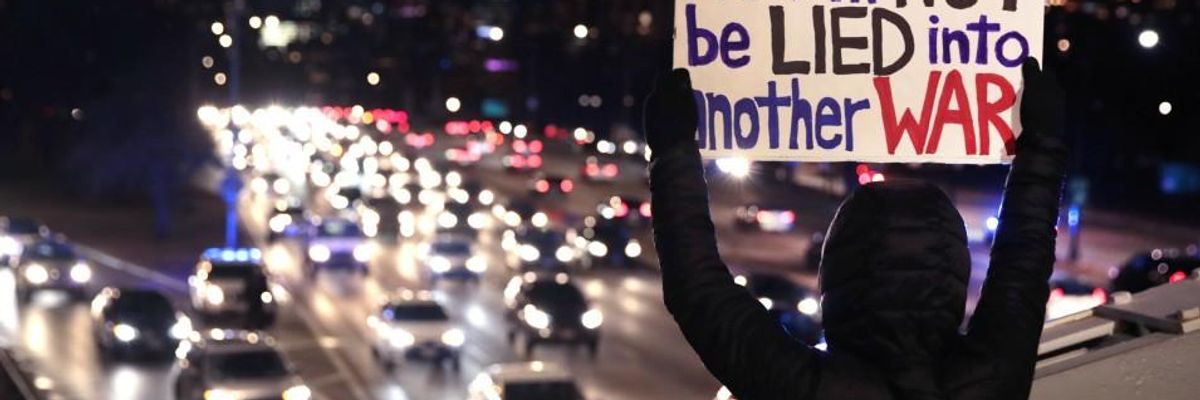
Every presidential hopeful should publicly publicly commit to not use the 2001 or 2002 AUMFs to take military action. (Photo: Scott Olson/Getty Images)
Tuesday night, Democratic candidates took to the stage for another debate that touched on a lot of topics that have garnered the politically-minded public's attention in recent days, including Australia's bushfires, the impeachment proceedings against President Trump, and the killing of Major General Suleimani of Iran's Quds Force. It's unusual for foreign policy to be so prominently discussed so early in a presidential debate, but being brought to the brink of war with Iran seems to have highlighted the urgency of foreign policy for our next administration.
Every candidate who spoke on the subject agreed that the United States should not be on the path to war with Iran. What's more, most of them agreed that the President did not have the authority under previous war authorizations to go to war with Iran, which was a genuine danger given the drone strike in Iraq that killed Suleimani. This is a major recognition that the Trump administration has followed in the footsteps of previous administrations in claiming for itself far more extensive war powers than it has actually been granted by the Constitution.
The U.S is operating in 40% of the world's countries and has troops in combat in 14 countries, including such disparate geographies as Yemen, Somalia, Kenya, the Central African Republic, Mauritania, and Cameroon.
However, this is not enough. To help ensure the next administration's respect for their constitutional obligation to consult Congress before going to war, we need presidential candidates to promise that, if elected, they would not abuse the executive's Constitutionally-enumerated war powers. Warren did state that she would only use military force if the country was faced with an imminent threat, as the power of self-defense is well within the President's acknowledged powers as commander-in-chief. However, this language has been used and abused across multiple administrations, both Republican and Democrat, in order to evade the legal obligation to secure an AUMF to engage in military action abroad.
The authorizations alluded to during the debate are the most current and direct incarnation of this trend. The 2001 AUMF specifically authorized the limited use of force against the groups who planned or aided in the September 11th terrorist attacks. Now, it has been stretched beyond recognition to support the endless, global "war on terror" being waged by the United States 18 years later. The U.S is operating in 40% of the world's countries and has troops in combat in 14 countries, including such disparate geographies as Yemen, Somalia, Kenya, the Central African Republic, Mauritania, and Cameroon.
National Security Advisor Robert O'Brien indicated that the drone strike that killed Suleimani was supposedly authorized under the 2002 AUMF. The 2002 Iraq War AUMF authorized the U.S.'s invasion of Iraq in 2003; however, it has mainly been used over the last 17 years to bolster the U.S.'s claims of authority in other theaters identified above.
The stretching of these two authorizations is a total departure from both the objective reality of their factual basis and the law which governs presidential use of force. Decades-old authorizations cannot and should not suddenly apply to new situations merely due to mission creep. We are glad that the Democratic presidential candidates agree with the numerous legal experts and members of Congress who insist that these authorities do not apply to using force against Iran, but they must take more proactive measures to prevent such abuses in the future, even by a Democratic administration.
Obviously, a great deal of that burden rests with Congress, and members of Congress are already taking steps to stop war with Iran. The House has passed a resolution requiring the President to seek permission from Congress before using any more military action against Iran, and the Senate should follow suit (or support any other independent piece of legislation similar to the multiple resolutions currently circling the House and the Senate).
But we still need more. Every presidential hopeful should publicly publicly commit to not use the 2001 or 2002 AUMFs to take military action. If the next President thinks force might be merited, they should be required to go before Congress for permission, as envisioned in the Constitution. Any future war authorizations should have mandatory sunset clauses and other restrictions to prevent authorizing another round of "forever wars".
Beyond that, the American people need presidential candidates who will vow to use peaceful, constructive means to solve diplomatic disagreements. We must turn away from a force-first foreign policy built on American hegemony. If we are to prevent future bloodshed, our Congress and our next president must act to substantively restore Congress' war powers. If we are to choose peace, we must first reclaim the power of choice.
Dear Common Dreams reader, It’s been nearly 30 years since I co-founded Common Dreams with my late wife, Lina Newhouser. We had the radical notion that journalism should serve the public good, not corporate profits. It was clear to us from the outset what it would take to build such a project. No paid advertisements. No corporate sponsors. No millionaire publisher telling us what to think or do. Many people said we wouldn't last a year, but we proved those doubters wrong. Together with a tremendous team of journalists and dedicated staff, we built an independent media outlet free from the constraints of profits and corporate control. Our mission has always been simple: To inform. To inspire. To ignite change for the common good. Building Common Dreams was not easy. Our survival was never guaranteed. When you take on the most powerful forces—Wall Street greed, fossil fuel industry destruction, Big Tech lobbyists, and uber-rich oligarchs who have spent billions upon billions rigging the economy and democracy in their favor—the only bulwark you have is supporters who believe in your work. But here’s the urgent message from me today. It's never been this bad out there. And it's never been this hard to keep us going. At the very moment Common Dreams is most needed, the threats we face are intensifying. We need your support now more than ever. We don't accept corporate advertising and never will. We don't have a paywall because we don't think people should be blocked from critical news based on their ability to pay. Everything we do is funded by the donations of readers like you. When everyone does the little they can afford, we are strong. But if that support retreats or dries up, so do we. Will you donate now to make sure Common Dreams not only survives but thrives? —Craig Brown, Co-founder |
Tuesday night, Democratic candidates took to the stage for another debate that touched on a lot of topics that have garnered the politically-minded public's attention in recent days, including Australia's bushfires, the impeachment proceedings against President Trump, and the killing of Major General Suleimani of Iran's Quds Force. It's unusual for foreign policy to be so prominently discussed so early in a presidential debate, but being brought to the brink of war with Iran seems to have highlighted the urgency of foreign policy for our next administration.
Every candidate who spoke on the subject agreed that the United States should not be on the path to war with Iran. What's more, most of them agreed that the President did not have the authority under previous war authorizations to go to war with Iran, which was a genuine danger given the drone strike in Iraq that killed Suleimani. This is a major recognition that the Trump administration has followed in the footsteps of previous administrations in claiming for itself far more extensive war powers than it has actually been granted by the Constitution.
The U.S is operating in 40% of the world's countries and has troops in combat in 14 countries, including such disparate geographies as Yemen, Somalia, Kenya, the Central African Republic, Mauritania, and Cameroon.
However, this is not enough. To help ensure the next administration's respect for their constitutional obligation to consult Congress before going to war, we need presidential candidates to promise that, if elected, they would not abuse the executive's Constitutionally-enumerated war powers. Warren did state that she would only use military force if the country was faced with an imminent threat, as the power of self-defense is well within the President's acknowledged powers as commander-in-chief. However, this language has been used and abused across multiple administrations, both Republican and Democrat, in order to evade the legal obligation to secure an AUMF to engage in military action abroad.
The authorizations alluded to during the debate are the most current and direct incarnation of this trend. The 2001 AUMF specifically authorized the limited use of force against the groups who planned or aided in the September 11th terrorist attacks. Now, it has been stretched beyond recognition to support the endless, global "war on terror" being waged by the United States 18 years later. The U.S is operating in 40% of the world's countries and has troops in combat in 14 countries, including such disparate geographies as Yemen, Somalia, Kenya, the Central African Republic, Mauritania, and Cameroon.
National Security Advisor Robert O'Brien indicated that the drone strike that killed Suleimani was supposedly authorized under the 2002 AUMF. The 2002 Iraq War AUMF authorized the U.S.'s invasion of Iraq in 2003; however, it has mainly been used over the last 17 years to bolster the U.S.'s claims of authority in other theaters identified above.
The stretching of these two authorizations is a total departure from both the objective reality of their factual basis and the law which governs presidential use of force. Decades-old authorizations cannot and should not suddenly apply to new situations merely due to mission creep. We are glad that the Democratic presidential candidates agree with the numerous legal experts and members of Congress who insist that these authorities do not apply to using force against Iran, but they must take more proactive measures to prevent such abuses in the future, even by a Democratic administration.
Obviously, a great deal of that burden rests with Congress, and members of Congress are already taking steps to stop war with Iran. The House has passed a resolution requiring the President to seek permission from Congress before using any more military action against Iran, and the Senate should follow suit (or support any other independent piece of legislation similar to the multiple resolutions currently circling the House and the Senate).
But we still need more. Every presidential hopeful should publicly publicly commit to not use the 2001 or 2002 AUMFs to take military action. If the next President thinks force might be merited, they should be required to go before Congress for permission, as envisioned in the Constitution. Any future war authorizations should have mandatory sunset clauses and other restrictions to prevent authorizing another round of "forever wars".
Beyond that, the American people need presidential candidates who will vow to use peaceful, constructive means to solve diplomatic disagreements. We must turn away from a force-first foreign policy built on American hegemony. If we are to prevent future bloodshed, our Congress and our next president must act to substantively restore Congress' war powers. If we are to choose peace, we must first reclaim the power of choice.
Tuesday night, Democratic candidates took to the stage for another debate that touched on a lot of topics that have garnered the politically-minded public's attention in recent days, including Australia's bushfires, the impeachment proceedings against President Trump, and the killing of Major General Suleimani of Iran's Quds Force. It's unusual for foreign policy to be so prominently discussed so early in a presidential debate, but being brought to the brink of war with Iran seems to have highlighted the urgency of foreign policy for our next administration.
Every candidate who spoke on the subject agreed that the United States should not be on the path to war with Iran. What's more, most of them agreed that the President did not have the authority under previous war authorizations to go to war with Iran, which was a genuine danger given the drone strike in Iraq that killed Suleimani. This is a major recognition that the Trump administration has followed in the footsteps of previous administrations in claiming for itself far more extensive war powers than it has actually been granted by the Constitution.
The U.S is operating in 40% of the world's countries and has troops in combat in 14 countries, including such disparate geographies as Yemen, Somalia, Kenya, the Central African Republic, Mauritania, and Cameroon.
However, this is not enough. To help ensure the next administration's respect for their constitutional obligation to consult Congress before going to war, we need presidential candidates to promise that, if elected, they would not abuse the executive's Constitutionally-enumerated war powers. Warren did state that she would only use military force if the country was faced with an imminent threat, as the power of self-defense is well within the President's acknowledged powers as commander-in-chief. However, this language has been used and abused across multiple administrations, both Republican and Democrat, in order to evade the legal obligation to secure an AUMF to engage in military action abroad.
The authorizations alluded to during the debate are the most current and direct incarnation of this trend. The 2001 AUMF specifically authorized the limited use of force against the groups who planned or aided in the September 11th terrorist attacks. Now, it has been stretched beyond recognition to support the endless, global "war on terror" being waged by the United States 18 years later. The U.S is operating in 40% of the world's countries and has troops in combat in 14 countries, including such disparate geographies as Yemen, Somalia, Kenya, the Central African Republic, Mauritania, and Cameroon.
National Security Advisor Robert O'Brien indicated that the drone strike that killed Suleimani was supposedly authorized under the 2002 AUMF. The 2002 Iraq War AUMF authorized the U.S.'s invasion of Iraq in 2003; however, it has mainly been used over the last 17 years to bolster the U.S.'s claims of authority in other theaters identified above.
The stretching of these two authorizations is a total departure from both the objective reality of their factual basis and the law which governs presidential use of force. Decades-old authorizations cannot and should not suddenly apply to new situations merely due to mission creep. We are glad that the Democratic presidential candidates agree with the numerous legal experts and members of Congress who insist that these authorities do not apply to using force against Iran, but they must take more proactive measures to prevent such abuses in the future, even by a Democratic administration.
Obviously, a great deal of that burden rests with Congress, and members of Congress are already taking steps to stop war with Iran. The House has passed a resolution requiring the President to seek permission from Congress before using any more military action against Iran, and the Senate should follow suit (or support any other independent piece of legislation similar to the multiple resolutions currently circling the House and the Senate).
But we still need more. Every presidential hopeful should publicly publicly commit to not use the 2001 or 2002 AUMFs to take military action. If the next President thinks force might be merited, they should be required to go before Congress for permission, as envisioned in the Constitution. Any future war authorizations should have mandatory sunset clauses and other restrictions to prevent authorizing another round of "forever wars".
Beyond that, the American people need presidential candidates who will vow to use peaceful, constructive means to solve diplomatic disagreements. We must turn away from a force-first foreign policy built on American hegemony. If we are to prevent future bloodshed, our Congress and our next president must act to substantively restore Congress' war powers. If we are to choose peace, we must first reclaim the power of choice.