SUBSCRIBE TO OUR FREE NEWSLETTER
Daily news & progressive opinion—funded by the people, not the corporations—delivered straight to your inbox.
5
#000000
#FFFFFF
To donate by check, phone, or other method, see our More Ways to Give page.
Daily news & progressive opinion—funded by the people, not the corporations—delivered straight to your inbox.
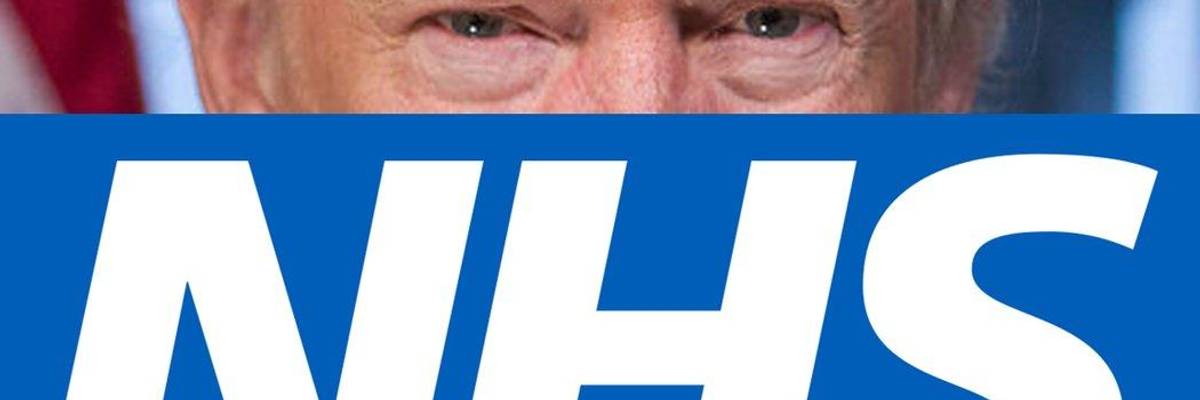
Trump-style politics, and particularly American-style privatized healthcare, are the bogeymen of the U.K. election. (Photo: The Progressive)
There are a little under two weeks left before the United Kingdom's general election, set for December 12, and the perhaps-unexpected star of many campaign trail arguments has been . . . Donald Trump.
Trump features in story after story about the potential for post-Brexit trade deals--if Boris Johnson is returned to the prime ministership with a majority large enough to force through his preferred hard Brexit. Trump is also featured in a creepy billboard, grinning from behind a surgical mask that he's peeling away from his face. The billboard warns: "Look who's coming for our NHS."
Trump-style politics, and particularly American-style privatized health care, are the bogeymen of this election. The National Health Service, Britain's universal health care system, is deeply loved across political parties--the rightwing campaign to leave the European Union famously featured buses promising more money for the NHS if the U.K. didn't have to send money to the European Union.
Even Margaret Thatcher wasn't able to privatize the NHS, though decades of governments have chipped away at it. Yet leaked documents publicized by the Labour party reveal Trump's people in conversation with Johnson's government, demanding "total market access" to the health service. A trade economist warned that U.S.-based tech companies could gain access to NHS patient data. Labour Party leader Jeremy Corbyn pointed to discussions about lengthening drug patents, which he argued, leads to the much higher drug prices in the U.S. system.
The NHS has lasted because it works for people, continuing to serve them despite underfunding.
In response, the Conservative Party rushed to issue denials and is now running Google ads promising "The NHS is Not for Sale." Trump landed in London for a NATO meeting on December 2 and was immediately asked about the NHS; Conservative Foreign Secretary Dominic Raab was grilled on the radio over a 2011 pamphlet he co-wrote that advocated privatization. An election that was supposed to be about Brexit is now, because of Brexit, becoming a referendum on universal public services.
Labour is running on strengthening existing services and creating new ones; the Tories have to swear they won't diminish them (although their history suggests they'll do the opposite). Either way, promising NHS cuts is an election-loser.
An online petition by NHS doctor Sonia Adesara to keep the NHS out of trade deals has garnered more than a million signatures. American actor Rob Delaney, a U.K. resident since 2014, made a video for the Labour party in which he describes "tens of thousands of dollars in bills" he was stuck with when his U.S. insurance company dropped him. He contrasts that experience with the NHS taking "extraordinary care" of his infant son, who suffered from a brain tumor, for twenty-one months. He called the NHS "the pinnacle of human achievement." The video has had more than 10 million views--some of them, presumably, in the United States.
Because, of course, the United States is also facing an election hinging on universal health care. Bernie Sanders and Elizabeth Warren are promising Medicare for All, though they disagree on how quickly to pursue it. Everyone else in the Democratic primary is stuck trying to explain why universal services are a bad thing. Candidates like Mayor Pete Buttigieg and Senator Amy Klobuchar hem and haw about how people like their private insurance--as if Americans are sitting around cheering for the company to which they pay increasing premiums every month; as if union workers love fighting their bosses over insurance costs each contract.
The fact remains that universally provided public services are popular. The NHS has lasted because it works for people, continuing to serve them despite underfunding. The system is there, no questions asked, when crisis strikes, serving the rich and the working class alike.
That last bit is the unspoken problem that centrists and the right have with universal services. Campaigning against the promise of free college offered by Sanders and Warren, Buttigieg ran ads complaining that free public universities would serve the children of the wealthy, an argument that inspired massive pushback.
But the fact that the rich would use the same services as the poor is the point of universal services. Health care that is free for everyone at the point of service means everyone gets the same care and the fundamental inequality of life chances created by a privatized, paid system would disappear. Making college free would mean the children of the poor could access the same quality education currently available to children of professors like Buttigieg himself.
Across the political spectrum, the British are clear: American-style health care is a terrible idea. Boris Johnson faces questions on it wherever he goes. The NHS might be squeezed, but no one wants to get rid of it--no one, that is, who doesn't stand to profit off its privatization.
But in the United States, we are told that such a system is impossible. We are told that it doesn't work, that the people who currently have it are suffering. A glimpse at election news in the United Kingdom proves the opposite: that when you create such a system, the people will fight to keep it.
Dear Common Dreams reader, It’s been nearly 30 years since I co-founded Common Dreams with my late wife, Lina Newhouser. We had the radical notion that journalism should serve the public good, not corporate profits. It was clear to us from the outset what it would take to build such a project. No paid advertisements. No corporate sponsors. No millionaire publisher telling us what to think or do. Many people said we wouldn't last a year, but we proved those doubters wrong. Together with a tremendous team of journalists and dedicated staff, we built an independent media outlet free from the constraints of profits and corporate control. Our mission has always been simple: To inform. To inspire. To ignite change for the common good. Building Common Dreams was not easy. Our survival was never guaranteed. When you take on the most powerful forces—Wall Street greed, fossil fuel industry destruction, Big Tech lobbyists, and uber-rich oligarchs who have spent billions upon billions rigging the economy and democracy in their favor—the only bulwark you have is supporters who believe in your work. But here’s the urgent message from me today. It's never been this bad out there. And it's never been this hard to keep us going. At the very moment Common Dreams is most needed, the threats we face are intensifying. We need your support now more than ever. We don't accept corporate advertising and never will. We don't have a paywall because we don't think people should be blocked from critical news based on their ability to pay. Everything we do is funded by the donations of readers like you. When everyone does the little they can afford, we are strong. But if that support retreats or dries up, so do we. Will you donate now to make sure Common Dreams not only survives but thrives? —Craig Brown, Co-founder |
There are a little under two weeks left before the United Kingdom's general election, set for December 12, and the perhaps-unexpected star of many campaign trail arguments has been . . . Donald Trump.
Trump features in story after story about the potential for post-Brexit trade deals--if Boris Johnson is returned to the prime ministership with a majority large enough to force through his preferred hard Brexit. Trump is also featured in a creepy billboard, grinning from behind a surgical mask that he's peeling away from his face. The billboard warns: "Look who's coming for our NHS."
Trump-style politics, and particularly American-style privatized health care, are the bogeymen of this election. The National Health Service, Britain's universal health care system, is deeply loved across political parties--the rightwing campaign to leave the European Union famously featured buses promising more money for the NHS if the U.K. didn't have to send money to the European Union.
Even Margaret Thatcher wasn't able to privatize the NHS, though decades of governments have chipped away at it. Yet leaked documents publicized by the Labour party reveal Trump's people in conversation with Johnson's government, demanding "total market access" to the health service. A trade economist warned that U.S.-based tech companies could gain access to NHS patient data. Labour Party leader Jeremy Corbyn pointed to discussions about lengthening drug patents, which he argued, leads to the much higher drug prices in the U.S. system.
The NHS has lasted because it works for people, continuing to serve them despite underfunding.
In response, the Conservative Party rushed to issue denials and is now running Google ads promising "The NHS is Not for Sale." Trump landed in London for a NATO meeting on December 2 and was immediately asked about the NHS; Conservative Foreign Secretary Dominic Raab was grilled on the radio over a 2011 pamphlet he co-wrote that advocated privatization. An election that was supposed to be about Brexit is now, because of Brexit, becoming a referendum on universal public services.
Labour is running on strengthening existing services and creating new ones; the Tories have to swear they won't diminish them (although their history suggests they'll do the opposite). Either way, promising NHS cuts is an election-loser.
An online petition by NHS doctor Sonia Adesara to keep the NHS out of trade deals has garnered more than a million signatures. American actor Rob Delaney, a U.K. resident since 2014, made a video for the Labour party in which he describes "tens of thousands of dollars in bills" he was stuck with when his U.S. insurance company dropped him. He contrasts that experience with the NHS taking "extraordinary care" of his infant son, who suffered from a brain tumor, for twenty-one months. He called the NHS "the pinnacle of human achievement." The video has had more than 10 million views--some of them, presumably, in the United States.
Because, of course, the United States is also facing an election hinging on universal health care. Bernie Sanders and Elizabeth Warren are promising Medicare for All, though they disagree on how quickly to pursue it. Everyone else in the Democratic primary is stuck trying to explain why universal services are a bad thing. Candidates like Mayor Pete Buttigieg and Senator Amy Klobuchar hem and haw about how people like their private insurance--as if Americans are sitting around cheering for the company to which they pay increasing premiums every month; as if union workers love fighting their bosses over insurance costs each contract.
The fact remains that universally provided public services are popular. The NHS has lasted because it works for people, continuing to serve them despite underfunding. The system is there, no questions asked, when crisis strikes, serving the rich and the working class alike.
That last bit is the unspoken problem that centrists and the right have with universal services. Campaigning against the promise of free college offered by Sanders and Warren, Buttigieg ran ads complaining that free public universities would serve the children of the wealthy, an argument that inspired massive pushback.
But the fact that the rich would use the same services as the poor is the point of universal services. Health care that is free for everyone at the point of service means everyone gets the same care and the fundamental inequality of life chances created by a privatized, paid system would disappear. Making college free would mean the children of the poor could access the same quality education currently available to children of professors like Buttigieg himself.
Across the political spectrum, the British are clear: American-style health care is a terrible idea. Boris Johnson faces questions on it wherever he goes. The NHS might be squeezed, but no one wants to get rid of it--no one, that is, who doesn't stand to profit off its privatization.
But in the United States, we are told that such a system is impossible. We are told that it doesn't work, that the people who currently have it are suffering. A glimpse at election news in the United Kingdom proves the opposite: that when you create such a system, the people will fight to keep it.
There are a little under two weeks left before the United Kingdom's general election, set for December 12, and the perhaps-unexpected star of many campaign trail arguments has been . . . Donald Trump.
Trump features in story after story about the potential for post-Brexit trade deals--if Boris Johnson is returned to the prime ministership with a majority large enough to force through his preferred hard Brexit. Trump is also featured in a creepy billboard, grinning from behind a surgical mask that he's peeling away from his face. The billboard warns: "Look who's coming for our NHS."
Trump-style politics, and particularly American-style privatized health care, are the bogeymen of this election. The National Health Service, Britain's universal health care system, is deeply loved across political parties--the rightwing campaign to leave the European Union famously featured buses promising more money for the NHS if the U.K. didn't have to send money to the European Union.
Even Margaret Thatcher wasn't able to privatize the NHS, though decades of governments have chipped away at it. Yet leaked documents publicized by the Labour party reveal Trump's people in conversation with Johnson's government, demanding "total market access" to the health service. A trade economist warned that U.S.-based tech companies could gain access to NHS patient data. Labour Party leader Jeremy Corbyn pointed to discussions about lengthening drug patents, which he argued, leads to the much higher drug prices in the U.S. system.
The NHS has lasted because it works for people, continuing to serve them despite underfunding.
In response, the Conservative Party rushed to issue denials and is now running Google ads promising "The NHS is Not for Sale." Trump landed in London for a NATO meeting on December 2 and was immediately asked about the NHS; Conservative Foreign Secretary Dominic Raab was grilled on the radio over a 2011 pamphlet he co-wrote that advocated privatization. An election that was supposed to be about Brexit is now, because of Brexit, becoming a referendum on universal public services.
Labour is running on strengthening existing services and creating new ones; the Tories have to swear they won't diminish them (although their history suggests they'll do the opposite). Either way, promising NHS cuts is an election-loser.
An online petition by NHS doctor Sonia Adesara to keep the NHS out of trade deals has garnered more than a million signatures. American actor Rob Delaney, a U.K. resident since 2014, made a video for the Labour party in which he describes "tens of thousands of dollars in bills" he was stuck with when his U.S. insurance company dropped him. He contrasts that experience with the NHS taking "extraordinary care" of his infant son, who suffered from a brain tumor, for twenty-one months. He called the NHS "the pinnacle of human achievement." The video has had more than 10 million views--some of them, presumably, in the United States.
Because, of course, the United States is also facing an election hinging on universal health care. Bernie Sanders and Elizabeth Warren are promising Medicare for All, though they disagree on how quickly to pursue it. Everyone else in the Democratic primary is stuck trying to explain why universal services are a bad thing. Candidates like Mayor Pete Buttigieg and Senator Amy Klobuchar hem and haw about how people like their private insurance--as if Americans are sitting around cheering for the company to which they pay increasing premiums every month; as if union workers love fighting their bosses over insurance costs each contract.
The fact remains that universally provided public services are popular. The NHS has lasted because it works for people, continuing to serve them despite underfunding. The system is there, no questions asked, when crisis strikes, serving the rich and the working class alike.
That last bit is the unspoken problem that centrists and the right have with universal services. Campaigning against the promise of free college offered by Sanders and Warren, Buttigieg ran ads complaining that free public universities would serve the children of the wealthy, an argument that inspired massive pushback.
But the fact that the rich would use the same services as the poor is the point of universal services. Health care that is free for everyone at the point of service means everyone gets the same care and the fundamental inequality of life chances created by a privatized, paid system would disappear. Making college free would mean the children of the poor could access the same quality education currently available to children of professors like Buttigieg himself.
Across the political spectrum, the British are clear: American-style health care is a terrible idea. Boris Johnson faces questions on it wherever he goes. The NHS might be squeezed, but no one wants to get rid of it--no one, that is, who doesn't stand to profit off its privatization.
But in the United States, we are told that such a system is impossible. We are told that it doesn't work, that the people who currently have it are suffering. A glimpse at election news in the United Kingdom proves the opposite: that when you create such a system, the people will fight to keep it.