SUBSCRIBE TO OUR FREE NEWSLETTER
Daily news & progressive opinion—funded by the people, not the corporations—delivered straight to your inbox.
5
#000000
#FFFFFF
To donate by check, phone, or other method, see our More Ways to Give page.
Daily news & progressive opinion—funded by the people, not the corporations—delivered straight to your inbox.
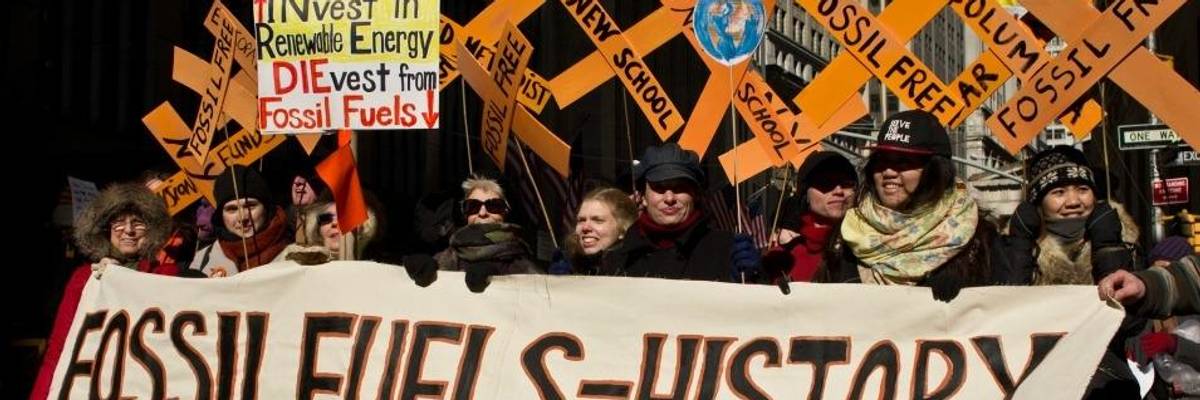
Governments are still not stepping up on climate action, yet there are no more excuses to not be delivering on real commitments that put an end to fossil fuel production. (Photo: 350.org/flickr/cc)
The planet is in an almighty mess, we see and feel its pain daily as we watch people being flooded from their houses, hurricanes and tornadoes lashing coastal areas, wildfires consuming everything in their path.
Then we see hope in the form of hundreds of thousands of people, young and old, across the groaning globe take to the streets, demanding and ready for change. We see leaders clamouring over each other, in response, commending the brave young people who are standing up for all of us and we watch them pledge to do more to tackle climate breakdown.
And then the Stockholm Environment Institute (SEI) releases the production gap report.
Although the governments' pledge to decrease country emissions, they are signalling the opposite when it comes to fossil fuel production with plans and projections for expansion.
The report released by the SEI shows that we are currently on course to produce far more coal, oil and gas than would be consistent with limiting warming to 1.5degC or 2degC, creating a "production gap" that makes climate goals much harder to reach.
Although the governments' pledge to decrease country emissions, they are signalling the opposite when it comes to fossil fuel production with plans and projections for expansion.
The "production gap" is a term used to refer to the difference between a countries' planned levels of fossil fuel production, and what is needed to achieve international climate goals. This is the first time a UN report has looked directly and specifically at fossil fuel production as a key driver of climate breakdown. It shows that countries are planning to produce fossil fuels far in excess of the levels needed to fulfil their climate pledges under the Paris Agreement, which themselves are far from adequate. This over investment in coal, oil, and gas supply locks in fossil fuel infrastructure that will make emissions reductions harder to achieve.
The disconnect between Paris temperature goals and countries' plans and policies for coal, oil, and gas production is massive, worrying and unacceptable.
The science is clear, to stay below 1.5 degrees we must stop the expansion of the fossil fuel industry immediately. That means that not a single new mine can be dug, not another pipeline built, not one more emitting powerplant fired up. And we have to get to work transitioning to sustainable renewable energy powered energy systems.
Across the globe resistance to fossil fuels is rising, the climate strikes have shown the world that we are prepared to take action.
Across the globe resistance to fossil fuels is rising, the climate strikes have shown the world that we are prepared to take action. Going forward our job is to keep up a steady drumbeat of actions, strikes and protests that gets louder and louder throughout 2020. Governments need to follow through, to act at the source of the flames that are engulfing our planet and phase out coal, oil, and gas production.
The next 18 months are so critical, they present one of our last chances to get the political commitments necessary to drive the radical changes required between 2020-2030 to keep global warming below 1.5degC (or even 2degC).
That's because, first and foremost, we're running out of time to transform the economy. And second, because there are a series of critical international meetings and national elections that will shape climate politics for decades to come.
"The Production Gap" report signals a paradigm shift, where fossil fuels are finally being accepted in the mainstream for what they are: the primary drivers of the climate crisis. Closing the production gap needs to be a primary goal of governments; to address in both international meetings and national elections. The report recommends curbing public finance for fossil fuels; limiting exploration and extraction by denying permits and passing bans, eliminating fossil fuel subsidies and aligning future production plans with climate goals and with international cooperation under the Paris Agreement
With 2020 rapidly approaching, these findings show just how much work is left to be done to protect home and livelihoods for millions of people. Governments are still not stepping up on climate action, yet there are no more excuses to not be delivering on real commitments that put an end to fossil fuel production. It's up to us to keep up the pressure, on November 29, climate strikers around the world will take to the streets again to demand governments act, just days before the UN itself holds the 25th annual Climate Talks in Madrid. There are plenty of options to close the gap--and activists all around the world are standing up for them.
Dear Common Dreams reader, It’s been nearly 30 years since I co-founded Common Dreams with my late wife, Lina Newhouser. We had the radical notion that journalism should serve the public good, not corporate profits. It was clear to us from the outset what it would take to build such a project. No paid advertisements. No corporate sponsors. No millionaire publisher telling us what to think or do. Many people said we wouldn't last a year, but we proved those doubters wrong. Together with a tremendous team of journalists and dedicated staff, we built an independent media outlet free from the constraints of profits and corporate control. Our mission has always been simple: To inform. To inspire. To ignite change for the common good. Building Common Dreams was not easy. Our survival was never guaranteed. When you take on the most powerful forces—Wall Street greed, fossil fuel industry destruction, Big Tech lobbyists, and uber-rich oligarchs who have spent billions upon billions rigging the economy and democracy in their favor—the only bulwark you have is supporters who believe in your work. But here’s the urgent message from me today. It's never been this bad out there. And it's never been this hard to keep us going. At the very moment Common Dreams is most needed, the threats we face are intensifying. We need your support now more than ever. We don't accept corporate advertising and never will. We don't have a paywall because we don't think people should be blocked from critical news based on their ability to pay. Everything we do is funded by the donations of readers like you. When everyone does the little they can afford, we are strong. But if that support retreats or dries up, so do we. Will you donate now to make sure Common Dreams not only survives but thrives? —Craig Brown, Co-founder |
The planet is in an almighty mess, we see and feel its pain daily as we watch people being flooded from their houses, hurricanes and tornadoes lashing coastal areas, wildfires consuming everything in their path.
Then we see hope in the form of hundreds of thousands of people, young and old, across the groaning globe take to the streets, demanding and ready for change. We see leaders clamouring over each other, in response, commending the brave young people who are standing up for all of us and we watch them pledge to do more to tackle climate breakdown.
And then the Stockholm Environment Institute (SEI) releases the production gap report.
Although the governments' pledge to decrease country emissions, they are signalling the opposite when it comes to fossil fuel production with plans and projections for expansion.
The report released by the SEI shows that we are currently on course to produce far more coal, oil and gas than would be consistent with limiting warming to 1.5degC or 2degC, creating a "production gap" that makes climate goals much harder to reach.
Although the governments' pledge to decrease country emissions, they are signalling the opposite when it comes to fossil fuel production with plans and projections for expansion.
The "production gap" is a term used to refer to the difference between a countries' planned levels of fossil fuel production, and what is needed to achieve international climate goals. This is the first time a UN report has looked directly and specifically at fossil fuel production as a key driver of climate breakdown. It shows that countries are planning to produce fossil fuels far in excess of the levels needed to fulfil their climate pledges under the Paris Agreement, which themselves are far from adequate. This over investment in coal, oil, and gas supply locks in fossil fuel infrastructure that will make emissions reductions harder to achieve.
The disconnect between Paris temperature goals and countries' plans and policies for coal, oil, and gas production is massive, worrying and unacceptable.
The science is clear, to stay below 1.5 degrees we must stop the expansion of the fossil fuel industry immediately. That means that not a single new mine can be dug, not another pipeline built, not one more emitting powerplant fired up. And we have to get to work transitioning to sustainable renewable energy powered energy systems.
Across the globe resistance to fossil fuels is rising, the climate strikes have shown the world that we are prepared to take action.
Across the globe resistance to fossil fuels is rising, the climate strikes have shown the world that we are prepared to take action. Going forward our job is to keep up a steady drumbeat of actions, strikes and protests that gets louder and louder throughout 2020. Governments need to follow through, to act at the source of the flames that are engulfing our planet and phase out coal, oil, and gas production.
The next 18 months are so critical, they present one of our last chances to get the political commitments necessary to drive the radical changes required between 2020-2030 to keep global warming below 1.5degC (or even 2degC).
That's because, first and foremost, we're running out of time to transform the economy. And second, because there are a series of critical international meetings and national elections that will shape climate politics for decades to come.
"The Production Gap" report signals a paradigm shift, where fossil fuels are finally being accepted in the mainstream for what they are: the primary drivers of the climate crisis. Closing the production gap needs to be a primary goal of governments; to address in both international meetings and national elections. The report recommends curbing public finance for fossil fuels; limiting exploration and extraction by denying permits and passing bans, eliminating fossil fuel subsidies and aligning future production plans with climate goals and with international cooperation under the Paris Agreement
With 2020 rapidly approaching, these findings show just how much work is left to be done to protect home and livelihoods for millions of people. Governments are still not stepping up on climate action, yet there are no more excuses to not be delivering on real commitments that put an end to fossil fuel production. It's up to us to keep up the pressure, on November 29, climate strikers around the world will take to the streets again to demand governments act, just days before the UN itself holds the 25th annual Climate Talks in Madrid. There are plenty of options to close the gap--and activists all around the world are standing up for them.
The planet is in an almighty mess, we see and feel its pain daily as we watch people being flooded from their houses, hurricanes and tornadoes lashing coastal areas, wildfires consuming everything in their path.
Then we see hope in the form of hundreds of thousands of people, young and old, across the groaning globe take to the streets, demanding and ready for change. We see leaders clamouring over each other, in response, commending the brave young people who are standing up for all of us and we watch them pledge to do more to tackle climate breakdown.
And then the Stockholm Environment Institute (SEI) releases the production gap report.
Although the governments' pledge to decrease country emissions, they are signalling the opposite when it comes to fossil fuel production with plans and projections for expansion.
The report released by the SEI shows that we are currently on course to produce far more coal, oil and gas than would be consistent with limiting warming to 1.5degC or 2degC, creating a "production gap" that makes climate goals much harder to reach.
Although the governments' pledge to decrease country emissions, they are signalling the opposite when it comes to fossil fuel production with plans and projections for expansion.
The "production gap" is a term used to refer to the difference between a countries' planned levels of fossil fuel production, and what is needed to achieve international climate goals. This is the first time a UN report has looked directly and specifically at fossil fuel production as a key driver of climate breakdown. It shows that countries are planning to produce fossil fuels far in excess of the levels needed to fulfil their climate pledges under the Paris Agreement, which themselves are far from adequate. This over investment in coal, oil, and gas supply locks in fossil fuel infrastructure that will make emissions reductions harder to achieve.
The disconnect between Paris temperature goals and countries' plans and policies for coal, oil, and gas production is massive, worrying and unacceptable.
The science is clear, to stay below 1.5 degrees we must stop the expansion of the fossil fuel industry immediately. That means that not a single new mine can be dug, not another pipeline built, not one more emitting powerplant fired up. And we have to get to work transitioning to sustainable renewable energy powered energy systems.
Across the globe resistance to fossil fuels is rising, the climate strikes have shown the world that we are prepared to take action.
Across the globe resistance to fossil fuels is rising, the climate strikes have shown the world that we are prepared to take action. Going forward our job is to keep up a steady drumbeat of actions, strikes and protests that gets louder and louder throughout 2020. Governments need to follow through, to act at the source of the flames that are engulfing our planet and phase out coal, oil, and gas production.
The next 18 months are so critical, they present one of our last chances to get the political commitments necessary to drive the radical changes required between 2020-2030 to keep global warming below 1.5degC (or even 2degC).
That's because, first and foremost, we're running out of time to transform the economy. And second, because there are a series of critical international meetings and national elections that will shape climate politics for decades to come.
"The Production Gap" report signals a paradigm shift, where fossil fuels are finally being accepted in the mainstream for what they are: the primary drivers of the climate crisis. Closing the production gap needs to be a primary goal of governments; to address in both international meetings and national elections. The report recommends curbing public finance for fossil fuels; limiting exploration and extraction by denying permits and passing bans, eliminating fossil fuel subsidies and aligning future production plans with climate goals and with international cooperation under the Paris Agreement
With 2020 rapidly approaching, these findings show just how much work is left to be done to protect home and livelihoods for millions of people. Governments are still not stepping up on climate action, yet there are no more excuses to not be delivering on real commitments that put an end to fossil fuel production. It's up to us to keep up the pressure, on November 29, climate strikers around the world will take to the streets again to demand governments act, just days before the UN itself holds the 25th annual Climate Talks in Madrid. There are plenty of options to close the gap--and activists all around the world are standing up for them.