SUBSCRIBE TO OUR FREE NEWSLETTER
Daily news & progressive opinion—funded by the people, not the corporations—delivered straight to your inbox.
5
#000000
#FFFFFF
To donate by check, phone, or other method, see our More Ways to Give page.
Daily news & progressive opinion—funded by the people, not the corporations—delivered straight to your inbox.
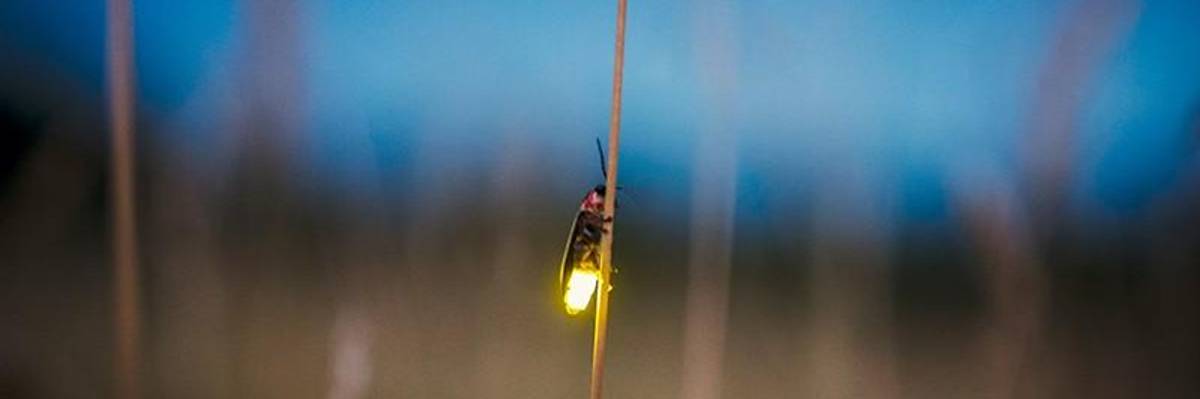
A firefly lights up at dusk. (Photo: Jeremy_Hogan / Getty Images)
Say goodbye to one of the dreamiest things about childhood. In the Midwest, fireflies are dying off.
For many Americans, it's hard to imagine summer nights without the magical glow of dozens of bioluminescent bodies fluttering above the grasses and fields, and lighting up the dark skies above.
But the die-offs aren't just limited to fireflies -- or to the American heartland. As anyone who's been paying attention to the news this summer knows, species across the globe are taking a nosedive toward extinction. The United Nations report on biodiversity that came out in May is just the latest assessment to warn that the health of our ecosystems is "deteriorating more rapidly than ever."
Humans are largely to blame. By spraying toxic pesticides, polluting our air and water, degrading the landscape, and emitting ever more carbon, we've essentially captured nature in a big glass Mason jar, screwed the lid tight, and neglected to punch holes in the top. According to the UN report, these unsustainable actions are causing nature to decline at unprecedented rates and accelerating the rate of species' extinction. Around 1 million animal and plant species -- more than ever before in human history--are now threatened with extinction, many within decades.
Scientists say that the estimated 2,000 species of fireflies have been declining for years. Losing these glowing creatures, also known as "lightning bugs" in some parts of the U.S., robs future generations of one of the simplest and most pleasurable joys of childhood. It also robs doctors and researchers of a valuable diagnostic tool. By injecting chemicals found in a firefly's tail into human cells, researchers can detect diseases like cancer and muscular dystrophy.
On a broader scale, losing plant and animal species at an accelerated rate threatens "the very foundations of our economies, livelihoods, food security, health and quality of life worldwide," warn the UN researchers. Up to $577 billion in annual global crops are at risk from pollinator loss alone.
Yet there's still time--just barely--to turn things around.
At Earthjustice, our attorneys have fought for decades to protect endangered species big and small from harm. Just recently, we successfully defended against attempts by developers to remove endangered species protections for the California gnatcatcher. This adorable little songbird lives in the rapidly declining sagebrush habitat unique to coastal southern California and northern Baja California, which is also home to many other species.
Of course, we know it's not enough to address the extinction crisis bird by bird. The UN report recommends a transformative societal shift toward an economic model where we value nature by restoring, conserving, and using it sustainably. That's why Earthjustice is also tackling the extinction crisis at a broader level.
In the courts, we're defending core conservation laws like the Endangered Species Act, which has a 99 percent success rate in stopping species' extinction. On the Hill, we're supporting bold ideas like the Green New Deal, which lays out a vision for systemic change that matches the scale of the environmental crisis.
We already have many of the legal and policy tools needed to stop a mass extinction. Now we must push for the political will to open the jar and set loose a just and sustainable future for all.
Dear Common Dreams reader, It’s been nearly 30 years since I co-founded Common Dreams with my late wife, Lina Newhouser. We had the radical notion that journalism should serve the public good, not corporate profits. It was clear to us from the outset what it would take to build such a project. No paid advertisements. No corporate sponsors. No millionaire publisher telling us what to think or do. Many people said we wouldn't last a year, but we proved those doubters wrong. Together with a tremendous team of journalists and dedicated staff, we built an independent media outlet free from the constraints of profits and corporate control. Our mission has always been simple: To inform. To inspire. To ignite change for the common good. Building Common Dreams was not easy. Our survival was never guaranteed. When you take on the most powerful forces—Wall Street greed, fossil fuel industry destruction, Big Tech lobbyists, and uber-rich oligarchs who have spent billions upon billions rigging the economy and democracy in their favor—the only bulwark you have is supporters who believe in your work. But here’s the urgent message from me today. It's never been this bad out there. And it's never been this hard to keep us going. At the very moment Common Dreams is most needed, the threats we face are intensifying. We need your support now more than ever. We don't accept corporate advertising and never will. We don't have a paywall because we don't think people should be blocked from critical news based on their ability to pay. Everything we do is funded by the donations of readers like you. When everyone does the little they can afford, we are strong. But if that support retreats or dries up, so do we. Will you donate now to make sure Common Dreams not only survives but thrives? —Craig Brown, Co-founder |
Say goodbye to one of the dreamiest things about childhood. In the Midwest, fireflies are dying off.
For many Americans, it's hard to imagine summer nights without the magical glow of dozens of bioluminescent bodies fluttering above the grasses and fields, and lighting up the dark skies above.
But the die-offs aren't just limited to fireflies -- or to the American heartland. As anyone who's been paying attention to the news this summer knows, species across the globe are taking a nosedive toward extinction. The United Nations report on biodiversity that came out in May is just the latest assessment to warn that the health of our ecosystems is "deteriorating more rapidly than ever."
Humans are largely to blame. By spraying toxic pesticides, polluting our air and water, degrading the landscape, and emitting ever more carbon, we've essentially captured nature in a big glass Mason jar, screwed the lid tight, and neglected to punch holes in the top. According to the UN report, these unsustainable actions are causing nature to decline at unprecedented rates and accelerating the rate of species' extinction. Around 1 million animal and plant species -- more than ever before in human history--are now threatened with extinction, many within decades.
Scientists say that the estimated 2,000 species of fireflies have been declining for years. Losing these glowing creatures, also known as "lightning bugs" in some parts of the U.S., robs future generations of one of the simplest and most pleasurable joys of childhood. It also robs doctors and researchers of a valuable diagnostic tool. By injecting chemicals found in a firefly's tail into human cells, researchers can detect diseases like cancer and muscular dystrophy.
On a broader scale, losing plant and animal species at an accelerated rate threatens "the very foundations of our economies, livelihoods, food security, health and quality of life worldwide," warn the UN researchers. Up to $577 billion in annual global crops are at risk from pollinator loss alone.
Yet there's still time--just barely--to turn things around.
At Earthjustice, our attorneys have fought for decades to protect endangered species big and small from harm. Just recently, we successfully defended against attempts by developers to remove endangered species protections for the California gnatcatcher. This adorable little songbird lives in the rapidly declining sagebrush habitat unique to coastal southern California and northern Baja California, which is also home to many other species.
Of course, we know it's not enough to address the extinction crisis bird by bird. The UN report recommends a transformative societal shift toward an economic model where we value nature by restoring, conserving, and using it sustainably. That's why Earthjustice is also tackling the extinction crisis at a broader level.
In the courts, we're defending core conservation laws like the Endangered Species Act, which has a 99 percent success rate in stopping species' extinction. On the Hill, we're supporting bold ideas like the Green New Deal, which lays out a vision for systemic change that matches the scale of the environmental crisis.
We already have many of the legal and policy tools needed to stop a mass extinction. Now we must push for the political will to open the jar and set loose a just and sustainable future for all.
Say goodbye to one of the dreamiest things about childhood. In the Midwest, fireflies are dying off.
For many Americans, it's hard to imagine summer nights without the magical glow of dozens of bioluminescent bodies fluttering above the grasses and fields, and lighting up the dark skies above.
But the die-offs aren't just limited to fireflies -- or to the American heartland. As anyone who's been paying attention to the news this summer knows, species across the globe are taking a nosedive toward extinction. The United Nations report on biodiversity that came out in May is just the latest assessment to warn that the health of our ecosystems is "deteriorating more rapidly than ever."
Humans are largely to blame. By spraying toxic pesticides, polluting our air and water, degrading the landscape, and emitting ever more carbon, we've essentially captured nature in a big glass Mason jar, screwed the lid tight, and neglected to punch holes in the top. According to the UN report, these unsustainable actions are causing nature to decline at unprecedented rates and accelerating the rate of species' extinction. Around 1 million animal and plant species -- more than ever before in human history--are now threatened with extinction, many within decades.
Scientists say that the estimated 2,000 species of fireflies have been declining for years. Losing these glowing creatures, also known as "lightning bugs" in some parts of the U.S., robs future generations of one of the simplest and most pleasurable joys of childhood. It also robs doctors and researchers of a valuable diagnostic tool. By injecting chemicals found in a firefly's tail into human cells, researchers can detect diseases like cancer and muscular dystrophy.
On a broader scale, losing plant and animal species at an accelerated rate threatens "the very foundations of our economies, livelihoods, food security, health and quality of life worldwide," warn the UN researchers. Up to $577 billion in annual global crops are at risk from pollinator loss alone.
Yet there's still time--just barely--to turn things around.
At Earthjustice, our attorneys have fought for decades to protect endangered species big and small from harm. Just recently, we successfully defended against attempts by developers to remove endangered species protections for the California gnatcatcher. This adorable little songbird lives in the rapidly declining sagebrush habitat unique to coastal southern California and northern Baja California, which is also home to many other species.
Of course, we know it's not enough to address the extinction crisis bird by bird. The UN report recommends a transformative societal shift toward an economic model where we value nature by restoring, conserving, and using it sustainably. That's why Earthjustice is also tackling the extinction crisis at a broader level.
In the courts, we're defending core conservation laws like the Endangered Species Act, which has a 99 percent success rate in stopping species' extinction. On the Hill, we're supporting bold ideas like the Green New Deal, which lays out a vision for systemic change that matches the scale of the environmental crisis.
We already have many of the legal and policy tools needed to stop a mass extinction. Now we must push for the political will to open the jar and set loose a just and sustainable future for all.