
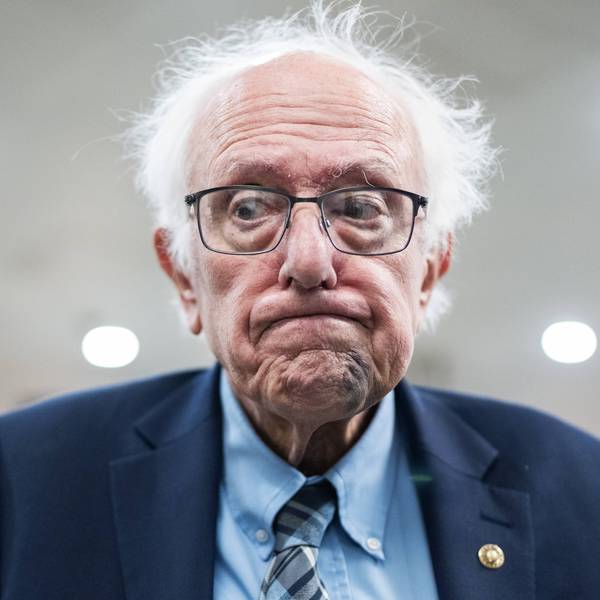
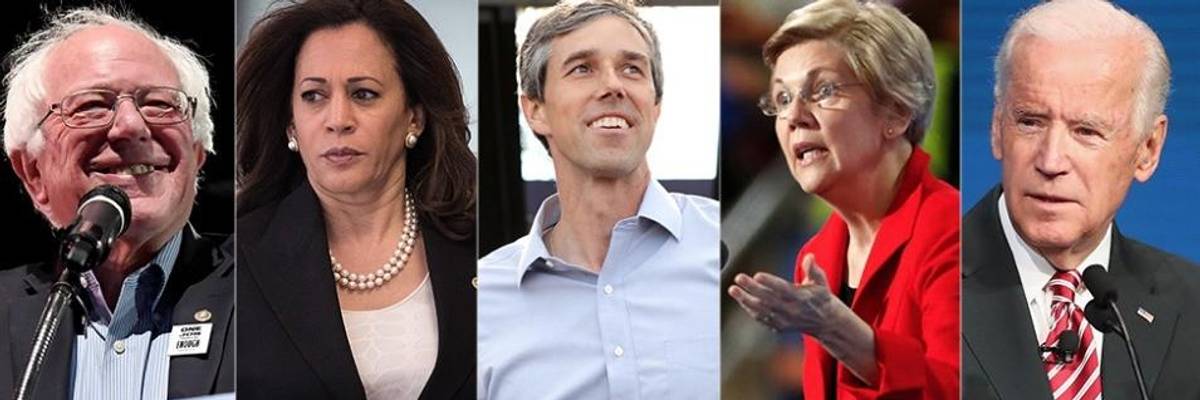
Sen. Bernie Sanders (I-Vt.), Sen. Kamala Harris (D-Calif.), former Rep. Beto O'Rourke (D-Texas), Sen. Elizabeth Warren (D-Mass.), and former vice president Joe Biden. (Photo: Screenshot)
Democrats Need to Think Big for 2020
We need a true populist, someone who is able to detail how Trump has betrayed the very workers he claims to serve
There is a dizzying array of potential presidential nominees for Democratic primary voters to choose from--so many that they won't even fit on one debate stage. But there is one basic choice the party will have to make: Will it nominate someone based on perceived electability, which is usually code for incremental policy ideas and a long political career, or a fresh-faced progressive reformer with big ideas?
"What we need is a moderate, straight white male from the Midwest," one feminist, progressive activist and former Obama campaign worker told me. Indeed, some Democrats intent on beating Trump are embracing this type of tactical voting: suppressing their own preferences for someone they think most likely to beat Trump.
This isn't a new idea; both parties have embraced this line of thinking in the past. The problem is that it rarely works. Think Walter Mondale against Ronald Reagan, Bob Dole against Bill Clinton, John Kerry against George W. Bush, and Mitt Romney against Barack Obama.
All were uninspiring mainstream politicians who could not excite the activist base of their parties. All were unable to offer a compelling alternative direction. A former vice president, Mondale ran on experience and responsibility, boasting that he'd raise your taxes and balance the budget. Dole never figured out what his candidacy was about. Kerry was a less-than-credible opponent of a disastrous war that he had voted for. Romney was epitome of the plutocratic, clueless Republican.
By contrast, the two most recent challengers that beat incumbents--Jimmy Carter and Bill Clinton--were relative newcomers to the national stage who offered new energy and ideas. Similarly, in recent elections without incumbents, voters have chosen the fresh face over tried and tired politicians--Obama over Senator John McCain, a longtime creature of the Senate, and Trump over Hillary Clinton.
Democrats weighing who might be strongest against Trump would be wise to bet on someone fresh: a person outside the party mainstream who has a compelling agenda.
If history is a guide, Democrats weighing who might be strongest against Trump would be wise to bet on someone fresh: a person outside the party mainstream who has a compelling agenda.
Not Joe Biden, who is offering a return to Obama; not Amy Klobuchar, peddling the illusion of bipartisan cooperation. What's clear is that the voters who put Trump in office were looking for dramatic change. Trump will try to run once more as a populist outsider fighting against a corrupted political class. He is most vulnerable not to a Democrat fixated on Russiagate, nor to a Democrat offering a restoration to the Obama years, but to a true populist, able to detail how Trump has betrayed the very workers he claims to serve.
Klobuchar received kudos for dismissing tuition-free college as unrealistic, saying, "If I was a magic genie and could give that to everyone and we could afford it, I would," while offering vague promises of "a mix of incentives" for students, like expanding Pell grants or refinancing student loans.
Klobuchar is simply wrong. Tuition-free public college--with an annual price tag estimated at about $47 billion at the federal level--is very affordable in a country that just passed a $1.8 trillion tax cut that went largely to the rich and the corporations. The Tax Policy Institute estimated that the Trump tax cuts resulted in a revenue decline of $164 billion in FY2018 even though they had been in effect only three-fourths of the fiscal year.
Student-loan debt now totals a staggering $1.5 trillion. Forty-four million Americans are carrying loans. The burdened can't afford homes, and put off marriage and children--all because they sought the education they were told they needed. You don't need a genie to address this; you simply need to see it as a priority.
Klobuchar's theme--on student loans, Medicare for All, the Green New Deal--is that "we need more than aspirational. We need real action now," which she promises to deliver by reaching across the aisle to pass incremental reforms.
If history is any judge, the promise of incremental change and working across the aisle isn't realism; it's a pie-in-the-sky fantasy.
Yet, if history is any judge, the promise of incremental change and working across the aisle isn't realism; it's a pie-in-the-sky fantasy. Barack Obama ran as the great unifier. After becoming president, he attempted to govern by reaching out to Republicans with moderate Republican ideas, exemplified by his health-care plan. He embraced wrongheaded Republican tax cuts that weakened his stimulus plan. He nominated a moderate, pro-corporate judge to the Supreme Court. Yet he received scorched-earth opposition, with Republicans scorning every major entreaty. And Republicans are now even more extreme post-Trump than they were in the Obama era.
By contrast, Ronald Reagan ran and won as a movement conservative, calling for deep tax cuts, dismantling government, and ramping up the Cold War. When elected with sweeping Republican gains in the Senate, he claimed a mandate that cowed a Democratic majority in Congress that then gave him much of what he sought. In today's bitterly partisan atmosphere, the pie-in-the-sky fantasists may well be those who think moderation can gain bipartisan support. The more pragmatic Democrats understand that only by claiming and winning a mandate for dramatic change is there a possibility of intimidating the opposition enough to make progress.
So before Democrats anoint Joe Biden as the great white hope against Trump, or the media elevates those with incremental-reform ideas as the pragmatic realists, they might want to take a long look at recent history and think again. In the end, Democrats might do better voting with their hearts than with their heads.
First published in The Nation
We are at a crossroads
This country and this world are at a monumental crossroads. In a few short weeks, US voters will have an opportunity to beat back the forces of fascism and confront the billionaires who are rigging the economy, our media system, and our democracy, making it increasingly impossible for ordinary people to get by. We’re not just talking about the election. We’re talking about what must be done once these fascist elements are vanquished from power. We need a bolder set of solutions than what either major party has so far been willing to offer and a working-class movement ready to fight like hell for it. Trump didn't emerge from nowhere. The conditions that fueled MAGA authoritarianism were created by decades of radical neoliberal economic policies and a corrupt political system dominated by corporate interests. They slashed taxes on the super-rich, promising that the benefits would trickle down. They said giveaways to the corporate titans would make life more affordable for the rest of us. It was all bullshit. And when a bitter, betrayed populace searches for someone to blame, right-wing demagogues have little trouble finding scapegoats. People know when they're being lied to, but you won't hear any of this from the corporate media. Only independent journalism—powered and funded by people who believe in building a better world—can deliver truly trustworthy daily news. Our Fall Campaign is underway, and we need your help. To power our newsroom through the rest of the year, we need to raise $125,000 by midnight on October 31. So if you share our vision, please contribute whatever you can to sustain our work. |
There is a dizzying array of potential presidential nominees for Democratic primary voters to choose from--so many that they won't even fit on one debate stage. But there is one basic choice the party will have to make: Will it nominate someone based on perceived electability, which is usually code for incremental policy ideas and a long political career, or a fresh-faced progressive reformer with big ideas?
"What we need is a moderate, straight white male from the Midwest," one feminist, progressive activist and former Obama campaign worker told me. Indeed, some Democrats intent on beating Trump are embracing this type of tactical voting: suppressing their own preferences for someone they think most likely to beat Trump.
This isn't a new idea; both parties have embraced this line of thinking in the past. The problem is that it rarely works. Think Walter Mondale against Ronald Reagan, Bob Dole against Bill Clinton, John Kerry against George W. Bush, and Mitt Romney against Barack Obama.
All were uninspiring mainstream politicians who could not excite the activist base of their parties. All were unable to offer a compelling alternative direction. A former vice president, Mondale ran on experience and responsibility, boasting that he'd raise your taxes and balance the budget. Dole never figured out what his candidacy was about. Kerry was a less-than-credible opponent of a disastrous war that he had voted for. Romney was epitome of the plutocratic, clueless Republican.
By contrast, the two most recent challengers that beat incumbents--Jimmy Carter and Bill Clinton--were relative newcomers to the national stage who offered new energy and ideas. Similarly, in recent elections without incumbents, voters have chosen the fresh face over tried and tired politicians--Obama over Senator John McCain, a longtime creature of the Senate, and Trump over Hillary Clinton.
Democrats weighing who might be strongest against Trump would be wise to bet on someone fresh: a person outside the party mainstream who has a compelling agenda.
If history is a guide, Democrats weighing who might be strongest against Trump would be wise to bet on someone fresh: a person outside the party mainstream who has a compelling agenda.
Not Joe Biden, who is offering a return to Obama; not Amy Klobuchar, peddling the illusion of bipartisan cooperation. What's clear is that the voters who put Trump in office were looking for dramatic change. Trump will try to run once more as a populist outsider fighting against a corrupted political class. He is most vulnerable not to a Democrat fixated on Russiagate, nor to a Democrat offering a restoration to the Obama years, but to a true populist, able to detail how Trump has betrayed the very workers he claims to serve.
Klobuchar received kudos for dismissing tuition-free college as unrealistic, saying, "If I was a magic genie and could give that to everyone and we could afford it, I would," while offering vague promises of "a mix of incentives" for students, like expanding Pell grants or refinancing student loans.
Klobuchar is simply wrong. Tuition-free public college--with an annual price tag estimated at about $47 billion at the federal level--is very affordable in a country that just passed a $1.8 trillion tax cut that went largely to the rich and the corporations. The Tax Policy Institute estimated that the Trump tax cuts resulted in a revenue decline of $164 billion in FY2018 even though they had been in effect only three-fourths of the fiscal year.
Student-loan debt now totals a staggering $1.5 trillion. Forty-four million Americans are carrying loans. The burdened can't afford homes, and put off marriage and children--all because they sought the education they were told they needed. You don't need a genie to address this; you simply need to see it as a priority.
Klobuchar's theme--on student loans, Medicare for All, the Green New Deal--is that "we need more than aspirational. We need real action now," which she promises to deliver by reaching across the aisle to pass incremental reforms.
If history is any judge, the promise of incremental change and working across the aisle isn't realism; it's a pie-in-the-sky fantasy.
Yet, if history is any judge, the promise of incremental change and working across the aisle isn't realism; it's a pie-in-the-sky fantasy. Barack Obama ran as the great unifier. After becoming president, he attempted to govern by reaching out to Republicans with moderate Republican ideas, exemplified by his health-care plan. He embraced wrongheaded Republican tax cuts that weakened his stimulus plan. He nominated a moderate, pro-corporate judge to the Supreme Court. Yet he received scorched-earth opposition, with Republicans scorning every major entreaty. And Republicans are now even more extreme post-Trump than they were in the Obama era.
By contrast, Ronald Reagan ran and won as a movement conservative, calling for deep tax cuts, dismantling government, and ramping up the Cold War. When elected with sweeping Republican gains in the Senate, he claimed a mandate that cowed a Democratic majority in Congress that then gave him much of what he sought. In today's bitterly partisan atmosphere, the pie-in-the-sky fantasists may well be those who think moderation can gain bipartisan support. The more pragmatic Democrats understand that only by claiming and winning a mandate for dramatic change is there a possibility of intimidating the opposition enough to make progress.
So before Democrats anoint Joe Biden as the great white hope against Trump, or the media elevates those with incremental-reform ideas as the pragmatic realists, they might want to take a long look at recent history and think again. In the end, Democrats might do better voting with their hearts than with their heads.
First published in The Nation
There is a dizzying array of potential presidential nominees for Democratic primary voters to choose from--so many that they won't even fit on one debate stage. But there is one basic choice the party will have to make: Will it nominate someone based on perceived electability, which is usually code for incremental policy ideas and a long political career, or a fresh-faced progressive reformer with big ideas?
"What we need is a moderate, straight white male from the Midwest," one feminist, progressive activist and former Obama campaign worker told me. Indeed, some Democrats intent on beating Trump are embracing this type of tactical voting: suppressing their own preferences for someone they think most likely to beat Trump.
This isn't a new idea; both parties have embraced this line of thinking in the past. The problem is that it rarely works. Think Walter Mondale against Ronald Reagan, Bob Dole against Bill Clinton, John Kerry against George W. Bush, and Mitt Romney against Barack Obama.
All were uninspiring mainstream politicians who could not excite the activist base of their parties. All were unable to offer a compelling alternative direction. A former vice president, Mondale ran on experience and responsibility, boasting that he'd raise your taxes and balance the budget. Dole never figured out what his candidacy was about. Kerry was a less-than-credible opponent of a disastrous war that he had voted for. Romney was epitome of the plutocratic, clueless Republican.
By contrast, the two most recent challengers that beat incumbents--Jimmy Carter and Bill Clinton--were relative newcomers to the national stage who offered new energy and ideas. Similarly, in recent elections without incumbents, voters have chosen the fresh face over tried and tired politicians--Obama over Senator John McCain, a longtime creature of the Senate, and Trump over Hillary Clinton.
Democrats weighing who might be strongest against Trump would be wise to bet on someone fresh: a person outside the party mainstream who has a compelling agenda.
If history is a guide, Democrats weighing who might be strongest against Trump would be wise to bet on someone fresh: a person outside the party mainstream who has a compelling agenda.
Not Joe Biden, who is offering a return to Obama; not Amy Klobuchar, peddling the illusion of bipartisan cooperation. What's clear is that the voters who put Trump in office were looking for dramatic change. Trump will try to run once more as a populist outsider fighting against a corrupted political class. He is most vulnerable not to a Democrat fixated on Russiagate, nor to a Democrat offering a restoration to the Obama years, but to a true populist, able to detail how Trump has betrayed the very workers he claims to serve.
Klobuchar received kudos for dismissing tuition-free college as unrealistic, saying, "If I was a magic genie and could give that to everyone and we could afford it, I would," while offering vague promises of "a mix of incentives" for students, like expanding Pell grants or refinancing student loans.
Klobuchar is simply wrong. Tuition-free public college--with an annual price tag estimated at about $47 billion at the federal level--is very affordable in a country that just passed a $1.8 trillion tax cut that went largely to the rich and the corporations. The Tax Policy Institute estimated that the Trump tax cuts resulted in a revenue decline of $164 billion in FY2018 even though they had been in effect only three-fourths of the fiscal year.
Student-loan debt now totals a staggering $1.5 trillion. Forty-four million Americans are carrying loans. The burdened can't afford homes, and put off marriage and children--all because they sought the education they were told they needed. You don't need a genie to address this; you simply need to see it as a priority.
Klobuchar's theme--on student loans, Medicare for All, the Green New Deal--is that "we need more than aspirational. We need real action now," which she promises to deliver by reaching across the aisle to pass incremental reforms.
If history is any judge, the promise of incremental change and working across the aisle isn't realism; it's a pie-in-the-sky fantasy.
Yet, if history is any judge, the promise of incremental change and working across the aisle isn't realism; it's a pie-in-the-sky fantasy. Barack Obama ran as the great unifier. After becoming president, he attempted to govern by reaching out to Republicans with moderate Republican ideas, exemplified by his health-care plan. He embraced wrongheaded Republican tax cuts that weakened his stimulus plan. He nominated a moderate, pro-corporate judge to the Supreme Court. Yet he received scorched-earth opposition, with Republicans scorning every major entreaty. And Republicans are now even more extreme post-Trump than they were in the Obama era.
By contrast, Ronald Reagan ran and won as a movement conservative, calling for deep tax cuts, dismantling government, and ramping up the Cold War. When elected with sweeping Republican gains in the Senate, he claimed a mandate that cowed a Democratic majority in Congress that then gave him much of what he sought. In today's bitterly partisan atmosphere, the pie-in-the-sky fantasists may well be those who think moderation can gain bipartisan support. The more pragmatic Democrats understand that only by claiming and winning a mandate for dramatic change is there a possibility of intimidating the opposition enough to make progress.
So before Democrats anoint Joe Biden as the great white hope against Trump, or the media elevates those with incremental-reform ideas as the pragmatic realists, they might want to take a long look at recent history and think again. In the end, Democrats might do better voting with their hearts than with their heads.
First published in The Nation