

SUBSCRIBE TO OUR FREE NEWSLETTER
Daily news & progressive opinion—funded by the people, not the corporations—delivered straight to your inbox.
5
#000000
#FFFFFF
To donate by check, phone, or other method, see our More Ways to Give page.
Daily news & progressive opinion—funded by the people, not the corporations—delivered straight to your inbox.
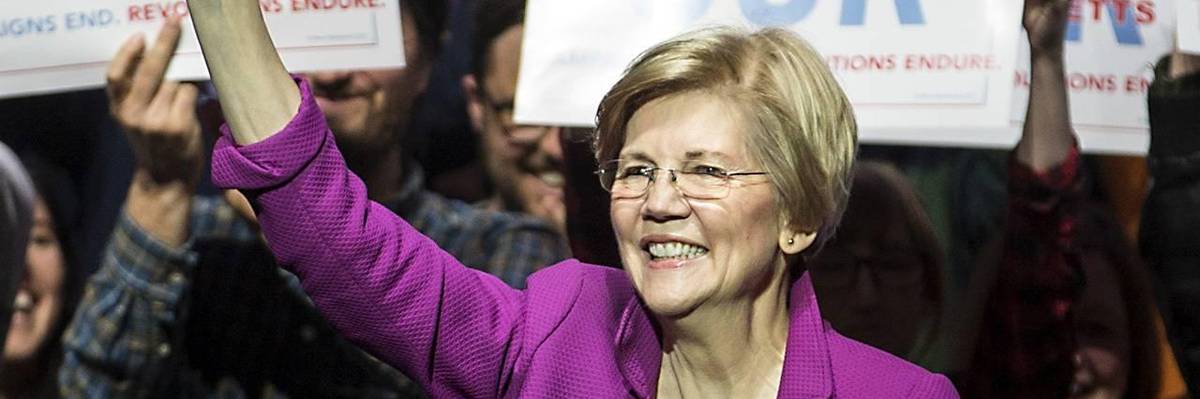
Carefully calculated by economists Emmanuel Saez and Gabriel Zucman, the proposal by Sen. Elizabeth Warren (D-Mass.), now running for president, sets a rate of 2 percent on fortunes valued between $50 million and $1 billion, and 3 percent above $1 billion. (Photo: Getty Images)
What if the final blow for French President Emmanuel Macron came not from the yellow vests but from US Senator Elizabeth Warren of Massachusetts? Warren, who announced her candidacy for president on Saturday, has proposed what will doubtless be one of the key points of her campaign -- the creation of a genuine federal progressive wealth tax.
Carefully calculated by Emmanuel Saez and Gabriel Zucman, the Warren proposal sets a rate of 2 percent on fortunes valued between $50 million and $1 billion, and 3 percent above $1 billion. The proposal also provides for an exit tax equal to 40 percent of total wealth for those who relinquish their American citizenship. The tax would apply to all assets, with no exemptions, with dissuasive sanctions for people and governments that do not transmit appropriate information on assets held abroad.
The debate has only just begun and the proposed schedule could still be extended and made more progressive -- with rates rising, for example, to 5 to 10 percent per annum for multibillionaires. What is certain is that the issue of fiscal justice will be central to the presidential campaign. US Representative Alexandria Ocasio-Cortez of New York has suggested a rate of 70 percent on the highest incomes, while Senator Bernie Sanders of Vermont defends a tax rate of 77 percent on the highest inherited estates. While the Warren proposal is the most innovative, the three approaches are complementary and should be mutually beneficial. Advertisement
To understand this, let's look back. Between 1880 and 1910, while the concentration of industrial and financial wealth was gaining momentum in the United States and the country was threatening to become almost as unequal as old Europe, a powerful political movement in favor of an improved distribution in wealth was developing. This led to the creation of a federal tax on income in 1913 and on inheritances in 1916.
Between 1930 and 1980, the rate applied on the highest incomes was on average 81 percent, and the rate applied to the highest inherited estates was 74 percent. Clearly this did not destroy American capitalism. Far from it. It made it more egalitarian and more productive, at a time when the United States had not forgotten that educational advancement and investment in training and skills -- not the religion of property and inequality -- were the backbone of prosperity.
Presidents Ronald Reagan, George W. Bush, and Donald Trump subsequently endeavored to destroy this heritage. They turned their backs on the egalitarian origins of the country by counting on historical amnesia and by fueling identity-based divisions. With the hindsight we have today, it is obvious that the outcome of this policy was disastrous. Between 1980 and 2020, the rise in per capita national income was halved in comparison with the period 1930-1980. What little growth there was ended up being swept up by the richest, the consequence being a complete stagnation in income for the poorest 50 percent. There is something obvious about the movement of a return to progressive taxation and greater fiscal justice that is emerging today and which is long overdue.
The innovation is that it is now a question of creating an annual wealth tax in addition to the income and inherited estate taxes. This is a crucial innovation in terms of justice and efficiency. Numerous one-shot capital levies have been successfully applied to real estate, professional, and financial assets subsequent to the world wars to pay off public debts, in particular in Japan, Germany, Italy, France and in many European countries. Collected only once, the rates applied to the largest private estates often rose to 40 and 50 percent, or even more.
With an annual wealth tax designed to be applied on a permanent basis, the rates are of necessity more restricted. However, they must be high enough to enable genuine mobility of wealth. From this point of view, the tax on inherited wealth comes much too late. We are not going to wait until Jeff Bezos or Mark Zuckerberg reach the age of 90 before they begin to pay taxes. With the 3 percent annual rate proposed by Warren, a static estate worth $100 billion would return to the community in 30 years. This is a good beginning but, given the average rate of progression of the highest financial assets, the aim should undoubtedly be higher (5 to 10 percent or more).
It is also crucial to allocate all the revenue to the reduction of inequalities. In particular, the American property tax, like the French real estate tax, weighs heavily on those with limited resources. Those two venerable property taxes, contrary to what is sometimes stated, tax not only the ownership of housing but also tax business assets (offices, plots of land, warehouses, etc.). The problem is that they have never been genuinely rethought since the 18th century. The time has come for them to become progressive taxes with graduated rates on net assets, with the key element being strong reductions for indebted households who are seeking to accede to property ownership. Let's hope that the forthcoming American campaign, like the French discussion around the yellow vests, will at last afford the opportunity for an in-depth discussion on the taxation of property and fiscal justice.
Dear Common Dreams reader, It’s been nearly 30 years since I co-founded Common Dreams with my late wife, Lina Newhouser. We had the radical notion that journalism should serve the public good, not corporate profits. It was clear to us from the outset what it would take to build such a project. No paid advertisements. No corporate sponsors. No millionaire publisher telling us what to think or do. Many people said we wouldn't last a year, but we proved those doubters wrong. Together with a tremendous team of journalists and dedicated staff, we built an independent media outlet free from the constraints of profits and corporate control. Our mission has always been simple: To inform. To inspire. To ignite change for the common good. Building Common Dreams was not easy. Our survival was never guaranteed. When you take on the most powerful forces—Wall Street greed, fossil fuel industry destruction, Big Tech lobbyists, and uber-rich oligarchs who have spent billions upon billions rigging the economy and democracy in their favor—the only bulwark you have is supporters who believe in your work. But here’s the urgent message from me today. It's never been this bad out there. And it's never been this hard to keep us going. At the very moment Common Dreams is most needed, the threats we face are intensifying. We need your support now more than ever. We don't accept corporate advertising and never will. We don't have a paywall because we don't think people should be blocked from critical news based on their ability to pay. Everything we do is funded by the donations of readers like you. When everyone does the little they can afford, we are strong. But if that support retreats or dries up, so do we. Will you donate now to make sure Common Dreams not only survives but thrives? —Craig Brown, Co-founder |
What if the final blow for French President Emmanuel Macron came not from the yellow vests but from US Senator Elizabeth Warren of Massachusetts? Warren, who announced her candidacy for president on Saturday, has proposed what will doubtless be one of the key points of her campaign -- the creation of a genuine federal progressive wealth tax.
Carefully calculated by Emmanuel Saez and Gabriel Zucman, the Warren proposal sets a rate of 2 percent on fortunes valued between $50 million and $1 billion, and 3 percent above $1 billion. The proposal also provides for an exit tax equal to 40 percent of total wealth for those who relinquish their American citizenship. The tax would apply to all assets, with no exemptions, with dissuasive sanctions for people and governments that do not transmit appropriate information on assets held abroad.
The debate has only just begun and the proposed schedule could still be extended and made more progressive -- with rates rising, for example, to 5 to 10 percent per annum for multibillionaires. What is certain is that the issue of fiscal justice will be central to the presidential campaign. US Representative Alexandria Ocasio-Cortez of New York has suggested a rate of 70 percent on the highest incomes, while Senator Bernie Sanders of Vermont defends a tax rate of 77 percent on the highest inherited estates. While the Warren proposal is the most innovative, the three approaches are complementary and should be mutually beneficial. Advertisement
To understand this, let's look back. Between 1880 and 1910, while the concentration of industrial and financial wealth was gaining momentum in the United States and the country was threatening to become almost as unequal as old Europe, a powerful political movement in favor of an improved distribution in wealth was developing. This led to the creation of a federal tax on income in 1913 and on inheritances in 1916.
Between 1930 and 1980, the rate applied on the highest incomes was on average 81 percent, and the rate applied to the highest inherited estates was 74 percent. Clearly this did not destroy American capitalism. Far from it. It made it more egalitarian and more productive, at a time when the United States had not forgotten that educational advancement and investment in training and skills -- not the religion of property and inequality -- were the backbone of prosperity.
Presidents Ronald Reagan, George W. Bush, and Donald Trump subsequently endeavored to destroy this heritage. They turned their backs on the egalitarian origins of the country by counting on historical amnesia and by fueling identity-based divisions. With the hindsight we have today, it is obvious that the outcome of this policy was disastrous. Between 1980 and 2020, the rise in per capita national income was halved in comparison with the period 1930-1980. What little growth there was ended up being swept up by the richest, the consequence being a complete stagnation in income for the poorest 50 percent. There is something obvious about the movement of a return to progressive taxation and greater fiscal justice that is emerging today and which is long overdue.
The innovation is that it is now a question of creating an annual wealth tax in addition to the income and inherited estate taxes. This is a crucial innovation in terms of justice and efficiency. Numerous one-shot capital levies have been successfully applied to real estate, professional, and financial assets subsequent to the world wars to pay off public debts, in particular in Japan, Germany, Italy, France and in many European countries. Collected only once, the rates applied to the largest private estates often rose to 40 and 50 percent, or even more.
With an annual wealth tax designed to be applied on a permanent basis, the rates are of necessity more restricted. However, they must be high enough to enable genuine mobility of wealth. From this point of view, the tax on inherited wealth comes much too late. We are not going to wait until Jeff Bezos or Mark Zuckerberg reach the age of 90 before they begin to pay taxes. With the 3 percent annual rate proposed by Warren, a static estate worth $100 billion would return to the community in 30 years. This is a good beginning but, given the average rate of progression of the highest financial assets, the aim should undoubtedly be higher (5 to 10 percent or more).
It is also crucial to allocate all the revenue to the reduction of inequalities. In particular, the American property tax, like the French real estate tax, weighs heavily on those with limited resources. Those two venerable property taxes, contrary to what is sometimes stated, tax not only the ownership of housing but also tax business assets (offices, plots of land, warehouses, etc.). The problem is that they have never been genuinely rethought since the 18th century. The time has come for them to become progressive taxes with graduated rates on net assets, with the key element being strong reductions for indebted households who are seeking to accede to property ownership. Let's hope that the forthcoming American campaign, like the French discussion around the yellow vests, will at last afford the opportunity for an in-depth discussion on the taxation of property and fiscal justice.
What if the final blow for French President Emmanuel Macron came not from the yellow vests but from US Senator Elizabeth Warren of Massachusetts? Warren, who announced her candidacy for president on Saturday, has proposed what will doubtless be one of the key points of her campaign -- the creation of a genuine federal progressive wealth tax.
Carefully calculated by Emmanuel Saez and Gabriel Zucman, the Warren proposal sets a rate of 2 percent on fortunes valued between $50 million and $1 billion, and 3 percent above $1 billion. The proposal also provides for an exit tax equal to 40 percent of total wealth for those who relinquish their American citizenship. The tax would apply to all assets, with no exemptions, with dissuasive sanctions for people and governments that do not transmit appropriate information on assets held abroad.
The debate has only just begun and the proposed schedule could still be extended and made more progressive -- with rates rising, for example, to 5 to 10 percent per annum for multibillionaires. What is certain is that the issue of fiscal justice will be central to the presidential campaign. US Representative Alexandria Ocasio-Cortez of New York has suggested a rate of 70 percent on the highest incomes, while Senator Bernie Sanders of Vermont defends a tax rate of 77 percent on the highest inherited estates. While the Warren proposal is the most innovative, the three approaches are complementary and should be mutually beneficial. Advertisement
To understand this, let's look back. Between 1880 and 1910, while the concentration of industrial and financial wealth was gaining momentum in the United States and the country was threatening to become almost as unequal as old Europe, a powerful political movement in favor of an improved distribution in wealth was developing. This led to the creation of a federal tax on income in 1913 and on inheritances in 1916.
Between 1930 and 1980, the rate applied on the highest incomes was on average 81 percent, and the rate applied to the highest inherited estates was 74 percent. Clearly this did not destroy American capitalism. Far from it. It made it more egalitarian and more productive, at a time when the United States had not forgotten that educational advancement and investment in training and skills -- not the religion of property and inequality -- were the backbone of prosperity.
Presidents Ronald Reagan, George W. Bush, and Donald Trump subsequently endeavored to destroy this heritage. They turned their backs on the egalitarian origins of the country by counting on historical amnesia and by fueling identity-based divisions. With the hindsight we have today, it is obvious that the outcome of this policy was disastrous. Between 1980 and 2020, the rise in per capita national income was halved in comparison with the period 1930-1980. What little growth there was ended up being swept up by the richest, the consequence being a complete stagnation in income for the poorest 50 percent. There is something obvious about the movement of a return to progressive taxation and greater fiscal justice that is emerging today and which is long overdue.
The innovation is that it is now a question of creating an annual wealth tax in addition to the income and inherited estate taxes. This is a crucial innovation in terms of justice and efficiency. Numerous one-shot capital levies have been successfully applied to real estate, professional, and financial assets subsequent to the world wars to pay off public debts, in particular in Japan, Germany, Italy, France and in many European countries. Collected only once, the rates applied to the largest private estates often rose to 40 and 50 percent, or even more.
With an annual wealth tax designed to be applied on a permanent basis, the rates are of necessity more restricted. However, they must be high enough to enable genuine mobility of wealth. From this point of view, the tax on inherited wealth comes much too late. We are not going to wait until Jeff Bezos or Mark Zuckerberg reach the age of 90 before they begin to pay taxes. With the 3 percent annual rate proposed by Warren, a static estate worth $100 billion would return to the community in 30 years. This is a good beginning but, given the average rate of progression of the highest financial assets, the aim should undoubtedly be higher (5 to 10 percent or more).
It is also crucial to allocate all the revenue to the reduction of inequalities. In particular, the American property tax, like the French real estate tax, weighs heavily on those with limited resources. Those two venerable property taxes, contrary to what is sometimes stated, tax not only the ownership of housing but also tax business assets (offices, plots of land, warehouses, etc.). The problem is that they have never been genuinely rethought since the 18th century. The time has come for them to become progressive taxes with graduated rates on net assets, with the key element being strong reductions for indebted households who are seeking to accede to property ownership. Let's hope that the forthcoming American campaign, like the French discussion around the yellow vests, will at last afford the opportunity for an in-depth discussion on the taxation of property and fiscal justice.

