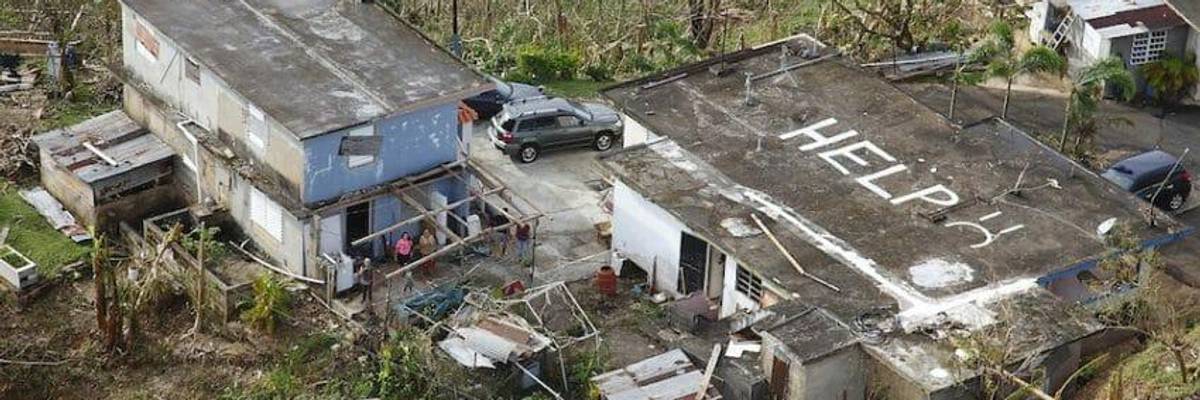
A house in the mountains of Puerto Rico that was damaged by Hurricane Maria broadcast a call for help from its roof. A new study out of Harvard University estimated that the death toll from the storm far surpassed the White House's figures, sparking censure of the Trump administration's handling of the crisis. (Photo: Wikimedia Commons)
Racism Keeps Rearing Its Ugly Head
We see over and over the dehumanization of people of color in our country and our world.
TV star Roseanne Barr's racist tweet about Valerie Jarrett and ABC's subsequent cancellation of her eponymous show constitute just the latest and most high-profile episode highlighting the ways in which people of color are routinely dehumanized. Barr insulted Jarrett, an African-American woman, by using both an anti-black comparison to apes and an Islamophobic accusation of membership in the Muslim Brotherhood. To their credit, ABC executives canceled "Roseanne" within hours.
But the network should have known better than to revive the self-avowed ardent Donald Trump supporter's show in the first place. Much like serial Twitter abuser Trump, this wasn't the first time Barr had spewed racist garbage on Twitter. In rebooting "Roseanne," ABC legitimized a high-profile racist supporter of a racist president.
Barr's words are a symbol of just how overtly the racist dehumanization of people of color continues to play out in Trump's America. On the same day as that controversy, news broke of a far higher death toll from Hurricane Maria in Puerto Rico last year than was previously reported. A Harvard University study published in The New England Journal of Medicine estimated that more than 4,600 Puerto Rican deaths were attributable to the hurricane--a number several orders of magnitude greater than the official U.S. estimate of 64. Because the study extrapolated numbers from a small sample size, the actual death toll could be as low as 800 or as high as 8,000.
In comparison, the 2005 devastation from Hurricane Katrina in New Orleans was linked to about 1,800 deaths. In that instance, people across the United States and even the world watched scenes of devastation in horror, and they rightly blamed George W. Bush's administration for inaction and a botched response to the calamity that mostly affected African-Americans. In the case of Puerto Rico, a Spanish-speaking U.S. territory, President Trump has not been held nearly as accountable in the court of public opinion for the government's poor response to the hurricane disaster, in part because of the undercount of deaths.
The message that the lives of people of color are worth less is also felt around the world--such as in countries where the U.S. wages wars, like Iraq, Afghanistan and Syria, or where the U.S. supports wars like Saudi Arabia's assault on Yemen and Israel's violence against Palestinians in Gaza.
The message that the lives of people of color are worth less is also felt around the world--such as in countries where the U.S. wages wars, like Iraq, Afghanistan and Syria, or where the U.S. supports wars like Saudi Arabia's assault on Yemen and Israel's violence against Palestinians in Gaza. The people of color who inhabit these lands are considered expendable, their lives subject to the whims of "collateral damage."
Those people of color who flee our wars are also met with contempt abroad. In France, Malian refugee Mamoudou Gassama, who risked his life crossing the Mediterranean, was offered French citizenship after carrying out a bold rescue of a child dangling from a fourth-floor balcony in Paris. As political commentator Wajahat Ali noted wryly on Twitter, "In order to be seen as a human, a migrant has to literally leap, climb tall buildings and save lives." The rest of the refugee population in France and Europe at large struggles daily to be seen as human.
Here in the United States, even acts of incredible heroism by people of color don't guarantee attention from our current head of state. Three weeks after a black man named James Shaw risked his life to tackle a shooter at a Waffle House in Tennessee, Trump reached out to him in a phone call that Shaw described as "lackluster." Meanwhile the president was victorious in his push to silence black people from speaking out about racism when the NFL decided recently to fine football players who refuse to stand for the national anthem. Trump had conflated peaceful anti-racist protests by players with disrespect for the U.S. military and the flag, and the NFL appears to have capitulated.
Black communities in the U.S. know intimately what the project of dehumanization feels like. When two men were arrested on April 12 at a Philadelphia Starbucks, it was business as usual in America. This week as Starbucks closed shop en masse for a high-profile afternoon racial sensitivity training session for its staff in light of the incident, the corporation hoped to fix the problem in one fell swoop while restoring its liberal reputation. Despite the fact that the training will likely fall far short of what is needed, and is probably a major publicity stunt, it is a start. But there were two sets of perpetrators during the arrest: the white manager who called the cops on the black men, and the officers who believed the manager and hauled the men away in handcuffs without determining properly if they deserved to be arrested. When will police be required to receive anti-racist training? It is precisely this sort of racist mistreatment by police that NFL players like Colin Kaepernick were protesting and that the NFL and Trump have decided to ignore.
The systems that dehumanize people of color have remained largely bipartisan even in recent years, as detrimental policies aimed at people of color were being quietly pursued by Democrats and President Obama when they held political power.
We see over and over the dehumanization of people of color in our country and our world. As I concluded in my recent documentary "Making America Racist Again," racism was not invented by Trump, the Republicans or conservatives. It is built into the fabric of this country right from the start, through the genocide of Native Americans, the enslavement of Africans, the exploitation of immigrant labor and more. The systems that dehumanize people of color have remained largely bipartisan even in recent years, as detrimental policies aimed at people of color were being quietly pursued by Democrats and President Obama when they held political power (e.g., unchecked police brutality, disproportionate incarceration of people of color, mass detention of undocumented mothers and children). Now Trump and the GOP are able to point out Democratic hypocrisy and have ratcheted up those horrors. Trump has even repeatedly used the term "animals" to refer to his favored anti-immigrant symbol, the MS-13 gang.
A case in point is a set of photos of undocumented immigrant children being held in metal cages that a news outlet recently posted alongside an article about Trump's policy of separating children from undocumented parents. Except that those photos, which were widely shared on social media, were from 2014, when Obama's approach also resulted in immigrant suffering (though the children pictured were actually unaccompanied minors, not separated from their parents by U.S. authorities). Now Trump and his defenders are scoring political points because the Democrats simply did not do enough to distinguish themselves from Republicans on immigration.
Just as a border patrol agent recently shot a young undocumented Guatemalan woman named Claudia Patricia Gomez Gonzalez, under Obama another border patrol agent fatally shot an immigrant youth through the U.S. border fence with Mexico. That agent was just acquitted of all charges in the killing of 16-year old Jose Antonio Elena Rodriguez. Of course, Trump is worse than Obama, but not by as much as you'd probably assume. The Democratic Party ought be as clearly distinct from its rivals as possible on the issues of immigration and race--not interchangeable, as the embarrassing photos of immigrant children being held in metal cages suggest.
If Starbucks, ABC, the NFL, the Democratic Party or even the U.S. government truly wanted to fix the problems of racism, real inequalities that diminish the rights of people of color and in turn dehumanize them need to be addressed. After all, our very democracy is in jeopardy as racism drives a faction in the country toward fascism. A recent study found a correlation between those white Americans who voted for Trump and those who favor fascism, or as NBC's Noah Berlatsky wrote, "When intolerant white people fear democracy may benefit marginalized people, they abandon their commitment to democracy." The stakes are high.
There are deep, systemic approaches to addressing racism that go well beyond a four-hour training session or the cancellation of a racist's TV show.
There are deep, systemic approaches to addressing racism that go well beyond a four-hour training session or the cancellation of a racist's TV show. Some of those solutions are as old as the civil rights movement, when figures like Dr. Martin Luther King Jr. began linking racism to poverty and war. Today the Movement for Black Lives is centered on a similar set of concrete systemic solutions focusing on economic justice, and even more recently there has been a modern-day revival of the Poor People's Campaign. There are strong movements to end wars and curtail our support for warring regimes. There are calls for better government support for the vulnerable victims of climate change such as those in Puerto Rico. There are networks of immigrant rights organizations advocating for justice for the undocumented.
These and others are the appropriate places to begin the long and necessary work of restoring the humanity and dignity of people of color.

An Urgent Message From Our Co-Founder
Dear Common Dreams reader, It’s been nearly 30 years since I co-founded Common Dreams with my late wife, Lina Newhouser. We had the radical notion that journalism should serve the public good, not corporate profits. It was clear to us from the outset what it would take to build such a project. No paid advertisements. No corporate sponsors. No millionaire publisher telling us what to think or do. Many people said we wouldn't last a year, but we proved those doubters wrong. Together with a tremendous team of journalists and dedicated staff, we built an independent media outlet free from the constraints of profits and corporate control. Our mission has always been simple: To inform. To inspire. To ignite change for the common good. Building Common Dreams was not easy. Our survival was never guaranteed. When you take on the most powerful forces—Wall Street greed, fossil fuel industry destruction, Big Tech lobbyists, and uber-rich oligarchs who have spent billions upon billions rigging the economy and democracy in their favor—the only bulwark you have is supporters who believe in your work. But here’s the urgent message from me today. It's never been this bad out there. And it's never been this hard to keep us going. At the very moment Common Dreams is most needed, the threats we face are intensifying. We need your support now more than ever. We don't accept corporate advertising and never will. We don't have a paywall because we don't think people should be blocked from critical news based on their ability to pay. Everything we do is funded by the donations of readers like you. When everyone does the little they can afford, we are strong. But if that support retreats or dries up, so do we. Will you donate now to make sure Common Dreams not only survives but thrives? —Craig Brown, Co-founder |
TV star Roseanne Barr's racist tweet about Valerie Jarrett and ABC's subsequent cancellation of her eponymous show constitute just the latest and most high-profile episode highlighting the ways in which people of color are routinely dehumanized. Barr insulted Jarrett, an African-American woman, by using both an anti-black comparison to apes and an Islamophobic accusation of membership in the Muslim Brotherhood. To their credit, ABC executives canceled "Roseanne" within hours.
But the network should have known better than to revive the self-avowed ardent Donald Trump supporter's show in the first place. Much like serial Twitter abuser Trump, this wasn't the first time Barr had spewed racist garbage on Twitter. In rebooting "Roseanne," ABC legitimized a high-profile racist supporter of a racist president.
Barr's words are a symbol of just how overtly the racist dehumanization of people of color continues to play out in Trump's America. On the same day as that controversy, news broke of a far higher death toll from Hurricane Maria in Puerto Rico last year than was previously reported. A Harvard University study published in The New England Journal of Medicine estimated that more than 4,600 Puerto Rican deaths were attributable to the hurricane--a number several orders of magnitude greater than the official U.S. estimate of 64. Because the study extrapolated numbers from a small sample size, the actual death toll could be as low as 800 or as high as 8,000.
In comparison, the 2005 devastation from Hurricane Katrina in New Orleans was linked to about 1,800 deaths. In that instance, people across the United States and even the world watched scenes of devastation in horror, and they rightly blamed George W. Bush's administration for inaction and a botched response to the calamity that mostly affected African-Americans. In the case of Puerto Rico, a Spanish-speaking U.S. territory, President Trump has not been held nearly as accountable in the court of public opinion for the government's poor response to the hurricane disaster, in part because of the undercount of deaths.
The message that the lives of people of color are worth less is also felt around the world--such as in countries where the U.S. wages wars, like Iraq, Afghanistan and Syria, or where the U.S. supports wars like Saudi Arabia's assault on Yemen and Israel's violence against Palestinians in Gaza.
The message that the lives of people of color are worth less is also felt around the world--such as in countries where the U.S. wages wars, like Iraq, Afghanistan and Syria, or where the U.S. supports wars like Saudi Arabia's assault on Yemen and Israel's violence against Palestinians in Gaza. The people of color who inhabit these lands are considered expendable, their lives subject to the whims of "collateral damage."
Those people of color who flee our wars are also met with contempt abroad. In France, Malian refugee Mamoudou Gassama, who risked his life crossing the Mediterranean, was offered French citizenship after carrying out a bold rescue of a child dangling from a fourth-floor balcony in Paris. As political commentator Wajahat Ali noted wryly on Twitter, "In order to be seen as a human, a migrant has to literally leap, climb tall buildings and save lives." The rest of the refugee population in France and Europe at large struggles daily to be seen as human.
Here in the United States, even acts of incredible heroism by people of color don't guarantee attention from our current head of state. Three weeks after a black man named James Shaw risked his life to tackle a shooter at a Waffle House in Tennessee, Trump reached out to him in a phone call that Shaw described as "lackluster." Meanwhile the president was victorious in his push to silence black people from speaking out about racism when the NFL decided recently to fine football players who refuse to stand for the national anthem. Trump had conflated peaceful anti-racist protests by players with disrespect for the U.S. military and the flag, and the NFL appears to have capitulated.
Black communities in the U.S. know intimately what the project of dehumanization feels like. When two men were arrested on April 12 at a Philadelphia Starbucks, it was business as usual in America. This week as Starbucks closed shop en masse for a high-profile afternoon racial sensitivity training session for its staff in light of the incident, the corporation hoped to fix the problem in one fell swoop while restoring its liberal reputation. Despite the fact that the training will likely fall far short of what is needed, and is probably a major publicity stunt, it is a start. But there were two sets of perpetrators during the arrest: the white manager who called the cops on the black men, and the officers who believed the manager and hauled the men away in handcuffs without determining properly if they deserved to be arrested. When will police be required to receive anti-racist training? It is precisely this sort of racist mistreatment by police that NFL players like Colin Kaepernick were protesting and that the NFL and Trump have decided to ignore.
The systems that dehumanize people of color have remained largely bipartisan even in recent years, as detrimental policies aimed at people of color were being quietly pursued by Democrats and President Obama when they held political power.
We see over and over the dehumanization of people of color in our country and our world. As I concluded in my recent documentary "Making America Racist Again," racism was not invented by Trump, the Republicans or conservatives. It is built into the fabric of this country right from the start, through the genocide of Native Americans, the enslavement of Africans, the exploitation of immigrant labor and more. The systems that dehumanize people of color have remained largely bipartisan even in recent years, as detrimental policies aimed at people of color were being quietly pursued by Democrats and President Obama when they held political power (e.g., unchecked police brutality, disproportionate incarceration of people of color, mass detention of undocumented mothers and children). Now Trump and the GOP are able to point out Democratic hypocrisy and have ratcheted up those horrors. Trump has even repeatedly used the term "animals" to refer to his favored anti-immigrant symbol, the MS-13 gang.
A case in point is a set of photos of undocumented immigrant children being held in metal cages that a news outlet recently posted alongside an article about Trump's policy of separating children from undocumented parents. Except that those photos, which were widely shared on social media, were from 2014, when Obama's approach also resulted in immigrant suffering (though the children pictured were actually unaccompanied minors, not separated from their parents by U.S. authorities). Now Trump and his defenders are scoring political points because the Democrats simply did not do enough to distinguish themselves from Republicans on immigration.
Just as a border patrol agent recently shot a young undocumented Guatemalan woman named Claudia Patricia Gomez Gonzalez, under Obama another border patrol agent fatally shot an immigrant youth through the U.S. border fence with Mexico. That agent was just acquitted of all charges in the killing of 16-year old Jose Antonio Elena Rodriguez. Of course, Trump is worse than Obama, but not by as much as you'd probably assume. The Democratic Party ought be as clearly distinct from its rivals as possible on the issues of immigration and race--not interchangeable, as the embarrassing photos of immigrant children being held in metal cages suggest.
If Starbucks, ABC, the NFL, the Democratic Party or even the U.S. government truly wanted to fix the problems of racism, real inequalities that diminish the rights of people of color and in turn dehumanize them need to be addressed. After all, our very democracy is in jeopardy as racism drives a faction in the country toward fascism. A recent study found a correlation between those white Americans who voted for Trump and those who favor fascism, or as NBC's Noah Berlatsky wrote, "When intolerant white people fear democracy may benefit marginalized people, they abandon their commitment to democracy." The stakes are high.
There are deep, systemic approaches to addressing racism that go well beyond a four-hour training session or the cancellation of a racist's TV show.
There are deep, systemic approaches to addressing racism that go well beyond a four-hour training session or the cancellation of a racist's TV show. Some of those solutions are as old as the civil rights movement, when figures like Dr. Martin Luther King Jr. began linking racism to poverty and war. Today the Movement for Black Lives is centered on a similar set of concrete systemic solutions focusing on economic justice, and even more recently there has been a modern-day revival of the Poor People's Campaign. There are strong movements to end wars and curtail our support for warring regimes. There are calls for better government support for the vulnerable victims of climate change such as those in Puerto Rico. There are networks of immigrant rights organizations advocating for justice for the undocumented.
These and others are the appropriate places to begin the long and necessary work of restoring the humanity and dignity of people of color.
TV star Roseanne Barr's racist tweet about Valerie Jarrett and ABC's subsequent cancellation of her eponymous show constitute just the latest and most high-profile episode highlighting the ways in which people of color are routinely dehumanized. Barr insulted Jarrett, an African-American woman, by using both an anti-black comparison to apes and an Islamophobic accusation of membership in the Muslim Brotherhood. To their credit, ABC executives canceled "Roseanne" within hours.
But the network should have known better than to revive the self-avowed ardent Donald Trump supporter's show in the first place. Much like serial Twitter abuser Trump, this wasn't the first time Barr had spewed racist garbage on Twitter. In rebooting "Roseanne," ABC legitimized a high-profile racist supporter of a racist president.
Barr's words are a symbol of just how overtly the racist dehumanization of people of color continues to play out in Trump's America. On the same day as that controversy, news broke of a far higher death toll from Hurricane Maria in Puerto Rico last year than was previously reported. A Harvard University study published in The New England Journal of Medicine estimated that more than 4,600 Puerto Rican deaths were attributable to the hurricane--a number several orders of magnitude greater than the official U.S. estimate of 64. Because the study extrapolated numbers from a small sample size, the actual death toll could be as low as 800 or as high as 8,000.
In comparison, the 2005 devastation from Hurricane Katrina in New Orleans was linked to about 1,800 deaths. In that instance, people across the United States and even the world watched scenes of devastation in horror, and they rightly blamed George W. Bush's administration for inaction and a botched response to the calamity that mostly affected African-Americans. In the case of Puerto Rico, a Spanish-speaking U.S. territory, President Trump has not been held nearly as accountable in the court of public opinion for the government's poor response to the hurricane disaster, in part because of the undercount of deaths.
The message that the lives of people of color are worth less is also felt around the world--such as in countries where the U.S. wages wars, like Iraq, Afghanistan and Syria, or where the U.S. supports wars like Saudi Arabia's assault on Yemen and Israel's violence against Palestinians in Gaza.
The message that the lives of people of color are worth less is also felt around the world--such as in countries where the U.S. wages wars, like Iraq, Afghanistan and Syria, or where the U.S. supports wars like Saudi Arabia's assault on Yemen and Israel's violence against Palestinians in Gaza. The people of color who inhabit these lands are considered expendable, their lives subject to the whims of "collateral damage."
Those people of color who flee our wars are also met with contempt abroad. In France, Malian refugee Mamoudou Gassama, who risked his life crossing the Mediterranean, was offered French citizenship after carrying out a bold rescue of a child dangling from a fourth-floor balcony in Paris. As political commentator Wajahat Ali noted wryly on Twitter, "In order to be seen as a human, a migrant has to literally leap, climb tall buildings and save lives." The rest of the refugee population in France and Europe at large struggles daily to be seen as human.
Here in the United States, even acts of incredible heroism by people of color don't guarantee attention from our current head of state. Three weeks after a black man named James Shaw risked his life to tackle a shooter at a Waffle House in Tennessee, Trump reached out to him in a phone call that Shaw described as "lackluster." Meanwhile the president was victorious in his push to silence black people from speaking out about racism when the NFL decided recently to fine football players who refuse to stand for the national anthem. Trump had conflated peaceful anti-racist protests by players with disrespect for the U.S. military and the flag, and the NFL appears to have capitulated.
Black communities in the U.S. know intimately what the project of dehumanization feels like. When two men were arrested on April 12 at a Philadelphia Starbucks, it was business as usual in America. This week as Starbucks closed shop en masse for a high-profile afternoon racial sensitivity training session for its staff in light of the incident, the corporation hoped to fix the problem in one fell swoop while restoring its liberal reputation. Despite the fact that the training will likely fall far short of what is needed, and is probably a major publicity stunt, it is a start. But there were two sets of perpetrators during the arrest: the white manager who called the cops on the black men, and the officers who believed the manager and hauled the men away in handcuffs without determining properly if they deserved to be arrested. When will police be required to receive anti-racist training? It is precisely this sort of racist mistreatment by police that NFL players like Colin Kaepernick were protesting and that the NFL and Trump have decided to ignore.
The systems that dehumanize people of color have remained largely bipartisan even in recent years, as detrimental policies aimed at people of color were being quietly pursued by Democrats and President Obama when they held political power.
We see over and over the dehumanization of people of color in our country and our world. As I concluded in my recent documentary "Making America Racist Again," racism was not invented by Trump, the Republicans or conservatives. It is built into the fabric of this country right from the start, through the genocide of Native Americans, the enslavement of Africans, the exploitation of immigrant labor and more. The systems that dehumanize people of color have remained largely bipartisan even in recent years, as detrimental policies aimed at people of color were being quietly pursued by Democrats and President Obama when they held political power (e.g., unchecked police brutality, disproportionate incarceration of people of color, mass detention of undocumented mothers and children). Now Trump and the GOP are able to point out Democratic hypocrisy and have ratcheted up those horrors. Trump has even repeatedly used the term "animals" to refer to his favored anti-immigrant symbol, the MS-13 gang.
A case in point is a set of photos of undocumented immigrant children being held in metal cages that a news outlet recently posted alongside an article about Trump's policy of separating children from undocumented parents. Except that those photos, which were widely shared on social media, were from 2014, when Obama's approach also resulted in immigrant suffering (though the children pictured were actually unaccompanied minors, not separated from their parents by U.S. authorities). Now Trump and his defenders are scoring political points because the Democrats simply did not do enough to distinguish themselves from Republicans on immigration.
Just as a border patrol agent recently shot a young undocumented Guatemalan woman named Claudia Patricia Gomez Gonzalez, under Obama another border patrol agent fatally shot an immigrant youth through the U.S. border fence with Mexico. That agent was just acquitted of all charges in the killing of 16-year old Jose Antonio Elena Rodriguez. Of course, Trump is worse than Obama, but not by as much as you'd probably assume. The Democratic Party ought be as clearly distinct from its rivals as possible on the issues of immigration and race--not interchangeable, as the embarrassing photos of immigrant children being held in metal cages suggest.
If Starbucks, ABC, the NFL, the Democratic Party or even the U.S. government truly wanted to fix the problems of racism, real inequalities that diminish the rights of people of color and in turn dehumanize them need to be addressed. After all, our very democracy is in jeopardy as racism drives a faction in the country toward fascism. A recent study found a correlation between those white Americans who voted for Trump and those who favor fascism, or as NBC's Noah Berlatsky wrote, "When intolerant white people fear democracy may benefit marginalized people, they abandon their commitment to democracy." The stakes are high.
There are deep, systemic approaches to addressing racism that go well beyond a four-hour training session or the cancellation of a racist's TV show.
There are deep, systemic approaches to addressing racism that go well beyond a four-hour training session or the cancellation of a racist's TV show. Some of those solutions are as old as the civil rights movement, when figures like Dr. Martin Luther King Jr. began linking racism to poverty and war. Today the Movement for Black Lives is centered on a similar set of concrete systemic solutions focusing on economic justice, and even more recently there has been a modern-day revival of the Poor People's Campaign. There are strong movements to end wars and curtail our support for warring regimes. There are calls for better government support for the vulnerable victims of climate change such as those in Puerto Rico. There are networks of immigrant rights organizations advocating for justice for the undocumented.
These and others are the appropriate places to begin the long and necessary work of restoring the humanity and dignity of people of color.