SUBSCRIBE TO OUR FREE NEWSLETTER
Daily news & progressive opinion—funded by the people, not the corporations—delivered straight to your inbox.
5
#000000
#FFFFFF
To donate by check, phone, or other method, see our More Ways to Give page.
Daily news & progressive opinion—funded by the people, not the corporations—delivered straight to your inbox.
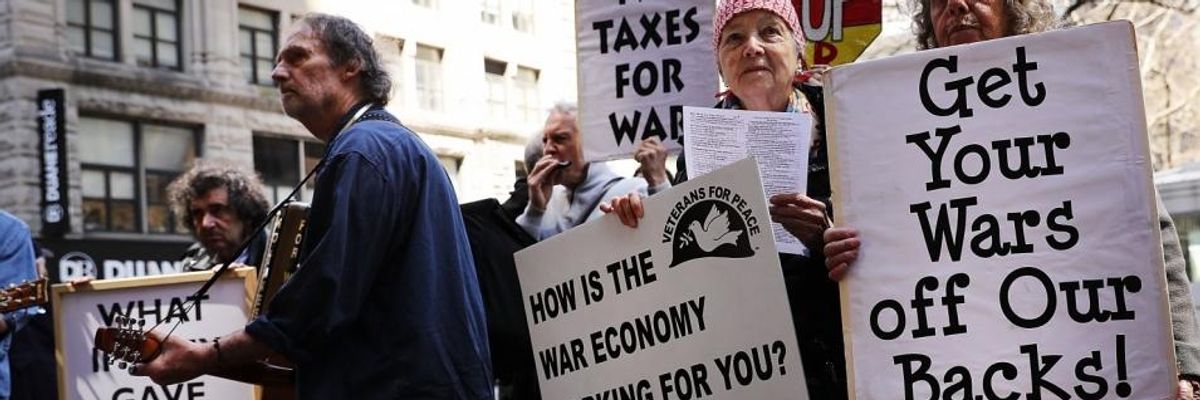
"In America, the horrors of poverty go on and on." (Photo: Spencer Platt/Getty Images)
It's so easy to paper over the real American security void with verbiage about strength vs. weakness and the endless need to upgrade the military.
Here's Secretary of Defense Jim Mattis, for instance, quoted the other day in The Guardian: "It is incumbent upon us to field a more lethal force if our nation is to retain the ability to defend ourselves and what we stand for."
This is the cornerstone of The Great Lie, the foundation of global suffering and disorder: that all the glorious abstractions for which we stand -- freedom, democracy, etc. -- are maintained by violence and the threat of violence. The strength of evil, see, is almost infinite, and it lurks uncontained beyond our borders, but it stays away from us as long as it fears us. Therefore, do not, under any circumstances, question the size of our military budget.
This is the directive followed by much of the U.S. media, even as that budget continues to swell and the wars we wage grow ever more intractable. Indeed, the Trump administration's recently released 2019 budget proposal includes $716 billion for the military. Think of it as a quiet hemorrhage. Mattis, this time referenced by the Associated Press, says it's needed "to pull the military out of a slump in combat readiness at a time of renewed focus on the stalemated conflict in Afghanistan and the threat of war on the Korean peninsula."
Don't ask any further questions. Blame domestic spending -- on schools, healthcare, highways, food stamps, environmental cleanup -- for the national deficit. And above all, don't look too closely at the dying empire the U.S. military continues to "defend." If you do, you might conclude it's not doing such a great job ensuring the nation's security.
"The United States is one of the world's richest and most powerful and technologically innovative countries; but neither its wealth nor its power nor its technology is being harnessed to address the situation in which 40 million people continue to live in poverty."
So Philip Alston, the United Nations special rapporteur on extreme poverty and human rights, wrote in December after a 10-day tour of poverty zones across a wide swath of the United States, from California to Puerto Rico. The points he makes in his U.N. report are excruciating to read, illuminating, as they do, the Fourth World poverty in this nation that is hidden in plain sight. To wit:
"US healthcare expenditures per capita are double the OECD (Organization for Economic Cooperation and Development) average and much higher than in all other countries. But there are many fewer doctors and hospital beds per person than the OECD average.
"US infant mortality rates in 2013 were the highest in the developed world.
"America has the highest incarceration rate in the world, ahead of Turkmenistan, El Salvador, Cuba, Thailand and the Russian Federation. Its rate is nearly five times the OECD average."
This is just a small portion of Alston's observations, which included such horrors as unsafe drinking water, inadequate sanitation facilities ("I saw sewage-filled yards in states where governments don't consider sanitation facilities to be their responsibility") and broke, desperate municipal governments meeting their budgets by trapping poor people in endless debt through the doubling and redoubling of fines for minor infractions.
In America, the horrors of poverty go on and on. The solution for some -- especially those in positions of power -- is simply to close their eyes to it. How quickly it goes away when it doesn't affect you.
"When our nation can't manage to turn the lights on for the people of Puerto Rico, when we can't help those suffering from opioid addiction get treatment, and when we can't ensure education and healthcare to all of our citizens, how is it possible we can justify spending billions more on weapons that don't work to fight enemies that don't exist?" asked Stephen Miles of Win Without War.
The questions raised by America's Fourth World poverty should never, ever be separated from the discussion of war and the military budget. And high-ranking politicians should never be permitted by the free press to wallow in abstract rhetoric about "our values" as they seek to justify war -- especially the current, endless wars, which, as they steal resources from the home front, keep worsening the quagmires they've created across the planet.
In our fear of facing what we've created, oh Lord, we continue to make things worse. It's called bipartisanship. In the current state of American politics, the best we can get from our allegedly democratic government is a compromise with hell: social bandages plus nuclear weapons.
I blame the media for this, because the only way to move beyond illusion and fear is to embark on a journey of complex awareness. Instead, Americans get simplistic analyses that fail to penetrate the Great Lie, that evil is somehow un-American, a force wielded by foreigners. For instance, in another recent AP story that addressed the Trump budget proposal, the framing, of course, was that deficit-spending was its biggest problem, appalling some Republicans but not all of them.
"But many other Republicans pointed to money they have long sought for the Pentagon, which they say needs huge sums for readiness, training and weapons modernization," the story tells us.
Then Paul Ryan is quoted: "It provides what the Pentagon needs to restore our military's edge for years to come."
So relax. Even if we're dying as a nation, we're still tougher than anybody else.
Dear Common Dreams reader, It’s been nearly 30 years since I co-founded Common Dreams with my late wife, Lina Newhouser. We had the radical notion that journalism should serve the public good, not corporate profits. It was clear to us from the outset what it would take to build such a project. No paid advertisements. No corporate sponsors. No millionaire publisher telling us what to think or do. Many people said we wouldn't last a year, but we proved those doubters wrong. Together with a tremendous team of journalists and dedicated staff, we built an independent media outlet free from the constraints of profits and corporate control. Our mission has always been simple: To inform. To inspire. To ignite change for the common good. Building Common Dreams was not easy. Our survival was never guaranteed. When you take on the most powerful forces—Wall Street greed, fossil fuel industry destruction, Big Tech lobbyists, and uber-rich oligarchs who have spent billions upon billions rigging the economy and democracy in their favor—the only bulwark you have is supporters who believe in your work. But here’s the urgent message from me today. It's never been this bad out there. And it's never been this hard to keep us going. At the very moment Common Dreams is most needed, the threats we face are intensifying. We need your support now more than ever. We don't accept corporate advertising and never will. We don't have a paywall because we don't think people should be blocked from critical news based on their ability to pay. Everything we do is funded by the donations of readers like you. When everyone does the little they can afford, we are strong. But if that support retreats or dries up, so do we. Will you donate now to make sure Common Dreams not only survives but thrives? —Craig Brown, Co-founder |
It's so easy to paper over the real American security void with verbiage about strength vs. weakness and the endless need to upgrade the military.
Here's Secretary of Defense Jim Mattis, for instance, quoted the other day in The Guardian: "It is incumbent upon us to field a more lethal force if our nation is to retain the ability to defend ourselves and what we stand for."
This is the cornerstone of The Great Lie, the foundation of global suffering and disorder: that all the glorious abstractions for which we stand -- freedom, democracy, etc. -- are maintained by violence and the threat of violence. The strength of evil, see, is almost infinite, and it lurks uncontained beyond our borders, but it stays away from us as long as it fears us. Therefore, do not, under any circumstances, question the size of our military budget.
This is the directive followed by much of the U.S. media, even as that budget continues to swell and the wars we wage grow ever more intractable. Indeed, the Trump administration's recently released 2019 budget proposal includes $716 billion for the military. Think of it as a quiet hemorrhage. Mattis, this time referenced by the Associated Press, says it's needed "to pull the military out of a slump in combat readiness at a time of renewed focus on the stalemated conflict in Afghanistan and the threat of war on the Korean peninsula."
Don't ask any further questions. Blame domestic spending -- on schools, healthcare, highways, food stamps, environmental cleanup -- for the national deficit. And above all, don't look too closely at the dying empire the U.S. military continues to "defend." If you do, you might conclude it's not doing such a great job ensuring the nation's security.
"The United States is one of the world's richest and most powerful and technologically innovative countries; but neither its wealth nor its power nor its technology is being harnessed to address the situation in which 40 million people continue to live in poverty."
So Philip Alston, the United Nations special rapporteur on extreme poverty and human rights, wrote in December after a 10-day tour of poverty zones across a wide swath of the United States, from California to Puerto Rico. The points he makes in his U.N. report are excruciating to read, illuminating, as they do, the Fourth World poverty in this nation that is hidden in plain sight. To wit:
"US healthcare expenditures per capita are double the OECD (Organization for Economic Cooperation and Development) average and much higher than in all other countries. But there are many fewer doctors and hospital beds per person than the OECD average.
"US infant mortality rates in 2013 were the highest in the developed world.
"America has the highest incarceration rate in the world, ahead of Turkmenistan, El Salvador, Cuba, Thailand and the Russian Federation. Its rate is nearly five times the OECD average."
This is just a small portion of Alston's observations, which included such horrors as unsafe drinking water, inadequate sanitation facilities ("I saw sewage-filled yards in states where governments don't consider sanitation facilities to be their responsibility") and broke, desperate municipal governments meeting their budgets by trapping poor people in endless debt through the doubling and redoubling of fines for minor infractions.
In America, the horrors of poverty go on and on. The solution for some -- especially those in positions of power -- is simply to close their eyes to it. How quickly it goes away when it doesn't affect you.
"When our nation can't manage to turn the lights on for the people of Puerto Rico, when we can't help those suffering from opioid addiction get treatment, and when we can't ensure education and healthcare to all of our citizens, how is it possible we can justify spending billions more on weapons that don't work to fight enemies that don't exist?" asked Stephen Miles of Win Without War.
The questions raised by America's Fourth World poverty should never, ever be separated from the discussion of war and the military budget. And high-ranking politicians should never be permitted by the free press to wallow in abstract rhetoric about "our values" as they seek to justify war -- especially the current, endless wars, which, as they steal resources from the home front, keep worsening the quagmires they've created across the planet.
In our fear of facing what we've created, oh Lord, we continue to make things worse. It's called bipartisanship. In the current state of American politics, the best we can get from our allegedly democratic government is a compromise with hell: social bandages plus nuclear weapons.
I blame the media for this, because the only way to move beyond illusion and fear is to embark on a journey of complex awareness. Instead, Americans get simplistic analyses that fail to penetrate the Great Lie, that evil is somehow un-American, a force wielded by foreigners. For instance, in another recent AP story that addressed the Trump budget proposal, the framing, of course, was that deficit-spending was its biggest problem, appalling some Republicans but not all of them.
"But many other Republicans pointed to money they have long sought for the Pentagon, which they say needs huge sums for readiness, training and weapons modernization," the story tells us.
Then Paul Ryan is quoted: "It provides what the Pentagon needs to restore our military's edge for years to come."
So relax. Even if we're dying as a nation, we're still tougher than anybody else.
It's so easy to paper over the real American security void with verbiage about strength vs. weakness and the endless need to upgrade the military.
Here's Secretary of Defense Jim Mattis, for instance, quoted the other day in The Guardian: "It is incumbent upon us to field a more lethal force if our nation is to retain the ability to defend ourselves and what we stand for."
This is the cornerstone of The Great Lie, the foundation of global suffering and disorder: that all the glorious abstractions for which we stand -- freedom, democracy, etc. -- are maintained by violence and the threat of violence. The strength of evil, see, is almost infinite, and it lurks uncontained beyond our borders, but it stays away from us as long as it fears us. Therefore, do not, under any circumstances, question the size of our military budget.
This is the directive followed by much of the U.S. media, even as that budget continues to swell and the wars we wage grow ever more intractable. Indeed, the Trump administration's recently released 2019 budget proposal includes $716 billion for the military. Think of it as a quiet hemorrhage. Mattis, this time referenced by the Associated Press, says it's needed "to pull the military out of a slump in combat readiness at a time of renewed focus on the stalemated conflict in Afghanistan and the threat of war on the Korean peninsula."
Don't ask any further questions. Blame domestic spending -- on schools, healthcare, highways, food stamps, environmental cleanup -- for the national deficit. And above all, don't look too closely at the dying empire the U.S. military continues to "defend." If you do, you might conclude it's not doing such a great job ensuring the nation's security.
"The United States is one of the world's richest and most powerful and technologically innovative countries; but neither its wealth nor its power nor its technology is being harnessed to address the situation in which 40 million people continue to live in poverty."
So Philip Alston, the United Nations special rapporteur on extreme poverty and human rights, wrote in December after a 10-day tour of poverty zones across a wide swath of the United States, from California to Puerto Rico. The points he makes in his U.N. report are excruciating to read, illuminating, as they do, the Fourth World poverty in this nation that is hidden in plain sight. To wit:
"US healthcare expenditures per capita are double the OECD (Organization for Economic Cooperation and Development) average and much higher than in all other countries. But there are many fewer doctors and hospital beds per person than the OECD average.
"US infant mortality rates in 2013 were the highest in the developed world.
"America has the highest incarceration rate in the world, ahead of Turkmenistan, El Salvador, Cuba, Thailand and the Russian Federation. Its rate is nearly five times the OECD average."
This is just a small portion of Alston's observations, which included such horrors as unsafe drinking water, inadequate sanitation facilities ("I saw sewage-filled yards in states where governments don't consider sanitation facilities to be their responsibility") and broke, desperate municipal governments meeting their budgets by trapping poor people in endless debt through the doubling and redoubling of fines for minor infractions.
In America, the horrors of poverty go on and on. The solution for some -- especially those in positions of power -- is simply to close their eyes to it. How quickly it goes away when it doesn't affect you.
"When our nation can't manage to turn the lights on for the people of Puerto Rico, when we can't help those suffering from opioid addiction get treatment, and when we can't ensure education and healthcare to all of our citizens, how is it possible we can justify spending billions more on weapons that don't work to fight enemies that don't exist?" asked Stephen Miles of Win Without War.
The questions raised by America's Fourth World poverty should never, ever be separated from the discussion of war and the military budget. And high-ranking politicians should never be permitted by the free press to wallow in abstract rhetoric about "our values" as they seek to justify war -- especially the current, endless wars, which, as they steal resources from the home front, keep worsening the quagmires they've created across the planet.
In our fear of facing what we've created, oh Lord, we continue to make things worse. It's called bipartisanship. In the current state of American politics, the best we can get from our allegedly democratic government is a compromise with hell: social bandages plus nuclear weapons.
I blame the media for this, because the only way to move beyond illusion and fear is to embark on a journey of complex awareness. Instead, Americans get simplistic analyses that fail to penetrate the Great Lie, that evil is somehow un-American, a force wielded by foreigners. For instance, in another recent AP story that addressed the Trump budget proposal, the framing, of course, was that deficit-spending was its biggest problem, appalling some Republicans but not all of them.
"But many other Republicans pointed to money they have long sought for the Pentagon, which they say needs huge sums for readiness, training and weapons modernization," the story tells us.
Then Paul Ryan is quoted: "It provides what the Pentagon needs to restore our military's edge for years to come."
So relax. Even if we're dying as a nation, we're still tougher than anybody else.