
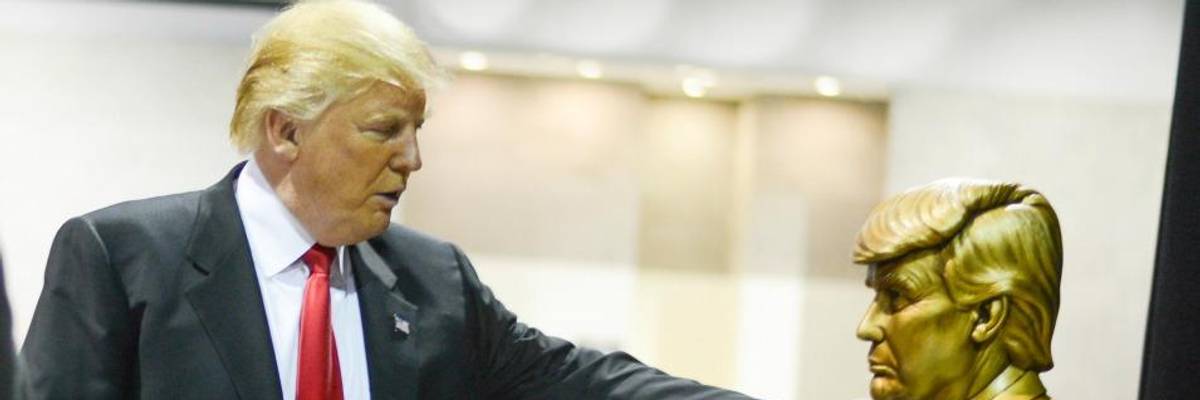
Every day through January 29, Public Citizen will announce nominations in a category and invite Twitter voting to select the worst of the worst. We'll announce the losers (winners) on January 30, the day of the State of the Union. The begin Monday with nominations for the Trumpy for the Worst Corrupting Conflict of Interest.
Announcing the Trumpys!
Finally, an award ready to recognize the worst elements of what is likely to go down as the worst presidency in American history
The Golden Globes and Screen Actors Guild Awards have been bestowed and Academy Award nominations will be announced tomorrow. And, of course, President Donald Trump last week conferred his Fake News Awards.
Now it's our turn to weigh in, with the Trumpys, recognizing the worst elements of what is likely to go down as the worst presidency in American history.
"Trump's refusal to divest his business interests is one of the defining features of his presidency, creating direct conflicts for the president relating to a wide swath of issues, signaling his utter disregard for ethical norms, and creating a climate in which governmental corruption is normalized."
Every day through January 29, we'll announce nominations in a category and invite Twitter voting to select the worst of the worst. We'll announce the losers (winners) on January 30, the day of the State of the Union.
We begin today with nominations for the Trumpy for the Worst Corrupting Conflict of Interest.
Trump's refusal to divest his business interests is one of the defining features of his presidency, creating direct conflicts for the president relating to a wide swath of issues, signaling his utter disregard for ethical norms, and creating a climate in which governmental corruption is normalized. Against this backdrop, it's no surprise that the contest for Worst Corrupting Conflict of Interest is so intense.
And the nominees are:
Carl Icahn: Refining the Meaning of Conflict. There's a reason that Carl Icahn was a model for the Gordon Gekko character who famously stated that "greed is good." Appointed by President Trump to the made-up position of "special adviser to the president of the United States on regulatory reform," Icahn tried to use the position to force a change in ethanol rules that would save an oil refinery he owned $200 million annually. Icahn didn't bother to deny his self-interest: "I own a refinery. Who knows it better than me? Why shouldn't I advocate?" he told Bloomberg. The prospect of winning his desired change to ethanol rules boosted the value of his stock by hundreds of millions of dollars, but his scheme collapsed under public scrutiny and with opposition from Big Oil. Afterwards, he quickly abandoned his "special advisor" position.
Jared Kushner and the Middle East: Like Father, Like Son-in-Law. Like the president, Jared Kushner has put most of his financial holdings in trust - but has not divested. Those financial holdings create a multitude of conflicts, including especially as regards his role in setting U.S. policy related to the Middle East. As the New York Times notes: "Even as Mr. Kushner's company maintains extensive business ties to Israel, as a top White House adviser, he has been charged with leading American efforts to broker peace in the Middle East as part of his broad global portfolio." And the family business ties with Israeli businesses are deepening, even while Kushner serves in the White House and engineers a major reorientation of U.S. Middle East policy.
Scott Pruitt and Dow Chemical: Conflicts on the Brain. At the U.S. Environmental Protection Agency (EPA), Scott Pruitt is enabling polluters in countless ways (the subject of its own Trumpy award; stay tuned), but his gift to Dow Chemical is particularly pernicious. Under President Barack Obama, the EPA proposed to ban a brain-damaging pesticide sold by Dow Chemical. Pruitt reversed the decision. Did it matter that Dow Chemical contributed $1 million to Trump's inauguration or that its CEO met with Trump five times? You decide.
The Tax Scam: Tax Cuts for Trump and the Cabinet. A superrich cabinet designed and helped ram through Congress a tax bill that will transfer more than a trillion dollars ... to the superrich and the corporate class. Among notable features, the bill doubles the amount exempt from the estate tax, a huge boon for Trump and his billionaire cabinet. The pass-through provisions will confer enormous benefits on Trump himself, lowering the tax rate he pays on his business operations; a last-minute change to the bill made the deal even more generous for Trump. "This is going to cost me a fortune," Trump said untruthfully. But he revealed the reality at a gathering at Mar-a-Lago: "You all just got a lot richer," he told his rich friends.
The Trump International Hotel in Washington, D.C. and Mar-a-Lago: The President Cashes In. The Trump International Hotel in D.C. is in Washington's historic Old Post Office, and is leased from the government. That lease by its plain terms prohibits the lessee from holding elected office, but with Trump now on both sides of the deal, it's going unenforced. Meanwhile, the hotel has become a go-to venue for foreign governments, including Saudi Arabia, political campaigns and industry groups - from the National Mining Association to the national candy association - to hold events and curry favor with the president. "Why wouldn't I stay at his hotel blocks from the White House, so I can tell the new president, 'I love your new hotel!' Isn't it rude to come to his city and say, 'I am staying at your competitor?'" one Asian diplomat told the Washington Post. Meanwhile, Mar-a-Lago has doubled its initiation fees - but offers direct access to the president.
Which corrupting conflict is the worst? Vote here.
An Urgent Message From Our Co-Founder
Dear Common Dreams reader, It’s been nearly 30 years since I co-founded Common Dreams with my late wife, Lina Newhouser. We had the radical notion that journalism should serve the public good, not corporate profits. It was clear to us from the outset what it would take to build such a project. No paid advertisements. No corporate sponsors. No millionaire publisher telling us what to think or do. Many people said we wouldn't last a year, but we proved those doubters wrong. Together with a tremendous team of journalists and dedicated staff, we built an independent media outlet free from the constraints of profits and corporate control. Our mission has always been simple: To inform. To inspire. To ignite change for the common good. Building Common Dreams was not easy. Our survival was never guaranteed. When you take on the most powerful forces—Wall Street greed, fossil fuel industry destruction, Big Tech lobbyists, and uber-rich oligarchs who have spent billions upon billions rigging the economy and democracy in their favor—the only bulwark you have is supporters who believe in your work. But here’s the urgent message from me today. It's never been this bad out there. And it's never been this hard to keep us going. At the very moment Common Dreams is most needed, the threats we face are intensifying. We need your support now more than ever. We don't accept corporate advertising and never will. We don't have a paywall because we don't think people should be blocked from critical news based on their ability to pay. Everything we do is funded by the donations of readers like you. When everyone does the little they can afford, we are strong. But if that support retreats or dries up, so do we. Will you donate now to make sure Common Dreams not only survives but thrives? —Craig Brown, Co-founder |
The Golden Globes and Screen Actors Guild Awards have been bestowed and Academy Award nominations will be announced tomorrow. And, of course, President Donald Trump last week conferred his Fake News Awards.
Now it's our turn to weigh in, with the Trumpys, recognizing the worst elements of what is likely to go down as the worst presidency in American history.
"Trump's refusal to divest his business interests is one of the defining features of his presidency, creating direct conflicts for the president relating to a wide swath of issues, signaling his utter disregard for ethical norms, and creating a climate in which governmental corruption is normalized."
Every day through January 29, we'll announce nominations in a category and invite Twitter voting to select the worst of the worst. We'll announce the losers (winners) on January 30, the day of the State of the Union.
We begin today with nominations for the Trumpy for the Worst Corrupting Conflict of Interest.
Trump's refusal to divest his business interests is one of the defining features of his presidency, creating direct conflicts for the president relating to a wide swath of issues, signaling his utter disregard for ethical norms, and creating a climate in which governmental corruption is normalized. Against this backdrop, it's no surprise that the contest for Worst Corrupting Conflict of Interest is so intense.
And the nominees are:
Carl Icahn: Refining the Meaning of Conflict. There's a reason that Carl Icahn was a model for the Gordon Gekko character who famously stated that "greed is good." Appointed by President Trump to the made-up position of "special adviser to the president of the United States on regulatory reform," Icahn tried to use the position to force a change in ethanol rules that would save an oil refinery he owned $200 million annually. Icahn didn't bother to deny his self-interest: "I own a refinery. Who knows it better than me? Why shouldn't I advocate?" he told Bloomberg. The prospect of winning his desired change to ethanol rules boosted the value of his stock by hundreds of millions of dollars, but his scheme collapsed under public scrutiny and with opposition from Big Oil. Afterwards, he quickly abandoned his "special advisor" position.
Jared Kushner and the Middle East: Like Father, Like Son-in-Law. Like the president, Jared Kushner has put most of his financial holdings in trust - but has not divested. Those financial holdings create a multitude of conflicts, including especially as regards his role in setting U.S. policy related to the Middle East. As the New York Times notes: "Even as Mr. Kushner's company maintains extensive business ties to Israel, as a top White House adviser, he has been charged with leading American efforts to broker peace in the Middle East as part of his broad global portfolio." And the family business ties with Israeli businesses are deepening, even while Kushner serves in the White House and engineers a major reorientation of U.S. Middle East policy.
Scott Pruitt and Dow Chemical: Conflicts on the Brain. At the U.S. Environmental Protection Agency (EPA), Scott Pruitt is enabling polluters in countless ways (the subject of its own Trumpy award; stay tuned), but his gift to Dow Chemical is particularly pernicious. Under President Barack Obama, the EPA proposed to ban a brain-damaging pesticide sold by Dow Chemical. Pruitt reversed the decision. Did it matter that Dow Chemical contributed $1 million to Trump's inauguration or that its CEO met with Trump five times? You decide.
The Tax Scam: Tax Cuts for Trump and the Cabinet. A superrich cabinet designed and helped ram through Congress a tax bill that will transfer more than a trillion dollars ... to the superrich and the corporate class. Among notable features, the bill doubles the amount exempt from the estate tax, a huge boon for Trump and his billionaire cabinet. The pass-through provisions will confer enormous benefits on Trump himself, lowering the tax rate he pays on his business operations; a last-minute change to the bill made the deal even more generous for Trump. "This is going to cost me a fortune," Trump said untruthfully. But he revealed the reality at a gathering at Mar-a-Lago: "You all just got a lot richer," he told his rich friends.
The Trump International Hotel in Washington, D.C. and Mar-a-Lago: The President Cashes In. The Trump International Hotel in D.C. is in Washington's historic Old Post Office, and is leased from the government. That lease by its plain terms prohibits the lessee from holding elected office, but with Trump now on both sides of the deal, it's going unenforced. Meanwhile, the hotel has become a go-to venue for foreign governments, including Saudi Arabia, political campaigns and industry groups - from the National Mining Association to the national candy association - to hold events and curry favor with the president. "Why wouldn't I stay at his hotel blocks from the White House, so I can tell the new president, 'I love your new hotel!' Isn't it rude to come to his city and say, 'I am staying at your competitor?'" one Asian diplomat told the Washington Post. Meanwhile, Mar-a-Lago has doubled its initiation fees - but offers direct access to the president.
Which corrupting conflict is the worst? Vote here.
The Golden Globes and Screen Actors Guild Awards have been bestowed and Academy Award nominations will be announced tomorrow. And, of course, President Donald Trump last week conferred his Fake News Awards.
Now it's our turn to weigh in, with the Trumpys, recognizing the worst elements of what is likely to go down as the worst presidency in American history.
"Trump's refusal to divest his business interests is one of the defining features of his presidency, creating direct conflicts for the president relating to a wide swath of issues, signaling his utter disregard for ethical norms, and creating a climate in which governmental corruption is normalized."
Every day through January 29, we'll announce nominations in a category and invite Twitter voting to select the worst of the worst. We'll announce the losers (winners) on January 30, the day of the State of the Union.
We begin today with nominations for the Trumpy for the Worst Corrupting Conflict of Interest.
Trump's refusal to divest his business interests is one of the defining features of his presidency, creating direct conflicts for the president relating to a wide swath of issues, signaling his utter disregard for ethical norms, and creating a climate in which governmental corruption is normalized. Against this backdrop, it's no surprise that the contest for Worst Corrupting Conflict of Interest is so intense.
And the nominees are:
Carl Icahn: Refining the Meaning of Conflict. There's a reason that Carl Icahn was a model for the Gordon Gekko character who famously stated that "greed is good." Appointed by President Trump to the made-up position of "special adviser to the president of the United States on regulatory reform," Icahn tried to use the position to force a change in ethanol rules that would save an oil refinery he owned $200 million annually. Icahn didn't bother to deny his self-interest: "I own a refinery. Who knows it better than me? Why shouldn't I advocate?" he told Bloomberg. The prospect of winning his desired change to ethanol rules boosted the value of his stock by hundreds of millions of dollars, but his scheme collapsed under public scrutiny and with opposition from Big Oil. Afterwards, he quickly abandoned his "special advisor" position.
Jared Kushner and the Middle East: Like Father, Like Son-in-Law. Like the president, Jared Kushner has put most of his financial holdings in trust - but has not divested. Those financial holdings create a multitude of conflicts, including especially as regards his role in setting U.S. policy related to the Middle East. As the New York Times notes: "Even as Mr. Kushner's company maintains extensive business ties to Israel, as a top White House adviser, he has been charged with leading American efforts to broker peace in the Middle East as part of his broad global portfolio." And the family business ties with Israeli businesses are deepening, even while Kushner serves in the White House and engineers a major reorientation of U.S. Middle East policy.
Scott Pruitt and Dow Chemical: Conflicts on the Brain. At the U.S. Environmental Protection Agency (EPA), Scott Pruitt is enabling polluters in countless ways (the subject of its own Trumpy award; stay tuned), but his gift to Dow Chemical is particularly pernicious. Under President Barack Obama, the EPA proposed to ban a brain-damaging pesticide sold by Dow Chemical. Pruitt reversed the decision. Did it matter that Dow Chemical contributed $1 million to Trump's inauguration or that its CEO met with Trump five times? You decide.
The Tax Scam: Tax Cuts for Trump and the Cabinet. A superrich cabinet designed and helped ram through Congress a tax bill that will transfer more than a trillion dollars ... to the superrich and the corporate class. Among notable features, the bill doubles the amount exempt from the estate tax, a huge boon for Trump and his billionaire cabinet. The pass-through provisions will confer enormous benefits on Trump himself, lowering the tax rate he pays on his business operations; a last-minute change to the bill made the deal even more generous for Trump. "This is going to cost me a fortune," Trump said untruthfully. But he revealed the reality at a gathering at Mar-a-Lago: "You all just got a lot richer," he told his rich friends.
The Trump International Hotel in Washington, D.C. and Mar-a-Lago: The President Cashes In. The Trump International Hotel in D.C. is in Washington's historic Old Post Office, and is leased from the government. That lease by its plain terms prohibits the lessee from holding elected office, but with Trump now on both sides of the deal, it's going unenforced. Meanwhile, the hotel has become a go-to venue for foreign governments, including Saudi Arabia, political campaigns and industry groups - from the National Mining Association to the national candy association - to hold events and curry favor with the president. "Why wouldn't I stay at his hotel blocks from the White House, so I can tell the new president, 'I love your new hotel!' Isn't it rude to come to his city and say, 'I am staying at your competitor?'" one Asian diplomat told the Washington Post. Meanwhile, Mar-a-Lago has doubled its initiation fees - but offers direct access to the president.
Which corrupting conflict is the worst? Vote here.