"Instead of a poster child for the small-government theories championed by economist Arthur Laffer, tax reform activist Grover Norquist and the rest of the Republican Party, Kansas has become a cautionary tale about what happens when you expose their economic ideas to sunlight."
Kansas' Tax Cuts Are a Spectacular Failure. Meanwhile, in California
Republican legislators in Kansas did the unthinkable this month: They voted to raise income taxes, ending a painful five-year experiment with an extreme anti-tax agenda introduced by Republican Gov. Sam Brownback. The Republican-held Legislature had to override a veto by the governor to pass the emergency tax increase, now crucial to prevent deep budget cuts for schools and other essential public services.
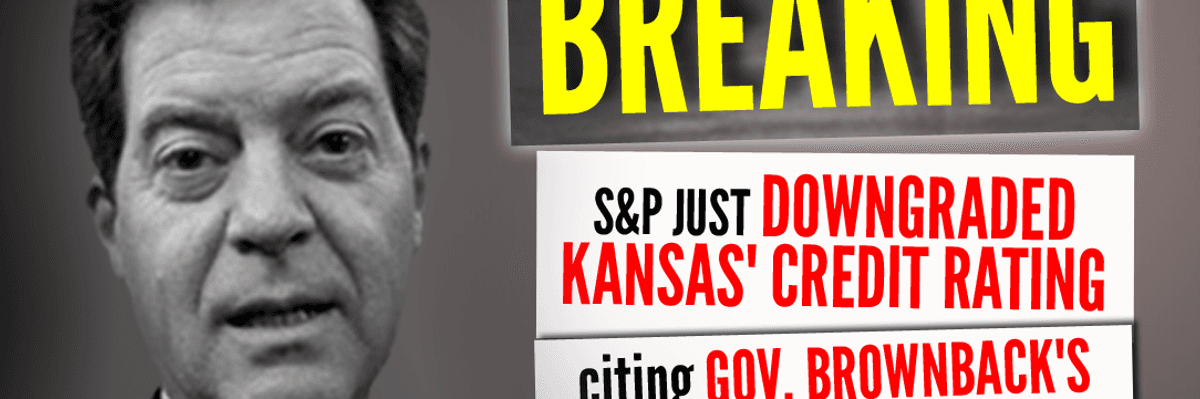
Kansas embarked on its trickle-down experiment in 2012. Brownback slashed taxes across the board, calling his plan "a shot of adrenaline into the heart of the Kansas economy." Five years later, the state's economy is on life support, and government expenses are expected to outpace income by $1.1 billion through June 2019. Instead of a poster child for the small-government theories championed by economist Arthur Laffer, tax reform activist Grover Norquist and the rest of the Republican Party, Kansas has become a cautionary tale about what happens when you expose their economic ideas to sunlight.
Meanwhile, a state that Republicans love to mock - California - has done just the opposite. In November of 2012, the same year Kansas plunged into its tax-slashing experiment, more than 54% of California voters approved Proposition 30, a measure that temporarily raised income taxes for the state's wealthiest residents and increased the sales tax in order to fund schools and pay down debt. The tax hikes helped California erase $27 billion in debt, and the state has since enjoyed some of the strongest economic growth in the country. (Of course that growth isn't due to tax hikes alone; the state has a robust tech sector, among other factors.)
If states can indeed serve as laboratories of democracy, as Supreme Court Justice Louis Brandeis suggested, there's no question which state embarked on the more successful test.
Brownback was elected in 2010 on the usual Republican promises to slash taxes and boost growth. Though Kansas' income tax rates were already low, Brownback cut them further. Along with the Republican Legislature, he also got rid of taxes for most owner-operated businesses. These steep reductions were accompanied by cruel cuts to public services that hurt the poorest and most vulnerable.
Predictably, wealthy corporate interests such as the Wichita-based Koch Industries - one of Brownback's largest campaign donors - did fine under this scheme, while working families took a beating. In time, Kansas' budget tanked, funding for higher education was slashed, businesses began to flee the state, and Brownback earned the distinction of "most unpopular governor in America." (He has since lost the title to New Jersey Gov. Chris Christie.)
As Brownback was instituting his signature tax cuts, Republicans and conservative media organs were savagely attacking Proposition 30 and predicting imminent doom for California if it passed. Instead, California's job growth has consistently outpaced that of other states, its credit outlook rating has been repeatedly upgraded, and funding for the state's schools has increased. Voters liked all this fiscal stability so much that, last year, they voted to extend some of the taxes. Over the same period, Gov. Jerry Brown and state legislators have enjoyed record-high poll numbers.
Brown put California back on track with tax increases, in other words, while Brownback's "real live experiment" with unprecedented tax cuts knocked Kansas off the rails. And how does the Republican Party respond to this massive failure? By doubling down on their destructive obsession with tax giveaways for the wealthy, of course. President Trump's tax plan is modeled on the Kansas experiment - and Republicans in Congress can't wait to enact it.
Why do Republicans want to replicate Kansas' failure on a national scale? There's the rub. If your goal is to enrich billionaires and millionaires in the short-term, Kansas is not a failure. If your metric of success is whether taxes are decreased for the rich, Kansas is a big success.
The Republicans' zeal to duplicate the Kansas disaster for the whole country proves that they'll stop at nothing to stack wealth and power in the hands of the few. They'll take healthcare away from millions of Americans. They'll even drive the economy off a cliff.
The Kansas experiment is a failure only if you care about what happens to American workers and their families. Clearly, Republicans don't.
An Urgent Message From Our Co-Founder
Dear Common Dreams reader, It’s been nearly 30 years since I co-founded Common Dreams with my late wife, Lina Newhouser. We had the radical notion that journalism should serve the public good, not corporate profits. It was clear to us from the outset what it would take to build such a project. No paid advertisements. No corporate sponsors. No millionaire publisher telling us what to think or do. Many people said we wouldn't last a year, but we proved those doubters wrong. Together with a tremendous team of journalists and dedicated staff, we built an independent media outlet free from the constraints of profits and corporate control. Our mission has always been simple: To inform. To inspire. To ignite change for the common good. Building Common Dreams was not easy. Our survival was never guaranteed. When you take on the most powerful forces—Wall Street greed, fossil fuel industry destruction, Big Tech lobbyists, and uber-rich oligarchs who have spent billions upon billions rigging the economy and democracy in their favor—the only bulwark you have is supporters who believe in your work. But here’s the urgent message from me today. It's never been this bad out there. And it's never been this hard to keep us going. At the very moment Common Dreams is most needed, the threats we face are intensifying. We need your support now more than ever. We don't accept corporate advertising and never will. We don't have a paywall because we don't think people should be blocked from critical news based on their ability to pay. Everything we do is funded by the donations of readers like you. When everyone does the little they can afford, we are strong. But if that support retreats or dries up, so do we. Will you donate now to make sure Common Dreams not only survives but thrives? —Craig Brown, Co-founder |
Republican legislators in Kansas did the unthinkable this month: They voted to raise income taxes, ending a painful five-year experiment with an extreme anti-tax agenda introduced by Republican Gov. Sam Brownback. The Republican-held Legislature had to override a veto by the governor to pass the emergency tax increase, now crucial to prevent deep budget cuts for schools and other essential public services.
Kansas embarked on its trickle-down experiment in 2012. Brownback slashed taxes across the board, calling his plan "a shot of adrenaline into the heart of the Kansas economy." Five years later, the state's economy is on life support, and government expenses are expected to outpace income by $1.1 billion through June 2019. Instead of a poster child for the small-government theories championed by economist Arthur Laffer, tax reform activist Grover Norquist and the rest of the Republican Party, Kansas has become a cautionary tale about what happens when you expose their economic ideas to sunlight.
Meanwhile, a state that Republicans love to mock - California - has done just the opposite. In November of 2012, the same year Kansas plunged into its tax-slashing experiment, more than 54% of California voters approved Proposition 30, a measure that temporarily raised income taxes for the state's wealthiest residents and increased the sales tax in order to fund schools and pay down debt. The tax hikes helped California erase $27 billion in debt, and the state has since enjoyed some of the strongest economic growth in the country. (Of course that growth isn't due to tax hikes alone; the state has a robust tech sector, among other factors.)
If states can indeed serve as laboratories of democracy, as Supreme Court Justice Louis Brandeis suggested, there's no question which state embarked on the more successful test.
Brownback was elected in 2010 on the usual Republican promises to slash taxes and boost growth. Though Kansas' income tax rates were already low, Brownback cut them further. Along with the Republican Legislature, he also got rid of taxes for most owner-operated businesses. These steep reductions were accompanied by cruel cuts to public services that hurt the poorest and most vulnerable.
Predictably, wealthy corporate interests such as the Wichita-based Koch Industries - one of Brownback's largest campaign donors - did fine under this scheme, while working families took a beating. In time, Kansas' budget tanked, funding for higher education was slashed, businesses began to flee the state, and Brownback earned the distinction of "most unpopular governor in America." (He has since lost the title to New Jersey Gov. Chris Christie.)
As Brownback was instituting his signature tax cuts, Republicans and conservative media organs were savagely attacking Proposition 30 and predicting imminent doom for California if it passed. Instead, California's job growth has consistently outpaced that of other states, its credit outlook rating has been repeatedly upgraded, and funding for the state's schools has increased. Voters liked all this fiscal stability so much that, last year, they voted to extend some of the taxes. Over the same period, Gov. Jerry Brown and state legislators have enjoyed record-high poll numbers.
Brown put California back on track with tax increases, in other words, while Brownback's "real live experiment" with unprecedented tax cuts knocked Kansas off the rails. And how does the Republican Party respond to this massive failure? By doubling down on their destructive obsession with tax giveaways for the wealthy, of course. President Trump's tax plan is modeled on the Kansas experiment - and Republicans in Congress can't wait to enact it.
Why do Republicans want to replicate Kansas' failure on a national scale? There's the rub. If your goal is to enrich billionaires and millionaires in the short-term, Kansas is not a failure. If your metric of success is whether taxes are decreased for the rich, Kansas is a big success.
The Republicans' zeal to duplicate the Kansas disaster for the whole country proves that they'll stop at nothing to stack wealth and power in the hands of the few. They'll take healthcare away from millions of Americans. They'll even drive the economy off a cliff.
The Kansas experiment is a failure only if you care about what happens to American workers and their families. Clearly, Republicans don't.
Republican legislators in Kansas did the unthinkable this month: They voted to raise income taxes, ending a painful five-year experiment with an extreme anti-tax agenda introduced by Republican Gov. Sam Brownback. The Republican-held Legislature had to override a veto by the governor to pass the emergency tax increase, now crucial to prevent deep budget cuts for schools and other essential public services.
Kansas embarked on its trickle-down experiment in 2012. Brownback slashed taxes across the board, calling his plan "a shot of adrenaline into the heart of the Kansas economy." Five years later, the state's economy is on life support, and government expenses are expected to outpace income by $1.1 billion through June 2019. Instead of a poster child for the small-government theories championed by economist Arthur Laffer, tax reform activist Grover Norquist and the rest of the Republican Party, Kansas has become a cautionary tale about what happens when you expose their economic ideas to sunlight.
Meanwhile, a state that Republicans love to mock - California - has done just the opposite. In November of 2012, the same year Kansas plunged into its tax-slashing experiment, more than 54% of California voters approved Proposition 30, a measure that temporarily raised income taxes for the state's wealthiest residents and increased the sales tax in order to fund schools and pay down debt. The tax hikes helped California erase $27 billion in debt, and the state has since enjoyed some of the strongest economic growth in the country. (Of course that growth isn't due to tax hikes alone; the state has a robust tech sector, among other factors.)
If states can indeed serve as laboratories of democracy, as Supreme Court Justice Louis Brandeis suggested, there's no question which state embarked on the more successful test.
Brownback was elected in 2010 on the usual Republican promises to slash taxes and boost growth. Though Kansas' income tax rates were already low, Brownback cut them further. Along with the Republican Legislature, he also got rid of taxes for most owner-operated businesses. These steep reductions were accompanied by cruel cuts to public services that hurt the poorest and most vulnerable.
Predictably, wealthy corporate interests such as the Wichita-based Koch Industries - one of Brownback's largest campaign donors - did fine under this scheme, while working families took a beating. In time, Kansas' budget tanked, funding for higher education was slashed, businesses began to flee the state, and Brownback earned the distinction of "most unpopular governor in America." (He has since lost the title to New Jersey Gov. Chris Christie.)
As Brownback was instituting his signature tax cuts, Republicans and conservative media organs were savagely attacking Proposition 30 and predicting imminent doom for California if it passed. Instead, California's job growth has consistently outpaced that of other states, its credit outlook rating has been repeatedly upgraded, and funding for the state's schools has increased. Voters liked all this fiscal stability so much that, last year, they voted to extend some of the taxes. Over the same period, Gov. Jerry Brown and state legislators have enjoyed record-high poll numbers.
Brown put California back on track with tax increases, in other words, while Brownback's "real live experiment" with unprecedented tax cuts knocked Kansas off the rails. And how does the Republican Party respond to this massive failure? By doubling down on their destructive obsession with tax giveaways for the wealthy, of course. President Trump's tax plan is modeled on the Kansas experiment - and Republicans in Congress can't wait to enact it.
Why do Republicans want to replicate Kansas' failure on a national scale? There's the rub. If your goal is to enrich billionaires and millionaires in the short-term, Kansas is not a failure. If your metric of success is whether taxes are decreased for the rich, Kansas is a big success.
The Republicans' zeal to duplicate the Kansas disaster for the whole country proves that they'll stop at nothing to stack wealth and power in the hands of the few. They'll take healthcare away from millions of Americans. They'll even drive the economy off a cliff.
The Kansas experiment is a failure only if you care about what happens to American workers and their families. Clearly, Republicans don't.