SUBSCRIBE TO OUR FREE NEWSLETTER
Daily news & progressive opinion—funded by the people, not the corporations—delivered straight to your inbox.
5
#000000
#FFFFFF
To donate by check, phone, or other method, see our More Ways to Give page.


Daily news & progressive opinion—funded by the people, not the corporations—delivered straight to your inbox.
Western leaders meeting in The Hague this week for a nuclear summit considered new measures, including new sanctions, against Russia in response to Putin's annexation of the Crimean region of Ukraine.
Western leaders meeting in The Hague this week for a nuclear summit considered new measures, including new sanctions, against Russia in response to Putin's annexation of the Crimean region of Ukraine. According to the Globe and Mail, Prime Minister Harper "has singled out the prospect of sanctions against Russia's energy industry, which would likely entail curtailing the ability of Canadians - and those in other G7 countries - from doing petroleum-related business with Russians."

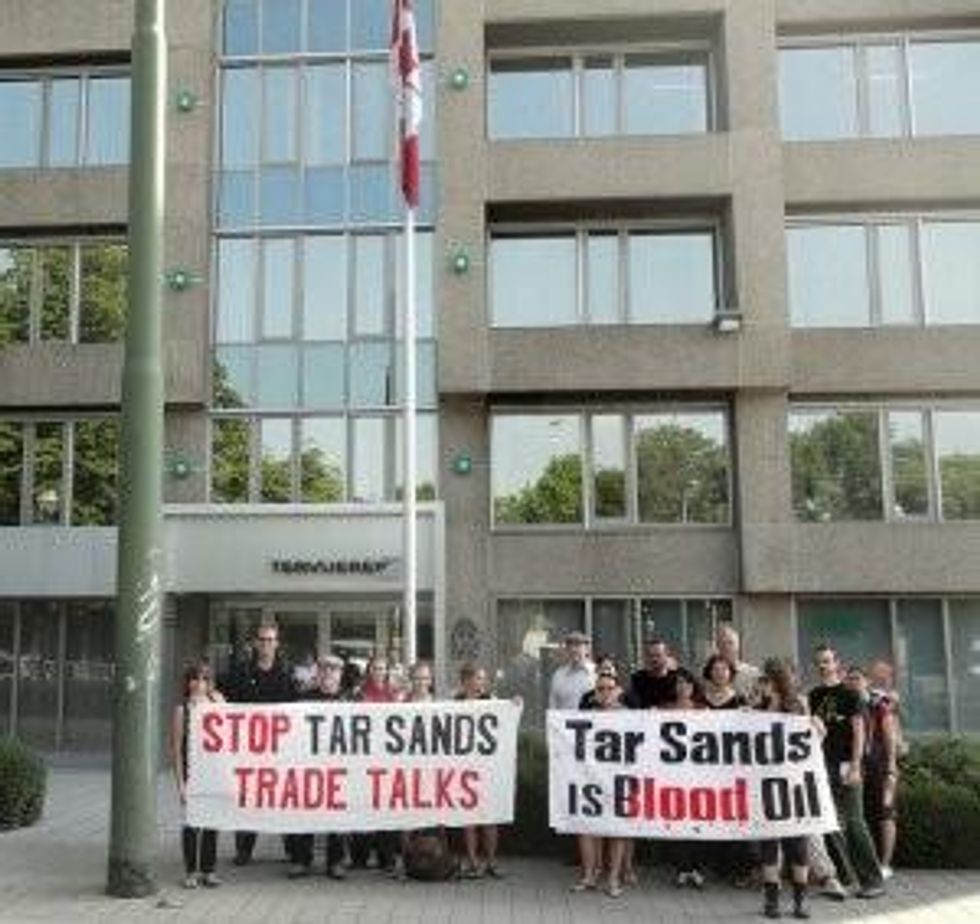
Now Canada, political voices in the United States, and the European Commission for that matter, are trying to leverage the political crisis in Ukraine to make a case for more (not less) North American imports of the dirty stuff: tar sands from Alberta and fracked gas from North America's "boom" in unconventional shale production. The first puts pressure on Obama to approve the Keystone XL pipeline, which would bring bitumen from Canada to refineries on the Gulf Coast before shipping the final product to Europe and Asia. (The Energy East pipeline would do the same in Canada.)
The second (fracked gas) would require the U.S. to approve new LNG plants and remove energy export restrictions, which the EU is trying to do through trade and investment negotiations with the United States. David Cameron's government in the UK is also using the crisis to justify a European shale gas boom that environmental groups and the general public strongly opposes.
"Why has it taken so long in the UK and Europe as compared to the US?" asked Cameron this week. "We can ponder that or alternatively we can just do what this Government is doing which is to roll up the sleeves, simplify the process, make the permissions easier, getting on with some wells moving."
The prime minister said it was Europe's duty to become energy independent, partially through fracking. "I think something positive should come out of this for Europe, which is to take a long hard look at its energy resilience," he said. (About a third of Europe's oil and gas imports come from Russia, with 40 per cent of that passing through Ukraine.)
The EU's trade negotiations with Canada and the U.S. come into play in a big way here. As already mentioned, the EU is trying to use the Transatlantic Trade and Investment Partnership talks to loosen or eliminate U.S. restrictions on energy and raw resources exports. Canada has no such restrictions so the government has used ongoing Comprehensive Economic and Trade Agreement negotiations to try to entice European investment to Canada while constraining EU environmental leadership through WTO-plus chapters on technical barriers to trade and regulatory cooperation.
In CETA, Canada has also agreed to raise the threshold for reviewing foreign takeovers from $1- to $1.5-billion for European companies only. That will surely capture a lot of energy-related purchases if the agreement is ever ratified, but Canadian officials and business lobbies are already encouraging European firms to take advantage of new rules on transatlantic investment and its protection. This, importantly, brings us to the investor "rights" chapter and investor-to-state dispute settlement process in both CETA and TTIP.
As the Financial Post reported in November last year:
Another provision that could be of interest [to energy companies] is the creation of an investor-state dispute resolution mechanism. This would enable companies from the E.U. to sue Canada's federal government for any government actions that impair the value of their assets in Canada. The protection covers not just actions undertaken by the federal government, but also those by local governments. "That's got to be an incentive," Mr. [Greg] Kanargelidis [of Blake, Cassels & Graydon LLP in Toronto] says. "Investors will feel a greater measure of protection from having their investment adversely impacted by future government measures."
(Blakes is one of several sponsors of the 2014 Calgary Energy Roundtable meeting organized annually by the Canada-Europe Roundtable for Business. CERT has been, until recently, the main corporate support group for the CETA negotiations. The Chamber of Commerce and Canadian Council of Chief Executives have taken on that role in the past year but CERT, and its Energy Roundtable, still provides a twice-annual opportunity for the oil and gas industry to consider the trade-energy links in CETA.)
As EU energy companies would be able to use CETA to punish governments who want to better regulate the sector, the same would be true in reverse. Canadian and U.S. companies will be able to use CETA's or the TTIP's investment rules to challenge European hesitation on developing fracking projects in the UK, France, Poland, Germany and many other countries. Actually, U.S. firms won't even need the TTIP to do this since they will have access to CETA's investor-to-state dispute process via subsidiaries in Canada.
If the patriotic duty to face the Russian threat with tar sands and fracked gas is not enough to change public opinion, Europe's trade and investment pacts with Canada and the U.S. will give western industry a means (and green light) to strong-arm governments that would choose a more sustainable energy future. There is nothing accidental or tangential about this. For the Harper Conservatives, CERT, and energy sector lawyers, it is the point of CETA.
Dear Common Dreams reader, It’s been nearly 30 years since I co-founded Common Dreams with my late wife, Lina Newhouser. We had the radical notion that journalism should serve the public good, not corporate profits. It was clear to us from the outset what it would take to build such a project. No paid advertisements. No corporate sponsors. No millionaire publisher telling us what to think or do. Many people said we wouldn't last a year, but we proved those doubters wrong. Together with a tremendous team of journalists and dedicated staff, we built an independent media outlet free from the constraints of profits and corporate control. Our mission has always been simple: To inform. To inspire. To ignite change for the common good. Building Common Dreams was not easy. Our survival was never guaranteed. When you take on the most powerful forces—Wall Street greed, fossil fuel industry destruction, Big Tech lobbyists, and uber-rich oligarchs who have spent billions upon billions rigging the economy and democracy in their favor—the only bulwark you have is supporters who believe in your work. But here’s the urgent message from me today. It's never been this bad out there. And it's never been this hard to keep us going. At the very moment Common Dreams is most needed, the threats we face are intensifying. We need your support now more than ever. We don't accept corporate advertising and never will. We don't have a paywall because we don't think people should be blocked from critical news based on their ability to pay. Everything we do is funded by the donations of readers like you. When everyone does the little they can afford, we are strong. But if that support retreats or dries up, so do we. Will you donate now to make sure Common Dreams not only survives but thrives? —Craig Brown, Co-founder |
Western leaders meeting in The Hague this week for a nuclear summit considered new measures, including new sanctions, against Russia in response to Putin's annexation of the Crimean region of Ukraine. According to the Globe and Mail, Prime Minister Harper "has singled out the prospect of sanctions against Russia's energy industry, which would likely entail curtailing the ability of Canadians - and those in other G7 countries - from doing petroleum-related business with Russians."

Now Canada, political voices in the United States, and the European Commission for that matter, are trying to leverage the political crisis in Ukraine to make a case for more (not less) North American imports of the dirty stuff: tar sands from Alberta and fracked gas from North America's "boom" in unconventional shale production. The first puts pressure on Obama to approve the Keystone XL pipeline, which would bring bitumen from Canada to refineries on the Gulf Coast before shipping the final product to Europe and Asia. (The Energy East pipeline would do the same in Canada.)
The second (fracked gas) would require the U.S. to approve new LNG plants and remove energy export restrictions, which the EU is trying to do through trade and investment negotiations with the United States. David Cameron's government in the UK is also using the crisis to justify a European shale gas boom that environmental groups and the general public strongly opposes.
"Why has it taken so long in the UK and Europe as compared to the US?" asked Cameron this week. "We can ponder that or alternatively we can just do what this Government is doing which is to roll up the sleeves, simplify the process, make the permissions easier, getting on with some wells moving."
The prime minister said it was Europe's duty to become energy independent, partially through fracking. "I think something positive should come out of this for Europe, which is to take a long hard look at its energy resilience," he said. (About a third of Europe's oil and gas imports come from Russia, with 40 per cent of that passing through Ukraine.)
The EU's trade negotiations with Canada and the U.S. come into play in a big way here. As already mentioned, the EU is trying to use the Transatlantic Trade and Investment Partnership talks to loosen or eliminate U.S. restrictions on energy and raw resources exports. Canada has no such restrictions so the government has used ongoing Comprehensive Economic and Trade Agreement negotiations to try to entice European investment to Canada while constraining EU environmental leadership through WTO-plus chapters on technical barriers to trade and regulatory cooperation.
In CETA, Canada has also agreed to raise the threshold for reviewing foreign takeovers from $1- to $1.5-billion for European companies only. That will surely capture a lot of energy-related purchases if the agreement is ever ratified, but Canadian officials and business lobbies are already encouraging European firms to take advantage of new rules on transatlantic investment and its protection. This, importantly, brings us to the investor "rights" chapter and investor-to-state dispute settlement process in both CETA and TTIP.
As the Financial Post reported in November last year:
Another provision that could be of interest [to energy companies] is the creation of an investor-state dispute resolution mechanism. This would enable companies from the E.U. to sue Canada's federal government for any government actions that impair the value of their assets in Canada. The protection covers not just actions undertaken by the federal government, but also those by local governments. "That's got to be an incentive," Mr. [Greg] Kanargelidis [of Blake, Cassels & Graydon LLP in Toronto] says. "Investors will feel a greater measure of protection from having their investment adversely impacted by future government measures."
(Blakes is one of several sponsors of the 2014 Calgary Energy Roundtable meeting organized annually by the Canada-Europe Roundtable for Business. CERT has been, until recently, the main corporate support group for the CETA negotiations. The Chamber of Commerce and Canadian Council of Chief Executives have taken on that role in the past year but CERT, and its Energy Roundtable, still provides a twice-annual opportunity for the oil and gas industry to consider the trade-energy links in CETA.)
As EU energy companies would be able to use CETA to punish governments who want to better regulate the sector, the same would be true in reverse. Canadian and U.S. companies will be able to use CETA's or the TTIP's investment rules to challenge European hesitation on developing fracking projects in the UK, France, Poland, Germany and many other countries. Actually, U.S. firms won't even need the TTIP to do this since they will have access to CETA's investor-to-state dispute process via subsidiaries in Canada.
If the patriotic duty to face the Russian threat with tar sands and fracked gas is not enough to change public opinion, Europe's trade and investment pacts with Canada and the U.S. will give western industry a means (and green light) to strong-arm governments that would choose a more sustainable energy future. There is nothing accidental or tangential about this. For the Harper Conservatives, CERT, and energy sector lawyers, it is the point of CETA.
Western leaders meeting in The Hague this week for a nuclear summit considered new measures, including new sanctions, against Russia in response to Putin's annexation of the Crimean region of Ukraine. According to the Globe and Mail, Prime Minister Harper "has singled out the prospect of sanctions against Russia's energy industry, which would likely entail curtailing the ability of Canadians - and those in other G7 countries - from doing petroleum-related business with Russians."

Now Canada, political voices in the United States, and the European Commission for that matter, are trying to leverage the political crisis in Ukraine to make a case for more (not less) North American imports of the dirty stuff: tar sands from Alberta and fracked gas from North America's "boom" in unconventional shale production. The first puts pressure on Obama to approve the Keystone XL pipeline, which would bring bitumen from Canada to refineries on the Gulf Coast before shipping the final product to Europe and Asia. (The Energy East pipeline would do the same in Canada.)
The second (fracked gas) would require the U.S. to approve new LNG plants and remove energy export restrictions, which the EU is trying to do through trade and investment negotiations with the United States. David Cameron's government in the UK is also using the crisis to justify a European shale gas boom that environmental groups and the general public strongly opposes.
"Why has it taken so long in the UK and Europe as compared to the US?" asked Cameron this week. "We can ponder that or alternatively we can just do what this Government is doing which is to roll up the sleeves, simplify the process, make the permissions easier, getting on with some wells moving."
The prime minister said it was Europe's duty to become energy independent, partially through fracking. "I think something positive should come out of this for Europe, which is to take a long hard look at its energy resilience," he said. (About a third of Europe's oil and gas imports come from Russia, with 40 per cent of that passing through Ukraine.)
The EU's trade negotiations with Canada and the U.S. come into play in a big way here. As already mentioned, the EU is trying to use the Transatlantic Trade and Investment Partnership talks to loosen or eliminate U.S. restrictions on energy and raw resources exports. Canada has no such restrictions so the government has used ongoing Comprehensive Economic and Trade Agreement negotiations to try to entice European investment to Canada while constraining EU environmental leadership through WTO-plus chapters on technical barriers to trade and regulatory cooperation.
In CETA, Canada has also agreed to raise the threshold for reviewing foreign takeovers from $1- to $1.5-billion for European companies only. That will surely capture a lot of energy-related purchases if the agreement is ever ratified, but Canadian officials and business lobbies are already encouraging European firms to take advantage of new rules on transatlantic investment and its protection. This, importantly, brings us to the investor "rights" chapter and investor-to-state dispute settlement process in both CETA and TTIP.
As the Financial Post reported in November last year:
Another provision that could be of interest [to energy companies] is the creation of an investor-state dispute resolution mechanism. This would enable companies from the E.U. to sue Canada's federal government for any government actions that impair the value of their assets in Canada. The protection covers not just actions undertaken by the federal government, but also those by local governments. "That's got to be an incentive," Mr. [Greg] Kanargelidis [of Blake, Cassels & Graydon LLP in Toronto] says. "Investors will feel a greater measure of protection from having their investment adversely impacted by future government measures."
(Blakes is one of several sponsors of the 2014 Calgary Energy Roundtable meeting organized annually by the Canada-Europe Roundtable for Business. CERT has been, until recently, the main corporate support group for the CETA negotiations. The Chamber of Commerce and Canadian Council of Chief Executives have taken on that role in the past year but CERT, and its Energy Roundtable, still provides a twice-annual opportunity for the oil and gas industry to consider the trade-energy links in CETA.)
As EU energy companies would be able to use CETA to punish governments who want to better regulate the sector, the same would be true in reverse. Canadian and U.S. companies will be able to use CETA's or the TTIP's investment rules to challenge European hesitation on developing fracking projects in the UK, France, Poland, Germany and many other countries. Actually, U.S. firms won't even need the TTIP to do this since they will have access to CETA's investor-to-state dispute process via subsidiaries in Canada.
If the patriotic duty to face the Russian threat with tar sands and fracked gas is not enough to change public opinion, Europe's trade and investment pacts with Canada and the U.S. will give western industry a means (and green light) to strong-arm governments that would choose a more sustainable energy future. There is nothing accidental or tangential about this. For the Harper Conservatives, CERT, and energy sector lawyers, it is the point of CETA.