SUBSCRIBE TO OUR FREE NEWSLETTER
Daily news & progressive opinion—funded by the people, not the corporations—delivered straight to your inbox.
5
#000000
#FFFFFF
To donate by check, phone, or other method, see our More Ways to Give page.
"It is clear to me that the British Parliament, reflecting the views of the British people, does not want to see British military action. I get that, and the government will act accordingly," Prime Minister David Cameron said Thursday night. At least for now, Uncle Sam's poodle is off the leash.
Now all eyes turn to Congress, where the bar has suddenly been raised. Can the House of Representatives measure up to the House of Commons?
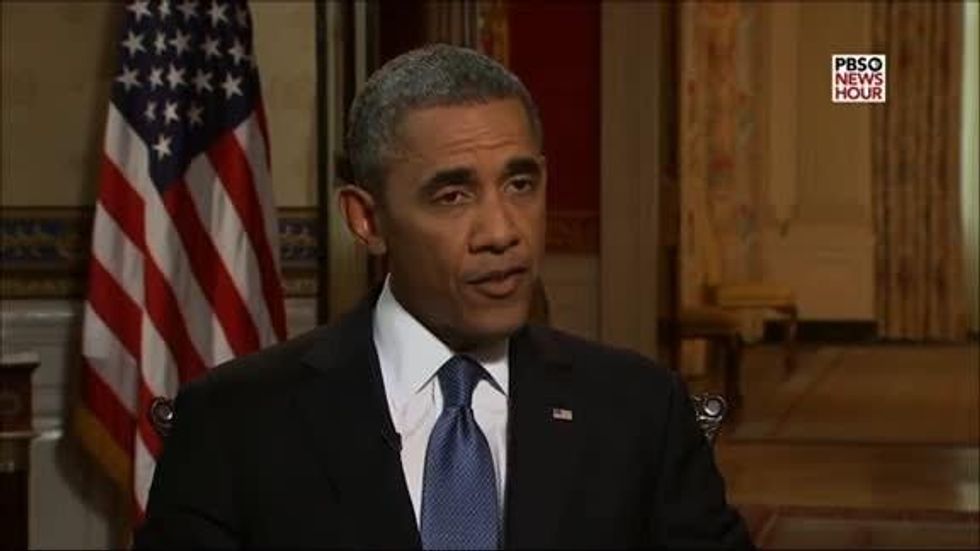
It's a crucial question--but President Obama intends to render it moot with unwavering contempt for the war authority of Congress. Like his predecessors.
Even with war votes on Capitol Hill, the charade quotient has been high. The Gulf War began in early 1991 after the Senate vote for war was close: 52 to 47. But, as the PBS "Frontline" program reported years later, President George H.W. Bush had a plan in place: if Congress voted against going to war, he'd ignore Congress.
"The president privately, with the most inner circle, made absolutely clear he was going to go forward with this action even if he were impeached," said Robert Gates, who was deputy national security advisor. "The truth of the matter is that while public opinion and the voice of Congress was important to Bush, I believe it had no impact on his decision about what he would do. He was going to throw that son of a bitch [Saddam Hussein] out of Kuwait, regardless of whether the Congress or the public supported him."
By the Pentagon's estimate, the six weeks of the Gulf War took the lives of 100,000 Iraqi people. "It's really not a number I'm terribly interested in," the Joint Chiefs of Staff chairman, Colin Powell, said at the time.
Eight years later, the War Powers Act's 60-day deadline for congressional approval of U.S. warfare expired on May 25, 1999--but large-scale U.S. bombing of Yugoslavia continued. Bill Clinton was unable to get authorization from Congress but, like other wartime presidents before and since, he ignored the law that was passed in 1973 to constrain autocratic war-making. Republican Rep. Tom Campbell said: "The president is in violation of the law. That is clear." Democratic Rep. Dennis Kucinich said: "The war continues unauthorized, without the consent of the governed." And President Clinton said, in effect, I don't care.
In October 2002, President George W. Bush won congressional approval for an invasion of Iraq, waving the fig leaf that passage would strengthen his hand at the bargaining table. Of course Bush got what he wanted--a full-scale war on Iraq.
"The president's ability to decide when and where to use America's military power is now absolute," pundit Michael Kinsley observed, writing in Time magazine in mid-April 2003, just after the U.S. occupation of Iraq began. "Congress cannot stop him. That's not what the Constitution says, and it's not what the War Powers Act says, but that's how it works in practice."
That's how it works in practice.
We've got to change how it works in practice.
During the next few days, a huge and historic battle will determine whether President Obama can continue the deadly record of presidential impunity to ignore Article 1 Section 8 of the Constitution ("The Congress shall have Power ... To declare War") and the War Powers Act as well as public opinion, now strongly against an attack on Syria.
In recent days, perhaps as a tactical matter, some progressive groups and members of Congress have focused on urging that Congress get to vote--or at least play a role--in the decision on whether to bomb Syria. But we should not imply that we'll be satisfied as long as the matter comes to a congressional vote. Time is very short; we should cut through the preliminaries and get to the point: No attack on Syria!
Since mid-week, more than 20,000 people have sent this email message to Congress: "No Attack on Syria. As a constituent, I am writing to let you know that I oppose a military attack on Syria. Creative diplomacy is the best way to respond to the alleged use of chemical weapons. I urge you to work for a ceasefire, to pressure Saudi Arabia, the Gulf states, and Turkey, to halt the flow of weapons, and to pressure Russia and Iran to do the same." (To join in sending that email message to your senators and representative, click here.)
Will the president again be able to order a military attack on yet another country--on his own say-so?
That is Obama's intention. "Administration officials made clear that the eroding support would not deter Mr. Obama in deciding to go ahead with a strike," the New York Times reported on Friday morning. "Pentagon officials said that the Navy had now moved a fifth destroyer into the eastern Mediterranean Sea. Each ship carries dozens of Tomahawk cruise missiles that would probably be the centerpiece of any attack on Syria."
In the next days, history will be made. Let's make it for peace.
"It is clear to me that the British Parliament, reflecting the views of the British people, does not want to see British military action. I get that, and the government will act accordingly," Prime Minister David Cameron said Thursday night. At least for now, Uncle Sam's poodle is off the leash.
Now all eyes turn to Congress, where the bar has suddenly been raised. Can the House of Representatives measure up to the House of Commons?
It's a crucial question--but President Obama intends to render it moot with unwavering contempt for the war authority of Congress. Like his predecessors.
Even with war votes on Capitol Hill, the charade quotient has been high. The Gulf War began in early 1991 after the Senate vote for war was close: 52 to 47. But, as the PBS "Frontline" program reported years later, President George H.W. Bush had a plan in place: if Congress voted against going to war, he'd ignore Congress.
"The president privately, with the most inner circle, made absolutely clear he was going to go forward with this action even if he were impeached," said Robert Gates, who was deputy national security advisor. "The truth of the matter is that while public opinion and the voice of Congress was important to Bush, I believe it had no impact on his decision about what he would do. He was going to throw that son of a bitch [Saddam Hussein] out of Kuwait, regardless of whether the Congress or the public supported him."
By the Pentagon's estimate, the six weeks of the Gulf War took the lives of 100,000 Iraqi people. "It's really not a number I'm terribly interested in," the Joint Chiefs of Staff chairman, Colin Powell, said at the time.
Eight years later, the War Powers Act's 60-day deadline for congressional approval of U.S. warfare expired on May 25, 1999--but large-scale U.S. bombing of Yugoslavia continued. Bill Clinton was unable to get authorization from Congress but, like other wartime presidents before and since, he ignored the law that was passed in 1973 to constrain autocratic war-making. Republican Rep. Tom Campbell said: "The president is in violation of the law. That is clear." Democratic Rep. Dennis Kucinich said: "The war continues unauthorized, without the consent of the governed." And President Clinton said, in effect, I don't care.
In October 2002, President George W. Bush won congressional approval for an invasion of Iraq, waving the fig leaf that passage would strengthen his hand at the bargaining table. Of course Bush got what he wanted--a full-scale war on Iraq.
"The president's ability to decide when and where to use America's military power is now absolute," pundit Michael Kinsley observed, writing in Time magazine in mid-April 2003, just after the U.S. occupation of Iraq began. "Congress cannot stop him. That's not what the Constitution says, and it's not what the War Powers Act says, but that's how it works in practice."
That's how it works in practice.
We've got to change how it works in practice.
During the next few days, a huge and historic battle will determine whether President Obama can continue the deadly record of presidential impunity to ignore Article 1 Section 8 of the Constitution ("The Congress shall have Power ... To declare War") and the War Powers Act as well as public opinion, now strongly against an attack on Syria.
In recent days, perhaps as a tactical matter, some progressive groups and members of Congress have focused on urging that Congress get to vote--or at least play a role--in the decision on whether to bomb Syria. But we should not imply that we'll be satisfied as long as the matter comes to a congressional vote. Time is very short; we should cut through the preliminaries and get to the point: No attack on Syria!
Since mid-week, more than 20,000 people have sent this email message to Congress: "No Attack on Syria. As a constituent, I am writing to let you know that I oppose a military attack on Syria. Creative diplomacy is the best way to respond to the alleged use of chemical weapons. I urge you to work for a ceasefire, to pressure Saudi Arabia, the Gulf states, and Turkey, to halt the flow of weapons, and to pressure Russia and Iran to do the same." (To join in sending that email message to your senators and representative, click here.)
Will the president again be able to order a military attack on yet another country--on his own say-so?
That is Obama's intention. "Administration officials made clear that the eroding support would not deter Mr. Obama in deciding to go ahead with a strike," the New York Times reported on Friday morning. "Pentagon officials said that the Navy had now moved a fifth destroyer into the eastern Mediterranean Sea. Each ship carries dozens of Tomahawk cruise missiles that would probably be the centerpiece of any attack on Syria."
In the next days, history will be made. Let's make it for peace.
"It is clear to me that the British Parliament, reflecting the views of the British people, does not want to see British military action. I get that, and the government will act accordingly," Prime Minister David Cameron said Thursday night. At least for now, Uncle Sam's poodle is off the leash.
Now all eyes turn to Congress, where the bar has suddenly been raised. Can the House of Representatives measure up to the House of Commons?
It's a crucial question--but President Obama intends to render it moot with unwavering contempt for the war authority of Congress. Like his predecessors.
Even with war votes on Capitol Hill, the charade quotient has been high. The Gulf War began in early 1991 after the Senate vote for war was close: 52 to 47. But, as the PBS "Frontline" program reported years later, President George H.W. Bush had a plan in place: if Congress voted against going to war, he'd ignore Congress.
"The president privately, with the most inner circle, made absolutely clear he was going to go forward with this action even if he were impeached," said Robert Gates, who was deputy national security advisor. "The truth of the matter is that while public opinion and the voice of Congress was important to Bush, I believe it had no impact on his decision about what he would do. He was going to throw that son of a bitch [Saddam Hussein] out of Kuwait, regardless of whether the Congress or the public supported him."
By the Pentagon's estimate, the six weeks of the Gulf War took the lives of 100,000 Iraqi people. "It's really not a number I'm terribly interested in," the Joint Chiefs of Staff chairman, Colin Powell, said at the time.
Eight years later, the War Powers Act's 60-day deadline for congressional approval of U.S. warfare expired on May 25, 1999--but large-scale U.S. bombing of Yugoslavia continued. Bill Clinton was unable to get authorization from Congress but, like other wartime presidents before and since, he ignored the law that was passed in 1973 to constrain autocratic war-making. Republican Rep. Tom Campbell said: "The president is in violation of the law. That is clear." Democratic Rep. Dennis Kucinich said: "The war continues unauthorized, without the consent of the governed." And President Clinton said, in effect, I don't care.
In October 2002, President George W. Bush won congressional approval for an invasion of Iraq, waving the fig leaf that passage would strengthen his hand at the bargaining table. Of course Bush got what he wanted--a full-scale war on Iraq.
"The president's ability to decide when and where to use America's military power is now absolute," pundit Michael Kinsley observed, writing in Time magazine in mid-April 2003, just after the U.S. occupation of Iraq began. "Congress cannot stop him. That's not what the Constitution says, and it's not what the War Powers Act says, but that's how it works in practice."
That's how it works in practice.
We've got to change how it works in practice.
During the next few days, a huge and historic battle will determine whether President Obama can continue the deadly record of presidential impunity to ignore Article 1 Section 8 of the Constitution ("The Congress shall have Power ... To declare War") and the War Powers Act as well as public opinion, now strongly against an attack on Syria.
In recent days, perhaps as a tactical matter, some progressive groups and members of Congress have focused on urging that Congress get to vote--or at least play a role--in the decision on whether to bomb Syria. But we should not imply that we'll be satisfied as long as the matter comes to a congressional vote. Time is very short; we should cut through the preliminaries and get to the point: No attack on Syria!
Since mid-week, more than 20,000 people have sent this email message to Congress: "No Attack on Syria. As a constituent, I am writing to let you know that I oppose a military attack on Syria. Creative diplomacy is the best way to respond to the alleged use of chemical weapons. I urge you to work for a ceasefire, to pressure Saudi Arabia, the Gulf states, and Turkey, to halt the flow of weapons, and to pressure Russia and Iran to do the same." (To join in sending that email message to your senators and representative, click here.)
Will the president again be able to order a military attack on yet another country--on his own say-so?
That is Obama's intention. "Administration officials made clear that the eroding support would not deter Mr. Obama in deciding to go ahead with a strike," the New York Times reported on Friday morning. "Pentagon officials said that the Navy had now moved a fifth destroyer into the eastern Mediterranean Sea. Each ship carries dozens of Tomahawk cruise missiles that would probably be the centerpiece of any attack on Syria."
In the next days, history will be made. Let's make it for peace.