SUBSCRIBE TO OUR FREE NEWSLETTER
Daily news & progressive opinion—funded by the people, not the corporations—delivered straight to your inbox.
5
#000000
#FFFFFF
To donate by check, phone, or other method, see our More Ways to Give page.
As Spain's prime minister announced deep austerity cuts Wednesday in order to secure funds from the European Union to bail out Spain's failing banks, the people of Spain have taken to the streets once again for what they call "Real Democracy Now." This comes a week after the government announced it was launching a criminal investigation into the former CEO of Spain's fourth-largest bank, Bankia. Rodrigo Rato is no small fish: Before running Bankia he was head of the International Monetary Fund. What the U.S. media don't tell you is that this official government investigation was initiated by grass-roots action.
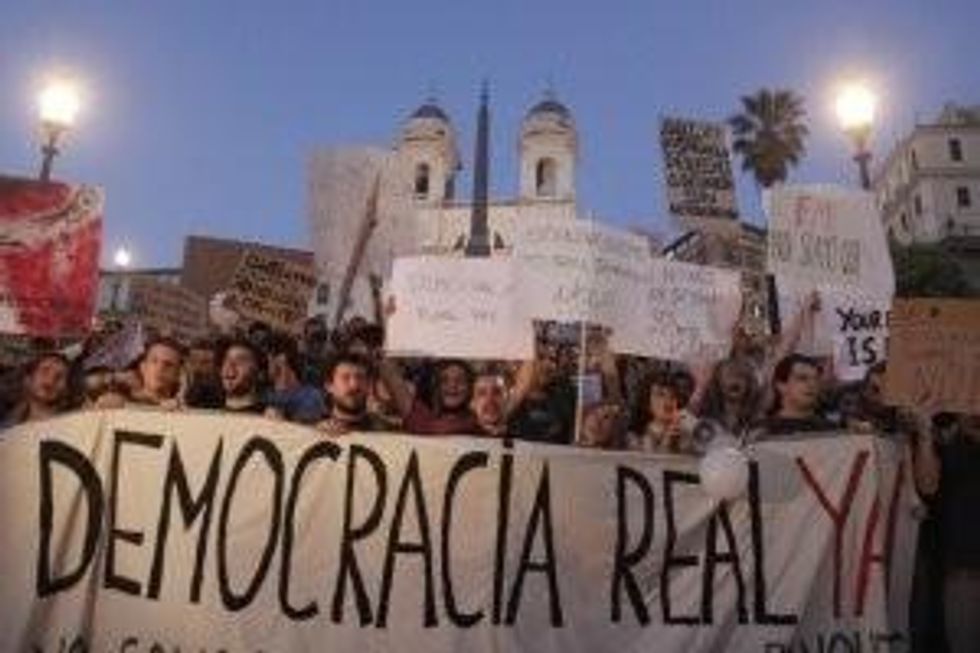
The Occupy movement in Spain is called M-15, for the day it began, May 15, 2011. I met with one of the key organizers in Madrid last week on the day the Rato investigation was announced. He smiled, and said, "Something is starting to happen." The organizer, Stephane Grueso, is an activist filmmaker who is making a documentary about the May 15 movement. He is a talented professional, but, like 25 percent of the Spanish population, he is unemployed: "We didn't like what we were seeing, where we were going. We felt we were losing our democracy, we were losing our country, we were losing our way of life. ... We had one slogan: 'Democracia real YA!'--we want a 'real democracy, now!' Fifty people stayed overnight in Puerta del Sol, this public square. And then the police tried to take us out, and so we came back. And then this thing began to multiply in other cities in Spain. In three, four days' time, we were like tens of thousands of people in dozens of cities in Spain, camped in the middle of the city--a little bit like we saw in Tahrir in Egypt."
"We are not a party. We are not a union. We are not an association. We are people."
-Stephane Grueso, M15 movement
The occupation of Puerta del Sol and other plazas around Spain continued, but, as with Occupy Wall Street encampments around the U.S., they were eventually broken up. The organizing continued, though, with issue-oriented working groups and neighborhood assemblies. One M-15 working group decided to sue Rodrigo Rato, and recruited pro bono lawyers and identified more than 50 plaintiffs, people who felt they'd been personally defrauded by Bankia. While the lawyers were volunteers, a massive lawsuit costs money, so this movement, driven by social media, turned to "crowd funding," to the masses of supporters in their movement for small donations. In less than a day, they raised more than $25,000. The lawsuit was filed in June of this year.
Olmo Galvez is another M-15 organizer I met with in Madrid. A young businessman with experience around the world, Galvez was profiled in Time magazine when they chose "The Protester" as the Person of the Year. Rato's alleged fraud at Bankia involved the sale of Bankia "preferred stock" to regular account holders, so-called retail investors, since sophisticated investors were not buying it. Galvez explained: "They were selling it to people--some of them couldn't read, many were elderly. That was a big scandal that wasn't in the media." Some who invested in Bankia's scheme had to sign the contract with a fingerprint because they couldn't write, nor could they read about, let alone understand, what they were sinking their savings into.
This week, thousands of coal miners marched to Madrid, some walking 240 miles from Asturias, on Spain's northern coast. When the miners arrived in Madrid Tuesday night, according to the online publication ElDiario.es, they chanted "somos el 99 percent" ("we are the 99 percent") and were greeted like heroes. Wednesday morning, Prime Minister Mariano Rajoy, of the right-wing Partido Popular, made his latest pronouncement on austerity measures: an increase in the sales tax, cuts to the public-sector payroll, and shortening the period of unemployment support to six months.
As Rajoy was making his announcement in parliament, the miners were in the streets, joined by thousands of regular citizens, all demanding that government cuts be halted. The marchers were met by riot police, who fired rubber-coated steel balls and tear gas at them. Some protesters returned with volleys of firecrackers and other projectiles, and, in the ensuing melee, at least 76 were injured and eight arrested.
Stephane Grueso sums up the movement: "We are not a party. We are not a union. We are not an association. We are people. We want to expel corruption from public life ... now, today, maybe it is starting to happen."
Denis Moynihan contributed research to this column.
As Spain's prime minister announced deep austerity cuts Wednesday in order to secure funds from the European Union to bail out Spain's failing banks, the people of Spain have taken to the streets once again for what they call "Real Democracy Now." This comes a week after the government announced it was launching a criminal investigation into the former CEO of Spain's fourth-largest bank, Bankia. Rodrigo Rato is no small fish: Before running Bankia he was head of the International Monetary Fund. What the U.S. media don't tell you is that this official government investigation was initiated by grass-roots action.
The Occupy movement in Spain is called M-15, for the day it began, May 15, 2011. I met with one of the key organizers in Madrid last week on the day the Rato investigation was announced. He smiled, and said, "Something is starting to happen." The organizer, Stephane Grueso, is an activist filmmaker who is making a documentary about the May 15 movement. He is a talented professional, but, like 25 percent of the Spanish population, he is unemployed: "We didn't like what we were seeing, where we were going. We felt we were losing our democracy, we were losing our country, we were losing our way of life. ... We had one slogan: 'Democracia real YA!'--we want a 'real democracy, now!' Fifty people stayed overnight in Puerta del Sol, this public square. And then the police tried to take us out, and so we came back. And then this thing began to multiply in other cities in Spain. In three, four days' time, we were like tens of thousands of people in dozens of cities in Spain, camped in the middle of the city--a little bit like we saw in Tahrir in Egypt."
"We are not a party. We are not a union. We are not an association. We are people."
-Stephane Grueso, M15 movement
The occupation of Puerta del Sol and other plazas around Spain continued, but, as with Occupy Wall Street encampments around the U.S., they were eventually broken up. The organizing continued, though, with issue-oriented working groups and neighborhood assemblies. One M-15 working group decided to sue Rodrigo Rato, and recruited pro bono lawyers and identified more than 50 plaintiffs, people who felt they'd been personally defrauded by Bankia. While the lawyers were volunteers, a massive lawsuit costs money, so this movement, driven by social media, turned to "crowd funding," to the masses of supporters in their movement for small donations. In less than a day, they raised more than $25,000. The lawsuit was filed in June of this year.
Olmo Galvez is another M-15 organizer I met with in Madrid. A young businessman with experience around the world, Galvez was profiled in Time magazine when they chose "The Protester" as the Person of the Year. Rato's alleged fraud at Bankia involved the sale of Bankia "preferred stock" to regular account holders, so-called retail investors, since sophisticated investors were not buying it. Galvez explained: "They were selling it to people--some of them couldn't read, many were elderly. That was a big scandal that wasn't in the media." Some who invested in Bankia's scheme had to sign the contract with a fingerprint because they couldn't write, nor could they read about, let alone understand, what they were sinking their savings into.
This week, thousands of coal miners marched to Madrid, some walking 240 miles from Asturias, on Spain's northern coast. When the miners arrived in Madrid Tuesday night, according to the online publication ElDiario.es, they chanted "somos el 99 percent" ("we are the 99 percent") and were greeted like heroes. Wednesday morning, Prime Minister Mariano Rajoy, of the right-wing Partido Popular, made his latest pronouncement on austerity measures: an increase in the sales tax, cuts to the public-sector payroll, and shortening the period of unemployment support to six months.
As Rajoy was making his announcement in parliament, the miners were in the streets, joined by thousands of regular citizens, all demanding that government cuts be halted. The marchers were met by riot police, who fired rubber-coated steel balls and tear gas at them. Some protesters returned with volleys of firecrackers and other projectiles, and, in the ensuing melee, at least 76 were injured and eight arrested.
Stephane Grueso sums up the movement: "We are not a party. We are not a union. We are not an association. We are people. We want to expel corruption from public life ... now, today, maybe it is starting to happen."
Denis Moynihan contributed research to this column.
As Spain's prime minister announced deep austerity cuts Wednesday in order to secure funds from the European Union to bail out Spain's failing banks, the people of Spain have taken to the streets once again for what they call "Real Democracy Now." This comes a week after the government announced it was launching a criminal investigation into the former CEO of Spain's fourth-largest bank, Bankia. Rodrigo Rato is no small fish: Before running Bankia he was head of the International Monetary Fund. What the U.S. media don't tell you is that this official government investigation was initiated by grass-roots action.
The Occupy movement in Spain is called M-15, for the day it began, May 15, 2011. I met with one of the key organizers in Madrid last week on the day the Rato investigation was announced. He smiled, and said, "Something is starting to happen." The organizer, Stephane Grueso, is an activist filmmaker who is making a documentary about the May 15 movement. He is a talented professional, but, like 25 percent of the Spanish population, he is unemployed: "We didn't like what we were seeing, where we were going. We felt we were losing our democracy, we were losing our country, we were losing our way of life. ... We had one slogan: 'Democracia real YA!'--we want a 'real democracy, now!' Fifty people stayed overnight in Puerta del Sol, this public square. And then the police tried to take us out, and so we came back. And then this thing began to multiply in other cities in Spain. In three, four days' time, we were like tens of thousands of people in dozens of cities in Spain, camped in the middle of the city--a little bit like we saw in Tahrir in Egypt."
"We are not a party. We are not a union. We are not an association. We are people."
-Stephane Grueso, M15 movement
The occupation of Puerta del Sol and other plazas around Spain continued, but, as with Occupy Wall Street encampments around the U.S., they were eventually broken up. The organizing continued, though, with issue-oriented working groups and neighborhood assemblies. One M-15 working group decided to sue Rodrigo Rato, and recruited pro bono lawyers and identified more than 50 plaintiffs, people who felt they'd been personally defrauded by Bankia. While the lawyers were volunteers, a massive lawsuit costs money, so this movement, driven by social media, turned to "crowd funding," to the masses of supporters in their movement for small donations. In less than a day, they raised more than $25,000. The lawsuit was filed in June of this year.
Olmo Galvez is another M-15 organizer I met with in Madrid. A young businessman with experience around the world, Galvez was profiled in Time magazine when they chose "The Protester" as the Person of the Year. Rato's alleged fraud at Bankia involved the sale of Bankia "preferred stock" to regular account holders, so-called retail investors, since sophisticated investors were not buying it. Galvez explained: "They were selling it to people--some of them couldn't read, many were elderly. That was a big scandal that wasn't in the media." Some who invested in Bankia's scheme had to sign the contract with a fingerprint because they couldn't write, nor could they read about, let alone understand, what they were sinking their savings into.
This week, thousands of coal miners marched to Madrid, some walking 240 miles from Asturias, on Spain's northern coast. When the miners arrived in Madrid Tuesday night, according to the online publication ElDiario.es, they chanted "somos el 99 percent" ("we are the 99 percent") and were greeted like heroes. Wednesday morning, Prime Minister Mariano Rajoy, of the right-wing Partido Popular, made his latest pronouncement on austerity measures: an increase in the sales tax, cuts to the public-sector payroll, and shortening the period of unemployment support to six months.
As Rajoy was making his announcement in parliament, the miners were in the streets, joined by thousands of regular citizens, all demanding that government cuts be halted. The marchers were met by riot police, who fired rubber-coated steel balls and tear gas at them. Some protesters returned with volleys of firecrackers and other projectiles, and, in the ensuing melee, at least 76 were injured and eight arrested.
Stephane Grueso sums up the movement: "We are not a party. We are not a union. We are not an association. We are people. We want to expel corruption from public life ... now, today, maybe it is starting to happen."
Denis Moynihan contributed research to this column.