SUBSCRIBE TO OUR FREE NEWSLETTER
Daily news & progressive opinion—funded by the people, not the corporations—delivered straight to your inbox.
5
#000000
#FFFFFF
To donate by check, phone, or other method, see our More Ways to Give page.
Perhaps as early as today, the conservative-dominated Roberts Court will choose a metaphor that will affect millions of people and perhaps change the history of our country very much for the worse.
Back in 1978, linguists Michael Reddy and George Lakoff, working independently, demonstrated that metaphor is fundamentally a matter of thought, and that metaphorical language is secondary. Conceptual metaphors shape our understanding and can determine how we reason. Consequently, metaphor is central to law, as Citizens United showed by making the metaphor Corporations Are Persons into a law, with vast political consequences.
Today's likely judgment was prefigured in the 2008 Republican presidential race when Rudolph Giuliani likened health care to a flat screen tv. If you want a flat screen tv, buy one; and if you don't have the money, go earn it. If you can't, too bad, you don't deserve it. The same with health care, he argued, imposing the metaphor that Health Care Is a Product.
This was a sign that conservative strategists were looking for a way to impose this metaphor.
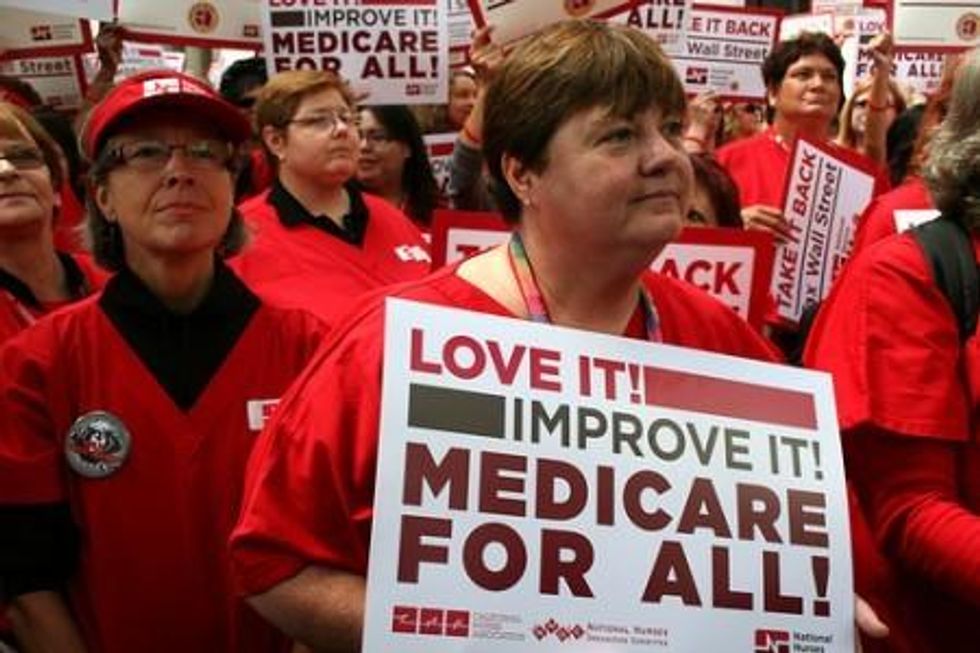
Barack Obama helped them. He bought into that metaphor when he chose the Interstate Commerce clause as the constitutional basis of his health care act. He had an alternative -- Medicare for All -- since Congress has the duty to provide for the general welfare.
But Obama accepted the Health Care as Product metaphor because he wanted to regulate the insurance industry, and Congress has the power to regulate interstate commerce. In doing so he fell into a conservative trap. The Interstate Commerce clause rests on the metaphor that Health Care is Product. That led to Supreme Court justices arguing that the individual mandate is forcing people to buy a product, and that, they hinted, is unconstitutional -- at least 5-4 unconstitutional. The argument is that if the government can force you to buy one product, it can force you to buy any product -- even broccoli.
There is another metaphor trying to get onstage -- that the individual mandate levies a health care tax on all citizens, with exemptions for those with health care. The mandate wasn't called a tax, but because money is fungible, it is economically equivalent to a tax, and so it could be metaphorically considered a tax -- but only if the Supreme Decided
Where the first metaphor would effectively kill the Affordable Care Act, the second could save it. Since Congress has the power to levy taxes, the second metaphor would clearly be constitutional.
But adopting such a metaphor would open the door to other disasters, since then all fees or fines can be argued to be taxes. Conservatives are already making such arguments.
The Supreme Court is a remarkable institution. By a 5-4 vote, it can decide what metaphors we will live -- or die -- by. It is time recognize, and speak regularly of, the Metaphor Power of the Court, the power to make metaphors legally binding. It is an awesome power. This is a something the press should be reporting on, legal theorists should be writing about, and all of us should be discussing. Should the Court have such a power? And if so, should there be any limits on it?
Indeed, could the Court decide whether the Metaphor Power of the Court itself is constitutional?
Perhaps as early as today, the conservative-dominated Roberts Court will choose a metaphor that will affect millions of people and perhaps change the history of our country very much for the worse.
Back in 1978, linguists Michael Reddy and George Lakoff, working independently, demonstrated that metaphor is fundamentally a matter of thought, and that metaphorical language is secondary. Conceptual metaphors shape our understanding and can determine how we reason. Consequently, metaphor is central to law, as Citizens United showed by making the metaphor Corporations Are Persons into a law, with vast political consequences.
Today's likely judgment was prefigured in the 2008 Republican presidential race when Rudolph Giuliani likened health care to a flat screen tv. If you want a flat screen tv, buy one; and if you don't have the money, go earn it. If you can't, too bad, you don't deserve it. The same with health care, he argued, imposing the metaphor that Health Care Is a Product.
This was a sign that conservative strategists were looking for a way to impose this metaphor.
Barack Obama helped them. He bought into that metaphor when he chose the Interstate Commerce clause as the constitutional basis of his health care act. He had an alternative -- Medicare for All -- since Congress has the duty to provide for the general welfare.
But Obama accepted the Health Care as Product metaphor because he wanted to regulate the insurance industry, and Congress has the power to regulate interstate commerce. In doing so he fell into a conservative trap. The Interstate Commerce clause rests on the metaphor that Health Care is Product. That led to Supreme Court justices arguing that the individual mandate is forcing people to buy a product, and that, they hinted, is unconstitutional -- at least 5-4 unconstitutional. The argument is that if the government can force you to buy one product, it can force you to buy any product -- even broccoli.
There is another metaphor trying to get onstage -- that the individual mandate levies a health care tax on all citizens, with exemptions for those with health care. The mandate wasn't called a tax, but because money is fungible, it is economically equivalent to a tax, and so it could be metaphorically considered a tax -- but only if the Supreme Decided
Where the first metaphor would effectively kill the Affordable Care Act, the second could save it. Since Congress has the power to levy taxes, the second metaphor would clearly be constitutional.
But adopting such a metaphor would open the door to other disasters, since then all fees or fines can be argued to be taxes. Conservatives are already making such arguments.
The Supreme Court is a remarkable institution. By a 5-4 vote, it can decide what metaphors we will live -- or die -- by. It is time recognize, and speak regularly of, the Metaphor Power of the Court, the power to make metaphors legally binding. It is an awesome power. This is a something the press should be reporting on, legal theorists should be writing about, and all of us should be discussing. Should the Court have such a power? And if so, should there be any limits on it?
Indeed, could the Court decide whether the Metaphor Power of the Court itself is constitutional?
Perhaps as early as today, the conservative-dominated Roberts Court will choose a metaphor that will affect millions of people and perhaps change the history of our country very much for the worse.
Back in 1978, linguists Michael Reddy and George Lakoff, working independently, demonstrated that metaphor is fundamentally a matter of thought, and that metaphorical language is secondary. Conceptual metaphors shape our understanding and can determine how we reason. Consequently, metaphor is central to law, as Citizens United showed by making the metaphor Corporations Are Persons into a law, with vast political consequences.
Today's likely judgment was prefigured in the 2008 Republican presidential race when Rudolph Giuliani likened health care to a flat screen tv. If you want a flat screen tv, buy one; and if you don't have the money, go earn it. If you can't, too bad, you don't deserve it. The same with health care, he argued, imposing the metaphor that Health Care Is a Product.
This was a sign that conservative strategists were looking for a way to impose this metaphor.
Barack Obama helped them. He bought into that metaphor when he chose the Interstate Commerce clause as the constitutional basis of his health care act. He had an alternative -- Medicare for All -- since Congress has the duty to provide for the general welfare.
But Obama accepted the Health Care as Product metaphor because he wanted to regulate the insurance industry, and Congress has the power to regulate interstate commerce. In doing so he fell into a conservative trap. The Interstate Commerce clause rests on the metaphor that Health Care is Product. That led to Supreme Court justices arguing that the individual mandate is forcing people to buy a product, and that, they hinted, is unconstitutional -- at least 5-4 unconstitutional. The argument is that if the government can force you to buy one product, it can force you to buy any product -- even broccoli.
There is another metaphor trying to get onstage -- that the individual mandate levies a health care tax on all citizens, with exemptions for those with health care. The mandate wasn't called a tax, but because money is fungible, it is economically equivalent to a tax, and so it could be metaphorically considered a tax -- but only if the Supreme Decided
Where the first metaphor would effectively kill the Affordable Care Act, the second could save it. Since Congress has the power to levy taxes, the second metaphor would clearly be constitutional.
But adopting such a metaphor would open the door to other disasters, since then all fees or fines can be argued to be taxes. Conservatives are already making such arguments.
The Supreme Court is a remarkable institution. By a 5-4 vote, it can decide what metaphors we will live -- or die -- by. It is time recognize, and speak regularly of, the Metaphor Power of the Court, the power to make metaphors legally binding. It is an awesome power. This is a something the press should be reporting on, legal theorists should be writing about, and all of us should be discussing. Should the Court have such a power? And if so, should there be any limits on it?
Indeed, could the Court decide whether the Metaphor Power of the Court itself is constitutional?