SUBSCRIBE TO OUR FREE NEWSLETTER
Daily news & progressive opinion—funded by the people, not the corporations—delivered straight to your inbox.
5
#000000
#FFFFFF
To donate by check, phone, or other method, see our More Ways to Give page.
Daily news & progressive opinion—funded by the people, not the corporations—delivered straight to your inbox.
When news arrived of the catastrophic earthquake in Sichuan, my mind turned to Zheng Sun Man, an up-and-coming security executive I met on a recent trip to China. Zheng heads Aebell Electrical Technology, a Guangzhou-based company that makes surveillance cameras and public address systems and sells them to the government.
Zheng, a 28-year-old MBA with a text-messaging addiction, was determined to persuade me that his cameras and speakers are not being used against pro-democracy activists or factory organizers. They are for managing natural disasters, Zheng explained, pointing to the freak snowstorms before Lunar New Year. During the crisis, the government "was able to use the feed from the railway cameras to communicate how to deal with the situation and organize an evacuation. We saw how the central government can command from the north emergencies in the south."
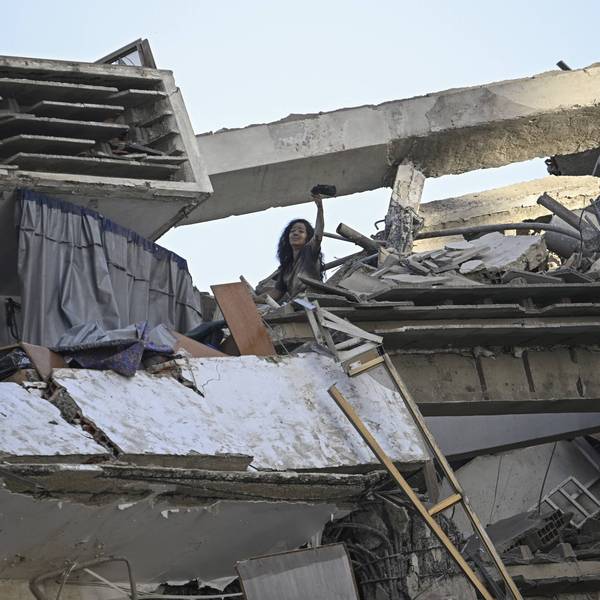
Of course, surveillance cameras have other uses too -- like helping to make "Most Wanted" posters of Tibetan activists. But Zheng did have a point: nothing terrifies a repressive regime quite like a natural disaster. Authoritarian states rule by fear and by projecting an aura of total control. When they suddenly seem short-staffed, absent or disorganized, their subjects can become dangerously emboldened. It's something to keep in mind as two of the most repressive regimes on the planet -- China and Burma -- struggle to respond to devastating disasters: the Sichuan earthquake and Cyclone Nargis. In both cases, the disasters have exposed grave political weaknesses within the regimes -- and both crises have the potential to ignite levels of public rage that would be difficult to control.
When China is busily building itself up, residents tend to stay quiet about what they all know: developers regularly flout safety codes, while local officials are bribed not to notice. But when China comes tumbling down -- including at least eight schools -- the truth has a way of escaping. "Look at all the buildings around. They were the same height, but why did the school fall down?" demanded a distraught relative in Juyuan. A mother in Dujiangyan told the Guardian, "Chinese officials are too corrupt and bad.... They have money for prostitutes and second wives but they don't have money for our children."
That the Olympic stadiums were built to withstand powerful quakes is suddenly of little comfort. When I was in China, it was hard to find anyone willing to criticize the Olympic spending spree. Now posts on mainstream web portals are calling the torch relay "wasteful" and its continuation in the midst of so much suffering "inhuman."
None of this compares with the rage boiling over in Burma, where cyclone survivors have badly beaten at least one local official, furious at his failure to distribute aid. There have been dozens of reports of the Burmese junta taking credit for supplies sent by foreign countries. It turns out that they have been taking more than credit -- in some cases they have been taking the aid. According to a report in Asia Times, the regime has been hijacking food shipments and distributing them among its 400,000 soldiers. The reason speaks to the threat the disaster poses to the very existence of the regime. The generals, it seems, are "haunted by an almost pathological fear of a split inside their own ranks...if soldiers are not given priority in aid distribution and are unable to feed themselves, the possibility of mutiny rises." Mark Farmaner, director of Burma Campaign UK, confirms that before the cyclone, the military was already coping with a wave of desertions.
This relatively small-scale theft of food is fortifying the junta for its much larger heist -- the one taking place via the constitutional referendum the generals have insisted on holding, come hell and high water. Enticed by high commodity prices, Burma's generals have been gorging off the country's natural abundance, stripping it of gems, timber, rice and oil. As profitable as this arrangement is, junta leader Gen. Than Shwe knows he cannot resist the calls for democracy indefinitely.
Taking a page out of the playbook of Chilean dictator Augusto Pinochet, the generals have drafted a Constitution that allows for elections but guarantees that no future government will ever have the power to prosecute them for their crimes or take back their ill-gotten wealth. As Farmaner puts it, after elections the junta leaders "are going to be wearing suits instead of boots." The cyclone, meanwhile, has presented them with one last, vast business opportunity: by blocking aid from reaching the highly fertile Irrawaddy delta, hundreds of thousands of mostly ethnic Karen rice farmers are being sentenced to death. According to Farmaner, "that land can be handed over to the generals' business cronies" (shades of the beachfront land grabs in Sri Lanka and Thailand after the Asian tsunami). This isn't incompetence, or even madness. It's laissez-faire ethnic cleansing.
If the Burmese junta avoids mutiny and achieves these goals, it will be thanks largely to China, which has vigorously blocked all attempts at the United Nations for humanitarian intervention in Burma. Inside China, where the central government is going to great lengths to show itself as compassionate, news of this complicity could prove explosive. Will China's citizens receive this news? They just might. Beijing has, up to now, displayed an awesome determination to censor and monitor all forms of communication. But in the wake of the quake, the notorious "Great Firewall" censoring the Internet is failing badly. Blogs are going wild, and even state reporters are insisting on reporting the news.
This may be the greatest threat that natural disasters pose to repressive regimes. For China's rulers, nothing has been more crucial to maintaining power than the ability to control what people see and hear. If they lose that, neither surveillance cameras nor loudspeakers will be able to help them.
Naomi Klein is an award-winning journalist and syndicated columnist and the author of the international and New York Times bestseller The Shock Doctrine: The Rise of Disaster Capitalism (September 2007); an earlier international best-seller, No Logo: Taking Aim at the Brand Bullies; and the collection Fences and Windows: Dispatches from the Front Lines of the Globalization Debate (2002).
Copyright (c) 2008 The Nation
Dear Common Dreams reader, It’s been nearly 30 years since I co-founded Common Dreams with my late wife, Lina Newhouser. We had the radical notion that journalism should serve the public good, not corporate profits. It was clear to us from the outset what it would take to build such a project. No paid advertisements. No corporate sponsors. No millionaire publisher telling us what to think or do. Many people said we wouldn't last a year, but we proved those doubters wrong. Together with a tremendous team of journalists and dedicated staff, we built an independent media outlet free from the constraints of profits and corporate control. Our mission has always been simple: To inform. To inspire. To ignite change for the common good. Building Common Dreams was not easy. Our survival was never guaranteed. When you take on the most powerful forces—Wall Street greed, fossil fuel industry destruction, Big Tech lobbyists, and uber-rich oligarchs who have spent billions upon billions rigging the economy and democracy in their favor—the only bulwark you have is supporters who believe in your work. But here’s the urgent message from me today. It's never been this bad out there. And it's never been this hard to keep us going. At the very moment Common Dreams is most needed, the threats we face are intensifying. We need your support now more than ever. We don't accept corporate advertising and never will. We don't have a paywall because we don't think people should be blocked from critical news based on their ability to pay. Everything we do is funded by the donations of readers like you. When everyone does the little they can afford, we are strong. But if that support retreats or dries up, so do we. Will you donate now to make sure Common Dreams not only survives but thrives? —Craig Brown, Co-founder |
When news arrived of the catastrophic earthquake in Sichuan, my mind turned to Zheng Sun Man, an up-and-coming security executive I met on a recent trip to China. Zheng heads Aebell Electrical Technology, a Guangzhou-based company that makes surveillance cameras and public address systems and sells them to the government.
Zheng, a 28-year-old MBA with a text-messaging addiction, was determined to persuade me that his cameras and speakers are not being used against pro-democracy activists or factory organizers. They are for managing natural disasters, Zheng explained, pointing to the freak snowstorms before Lunar New Year. During the crisis, the government "was able to use the feed from the railway cameras to communicate how to deal with the situation and organize an evacuation. We saw how the central government can command from the north emergencies in the south."
Of course, surveillance cameras have other uses too -- like helping to make "Most Wanted" posters of Tibetan activists. But Zheng did have a point: nothing terrifies a repressive regime quite like a natural disaster. Authoritarian states rule by fear and by projecting an aura of total control. When they suddenly seem short-staffed, absent or disorganized, their subjects can become dangerously emboldened. It's something to keep in mind as two of the most repressive regimes on the planet -- China and Burma -- struggle to respond to devastating disasters: the Sichuan earthquake and Cyclone Nargis. In both cases, the disasters have exposed grave political weaknesses within the regimes -- and both crises have the potential to ignite levels of public rage that would be difficult to control.
When China is busily building itself up, residents tend to stay quiet about what they all know: developers regularly flout safety codes, while local officials are bribed not to notice. But when China comes tumbling down -- including at least eight schools -- the truth has a way of escaping. "Look at all the buildings around. They were the same height, but why did the school fall down?" demanded a distraught relative in Juyuan. A mother in Dujiangyan told the Guardian, "Chinese officials are too corrupt and bad.... They have money for prostitutes and second wives but they don't have money for our children."
That the Olympic stadiums were built to withstand powerful quakes is suddenly of little comfort. When I was in China, it was hard to find anyone willing to criticize the Olympic spending spree. Now posts on mainstream web portals are calling the torch relay "wasteful" and its continuation in the midst of so much suffering "inhuman."
None of this compares with the rage boiling over in Burma, where cyclone survivors have badly beaten at least one local official, furious at his failure to distribute aid. There have been dozens of reports of the Burmese junta taking credit for supplies sent by foreign countries. It turns out that they have been taking more than credit -- in some cases they have been taking the aid. According to a report in Asia Times, the regime has been hijacking food shipments and distributing them among its 400,000 soldiers. The reason speaks to the threat the disaster poses to the very existence of the regime. The generals, it seems, are "haunted by an almost pathological fear of a split inside their own ranks...if soldiers are not given priority in aid distribution and are unable to feed themselves, the possibility of mutiny rises." Mark Farmaner, director of Burma Campaign UK, confirms that before the cyclone, the military was already coping with a wave of desertions.
This relatively small-scale theft of food is fortifying the junta for its much larger heist -- the one taking place via the constitutional referendum the generals have insisted on holding, come hell and high water. Enticed by high commodity prices, Burma's generals have been gorging off the country's natural abundance, stripping it of gems, timber, rice and oil. As profitable as this arrangement is, junta leader Gen. Than Shwe knows he cannot resist the calls for democracy indefinitely.
Taking a page out of the playbook of Chilean dictator Augusto Pinochet, the generals have drafted a Constitution that allows for elections but guarantees that no future government will ever have the power to prosecute them for their crimes or take back their ill-gotten wealth. As Farmaner puts it, after elections the junta leaders "are going to be wearing suits instead of boots." The cyclone, meanwhile, has presented them with one last, vast business opportunity: by blocking aid from reaching the highly fertile Irrawaddy delta, hundreds of thousands of mostly ethnic Karen rice farmers are being sentenced to death. According to Farmaner, "that land can be handed over to the generals' business cronies" (shades of the beachfront land grabs in Sri Lanka and Thailand after the Asian tsunami). This isn't incompetence, or even madness. It's laissez-faire ethnic cleansing.
If the Burmese junta avoids mutiny and achieves these goals, it will be thanks largely to China, which has vigorously blocked all attempts at the United Nations for humanitarian intervention in Burma. Inside China, where the central government is going to great lengths to show itself as compassionate, news of this complicity could prove explosive. Will China's citizens receive this news? They just might. Beijing has, up to now, displayed an awesome determination to censor and monitor all forms of communication. But in the wake of the quake, the notorious "Great Firewall" censoring the Internet is failing badly. Blogs are going wild, and even state reporters are insisting on reporting the news.
This may be the greatest threat that natural disasters pose to repressive regimes. For China's rulers, nothing has been more crucial to maintaining power than the ability to control what people see and hear. If they lose that, neither surveillance cameras nor loudspeakers will be able to help them.
Naomi Klein is an award-winning journalist and syndicated columnist and the author of the international and New York Times bestseller The Shock Doctrine: The Rise of Disaster Capitalism (September 2007); an earlier international best-seller, No Logo: Taking Aim at the Brand Bullies; and the collection Fences and Windows: Dispatches from the Front Lines of the Globalization Debate (2002).
Copyright (c) 2008 The Nation
When news arrived of the catastrophic earthquake in Sichuan, my mind turned to Zheng Sun Man, an up-and-coming security executive I met on a recent trip to China. Zheng heads Aebell Electrical Technology, a Guangzhou-based company that makes surveillance cameras and public address systems and sells them to the government.
Zheng, a 28-year-old MBA with a text-messaging addiction, was determined to persuade me that his cameras and speakers are not being used against pro-democracy activists or factory organizers. They are for managing natural disasters, Zheng explained, pointing to the freak snowstorms before Lunar New Year. During the crisis, the government "was able to use the feed from the railway cameras to communicate how to deal with the situation and organize an evacuation. We saw how the central government can command from the north emergencies in the south."
Of course, surveillance cameras have other uses too -- like helping to make "Most Wanted" posters of Tibetan activists. But Zheng did have a point: nothing terrifies a repressive regime quite like a natural disaster. Authoritarian states rule by fear and by projecting an aura of total control. When they suddenly seem short-staffed, absent or disorganized, their subjects can become dangerously emboldened. It's something to keep in mind as two of the most repressive regimes on the planet -- China and Burma -- struggle to respond to devastating disasters: the Sichuan earthquake and Cyclone Nargis. In both cases, the disasters have exposed grave political weaknesses within the regimes -- and both crises have the potential to ignite levels of public rage that would be difficult to control.
When China is busily building itself up, residents tend to stay quiet about what they all know: developers regularly flout safety codes, while local officials are bribed not to notice. But when China comes tumbling down -- including at least eight schools -- the truth has a way of escaping. "Look at all the buildings around. They were the same height, but why did the school fall down?" demanded a distraught relative in Juyuan. A mother in Dujiangyan told the Guardian, "Chinese officials are too corrupt and bad.... They have money for prostitutes and second wives but they don't have money for our children."
That the Olympic stadiums were built to withstand powerful quakes is suddenly of little comfort. When I was in China, it was hard to find anyone willing to criticize the Olympic spending spree. Now posts on mainstream web portals are calling the torch relay "wasteful" and its continuation in the midst of so much suffering "inhuman."
None of this compares with the rage boiling over in Burma, where cyclone survivors have badly beaten at least one local official, furious at his failure to distribute aid. There have been dozens of reports of the Burmese junta taking credit for supplies sent by foreign countries. It turns out that they have been taking more than credit -- in some cases they have been taking the aid. According to a report in Asia Times, the regime has been hijacking food shipments and distributing them among its 400,000 soldiers. The reason speaks to the threat the disaster poses to the very existence of the regime. The generals, it seems, are "haunted by an almost pathological fear of a split inside their own ranks...if soldiers are not given priority in aid distribution and are unable to feed themselves, the possibility of mutiny rises." Mark Farmaner, director of Burma Campaign UK, confirms that before the cyclone, the military was already coping with a wave of desertions.
This relatively small-scale theft of food is fortifying the junta for its much larger heist -- the one taking place via the constitutional referendum the generals have insisted on holding, come hell and high water. Enticed by high commodity prices, Burma's generals have been gorging off the country's natural abundance, stripping it of gems, timber, rice and oil. As profitable as this arrangement is, junta leader Gen. Than Shwe knows he cannot resist the calls for democracy indefinitely.
Taking a page out of the playbook of Chilean dictator Augusto Pinochet, the generals have drafted a Constitution that allows for elections but guarantees that no future government will ever have the power to prosecute them for their crimes or take back their ill-gotten wealth. As Farmaner puts it, after elections the junta leaders "are going to be wearing suits instead of boots." The cyclone, meanwhile, has presented them with one last, vast business opportunity: by blocking aid from reaching the highly fertile Irrawaddy delta, hundreds of thousands of mostly ethnic Karen rice farmers are being sentenced to death. According to Farmaner, "that land can be handed over to the generals' business cronies" (shades of the beachfront land grabs in Sri Lanka and Thailand after the Asian tsunami). This isn't incompetence, or even madness. It's laissez-faire ethnic cleansing.
If the Burmese junta avoids mutiny and achieves these goals, it will be thanks largely to China, which has vigorously blocked all attempts at the United Nations for humanitarian intervention in Burma. Inside China, where the central government is going to great lengths to show itself as compassionate, news of this complicity could prove explosive. Will China's citizens receive this news? They just might. Beijing has, up to now, displayed an awesome determination to censor and monitor all forms of communication. But in the wake of the quake, the notorious "Great Firewall" censoring the Internet is failing badly. Blogs are going wild, and even state reporters are insisting on reporting the news.
This may be the greatest threat that natural disasters pose to repressive regimes. For China's rulers, nothing has been more crucial to maintaining power than the ability to control what people see and hear. If they lose that, neither surveillance cameras nor loudspeakers will be able to help them.
Naomi Klein is an award-winning journalist and syndicated columnist and the author of the international and New York Times bestseller The Shock Doctrine: The Rise of Disaster Capitalism (September 2007); an earlier international best-seller, No Logo: Taking Aim at the Brand Bullies; and the collection Fences and Windows: Dispatches from the Front Lines of the Globalization Debate (2002).
Copyright (c) 2008 The Nation