

SUBSCRIBE TO OUR FREE NEWSLETTER
Daily news & progressive opinion—funded by the people, not the corporations—delivered straight to your inbox.
5
#000000
#FFFFFF
To donate by check, phone, or other method, see our More Ways to Give page.
Daily news & progressive opinion—funded by the people, not the corporations—delivered straight to your inbox.

A grant proposal concerning reparations for the descendants of slave owners, submitted in good faith to Elon Musk during this cruel and unusual time of oppressive wokeness.
Dear Elon,
On behalf of the Diversified Organization of Grant Enablers, (the original DOGE), thank you for ordering the National Institutes of Health and the National Science Foundation to flag proposals that contain certain oppressive “woke” words you don’t like. We’re not wild about them either.
Forbes leaked the list of the 197 terms, rendered here in bold italics. (And kudos, dear sir, for not banning George Carlin’s seven dirty words!)
BTW, the biased media is inflating the number of forbidden words, trying to make you look bad. For example, it counts as individual terms diverse, diverse backgrounds, diverse communities, diverse community, diverse group, diverse groups, diversified, diversify, diversifying, and diversity. Fake news, is it not?
But we have a suggestion. Rather than ban them, giving the liberals something easy to roast you with, why not put them to work in an anti-woke context? That’s what our professional team of DOGE grant writers has done in a model culturally appropriate proposal. You will love it, even though it uses just about all the barred terms. (Sorry, we failed to squeeze in people + uterus.)
We don’t want to brag, but this can’t-miss proposal will shake up the lunatic left. You will want to immediately fund it, even while chain-sawing so many others into sawdust. And when you spread the word on X, your popularity with anti-woke key groups is going to skyrocket! Even Steve Bannon will snuggle up to you.
Thanks for purifying our thoughts and bringing your antiracist Afrikaner sensibility to our great nation.
Proposal For Reparations for the Descendants of Slave Owners (DSO)
Britain abolished slavery in 1833 and provided former slave owners 20 million British pounds (the equivalent today of $22.1 billion US dollars) as compensation. Racial justice demands a similar response from the U.S. federal government for the descendants of U.S. slave owners.
In South Africa today, oppressed white farmers face land confiscation without compensation from its BIPOC government. Slave owners in the U.S. were victims of a similar injustice after the Civil War, punished for their identity. Without reparations, which have been too long denied, their descendants are victimized again generation after generation.
To promote a truly inclusive society based on equity, equality, and diversity for all, we must recognize and celebrate our cultural differences. While we are a nation of immigrants, we also are a nation of slaveowners!
For too long implicit bias and hate speech have been used against those, due to no fault of their own, who were born into slave-owning families. These key populations, labeled DSO here, should be considered at risk minorities. They helped create our national identity and contributed significantly to our cultural heritage. Racism in America would have little meaning without them.
Our proposal is a multicultural exploration of race and ethnicity among the slave-owning class, and their extended contact with indigenous communities and the Hispanic minority along the Gulf of Mexico. These marginalized non-white groups, including males and females, also owned slaves and suffered losses due to emancipation.
We must put aside our stereotypes about the plantation class. This underappreciated and undervalued population is difficult to analyze due to our own unconscious bias against all aspects of slavery. The DSO have lost their voice and its once fearsome power, since some ancestors of slaveowners are burdened by a crippling sense of guilt and so are underrepresented in modern political discourse.
To advocate for reparations for DSO members is not to whitewash their faults. Slave-owners promoted systemic racism, segregation, and white privilege— even for white non-slave-owners— but we should acknowledge their genuine sense of belonging formed though the intersectionality of sociocultural and socioeconomic factors in plantation society.
Even though white women were systematically placed on a pedestal, they were never excluded from institutional slave-owning power. They adored their narrow gender identity. These women of high status were never marginalized by aggressive feminists. They were totally at ease with being biologically female and with the gender they were assigned at birth.
Also, we can find no transgender and transexual members of slave-owning society and the DSO. Women did not run domestic plantation life in order to overcome disparities or spew meaningless pronouns in polite society. This wholesome tradition has been carried on by the DSO and provides another reason for just compensation.
A key, but seldom discussed factor, is the gender-based violence suffered at the hands of marauding Yankee soldiers. The DSO may deserve additional compensation for the trauma suffered as well as any resulting mental disabilities of their forebearers.
Meanwhile, slave-owning men were real men, biologically males with no wanton legacy of men having sex with men (MSM). And please forgive us for a personal judgement: These god-fearing slaveowners left their descendants with not the faintest expressions of non-binary awareness, thank goodness.
Because of the uncompensated destruction of the slave-holding structures, we regret to report that more than a few white plantation women became commercial sex workers in order to survive the marauding armies. The anguish and mental health problems facing white plantation prostitutes should be considered when awarding reparations. While it is too late to do something for them, our unconscious bias about sex should not distract us from a path of justice for their descendants.
Another important thread connects the slave owners to the climate crisis they and their descendants experienced. Monocrops repeatedly planted to raise cash in trade depleted the soil on Southern farms, creating pollution in their drinking water and a more generally degraded environmental quality. Westward expansion of slavery took more and more land from Native American tribes. Without climate science to inform them, effective solutions were missed and succeeding generations paid the price. We compensate farmers today for crop failures and tariff losses, why not do the same for the DSO including tribal DSO?
We hope that grant reviewers will look beyond their built-in anti-slaveowner confirmation bias, as well as their preconceived notions about race and ethnicity. It’s time to hone our cultural sensitivity and embrace a true cultural diversity, one that includes both descendants of slaves and slave owners. Our all-inclusive survey will make plain the biases we hold against this DSO class.
Since the Civil War, polarization has led to oppression and vilification of our great but marginalized plantation heritage. This injustice can only be rectified by fair and equitable compensation for the undervalued and underserved, whose relatives had their Black human capital stripped from them.
Our project asks only that we adjust our orientation and increase the diversity of those considered the victims of slavery. We must foster inclusiveness, devising just and equitable compensation programs for all descendants of slavery, including the DSO.
Social justice requires that we overcome our own prejudices and promote diversity of thought. By doing so, we all should recognize that slave-owning descendants too should be considered among our most vulnerable populations, entitled to equal opportunities when reparations are considered.
Now is the time to rectify the historical inequity faced by the DSO.
Now is the time to enhance the diversity of reparations recipients and the way they are viewed.
Now is the time to fund our bold proposal which strives, like no other, to bring community equity to all our people.
Cc: Rober Kennedy Jr., J.D. Vance, and the descendants of Robert E. Lee
Fighting endless wars in distant lands is not the solution, it’s the problem.
As President-elect Donald Trump prepares to take America back (again!) to greatness, there’s been much talk of Elon Musk’s new DOGE, or Department of Government Efficiency, and whether it will dare tackle Pentagon spending in useful ways. Could it curb rampant fraud, waste, and abuse within military contracting? Will the Pentagon finally pass a financial audit after seven consecutive failed attempts? Might the war in Ukraine finally sputter to an end, along with U.S. taxpayer support for that country of roughly $175 billion over the last three years?
“Efficiency” may be the word of the hour, but a more “efficient” imperial military, with a looser leash to attack Iran, bottle up China, and threaten Russia would likely bring yet more unrest to a world that’s already experiencing war-making chaos. When military “lethality” becomes the byword of even the Democrats, as was true with Kamala Harris’s campaign — her vice-presidential running mate’s main criticism of the Trump record on Iran was that his leadership was too “fickle” when it came to that country’s possible acquisition of a nuclear weapon — one wonders if any move toward restraint, let alone sanity and peace, is possible within the Washington beltway.
If Elon Musk and Vivek Ramaswamy want to lead a useful DOGE when it comes to the U.S. military, they should focus on effectiveness, not efficiency. Remind me, after all, of the last major war America effectively won. Yes, of course, it was World War II, 80 years ago, with a lot of help from allies like Joseph Stalin’s Soviet Union.
On the other hand, remind me of just how “effective” the U.S. military was in replacing the Taliban with… yes, the Taliban in Afghanistan after 20 years of effort and roughly $2 trillion in expenditures; or how “effective” it was in finding Saddam Hussein’s (nonexistent) weapons of mass destruction while bringing democracy to Iraq; or how “effective” it’s been in decreasing the risk of a world-altering nuclear war (while building a whole new generation of nuclear weaponry), as the Doomsday Clock of the Bulletin of the Atomic Scientists creeps ever closer to a thermonuclear midnight.
Color this retired Air Force officer red, as in angry and scared. Still, a new administration should represent somewhat of a fresh start, another opportunity for this country to alter its militaristic course. Perhaps you’ll indulge me for a moment as I dream of 10 ways the Trump administration could (but, of course, won’t) bring a form of “greatness” back to America. (An aside: Explain to me Donald Trump’s eternal focus on making America “great again” when any president should instead be focused on making America good, as in morally just and decent, again.)
1. It’s said that Trump’s nominee for secretary of defense, Pete Hegseth, will “end wokeness” in the military. No more DEI (diversity, equity, inclusion) generals, whatever that may mean. Apparently, the next administration wants to return to a military world of white men wearing stars (and losing wars) — the twenty-first-century equivalent of the heroes who “triumphed” in places like Korea and Vietnam in the previous century. Perhaps the new Trump administration should reanimate former Air Force Strategic Air Commander General Curtis LeMay to “win” a nuclear war against China or Russia. Whatever else you can say about LeMay, he wasn’t “woke.” Nor were generals like Douglas MacArthur in Korea and William Westmoreland in Vietnam. Nor, of course, were they victorious or even that effective, as was no less true of more recent “savior” generals like David Petraeus in Iraq and Stanley McChrystal in Afghanistan.
America, we don’t need a secretary of defense to “end wokeness” in the military. What we need is one to end warness, the pursuit of perpetual conflict across the globe. Instead of channeling his inner Darth Vader and choking the careers of the “woke,” Hegseth — assuming he makes it to the Pentagon — should act to rein in all its “warriors” and civilian neocons who keep boasting of putting on their big-boy pants as they clamor for yet more war.
2. Speaking of Darth Vader and Star Wars (and recalling its planet-destroying weaponry), the $2 trillion or so planned for the “modernization” of this country’s nuclear arsenal, including new Sentinel Intercontinental Ballistic Missiles, a new stealth bomber (the B-21 Raider), and new Columbia-class nuclear submarines, could easily be curtailed, even cut completely, without faintly impacting national security. Instead, the U.S. could pursue nuclear reduction talks with Russia and China that would enhance world security so much more than building a whole new genocidal set of nukes and their delivery systems. If the Trump administration wants to show “greatness,” it should do what President Ronald Reagan once did: work to put an end to nuclear madness through diplomacy.
3. Speaking of diplomacy and disarmament, isn’t it time for this country to stop being the world’s foremost merchant of death? The United States is, in fact, an uncontested number one in international arms sales, accounting for 40% of the marketplace. For a start, Trump and his minions could regain a smidgen of moral authority by halting the endless flow of (nearly) free bombs, missiles, and shells to Israel, thereby slowing its genocidal efforts to murder yet more Palestinians in Gaza. (Good luck on that one, of course.)
4. If Trump is so keen to put “America First,” shouldn’t that mean sending money to Main Street, USA, rather than to Wall Street, K Street arms lobbyists in Washington, D.C., and giant military contractors in Crystal City, Virginia, and elsewhere? Euphemistically called the “defense” budget, the money that flows into the U.S. military is now officially set at nearly $900 billion, but its future ceiling seems unlimited and the total “national security budget” is already closer to an astounding $1.4 trillion. Why are Americans letting the Pentagon and the National (In)Security State gobble up roughly 60% of the federal discretionary budget, year in, year out, no matter which political party gains the presidency? In truth, America’s real political party is a warbird with two right wings.
5. Given those two right wings, perhaps it shouldn’t be surprising how often it spins, flails, and fails. Only recently, for example, the Pentagon failed its seventh audit in a row. Had it been a Trump casino, it would have declared bankruptcy and gone belly up 30 years ago. Even then, you couldn’t have dissolved and distributed its assets, since roughly $2 trillion of them are “missing.” (America, your money is MIA, or missing in action, while the American dream has been KIA, or killed in action, by wanton, wasteful, and wrongheaded Pentagon spending.) Want that institution to pass an audit? Cut its budget in half until it produces a credible and accurate accounting. Something tells me that the bureaucracy would finally “win” its war on the numbers if faced with the equivalent of a budgetary guillotine.
6. Isn’t it finally time for the Pentagon to abandon its global fever dream of “full-spectrum dominance”? An American military deployed everywhere is also one that is vulnerable everywhere. What sense is there in having U.S. Special Forces in 80+ countries? What sense is there in having roughly 800 military bases around the globe? Harkening back to my sci-fi youth, America today most closely resembles the power-driven empire in Star Wars (with the belligerence of the Klingons in Star Trek thrown in for good measure). If Elon Musk truly believes that less can be more (as in more efficient), why not start with far fewer bases and foreign entanglements?
7. Speaking of Star Trek, this country could use a new “prime directive” where we don’t go in search of monsters to destroy everywhere. Isn’t it high time we turned inward and focused on healing ourselves? As presidential candidate and Senator George McGovern, a decorated World War II bomber pilot, said so powerfully in 1972, “Come home, America.” Leave the world to settle its own affairs.
8. Speaking of new approaches, why not try rapprochement? Stop attempting to dominate Russia and China, countries that could conceivably destroy the U.S. (as we could destroy them), and start finding smart ways to cooperate. Echoing the business-speak that might appeal to Musk and Trump, isn’t it time to seek win-win scenarios rather than war-war ones?
9. They say fascism will come to America only if it’s wrapped in the flag and carrying the cross, but maybe some version of that is, in fact, the only way to neutralize future fascism — with critical patriotism (rather than jingoistic nationalism) that stresses fidelity to America’s highest ideals. Stop hugging the flag and start living up to the vision of a United (rather than increasingly dis-united) States, a true land of the free and home of the brave that refuses to be frightened by drones in the sky or an expanding China. Stop promoting a vision of a crusading America and start living a vision of a country in which peacemakers are honored, even revered.
10. The names of American drones — “Predator” and “Reaper” — reveal much about this country’s direction over the last half-century. What this country needs to be “great again” are military and government establishments that are far less predatory and reap far fewer bodies overseas or, even better, none. (Keep in mind the millions of people killed, wounded, or displaced in countries ranging from Korea, Vietnam, Laos, and Cambodia to Afghanistan, Iraq, and all too many other lands across this planet in this century.)
There you have it, Donald Trump and Elon Musk, my 10 thoughts on your all too dodgy (rather than DOGE) quest for “efficiency” and “greatness” (again). In a nutshell, efficiency, as in doing things right, is far less important than effectiveness, or doing the right things, as management guru Peter Drucker put it. So, for example, a more efficient military might have fought in a somewhat smarter fashion in Iraq, but an effective military (and government) would have recognized that such a war should never have been pursued to begin with. Let me be clear: I don’t want an “efficient” war with Iran or China or any other country. I want an effective American foreign (and military) policy where, to cite Abraham Lincoln, right makes might.
Put bluntly, you can’t do a wrong thing the right way, a simple maxim I fear will be lost on that potential future trillionaire Musk and his DOGE. Therefore, the U.S. military and government will continue to do all too many wrong things, perhaps in a few cases slightly more efficiently, only making U.S. “defense” policy ever more predatory and so reaping yet more innocent lives across this globe of ours.
When it comes to Donald Trump and Elon Musk, let me say the obvious: the U.S. needs a smaller military establishment capable of defending this country by upholding the ideals and freedoms delineated in the Constitution. Fighting endless wars in distant lands is not the solution here, it’s the problem. As a result, America has an ineffective military (inefficient as hell to boot) that essentially launders trillions in taxpayer dollars to merchants of death like Lockheed Martin and Boeing while filling far too many body bags with dead foreigners. Your DOGE, Mr. Musk, won’t change this, nor will your predilection for spoiling the Pentagon with ever-higher budgets, President Trump.
So, what is to be done, America? As the prophet Michael Jackson once sang, we must start with the man in the mirror. Collectively, we need to ask ourselves and by extension “our” government to change its ways. Or, more effectively, we need to demand radical and extensive changes, since power of the sort wielded by this country’s national security state will concede nothing without a demand.
The forms those demands take are up to you, America.
In my darker hours, I wonder if, in our latest Trumpian moment, this country will be the national equivalent of the Titanic, post-iceberg — meaning that our fate is sealed. If that’s the case, maybe we can play sweeter music and be kinder to each other as we slip toward an ice-cold watery grave. But there are other moments when I imagine the iceberg still looming before the ship of state and a course correction still possible.
I hope that’s the case, even if our ship’s captain (Donald Trump) and his senior officers appear asleep at the wheel, while a few nutcases seem to be seeking that iceberg as a national death wish of sorts or, if you prefer, as an “end times” quest. As Howard Zinn once said, you can’t be neutral on a moving train — or for that matter on a ship of state already deep in perilous waters.
To use a different nautical reference, a more hopeful (if fictional) one, before the USS Caine goes down with all hands in high winds and heavy seas under the blundering and blustering Commander Queeg, maybe it’s time for us, the crew, to take matters into our own hands, as difficult as that may be to contemplate.
Come hard about, America! Seek the fair winds and following seas of peace. If we have the courage to do that, we will truly save our ship, ourselves, and much of the rest of the world from looming disaster.
The American Sociological Association condemned the move as "a failure of Florida's commitment to providing high-quality civics education and workforce readiness."
Despite opposition by sociologists and educators, the State University System of Florida on Wednesday cut sociology from core course requirements, continuing Republican Gov. Ron DeSantis' assault on academic freedom, intellectual pursuit, and knowledge.
The system's Board of Governors, which is full of DeSantis appointees and oversees a dozen public universities, approved replacing Principles of Sociology with a U.S. history course. It followed the State Board of Education's vote last week to do the same for 28 Florida colleges.
While the university system's chancellor, Ray Rodrigues, said he was "proud" of the decision, sociology educators and groups across the country sharply condemned both boards' moves as right-wing attacks on Florida's higher education, just one aspect of what DeSantis has termed his "war on woke."
Echoing its comments last week, the American Sociological Association (ASA) said that it was "outraged" by Wednesday's vote and urged the university board to reverse course.
"This decision seems to be coming not from an informed perspective, but rather from a gross misunderstanding of sociology as an illegitimate discipline driven by 'radical' and 'woke' ideology."
"There was no evidentiary basis for making this decision. In fact, the board rejected a proposal from one of the governors to table the vote while relevant data could be gathered," the ASA continued. "This decision seems to be coming not from an informed perspective, but rather from a gross misunderstanding of sociology as an illegitimate discipline driven by 'radical' and 'woke' ideology."
"To the contrary, sociology is the scientific study of social life, social change, and the social causes and consequences of human behavior, which are at the core of civic literacy and are essential to a broad range of careers," the association added. "Failure to prioritize the scientific study of the causes and consequences of human behavior is a failure of Florida's commitment to providing high-quality civics education and workforce readiness."
While efforts to "Save Sociology" in Florida have been mounting since November, some in the field have fueled the attacks. For example, Jukka Savolainen, a sociology professor at Wayne State University in Detroit, wrote for The Wall Street Journal last month that "I have watched my discipline morph from a scientific study of social reality into academic advocacy for left-wing causes."
Following the Wednesday vote, Heather Gautney, a sociology professor at Fordham University in New York City, told Common Dreams, "It's not surprising that people in power would actively suppress efforts to question their power and expose the dynamics underlying it."
"What's surprising is the ease through which that suppression is happening today, apparently with the help of sociologists themselves in cities like Detroit," she added, noting that such attacks on the crucial field come at a time when society is "in such dire need of what sociology has to bring—systematic analysis, understanding, and policy solutions."
Teresa M. Hodge, president of United Faculty of Florida, a union representing educators at the system's 12 universities and beyond, similarly said Wednesday that "we are disappointed in this decision... but unfortunately, we are not surprised," given that both boards "have made it abundantly clear that they do not care about the robust education of our students, and instead only care about political games."
After the State Board of Education's unanimous vote, Florida State University sociology professor Anne Barrett warned that such policies "are devastating for sociology in Florida. Enrollments will plummet. The opportunity to recruit majors will almost disappear. Weakened sociology departments are ripe for elimination and, ultimately, faculty layoffs."
"The costs to society are higher still," Barrett wrote in a blog post on the National Education Association website. "Sociology students learn how to use empirical research and logic to assess the accuracy of claims made about the social world. They also gain skills to critique how power is distributed. In short, they are positioned to be engaged citizens, armed with the power to destabilize right-wing policymakers' agendas—and this is the threat these regulations seek to neutralize."
Florida Education Association president Andrew Spar stressed last week that "the removal of sociology courses as a core general education requirement is part of a continued attack on our state's education system. We've seen it in our K-12 programs—first, they banned books, then classroom libraries, and now they are removing dictionaries from shelves because of their content. Then they attacked curriculum for being too 'woke' because it taught the truth about slavery."
Led by DeSantis—who on Sunday dropped out of the 2024 presidential contest—decision-makers in the state have also taken aim at Advanced Placement African American Studies and AP Psychology, and LGBTQ+ people in classrooms. As a White House hopeful, the governor took his right-wing education policies to the national stage, offering a model to other GOP-controlled states and Republicans in Congress.
"By stripping them of their ability to learn about diverse topics from diverse teachers all because some state leaders deem learning too controversial, Florida is taking away precious opportunities for students," said Spar. "We must continue to fight back against measures that seek to put special interests over the needs and outcomes of students."
In the 1950s “communist” was the slur of choice to attack those focused on equity, particularly for people of color.
Over half of Republicans agree that “fighting woke ideology in our schools and businesses” is more important than protecting Social Security and Medicare, finds a recent Wall Street Journal survey.
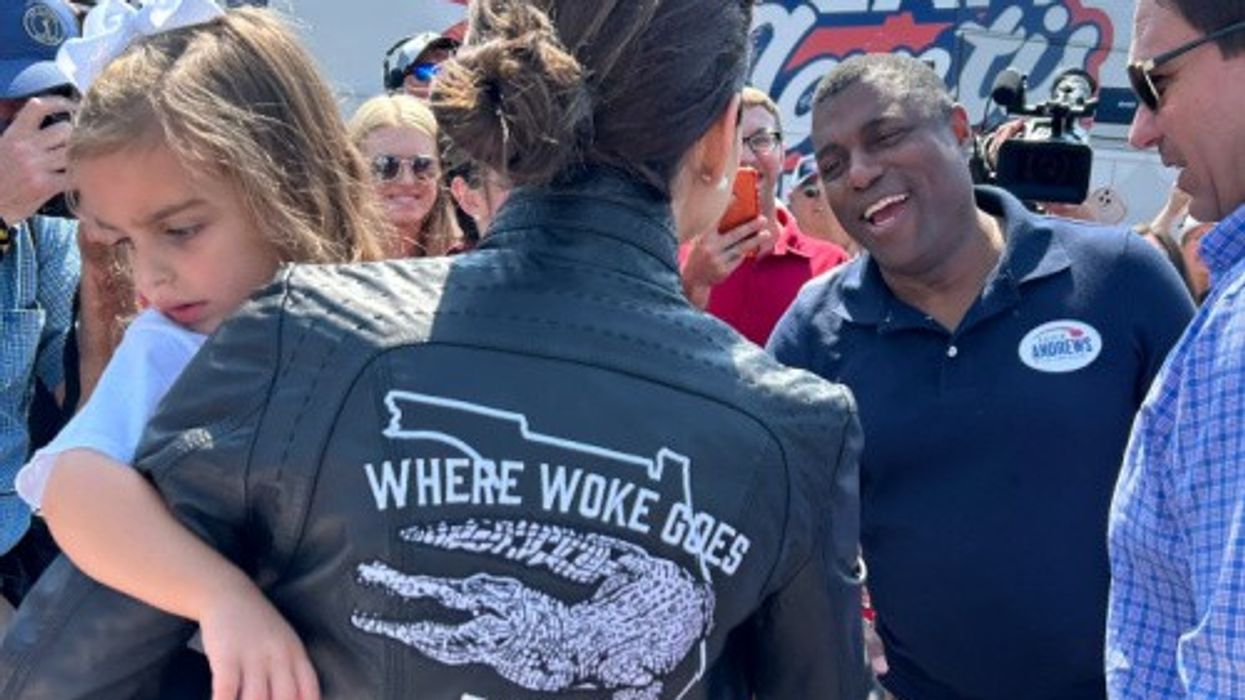
“Florida is where woke comes to die,” brags the state’s governor Ron DeSantis, “woke” is “basically a war on the truth.” Under the banner of anti-woke, he enacted sweeping limitations on what can be taught in public schools, a six-week abortion ban, and America’s cruelest anti-trans policies.
For DeSantis, the “woke” are “cultural Marxists” who are to blame for what’s broken in America.
We’ve endured a long history of labels that mislead, divide, and hinder us. So, let’s stop the name calling, listen to the actual agenda of those with whom we think we differ, and engage in real conversation.
Merriam-Webster defines “woke” first as being “aware of and actively attentive to important societal facts and issues (especially issues of racial and social justice).” The term took off in 2014 after Michael Brown was shot in Ferguson, Missouri, and then came to be used in the Black Lives Matter movement.
Today, “woke” is a sweeping, ill-defined insult making it harder to find common ground essential to reforms benefiting most Americans, such as lifting the minimum wage.
For those who lived through the 1950s it rings painful bells. Back then, “communist” was the slur of choice to attack those focused on equity, particularly for people of color. The McCarthy-era witch hunt caused as many as 12,000 people to lose their jobs.
Growing up in Fort Worth, Texas, in the early ’50s my parents helped found the first Unitarian church and to integrate it. The FBI took notice. I’ll never forget an agent knocking on our door as part of the agency’s investigation of our church. The inquiry was scary enough to shrink our membership. It didn’t shut us down but did lead to several members being fired from their jobs.
As a kid, I thought that we were suspect in the eyes of the FBI because Unitarians were seen as atheists, and atheism was associated with communism. Only recently did I learn my storyline was wrong.
With access to church archives, I discovered a letter from someone in our congregation to J. Edgar Hoover complaining that a member of our church had been questioned by two FBI agents at his home. The letter stated that “Among other questions, this man was asked what he thought of racial equality for Negroes, would he marry a Negro, and whether or not he attended the Unitarian Church.” He added: “I think you will agree these questions are completely out of line.”
Hoover’s response? “No questions were asked by representatives of this Bureau such as are alleged in your letter.”
At about the same time I uncovered these documents, someone in my extended family shared with me his related experience with the FBI. During the Korean War, the army had called him to serve. But when the recruiter learned he was a member of the NAACP, my relative was told that he was no longer qualified because that affiliation meant he was likely a communist.
Today, “woke” as a put down is similarly worrying. The term is derived from African American Vernacular English, meaning to be “alert to racial prejudice and discrimination.” It could have become a rallying cry for a better America. Especially now, as the Supreme Court has rejected affirmative action, facing racism’s deep and painful harm becomes even more urgent.
We’ve endured a long history of labels that mislead, divide, and hinder us. So, let’s stop the name calling, listen to the actual agenda of those with whom we think we differ, and engage in real conversation. We might discover common ground on which we can all advance.
We would then be able to tackle the long-standing, anti-democratic economic and political rules that generate income inequality more extreme than in 109 countries—including all of the Western, industrial world—and wealth so tightly held that the top 1% control almost as much as the bottom 90%. Such unequal economic power harms us all, as it is linked to poorer health and education, greater violence, and other social ills. Its effects also infuse our political lives, twisting policies to further favor the few and undermining democracy itself.
Together we could in fact wake up to what truly harms us and thus become eager to join hands for the benefit of all.

In very simple terms, the word "woke" means being aware of discrimination and social crises and wanting to repair them in order to make a more happy, loving, and egalitarian society.
Ron DeSantis says he’s going to save America from “wokeness,” proclaiming to a Los Angeles fundraiser:
“So in Florida, we say very clearly, we will never ever surrender to the woke mob. Our state is where woke goes to die.”
Nikki Haley declares:
“Wokeness is a virus more dangerous than any pandemic, hands down.”
Donald Trump is more nuanced, preferring to simply say racist things aloud without using the DeSantis shorthand.
“I don’t like the term ‘woke,” Trump told an Iowa audience, “because I hear the term ‘woke woke woke’ — it’s just a term they use, half the people can’t define it, they don’t know what it is.”
Trump notwithstanding, their competitors for the GOP nomination for president — along with Republican politicians across the country seeking their own re-election this year and next — are falling all over themselves to condemn “woke” and promise to be even tougher on “wokeness” than the last guy.
But what do they mean?
In 1938, Lead Belly sang a song about the “Scottsboro Boys,” a group of young Black men and boys who were falsely charged with rape and sentenced to the death penalty in Alabama in 1931. In the song, he talks about meeting the Scottsboro defendants, saying:
“I made this little song about down there. So I advise everybody, be a little careful when they go along through there — best stay woke, keep your eyes open.”
Republican politicians across the country seeking their own re-election this year and next... are falling all over themselves to condemn “woke” and promise to be even tougher on “wokeness” than the last guy. But what do they mean?
The phrase had a major revival in the Black community, as NBC News notes, in 2014 after Michael Brown was murdered by Ferguson, Missouri white police officer Darren Wilson.
“Stay woke” meant “keep an eye out for white cops who want to kill you” and to stay alert to and aware of other aspects of structural racism in American society. More recently, the term has expanded to being aware of and trying to do something about homophobia, misogyny, and our nation’s social ills.
Woke, in other words, means being aware of these social crises and wanting to repair them, to make a more happy, loving, egalitarian society.
Which is exactly why Republicans are using “woke” as their latest hate-filled dog whistle.
While these shout-outs to white racists, fascists, and haters go all the way back to the founding of the republic, most people are familiar with their more recent incarnations.
In the 1968 election and for his 1972 re-election, for example, Nixon rolled out his “War on Drugs” and talked constantly about “law and order” to signal to white people that he was going to come down hard on the Black community.
It was integral to his successful Southern Strategy to bring disaffected Dixiecrats — racist white Southern Democrats pissed off that LBJ had signed the Civil Rights and Voting Rights Acts into law in 1964/1965 — over to the GOP.
As Nixon‘s right hand man, John Ehrlichman, told reporter Dan Baum:
“You want to know what this was really all about? The Nixon campaign in 1968, and the Nixon White House after that, had two enemies: the antiwar left and Black people. Do you understand what I’m saying?
“We knew we couldn’t make it illegal to be either against the war or Black, but by getting the public to associate the hippies with marijuana and Blacks with heroin and then criminalizing both heavily, we could disrupt those communities.
“We could arrest their leaders, raid their homes, break up their meetings, and vilify them night after night on the evening news.
“Did we know we were lying about the drugs? Of course we did.“
And it worked:
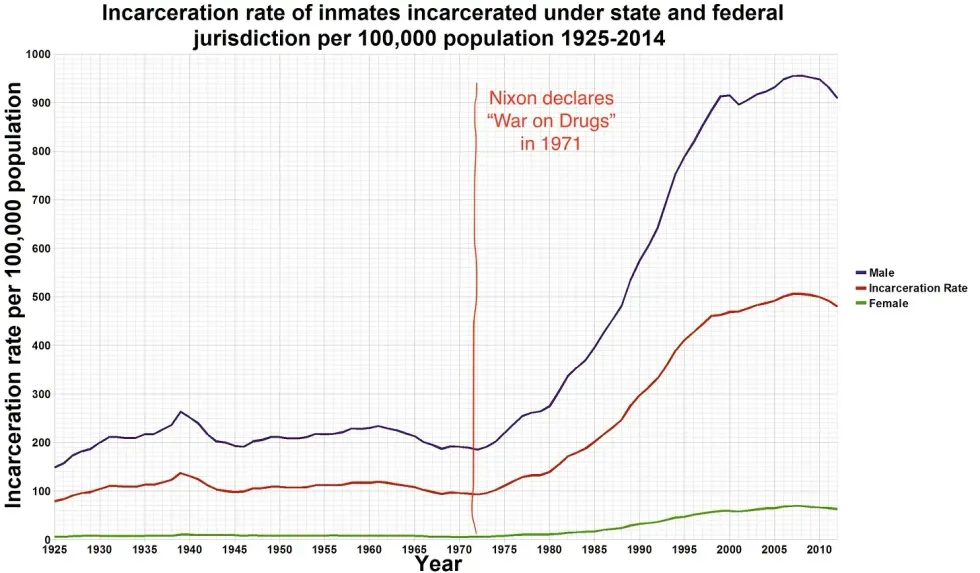 Source: adapted from Wikipedia on US Incarceration rates
Nixon, as you can see, had considerable success in his generation’s version of today’s “war on woke.” Literally millions of careers were disrupted, people imprisoned, and lives brutally ended by his campaign to seize and hold political power. It echoes to this day, particularly in Red states where a joint can still get you years in prison.
Republican use of language to demonize people who aren’t straight white men have bridged America’s modern political history.
— Reagan referred to “welfare queens” and “young bucks buying steak” with food stamps.
— George HW Bush had Willie Horton, the “unrepentant rapist and killer” of white women.
— George W. Bush handily lumped all Muslims into the “radical terrorist” category as he ran illegal torture sites around the world.
— Donald Trump referred to “Mexican murderers and rapists” while throwing a sop to “good people on both sides.”
— And now the GOP has settled on the word woke as their way of shouting out to racists, Nazis, and hate-filled bigots.
The simple reality that every demagogue in history has known is that it’s more powerful to declare revenge and war against an enemy than to proclaim a positive vision for the future. It’s why Trump recently told his followers that he is “your retribution.”
Words have the meaning that culture and repetition give them, which gives us the key to using “woke” against Republicans.
While the openly Nazi and racist Republican base knows well how attacking woke is shorthand for hating on Black people, queer folk, and progressive allies, the word has a much more amorphous meaning for most of the rest of America.
And therein lies the opportunity for Democrats.
A week before the 1988 election, the front page of The New York Times carried a story headlined:
“Dukakis Asserts He Is a ‘Liberal,’ But in Old Tradition of His Party.”
Rush Limbaugh had started his show — and his relentless demonization of the word liberal — just four months earlier.
At its core, their effort to turn woke into a pejorative is about the politics of elimination, about erasing large swaths of American history, about pushing queer people back into the closet, about turning schools into indoctrination factories.
By the 1992 presidential election, Bill Clinton won, in part, by running away from the word. The New York Times headline for September 26, 1992 told the entire story:
“Clinton Says He’s Not Leaning Left but Taking a New ‘Third Way.’”
Running for re-election in 1996, The Washington Post’s headline highlighted Clinton’s continuity: “Clinton Says He Is No Liberal.”
It would be thirty years before a Democratic nominee for president could safely assert that he was a liberal (and Hillary continued to avoid the word right up to the day she lost in 2016).
Joe Biden, in 2020, came right out and said it:
“I was always labeled as one of the most liberal members of the United States Congress. … All during my career as a senator and as vice president — the things that we did in the United States — as president and vice president of the United States, I thought they were pretty progressive.”
Meet, in other words, the power of reframing a word.
Progressives and Democrats need to take a page from the old Limbaugh playbook and pound on the GOP’s use of the word “woke” as a slur.
Make it as simple as possible, whenever Republicans invoke the word:
Republicans attack woke, in addition to shouting out to the racist base, because they’re trying to hide how deeply they’re in the pockets of fringe groups from the white supremacist movement to rightwing billionaires who disdain democracy.
— They don’t want voters to think they’re owned by the fossil fuel and weapons industries.
— It’s embarrassing to them when we point out that nine of the last ten recessions happened during Republican presidencies, or that their abortion bans are really about controlling the bodies and lives of women and have nothing to do with “saving the children” they’ll deny food or healthcare to the moment they’re born.
— They want their book bans framed as anti-pornography campaigns rather than what they really are: anti-intellectualism, attempts to whitewash history, and a fear of modernity.
Which is why they constantly talk about “woke.”
It’s a word that, at this moment, means different things to different people.
But, at its core, their effort to turn woke into a pejorative is about the politics of elimination, about erasing large swaths of American history, about pushing queer people back into the closet, about turning schools into indoctrination factories.
Rhetoric like this rarely turns out good. Hitler villainized Jews for years before he started killing them; Rwandan Hutus called Tutsis “cockroaches” before the slaughter began; Pinochet called union organizers “communists and parasites,” then started pushing them out of helicopters.
As we saw so vividly with Richard Nixon’s War On Drugs, language has meaning, impact, and the ability to transform societies.
Therefore, job one for Democrats must be to strip the GOP anti-woke message of its ambiguity. To call out their dog whistle of hate and bigotry for what it is. To do so in political campaigns and letters to the editor; in calls into talk shows and C-SPAN; in conversations with friends, neighbors, and even random strangers.
Turn on a light, the old saying goes, and the cockroaches will scatter. It’s time to bring honest and unflinching light to the Republican Party’s misuse of the word “woke.”
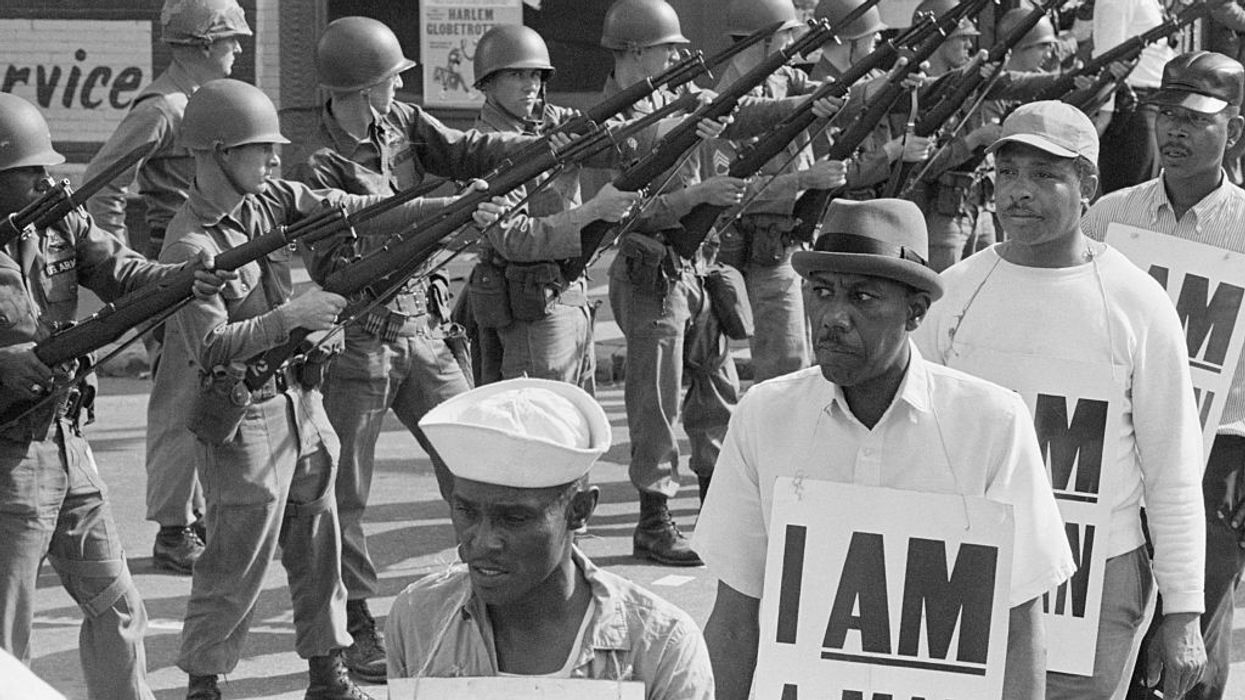
Learning history is partly about understanding injustices past and present. But it’s also about understanding how people came together to fight back.
At 85 years of age, having been a civil rights lawyer virtually all my professional life, at times my mind wanders toward despair.
How as a nation have we fallen into such a place? How have we simply watched as one of our political parties has embraced election deniers who seek to undermine our democracy and mortally weaken our public schools and public universities? How have we watched abortion rights and voting rights come under the gun of right-wing political power?
How is it that members of both our major political parties voted to let Congress and a Republican president weaken banking regulations designed to protect our citizens to the point where a major banking failure threatens us? How could President Biden authorize a massive drilling project for more oil in Alaska, which will only exacerbate the climate emergency?
Teaching history is vital to the common good, not least because it’s a step toward encouraging political engagement at all levels.
Certainly, there are many factors involved. There is the overwhelming desire for political power of some, which negates all else. There is the endless racism and belief by many in white superiority, which tears our country apart.
And even for those of us who believe we think rationally and without prejudice, whether we do or not, there are old but continuing myths that divide us.
On the conservative side, there is the myth that we are a nation of rugged individualists who pulled ourselves up by our bootstraps through hard work and self-reliance alone. These people believe that our problems are caused by a government that taxes their hard earned funds to support those who live on the dole.
On the progressive side, there are too few that stray far from the center of the Democratic Party.
Too many moderates believe in the myth of equal rights in the United States even as voting rights and women’s rights to control their own bodies are violated systemically. Many have rightly denounced the Supreme Court for its backward rulings, but still fail to see the court as anything other than a political body standing at the ready to destroy progressive dreams on many fronts.
Meanwhile, the right-wing war on “wokeness” carries a serious threat to public education, the teaching of history, and our nation's understanding of racism in the United States. State legislatures and governors keep passing laws to limit what teachers can teach at the risk of criminal charges.
So where do we go from here? Why not start with reclaiming that single word, "woke"?
That word, which originated in African American culture to mean “awakened to the injustices around you,” has been bastardized by right-wing politicians to mean virtually anything they don’t like. Today, extreme Republican politicians like Florida Governor Ron DeSantis have been weaponizing white fears of "wokeness" to criminalize basic teaching about slavery and other American history.
Yet that teaching is vital to the public’s understanding of the true history of this country since the Civil War, when slave-like conditions were reestablished in the South, enforced by Jim Crow laws and the Klan. That teaching is vital to understanding that racism still exists all over America despite the passage of the 1960s Civil Rights and Voting Rights Acts.
Put simply, whites need to understand that clever spin doctors have turned "wokeness" into grounds for reducing, discarding, and sanitizing history.
This is where we must fight back.
Knowing our history means acknowledging our country’s many injustices. But it also means learning about the times when white people worked together with Black-led movements to pass the 1960s civil rights laws — and continue to do so today in spaces like the Poor People’s Campaign. That knowledge points the way to building a more just country today.
Knowing this other history — of effective social movements — can help people to come together across races to address the wounds caused by police brutality, the school-to-prison pipeline, discrimination, and other injustices today.
In short, history is a tool that can help people come together to work for a better America. It is not a "weapon" to keep them apart.
Teaching history is vital to the common good, not least because it’s a step toward encouraging political engagement at all levels. This engagement takes time. But without that effort, our common dreams will remain just that: the dreams of people who do not understand how "woke" has become "woke" and how to return it to its original meaning and broaden it in the process.
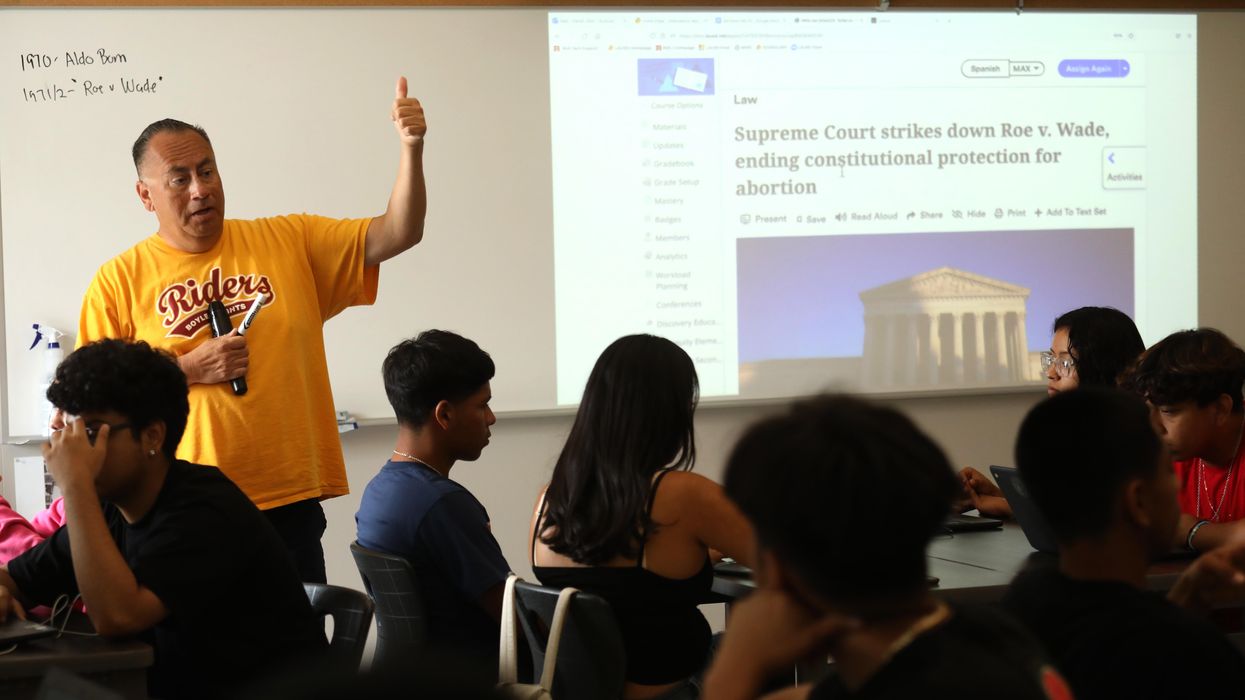
That's all being "woke" really means. I'm not sure what's so controversial about that.
“I advise everybody, be a little careful when they go along through there – best stay woke, keep their eyes open.”
–Lead Belly “Scottsboro Boys”
How can you understand a problem if you are not allowed to name it?
How can you fight injustice if you are forbidden from learning its history and connection to the present moment?
These questions are at the heart of a well-financed war against a simple term – woke-ness.
Since the summer of 2020, oligarchs and their tools in the United States have been waging a disinformation campaign against that term – especially as it pertains to our schools.
Chiding, nagging, insinuating – you hear it constantly, usually with a sneer and wagging finger, but what does it really mean?
To hear certain governors, state legislators and TV pundits talk, you’d think it was the worst thing in the world. But it’s not that at all.
In its simplest form, being woke is just being alert to racial prejudice and discrimination.
That’s all – just knowing that these things exist and trying to recognize them when present.
I’m not sure what’s so controversial about that. If we all agree racism is bad, why is it undesirable to acknowledge it exists when it’s demonstrably there?
More specifically, being woke means focusing on intersectionality – how issues of race, class and gender overlap and interrelate with each other. It means practicing critical race theory – not the made up dog whistle conservatives use to describe anything they don’t like being taught in school, but the study of how racial bias is inherent in many Western social and legal systems. It means using the lens of Black feminism, queer theory and others to address structural inequality.
Again, why is that a bad thing? If we agree that prejudice is bad, we should want to avoid it in every way possible, and these are the primary tools that enable us to do so.
Our society is not new. We have history to show us how we got here and how these issues have most successfully been addressed in the past.
But these Regressives demand we ignore it all.
Shouldn’t we protect hard-fought advances in human rights? Shouldn’t we continue to strive for social justice and the ability of every citizen to freely participate in our democracy – especially in our public schools?
Of course we should!
But leaders of the backlash will disagree.
Like in so many other areas of our culture, they have stolen the term “woke-ness” and tried to co-opt it into another invented grievance. For people who deride their political opponents as being too fragile and unable to handle reality, they certainly find a million things to cry about on their 24-hour news networks to keep their base angry and engaged all the time.
They have attacked librarians, spied on and harassed teachers, banned books and weaponized the law to forbid certain ideas from our schools and public spheres.
They have targeted and demonized antiracist work. They have tried to discredit the concepts that Black women and LGBTQ people have created to explain and improve the inequitable conditions of their lives.
And the reason is crystal clear – they oppose that work.
They oppose anti-racism. They oppose the rights of Black women and LGBTQ people to better treatment.
They are against everyone but a perceived white, male, heteronormative majority that doesn’t even really exist.
But it is Regressives’ anti-woke agenda that is really all of those things.
For them, up is down and circles are squares.
As public school teachers, being woke is not a choice. It is a responsibility.
For we are the keepers of history, science and culture.
Who will teach the true history that for more than 400 years in excess of 15 million men, women and children were the victims of the transatlantic slave trade? Who will teach the true history of the fight against human bondage and the struggle for equal rights? Who will teach about women’s fight for suffrage, equal pay, and reproductive freedom? Who will teach about the struggle of the individual to affirm their own gender identity and sexual expression?
We, teachers, must help students understand what happened, what’s happening and why. And to do so we must protect concepts that emerged from decades of struggle against all forms of domination.
It must be us.
It won’t be the College Board, a billion-dollar American business calling itself a non-profit, that after years of stalling finally released its Advanced Placement African American Studies curriculum – a college-level course available for high school students nationwide. In the wake of political backlash, the new course material is as watered-down as weak tea in comparison to previous drafts of the course.
This just goes to show that the free market will never stand up to political power if it is perceived as adversely affecting the bottom line. True education comes not from corporate academic standards or standardized test gatekeepers. It comes from teachers.
And we must teach like never before because our lessons have a pivotal impact on society at large.
Intersectional frames such as those under attack by billionaires posing as populists have been incredibly important in supporting overlooked social problems and addressing today’s human rights failures.
Those of us who know history understand that suppression of knowledge and intellectuals (especially those from marginalized peoples) are a tool used to increase racism and oppression – to overturn the progress of the last century.
Refusing students access to books, criminalizing “divisive concepts,” and discrediting those with whom they disagree have all been tools of domination. Just as denying the persistence of any inequality has been a tool to discredit its victims.
Progress has been made in the last hundred years, but the struggle is not over. And denying that there are any problems left to solve is a way of stifling that progress and turning back the clock against it.
If we give in to these partisan “anti-woke” imperatives, we enable the return of racist and cultural inequalities that had been at least partially rectified years ago. We clear the way for these extremists to bring back a mythical past in which women are meant to be merely subservient to men and where race, gender and sexuality are rigidly defined and limited according to the ruling class.
Teachers, we cannot allow this to happen.
We stand at the gates, the first (and perhaps last) line of defense, because we stand at the schoolhouse doors.
It is a responsibility none of us signed up to take. But here we are.
If we are truly educators, we must teach the truth.
We must put the facts in their proper context.
We must encourage our students to think about what came before and what’s happening now.
We must stay woke.
Or the whole world sleeps.
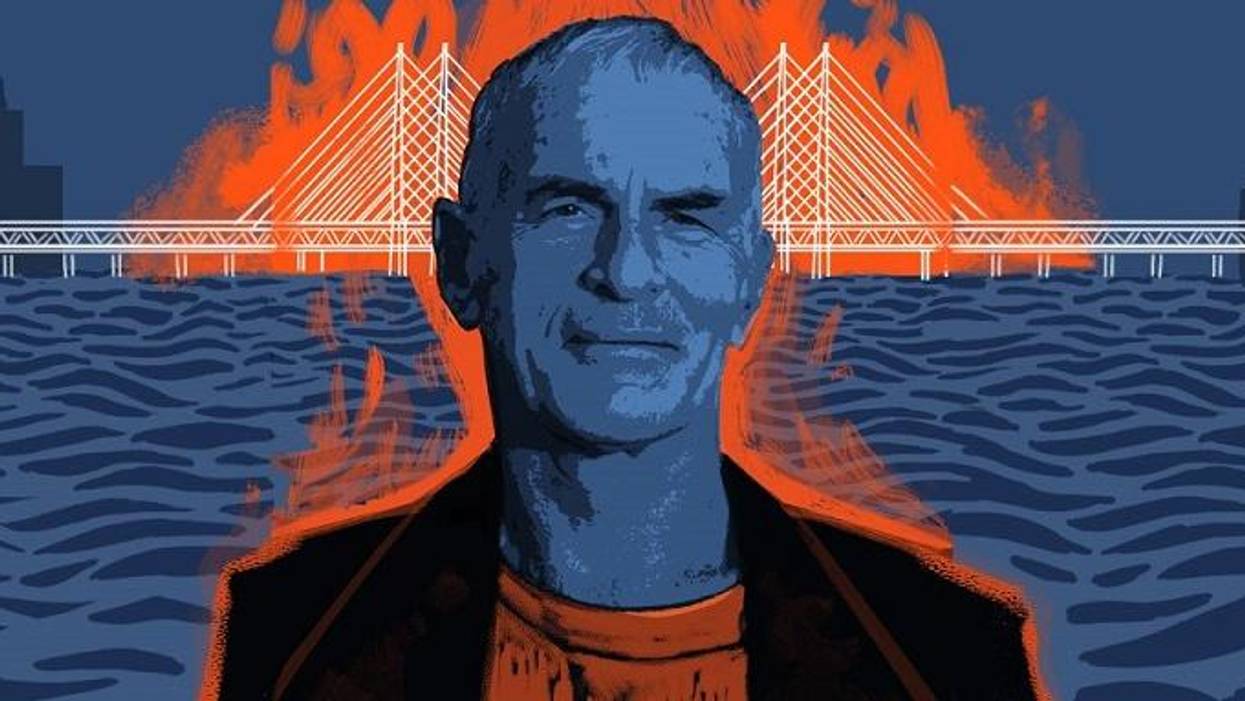
A few thoughts on the new book, "I'll Burn That Bridge When I Get to It!"
As I was reading Norman Finkelstein's new book, I'll Burn That Bridge When I Get to It!: Heretical Thoughts on Identity Politics, Cancel Culture, and Academic Freedom, I thought early on of Obama's joke at the expense of Rahm Emanuel: "he's one of a kind, and thank god he's one of a kind." Finkelstein, too, is very much one of a kind. But the analogy with Emanuel fails, because in fact one Rahm Emanuel is far too many whereas one Finkelstein is not nearly enough. We need hundreds of him. That is to say, we need hundreds of left intellectuals with the courage and intelligence to think for themselves and never sell out, to refuse to compromise—even to risk alienating fellow leftists by publicly repudiating woke culture and the more vacuous forms of identity politics in favor of an unstinting adherence to class politics. Nor would it hurt to have more writers who are as eloquent and hilarious as him.
It is widely known on the left that Finkelstein is, as it were, a martyr to truth and justice, having been subject to outrageous calumniation and denied an academic career because of his relentless advocacy of the Palestinian cause. With I'll Burn That Bridge, he shows his willingness to burn bridges not only with the establishment but also with the "left" of today, for which he shows scarcely mitigated contempt. He considers it, or dominant tendencies within it, to have degenerated from soaring moral and intellectual heights with Rosa Luxemburg, W. E. B. DuBois, and Paul Robeson into a censorious, narcissistic, morbidly navel-gazing culture preoccupied with subjectivist trivialities like personal pronouns at the expense of solidaristic struggle for a better world. "Whenever I see he/him or she/her, I think fuck/you." ("You must be living an awfully precious life," he goes on, "if, amid the pervasive despair of an economy in free fall, your uppermost concern is clinging to your pronouns.") If the book is not simply ignored, one can expect that it will elicit a flood of vituperation from leftists and liberals: "racist, misogynistic, transphobic, white supremacist, juvenile, incoherent, petty!" The intelligent reader will not be tempted by such facile judgments but instead will engage with the book's substance, because it has important things to say.
It consists of two parts: in the first, Finkelstein "deconstructs" identity politics and the cancel culture it has given rise to, focusing on five figures whom he eviscerates: Kimberlé Crenshaw, Ta-Nehisi Coates, Robin DiAngelo, Ibram X. Kendi, and Barack Obama. In the second part, he considers a related subject with which he is intimately familiar: academic freedom. To what extent should a regime of free speech reign on the university campus, and under what circumstances should an academic's "offensive" speech in the public square result in disciplinary action? Is it wrong for universities to grant Holocaust deniers a platform? When teaching, should professors strive for "balance"—presenting with equal force all sides of an issue so that students can make up their own minds—or should they teach only their own perspective? What should we think of campus speech codes? Finkelstein addresses all such questions at length and in a spirit of uncommon seriousness.
The intelligent reader will not be tempted by ... facile judgments but instead will engage with the book's substance, because it has important things to say.
One difficulty with the book is that it has a sprawling and meandering character, consisting variously of memoir, brutal polemic, dense argumentation, forensic dissection of texts, scores of long quotations, innumerable long footnotes, and very funny ridicule of everything and everyone from Michelle Obama to Bari Weiss, from the New York Times to woke terms like Latinx ("why would an ethnic group want to sound like a porn site?"). At its core, however, beneath the variegated surface, the book is an anguished cri de coeur against pervasive cultural, political, and intellectual rot—an unapologetic defense and exegesis of the heavily maligned "Western canon" (John Stuart Mill, Karl Marx, Bertrand Russell, Kant, DuBois, Frederick Douglass, and the like), a sustained lamentation over how far the left has fallen, a furious denunciation of rampant philistinism and pusillanimous groupthink (quoting Mill: "That so few now dare to be eccentric marks the chief danger of the time"), and a proudly unfashionable celebration of such quaint notions as Truth, Reason, and Justice (which Finkelstein capitalizes, in a consciously anti-postmodernist flourish). The book's kaleidoscopic nature and intimidating length might bewilder the reader, so in this review I propose to summarize and comment on several of its main arguments, to facilitate their diffusion.
Before doing so, however, I can't resist quoting a few Finkelsteinian zingers, to preface the following heavy discussion with a bit of levity. On MSNBC's Joy Reid: "living proof that not all yentas are Jewish and not all bovines are cows." On Angela Davis: "Once upon a time she was on the F.B.I.'s Ten Most Wanted List. Now she's on Martha's Vineyard's Five Most Coveted List." On Henry Louis Gates: "a virtuoso at crawling on the ground while typing on his keyboard." On Amy Goodman (whom he doesn't name): "Goddess of Wokeness…a woke machine, churning out insipid clichés as her mental faculty degenerates to mush." On Ibram X. Kendi: "mallet-wielding grifter…preposterous poseur…[whose] 'definitive history of racist ideas in America' reduces to a compendium of prepubescent binary name-calling." On Robin DiAngelo's morbid obsession with diagnosing "racism": "She is the monomaniacal Captain Ahab in pursuit of the White Whale. She is little Jackie Paper out to slay Puff the Racist Dragon. Her palette comprises two colors—white and black… What an unremitting, remorseless, insufferable bore!" On the widespread fascination with transgender people: "the first day of a graduate seminar, students used to describe their intellectual interests. Nowadays, it's de rigueur to declare your sexual orientation. It's only a matter of time before a student announces, 'I'm she/her and I'm packing a thick, juicy nine-incher.'"
In an adaptation of Emma Goldman's "If I can't dance, I don't want your Revolution," Finkelstein declares: "If I can't laugh, I don't want your Revolution." Political conservatives, too, have complained about the humorlessness of the woke crowd, but if you're alienating even die-hard leftists, maybe it's time to rethink your messaging.
Debates on the left over identity politics go back decades, and it is easy to be sick of them. Unfortunately, there is no prospect of their ending as long as identity politics and woke culture remain dominant on the left and in the Democratic Party—as they surely do today, at the expense of a class politics. Finkelstein is aware that the identity politics of the left isn't quite the same as the identity politics of the Democrats, but he is right that they overlap, and that such a politics is more conducive to being neutered into empty symbolism (statues, token representation in the corporate class, electing a vapid con artist like Obama) than a Bernie Sanders-style—or more radical—class politics is.
Serious leftists, like Robin D. G. Kelley, have written competent defenses of identity politics, and Finkelstein certainly isn't arguing against the necessity of incorporating anti-racism, anti-sexism, anti-homophobia, and other such "woke" agendas into popular movements. What he objects to are the forms that identity politics often takes, and its tendency to devolve into celebration of an insular tribal identity. The binary, balkanizing drawing of lines between groups and near-contempt for the "oppressing" group—white vs. black, cis vs. trans, straight vs. gay, man vs. woman—is, in its parochialism and vitiating of solidarity against capitalism, not what a real left politics looks like. He quotes at great length some words of Frederick Douglass in 1894 that might well have gotten him "cancelled" today:
We hear, since emancipation, much said by our modern colored leaders in commendation of race pride, race love, race effort, race superiority, race men, and the like… [But] I recognize and adopt no narrow basis for my thoughts, feelings, or modes of action. I would place myself, and I would place you, my young friends, upon grounds vastly higher and broader than any founded upon race or color… We should never forget that the ablest and most eloquent voices ever raised in behalf of the black man's cause, were the voices of white men. Not for the race; not for color, but for man and manhood alone, they labored, fought and died… It is better to be a member of the great human family, than a member of any particular variety of the human family… I put my foot upon the effort to draw lines between the white and the black…or to draw race lines anywhere in the domain of liberty.
Moreover, the very idea of being "proud" of what group one happens to belong to—proud of being black or a woman or gay or trans—is puzzling. "[I]t perplexes why one should feel proud of one's zoological difference," Finkelstein writes. "[W]hat sense is there in making a 'cult' of that over which one has no choice…? Shouldn't one aspire to transcend the 'inevitable' part—the color of one's skin—so as to be judged by the 'free part'—the content of one's character?" Similarly, the idea of "loving one's people" is odd, first in that it amounts to "loving one's self writ large," which, in its narcissism, hardly seems like a noble thing. It easily becomes chauvinism. Second, one would certainly not love all the individuals who are alleged to constitute "one's people." Many or most of them one would likely personally despise—just as, on the other hand, one would "love" many people belonging to a "different group." Too much identification with some imposed identity such as race is exactly what leads to irrational racial hostility (including against whites), sexist hostility (also against men), and other divisive social forces. Identity politics can be dangerous and destructive, not only on the right but even the left. "In their goodness and badness, there exist only persons, not peoples."
The vacuousness of contemporary identity politics is best exposed by considering its "great minds," the Crenshaws, Coateses, Kendis, and DiAngelos. For a really thorough demolition, Finkelstein would have had to review the record of various feminist and queer theorists too, but it's a big enough task to critique the writers on race. Or, more precisely, that isn't a difficult task—it's so easy that Finkelstein is able to devote huge chunks of these chapters to sheer mockery—but it does require patience and a willingness to wade through endless intellectual muck. Take Crenshaw. Unsurprisingly, in her seminal 1989 article on intersectionality "Demarginalizing the Intersection of Race and Sex," "she conspicuously omits class in her dissection of oppression." It disturbs her that white feminists are presumptuous enough to speak for black women, but she "seems less concerned or, for that matter, even conscious that a high-achieving Black woman speaking for Black working-class women might also be problematic."
The vacuousness of contemporary identity politics is best exposed by considering its "great minds," the Crenshaws, Coateses, Kendis, and DiAngelos.
Or take DiAngelo. She has a pathological obsession with racism and an utterly Manichean, paranoid view of the world. If you're white, you're a racist—whether you're John Brown or Jefferson Davis, a fascist or an anti-fascist. Racism is ubiquitous, "immovably entrenched in our psyches and structures" (as Finkelstein paraphrases), "the air we breathe and the water we drink," all-encompassing and constantly reproduced, she says, "automatically"—and therefore, evidently, ineradicable. At best, it can occasionally be "interrupted"—through the "diversity training" at which DiAngelo excels and for which she charges a hefty fee. Meanwhile, her book White Fragility has sold almost a million copies and has had quite an influence on woke culture, helping to instill a collective fixation on—incidentally—the same idée fixe of Ta-Nehisi Coates (according to Cornel West): the almighty, unremovable nature of white supremacy. "Whites," says DiAngelo, "control all major institutions of society and set the policies and practices that others must live by." Yes, whites are a homogeneous master-class: the billionaires and the working class, they're all equally guilty, they're all oppressors. And to blacks she says, as Finkelstein summarizes, "Beware! Don't trust white people! They're all racists, racists to the core! Every last one of them! They're hard-wired for racism; it's in their DNA." This is a message perfectly calculated to pit workers against each other. No wonder the business class has so enthusiastically promoted her book!
What about Ibram X. Kendi? Finkelstein seems to take particular pleasure in disemboweling this (as he says) non-scholar and non-activist, for his critique/massacre is a full 110 pages long and features withering juxtapositions with a titan, DuBois. It's sad that a book review can't communicate the verve or the slicing humor of this chapter (and others). Kendi's book Stamped from the Beginning: The Definitive History of Racist Ideas in America, for example, whose "only novelty is to shoehorn the epithets racist or antiracist, segregationist or assimilationist into every other sentence…[is] less a definitive history than an exhaustive, and exhausting, taxonomy that's as supple as a calcified femur and as subtle as an oversized mallet. It proceeds from the fatuous, almost juvenile, conceit that fastening binary, wooden labels on the actors and ideas incident to Black history will shed light on it." One problem with Kendi's and our culture's promiscuous, indiscriminate use of the label "racist" is that the concept becomes diluted: "to be a racist ceases to be what it ought to be: a scarlet badge of shame… [W]hat information is conveyed by a label that collapses the distinction between Frederick Douglass [whom Kendi considers a racist] and the Grand Wizard of the K.K.K.?" The abolitionists were all racists, as were DuBois, Martin Luther King Jr., Richard Wright, E. Franklin Frasier, etc. etc.—while Kendi singles out for praise Harry Truman, Michelle Obama, Eldridge Cleaver, Pam Grier, Bo Derek, Kanye West, etc. "[T]he rigor of his taxonomy recalls not the Periodic Table but, on the contrary, Pin the Tail on the Donkey."
As Finkelstein says, Kendi embraces the woke conceit that, over four hundred years, "African-Americans haven't registered any progress in the struggle against racism. Each seeming stride forward has been attended by a step backward." If anything, he implies, things have only gotten worse! Such an "analysis" recalls the flagrantly ahistorical, unabashedly gloomy academic school of Afro-pessimism, and, by reifying differences between "whites" and "blacks" and valorizing anti-white resentment among the latter, serves the same function of hindering the class solidarity necessary to achieve real progress in struggles over the distribution of wealth, working conditions, affordable housing, high levels of unemployment, expansion of public resources, abysmal healthcare, environmental destruction, hypertrophying militarism, and the like. (No wonder, again, Kendi has been fêted by the establishment and can charge $45,000 for his talks. It helps, too, that his only real policy proposal is…affirmative action.)
After Finkelstein's devastating exposure of Kendi's countless inconsistencies, hypocrisies, and idiocies—his woke dismissal of the Civil Rights Movement in favor of the macho Black Panthers (who, by comparison, achieved almost nothing); his (in Kendi's words) "striving to accept and equate and empower racial difference" even as he argues that the idea of race is a "mirage" that was invented to rationalize exploitation; his insistence that all racial disparities in society are purely a result of racism; his valorizing of racial differences (e.g., he praises the "irrepressible Blackness" of his friend) at the same time as he says anti-racists see only individuals and not racial behavior ("there is no such thing as Black behavior"); his positing of a deep separation between so-called white culture and black culture; his arguing against the racist "assimilationist" urge to value white culture over black even as he manifestly values white culture over black (lecturing before white audiences, accepting a fellowship at Harvard University, presiding over a research center at Boston University, being proud of publishing in white journals like The Atlantic)—nothing remains but the empty husk of a social-climbing charlatan. That such a person can be widely considered to be more or less on the left is a crushing indictment of the state of the left.
For charlatanry, though, few can beat the next entry on Finkelstein's shit list: Obama. "Barack Obama is the perfected and perfect instrument of identity politics, its summa summarum. He represents the cynical triumph of form over substance, color over character. He is the cool Black dude who is also the reliable—in Professor Cornel West's words—'mascot of Wall Street.'" Most leftists are hardly enamored of Obama, so I need not summarize the case against him. Nor would I even try, because I couldn't possibly reproduce the distinctive Finkelsteinian humor—and most of this very long chapter consists of (factually grounded) ridicule, directed at nearly everyone in Obama's presidential coterie, a "revolting retinue of bootlickers." Aside from Obama himself, the most satisfying skewering, I found, was of Samantha Power, the "Battleaxe from Hell…downright evil…[whose] conscience only bestirs at the suffering of victims of official U.S. enemies." One might argue that in this chapter Finkelstein's profound contempt for the "Elmer Gantry in blackface" at the head of this gaggle of amoral mediocrities gets the best of his prodigious literary gifts, since the ruthless mockery goes on and on and becomes somewhat tiresome, but it can't be gainsaid that it's all well-deserved.
After six chapters and almost 400 pages on the subject, Finkelstein's summary of identity politics is worth quoting:
Identity politics has distracted from and, when need be, outright sabotaged a class-based movement [viz., Bernie Sanders'] that promised profound social change. It counsels Black people not to trust whites, as their racism is so entrenched and so omnipresent as to poison their every thought and action. It conveys to poor whites that they, no less than the white billionaire class, are beneficiaries of racism, so that it would be foolhardy of them to ally with Black people… Then, identity politics puts forth demands that either appear radical but are in fact politically inert—Defund the police, Abolition of prisons—as they have no practical possibility of achievement; or that leave the overall system intact while still enabling a handful, who purport to represent marginalized groups, to access—on a "parity" basis—the exclusive club of the "haves." This, in effect, performance politics has spawned a disgusting den of thieves who brand themselves with radical-sounding hashtags, churn out radical-sounding tweets, and insinuate themselves into positions of prominence, as they rake in corporate donations, cash corporate paychecks, hang out at the watering holes of the rich and famous, and thence can be safely relied upon not to bite the hand that feeds them…
One might object that he's painting with too broad a brush here, that advocacy of the interests of minorities and women can, depending on the context and the cause, indeed be an essential political program, but he wouldn't deny this. He has the highest regard for the Civil Rights Movement, after all—although he would deny that that was identity politics. "The human rights of a victimized group must, of course, be uncompromisingly defended." More problematic than such defense is to make a cult of group differences (group "pride") in the way of the woke, and to place class issues at the bottom of the heap rather than the top, where they belong. "Human dignity is not possible without the ability to pay for a roof over one's head, clothes on one's back, and food on one's table."
Just consider how the woke mob reacted to the Sanders campaign, the most serious challenge to the establishment in more than a generation...
Whatever genuinely emancipatory political impulses exist in identity politics have long been, on the whole, coopted and buried under an avalanche of left-liberal virtue-signaling, preening and posing, careerism, and sabotage of a substantive left. Just consider how the woke mob reacted to the Sanders campaign, the most serious challenge to the establishment in more than a generation: they tried to "cancel" Sanders for his being a "privileged white male" with a supposed blind-spot on race. His "economic reductionism," according to Angela Davis, prevented him from "developing a vocabulary that allows him to speak…about the persistence of racism, racist violence, state violence." As Finkelstein says, "When the 'hour of serious danger' to the status quo struck during Bernie Sanders' class-struggle insurgency, the 'true nature' of woke radicalism—not just its opportunism but, even more, its rancid, reactionary core—was exposed as each and all of these erstwhile 'radicals' enlisted under the banner to stop him." Woke cancel culture cooperated with the establishment media's cancel culture to stop the Sanders juggernaut.
"Cancel culture might be defined as the turning of a person into a non-person." By that definition, it has been around for a very long time. Arguably, it is as old as civilization. The first and second Red Scares in the U.S. were instances of cancel culture; so is the corporate media's treatment of virtually everyone on the left; so is the woke treatment of anyone who publicly strays from the party line. Even if such victims of woke defamation campaigns usually find their footing again or don't always suffer career consequences in the first place, the mob's impulse to censor and silence remains operative and ever-vigilant. Finkelstein knows cancel culture from the inside, and it is unsurprising that he resolutely opposes it.
His defense of a regime of nearly untrammeled free speech is rooted, first and foremost, in his conviction that this is the surest way to Truth. He quotes DuBois: when free speech is stifled, "the nation…becomes morally emasculated and mentally hog-tied, and cannot evolve that healthy difference of opinion which leads to the discovery of truth under changing conditions." But John Stuart Mill's On Liberty is the text he primarily grounds his argument in, and he quotes from it liberally in his chapter on the right of even Holocaust deniers to make their case in public forums such as a college campus. "Complete liberty of contradicting and disproving our opinion," Mill writes, "is the very condition which justifies us in assuming its truth… The beliefs which we have most warrant for, have no safeguard to rest on but a standing invitation to the whole world to prove them unfounded." As Finkelstein translates, "if you want to rationally hug your certainty, you must first meet the challenge of every naysayer." Your opponents can even be useful for prodding you to rethink weak points in your reasoning or evidentiary basis, exposing little errors in your arguments, giving you something to think about that you had overlooked, in general giving you the opportunity to more rationally ground your beliefs.
The mob's desire to silence, attack, and destroy comes from feeling threatened, not from being rationally certain and confident. The latter attitudes are more likely to yield calm composure and willingness to give opponents a hearing because you know you're able to refute them. When a mob tries to prevent someone from talking because it feels threatened by his speech, it's quite possible, often, that his speech has some truth in it. Suppressing it—unless it's merely emotive speech like "fuck you!"—possibly allows his opponents to persist in having false or partially false views.
But someone might reply, "What if his speech is socially harmful? Isn't that a legitimate reason to suppress it?" Well, the definition of "harmful" is, of course, contested, and it evolves over time. Eugenics and forced sterilization were once considered a very enlightened movement, being supported by progressives like Bertrand Russell, Helen Keller, Jane Addams, and Oliver Wendell Holmes. Now eugenics is considered downright evil. Who is to say your definition of "socially harmful" is, in all cases, the right one, or that your application of it is always right? "When it comes to curbing speech," Finkelstein says, "experience thus confirms the general rule in human affairs: humility is to be preferred over arrogance."
The mob's desire to silence, attack, and destroy comes from feeling threatened, not from being rationally certain and confident.
Moreover, if the "harmful" speech is socially marginal such that hardly anyone believes it, what's the great danger in letting someone say it now and then? If, on the other hand, it's not marginal but holds the assent of millions, letting someone express it presents an opportunity to argue against it and thus inoculate people. The strategy of pure suppression is apt to lead many to think there might be something "dangerously truthful" to it—"the establishment doesn't want us to hear this because it's threatened by its truth!"—and thus might contribute to its diffusion across the population. People might think they're being "rebellious" or anti-establishmentarian by believing it, and furthermore that they're upholding noble values of free speech against authoritarian censoring leftists (as the reactionary right thinks today). I might also note that giving authorities the right to suppress or punish certain kinds of speech, and even encouraging them to do so, will soon lead to their suppressing speech you like.
The left has historically been in the vanguard of fights for free speech, from the abolitionists to the IWW (and most other unions, in fact) to the Socialists during World War I to the Civil Rights Movement. Its departure today from these honorable traditions is yet more evidence that it's become a pseudo-left, a reactionary left—for the empowering of authorities to regulate speech is ultimately reactionary. It's ironic that many self-styled anarchists advocate increasing the power of unaccountable bureaucrats to control what is said and what isn't.
Admittedly, it might have strengthened Finkelstein's discussion to consider in more depth possible counterarguments. It is, after all, very unfortunate that media operatives like Rush Limbaugh, Alex Jones, and the whole stable of Fox News social arsonists have brainwashed millions of people. It is likely they couldn't have had such a destructive impact had the FCC's Fairness Doctrine not been repealed in 1987. Maybe it was right to repeal it, but a case can at least be made that it was wrong. Issues of online content moderation, too, come into play in any debate over censorship, and Finkelstein doesn't say much about these. The reason, it seems, is that he doesn't think the internet has raised significantly new questions about free speech, and in any case there is already an extensive literature on web censorship.
Wokeness is what happens when the destruction of the labor movement proceeds so far, and social atomization becomes so all-consuming, that even the "left" adopts an individualistic, moralistic, psychologistic, censorious, self-righteous, performative approach to making social change.
Among the many excellent points he makes is one that cuts to the heart of wokeness: the collective obsession with pinning a label—racist or not, sexist or not, transphobic or not—on every thought passing through one's head and every utterance one makes, and then cancelling all the thoughts that (and all the people who) stray an inch past what's deemed "acceptable," is ridiculous and paranoid. It's also reactionary, because it makes solidarity vastly more difficult. One of the more memorable passages in the book is when he imagines, in some alternate universe, a Robin DiAngelo who actually does care about fighting oppression of blacks and not only grifting off a culture's pathologies. Were she to speak before a group of workers, she might say something like this (italics in the original):
Although racism is real and you should always be at the ready to fight it whenever it rears its ugly head, you all, Black and white, have a helluva lot more in common. You're all, Black and white, trapped in dead-end jobs. You all earn poverty wages… [You have to] organize together, as one because you are one, to overthrow this wretched, corrupt, god-forsaken system. You can't eliminate every fleeting, non-p.c. thought passing through your head… You can't wait until everyone's thoughts are simon-pure. You don't have the time, and they never will be. You cannot police your thoughts, and it's probably better that way. Were it otherwise, you wouldn't be human. You're fallible, you're imperfect vessels… If you unite to change the system, then your psyches will fall into place. It's common struggle, common sacrifice, that produces mutual respect, even mutual love. A connection that binds will be forged by you, united in the heat of battle facing a common enemy, each marching beside the other, each lifting the other, each protecting the other. You don't become better persons by each of you, singly, struggling with your racist demons. You become better persons by all of you, together, struggling against an antihuman system…
Wokeness is what happens when the destruction of the labor movement proceeds so far, and social atomization becomes so all-consuming, that even the "left" adopts an individualistic, moralistic, psychologistic, censorious, self-righteous, performative approach to making social change.
"The fight against racism must focus…not on the intangible, impalpable, unchangeable, invisible, or unprovable, but, instead, on what's substantive, meaningful, and corrigible. In the first place, securing economic opportunity and legal equality." The Sanders program was far more substantively "anti-racist" than the puny liberal programs of most of his woke critics. (As for Sanders' being constantly hounded to support "reparations" for blacks, I've explained elsewhere why that demand is anti-solidaristic, politically impossible, and ultimately a diversion from radical social transformation.)
The last chapter of I'll Burn That Bridge delves into a specific dimension of cancel culture: when is it appropriate for a professor to be disciplined for his public behavior and statements, whether on social media or in some other context? This issue bears, of course, on Finkelstein's own career, but he is hardly the only academic to have been disciplined in recent decades for alleged "incivility" or taking unpopular political stands. The chapter is tightly argued and has a more disciplined structure than others, consisting of analyses of four academic freedom cases (Bertrand Russell in 1940, Leo Koch in 1960, Angela Davis in 1969, and Steven Salaita in 2014) and then general reflections that conclude in a discussion of his own case. He endorses the American Association of University Professors' standard that "a faculty member's expression of opinion as a citizen cannot constitute grounds for dismissal unless it clearly demonstrates the faculty member's unfitness to serve [i.e., to teach]"—which was surely not the case in the four instances he examines. But he goes much further and questions whether it should even be seen as a professional obligation that one always use civil language in one's scholarship (which Finkelstein didn't when writing about the Holocaust industry and Alan Dershowitz's lies). Given all the invective in Marx's Capital, for example, the book would never have been published by a university press today and Marx wouldn't get a position at a top university. "But if the likes of Marx wouldn't qualify for a tenured appointment at a first-rank university, isn't that a reductio ad absurdum? Doesn't it conclusively demonstrate the inanity of a standard commanding restrained and temperate language?"
It can at least be said for Finkelstein that he practices what he preaches: his book, to put it mildly, does not shrink from uncivil words.
One might connect Finkelstein's lengthy discussion of academic civility with his book's focus on woke politics by pointing to something his targets have in common: a preoccupation with policing language and thought at the expense of more substantive concerns. Academia insists on politeness, decorum, "neutral" language, which often serves to enforce conventions, emasculate dissent, and uphold power structures; wokeness insists on ceaselessly monitoring your own and others' language, in fact making that a priority, allowing people to feel "radical" by doing nothing that remotely challenges real power structures. (No surprise that woke culture has largely emerged from the academy.) To do justice to Truth and Justice, though, requires more than this. In the case of scholarly writing and speaking,
There are moments that might positively require breaking free of the constraints imposed by polite public discourse in order to sound the tocsin that, as we indifferently carry on in a privileged sanctuary of peace and prosperity, innocent people are being butchered by our own state. The uncivil reality, not uncivil words, should be cause for reproach and excoriation, while uncivil words might be called for to bring home the uncivil reality.
It can at least be said for Finkelstein that he practices what he preaches: his book, to put it mildly, does not shrink from uncivil words.
It should be clear from what has been said here that I'll Burn That Bridge When I Get to It is an unusual book. It requires a lot of patience to read, but I think the effort is worth it. It's not a "polished" work, but in an academic and literary environment that sometimes seems to value polish above all else, including moral and intellectual substance, one appreciates something a little more raw. And someone with the courage to tear down—in order to build up.
Finkelstein is in the tradition of the great incorruptible truth-tellers. He relates an anecdote from when he was a graduate student at Princeton in 1984: his work exposing a bestselling scholarly hoax on the Israel-Palestine conflict had gotten the favorable attention of the editor of the New York Review of Books and his friend (Arthur Hertzberg) at Columbia University, and he sensed that career possibilities were opening up for him. But then, in a meeting with Hertzberg, he was bluntly asked, "Are you in Chomsky's stable?" Despite knowing the probable consequences of giving the wrong answer, he unhesitatingly said he deeply admired Chomsky and was grateful for his support—which, of course, was the wrong answer. He never heard from the men again. Even so, "I was proud of myself," he writes, "not to be tempted, at all, by the lure of fame and fortune, and I was grateful for this test of my fidelity to Truth (and Chomsky), so that I could prove in my own person dead wrong the cynics who imagine, or console themselves, that everyone has a price."
That unshakeable commitment, that willingness not to conform, combined with intellectual power, is chiefly what has set Finkelstein apart from most of his peers. One hopes that his book and his example will inspire young idealists to follow in his path.