

SUBSCRIBE TO OUR FREE NEWSLETTER
Daily news & progressive opinion—funded by the people, not the corporations—delivered straight to your inbox.
5
#000000
#FFFFFF
To donate by check, phone, or other method, see our More Ways to Give page.
Daily news & progressive opinion—funded by the people, not the corporations—delivered straight to your inbox.
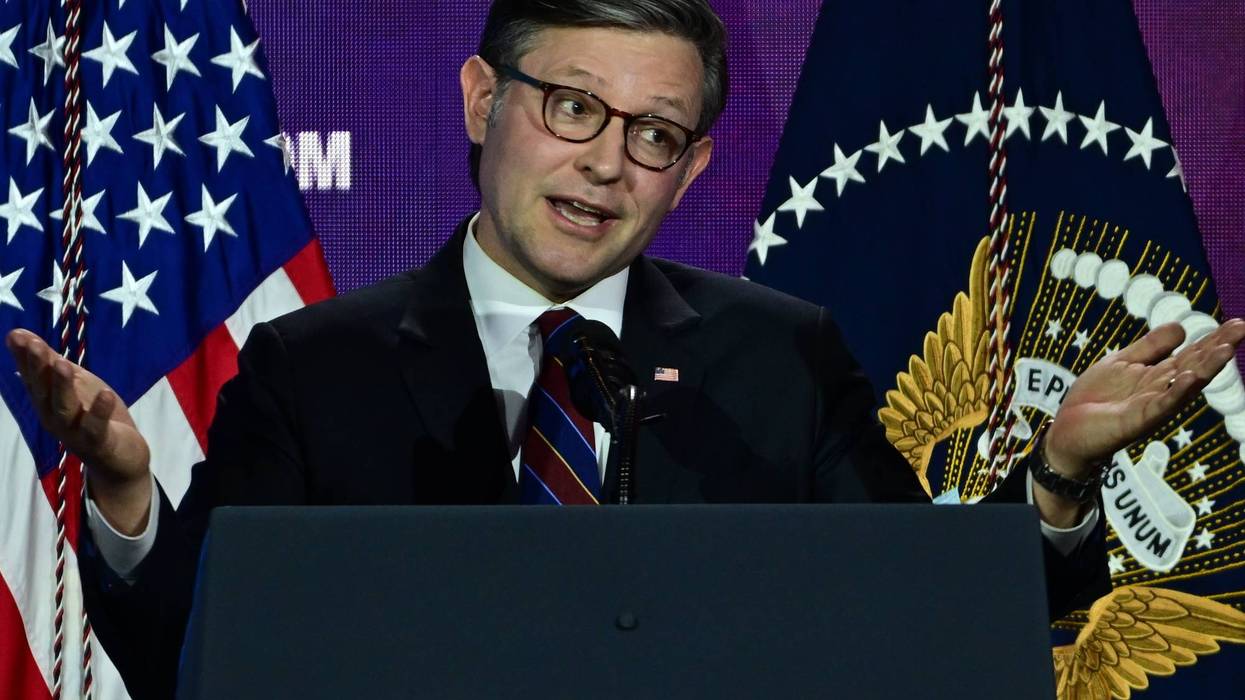
"If Republicans actually wanted to stop congressional stock trading, they’d pass our bipartisan Restore Trust in Congress Act," said Rep. Pramila Jayapal.
The US House of Representatives on Wednesday held a series of key votes, including one in which over a dozen Democrats helped Republicans pass a purported congressional stock trading ban, even though the GOP tacked on a voter suppression provision demanded by President Donald Trump.
The chamber passed the Stop Insider Trading Act (HR 7008) in a 232-198 vote. The Democrats who voted in favor are Reps. Kathy Castor (Fla.), Henry Cuellar (Texas), Don Davis (NC), Jared Golden (Maine), Vicente Gonzalez (Texas), Josh Gottheimer (NJ), Marcy Kaptur (Ohio), Susie Lee (Nev.), Jared Moskowitz (D-Fla.), Chris Pappas (NH), Marie Gluesenkamp Perez (Wash.), Darren Soto (Fla.), and Derek Tran (Calif.).
Taking aim at Trump on Wednesday, Congresswoman Sydney Kamlanger-Dove (D-Calif.) said that "the Stock Trader in Chief made 21,000 stock trades in his first year back in office. I 100% support a stock trading ban for Members of Congress AND the president and VP. But the bill Republicans brought to the floor was only about appeasing Trump."
"It caters to Trump's election conspiracy theories by enacting haphazard voter ID restrictions, and it conveniently excludes him and JD from the ban," she added, referring to Vice President JD Vance. "I voted no."
Many other House Democrats joined voting rights advocates in opposing the bill in the lead-up to Wednesday's vote, with Congressional Black Caucus Chair Yvette Clarke (D-NY) denouncing it as "a Trojan horse—using the premise of congressional ethics reform to advance a broader effort to restrict access to the ballot box."
In a letter to Congress earlier this week, the Campaign Legal Center (CLC) warned that "the Voter ID Act—which mostly mirrors a section of the deeply unpopular SAVE Act—aims to impose onerous new requirements on voting. It would demand Americans provide ID to cast a ballot but only accept an unreasonably narrow list of acceptable types of documentation. It excludes widely held and reliable forms of ID that young people and voters of color disproportionally rely on, while failing to account for the diversity of tribal identification practices."
As for the stock portion of the bill, CLC wrote, it "would not actually ban lawmakers from trading stocks or stop members from unduly profiting from their official positions," and "contains exceptions that regrettably swallow the few new rules it does try to enact."
Rep. Pramila Jayapal (D-Wash.) on Wednesday renewed her call for passing the bipartisan Restore Trust in Congress Act.
In addition to HR 7008, the House on Wednesday passed an annual military spending package and a budget reconciliation framework that includes $10 billion for election-related grants.
By adding SAVE America Act provisions to unrelated measures, House Speaker Mike Johnson (R-La.) is trying "to placate Mr. Trump and far-right House Republicans who are furious that the voting restriction bill has run aground in the Senate," The New York Times noted. "The moves are unlikely to budge Senate Republicans; they consider the bill dead, given that it cannot draw the 60 votes needed to move forward in that chamber."
As for the chamber's Democrats, Senate Minority Leader Chuck Schumer (NY) and his party's Election Protection Task Force on Wednesday brought together various experts, including Ian Bassin of Protect Democracy, former White House ethics czar Norm Eisen, lawyer Marc Elias, Vanita Gupta of New York University School of Law, and Skye Perryman of Democracy Forward.
"We all know that Donald Trump wants to steal America's elections, plain and simple. And Democrats won't let it happen," Schumer said. "We are looking at every very way to prevent him from stealing the elections. He's desperate. He's made life harder, more difficult for Americans. He wants to steal the election because he knows he can't win the election. Our job is to stop it. And so, we are doing many things. This month we're talking about Trump's corruption."
"But one of the things we are doing is a tabletop exercise where some of the experts on election reform will challenge us with certain scenarios that Trump might use. We're looking at things he would do to undo elections before Election Day, on Election Day, and after Election Day," he explained. "And we had one tabletop exercise three, four weeks ago. And it greatly strengthened our knowledge and ability to anticipate what he might do and how to thwart him. That's what we're doing here today. And whatever he does, we will be ready to respond."
"The Constitution gives this authority to the states and Congress, not you!" said the head of Democracy Defenders Fund, threatening a lawsuit.
US President Donald Trump continued his "authoritarian takeover of our election system" over the weekend, threatening an executive order requiring every voter to present identification, which experts swiftly denounced as clearly "unconstitutional."
"Voter I.D. Must Be Part of Every Single Vote. NO EXCEPTIONS!" Trump wrote on his Truth Social platform late Saturday. "I Will Be Doing An Executive Order To That End!!! Also, No Mail-In Voting, Except For Those That Are Very Ill, And The Far Away Military. USE PAPER BALLOTS ONLY!!!"
Less than two weeks ago, Trump declared on the platform that "I am going to lead a movement to get rid of MAIL-IN BALLOTS, and also, while we're at it, Highly 'Inaccurate,' Very Expensive, and Seriously Controversial VOTING MACHINES." He claimed, without evidence, that voting by mail leads to "MASSIVE VOTER FRAUD," and promised to take executive action ahead of the 2026 midterms.
Those posts came as battles over his March executive order (EO), "Preserving and Protecting the Integrity of American Elections," are playing out in federal court. The measure was largely blocked by multiple district judges, but the president is appealing.
Trump's voter ID post provoked a new threat of legal action to stop his unconstitutional attacks on the nation's election system.
"Go ahead, make my day Mr. Trump," said Norm Eisen, who co-founded Democracy Defenders Fund and served as White House special counsel for ethics and government reform during the Obama administration.
"We at Democracy Defenders Fund immediately sued you and got an injunction on your first voting EO," he noted. "We will do the same here if you try it again. The Constitution gives this authority to the states and Congress, not you!"
In addition to pointing out that Trump is "an absentee voter himself," Democracy Docket explained Sunday that "the US Constitution gives the states the primary authority to regulate elections, while empowering Congress to 'at any time by Law make or alter such Regulations.' The Framers never considered authorizing the president to oversee elections."
According to the National Conference of State Legislatures: "Thirty-six states have laws requesting or requiring voters to show some form of identification at the polls. The remaining 14 states and Washington, DC use other methods to verify the identity of voters."
Those laws already prevent Americans from participating in elections, according to the Brennan Center for Justice at New York University School of Law.
"Overly burdensome photo ID requirements block millions of eligible American citizens from voting," the center's voter ID webpage says. "As many as 11% of eligible voters do not have the kind of ID that is required by states with strict ID requirements, and that percentage is even higher among seniors, minorities, people with disabilities, low-income voters, and students."
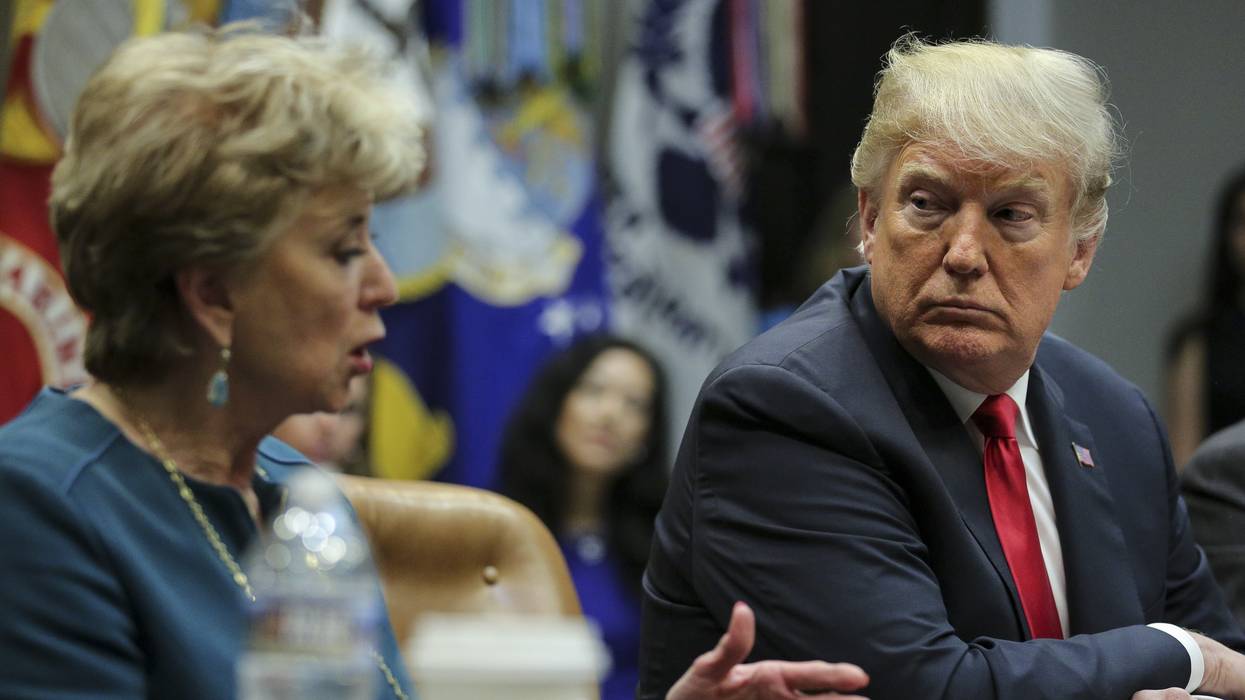
Her associations with the Trump movement, both in terms of policy execution and fundraising, quite literally prove that she is the opposite of the "moderate" label some have tried to give her.
Linda McMahon has been, and seemingly will always be, one of former U.S. President Donald Trump’s closest allies. McMahon is the wife of WWE billionaire Vince McMahon (who has paid hush money to at least four women to quell allegations of sexual misconduct and infidelity), a failed Senate candidate, and a former Small Business Administration (SBA) chief under Trump. She has spent the last eight years staunchly in the corner of the former president turned 34-time convict. Recently, it was reported that McMahon will be leading the transition should Trump retake the White House in November.
Other than the obvious indication that Trump is continuing to reward loyalists (shocker), this also is another example of McMahon being deeply entrenched in Trump’s movement. After all, she:
Ludicrously, McMahon has been described as a moderate (even having Republican darlings Sens. Susan Collins (R-Maine) and Lisa Murkowski (R-Alaska) stumping for her in 2012). AFPI alone really calls into question that moderate title. The think tank has promoted, in congruence with Russel Vought’s Schedule F, “relocating” federal jobs out of Washington to places with lower costs of living… which we all know to understand to be an effort to replace skilled technocrats with new people hired for loyalty to MAGAism. Similarly, AFPI has pushed voter ID laws widely and properly understood to be barely cloaked efforts to suppress voter turnout from voters MAGA doesn’t like.
So, what to make of the claims that McMahon is a moderate? Her associations with the Trump movement, both in terms of policy execution and fundraising, quite literally prove the opposite: she’s a dangerous extremist vying to cement right-wing authoritarianism.
Don't believe a word of it: It's all about race.
Despite state officials' quick denial that the closing of 31 Alabama DMVs has nothing to do with race, it is a fact that the closures - mostly in poor, majority-black counties - disproportionately hurt Black voters. Period.
Fifty years ago, in Selma, the civil rights movement won a hard-fought battle to gain the right to register to vote. Bloodshed in the streets, lost lives, a march to Montgomery, and the passage of the Voting Rights Act ensured that African-American citizens had the right to vote. It was all about race.
Unfortunately, some things in Alabama never change. When it comes to making sure people can vote, the state of Alabama has an avoidable problem. Our legislature passed an unnecessary law that put excessive burdens on citizens by requiring them to get a photo ID to exercise their fundamental constitutional right to vote -- despite the well-known fact that in-person voter fraud is rare.
Now Alabama closes 31 0f 67 Department of Motor Vehicle locations where most people get the most commonly used voter ID, the driver's license. The majority of these counties in the state that are home to poor and Black people are on that list. The photo ID law already disenfranchises voters who cannot obtain IDs. It has been reported that there are currently 250,000 registered voters who don't have IDs, so are now unable to vote in Alabama unless they either travel outside their county to get a driver's license or take a burdensome trip to a separate location (which is even harder without a driver's license!) just for a voter ID. And that disproportionately hurts Black voters.
Before the United States Supreme Court gutted the Voting Rights Act in 2013, Alabama would have had to submit this change for review by the U.S. Department of Justice to determine whether the closure was against the law. The fact that it was implemented without approval is the most recent example of why Congress must restore the Voting Rights Act.
Indeed, the very day that Alabama was no longer required to submit voting changes to the Department of Justice, Alabama announced its implementation of the photo ID requirement that had been delayed because of the requirements of the Voting Rights Act. This is all about race and what communities are most affected by the bad choices in Alabama.
After a day when hundreds rallied at the North Carolina legislative building against the 'extreme' policies pushed forth by the GOP-led body, 14 protesters were arrested early Wednesday morning after staging an overnight sit-in at the office of the state's House speaker Tom Tillis.
Organized under the banner of the "Moral Monday" campaign, over 170 took part in the demonstration Tuesday to call on lawmakers to "repent for the harm they have caused, to repeal the flood of extreme policies passed last year and to restore confidence in our elected officials," according to a statement by the North Carolina NAACP.
Eight fast food workers, four clergy members, one housing expert and one retired public school employee were arrested at 1:45 am after participating in a 12-hour protest during which the Republican leader left through a back exit to avoid meeting with the demonstrators. In the hallway outside the lawmaker's office, fellow protesters sang the the civil rights ballad, "We Shall Not Be Moved."
"I am participating in the nonviolent civil disobedience today to let my voice be heard," said demonstrator Crystal Price, a 27-year old mother of two and an employee of Wendy's in Greensboro.
"When state lawmakers pass laws eliminating the Earned Income Tax Credit or refuse to expand Medicaid--programs my children and I depend on--while giving tax breaks to the wealthiest few, it makes a statement that these representatives do not care about working mothers like me," she added. Price, who is suffering from cervical cancer, was initially one of the protesters staked out in Tillis's office but had to leave to take care of her children.
"Tonight, we put a face on the real harm these policies are inflicting across our state," said Rev. Dr. William J. Barber, II, movement leader and president of the state's NAACP.
Those arrested were charged with second-degree trespassing, a misdemeanor. By Wednesday morning, twelve of the fourteen were released. The other two continued to be held.
Roughly 950 total activists with the Forward Together Moral Movement were arrested at weekly demonstrations during the 2013 legislative season protesting what they say are the "extreme policies" passed by the GOP-led legislature. These included restrictive voting rules, denial of Medicaid expansion, cuts to unemployment benefits, and the repeal of the Earned Income Tax Credit, among others.
As lawmakers are once again convening at the state assembly, the weekly demonstrations are also set to return with renewed focus to "repeal and reverse" the regressive policies passed in 2013.
The NC NAACP released the below video of the action in and around Tillis's office:
We Shall Not Be Moved | Tillis 15May 27th, 2014 - After North Carolina House Speaker Thom Tillis refuses to meet with North Carolinians, a sit-in turns into a ...
During the demonstration, protesters posted images of the sit-in online:
_____________________