

SUBSCRIBE TO OUR FREE NEWSLETTER
Daily news & progressive opinion—funded by the people, not the corporations—delivered straight to your inbox.
5
#000000
#FFFFFF
To donate by check, phone, or other method, see our More Ways to Give page.
Daily news & progressive opinion—funded by the people, not the corporations—delivered straight to your inbox.

"Extremist legislators are trying to gain political power by harming vulnerable young people and their families."
North Carolina's Republican-dominated Legislature voted Wednesday to override Democratic Gov. Roy Cooper's vetoes of several GOP bills attacking trans youth, a move that rights advocates called a "devastating" assault on the rights of vulnerable young people.
One of the measures enacted Wednesday over the governor's opposition outlaws gender-affirming care—including puberty blockers and hormone therapy—for trans minors, making North Carolina the latest state to attack healthcare access for trans youth.
The gender-affirming care ban, H.B. 808, takes effect immediately.
Another bill, S.B. 49, bars any instruction about gender identity and sexuality in K-4 classrooms and "requires that public school teachers in most circumstances alert parents before they call a student by a different name or pronoun," the Associated Press reported.
A third measure, H.B. 574, prohibits trans girls from playing on sports teams that correspond with their gender identity from middle school through college.
"We need to call this what it is: An all-out attack on queer and transgender youth in North Carolina," Allison Scott, director of impact and innovation at the Campaign for Southern Equality, said in a statement Wednesday.
The North Carolina Legislature is "going out of its way to blatantly enact the far-right's anti-LGBTQ wish list, causing harm and discrimination to young people in every area of life, from school to the doctor's office to the athletic fields," Scott added.
The growing wave of Republican attacks on trans youth across the U.S. prompted the Human Rights Campaign (HRC) to declare a national state of emergency for LGBTQ+ people in June, with the advocacy group warning that "the multiplying threats facing millions in our community are not just perceived—they are real, tangible, and dangerous."
More than 550 bills targeting LGBTQ+ rights have been introduced in state legislatures nationwide this year, and more than 80 have been signed into law, according to HRC.
Cathryn Oakley, HRC's senior director for legal policy, said in a statement Wednesday that "every lawmaker in North Carolina that voted to override the governor's veto should be ashamed of themselves."
"These bills range in impact from curriculum censorship to school sports to banning best practice healthcare," said Oakley, "but they have one important throughline: extremist legislators are trying to gain political power by harming vulnerable young people and their families. Once again, the North Carolina General Assembly has prioritized anti-transgender discrimination over the well-being of North Carolina."
Republicans secured their veto-proof majority in the North Carolina General Assembly after state Rep. Tricia Cotham, formerly a Democrat, switched parties in April. The GOP already had a veto-proof majority in the Senate when Cotham became a Republican.
On Wednesday, Cotham joined Republicans in voting to override Cooper's vetoes.
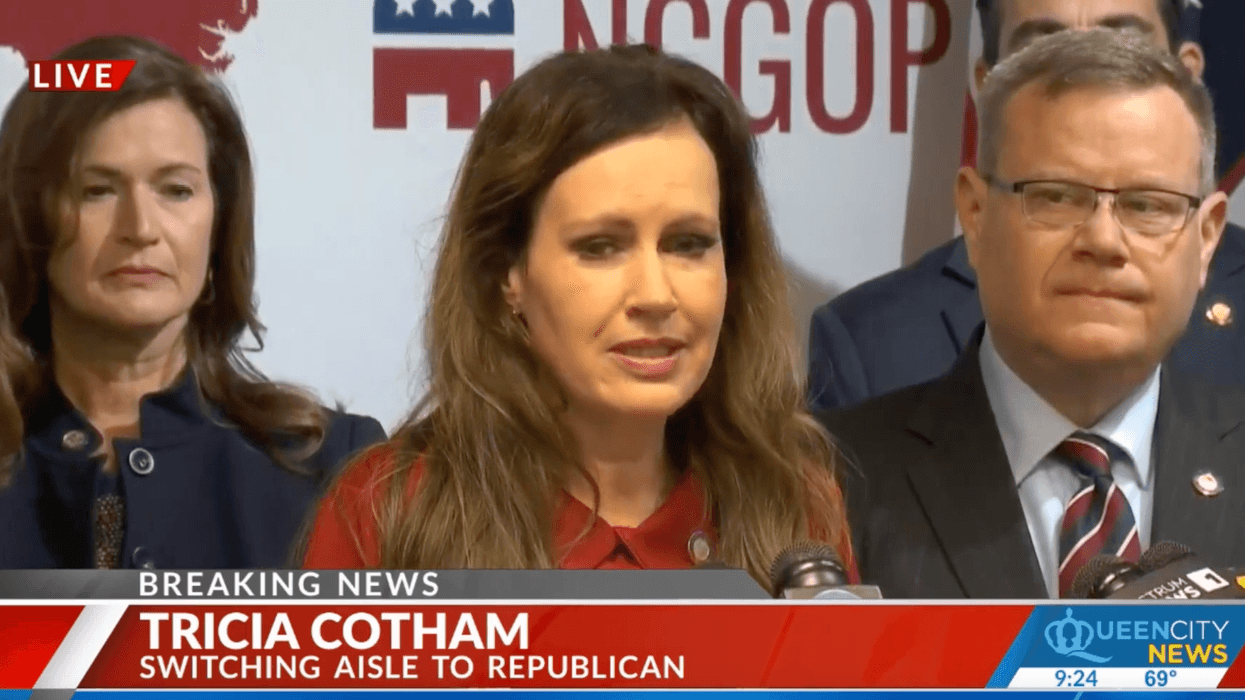
North Carolinians who voted for state Rep. Tricia Cotham, who defended abortion rights before switching to the GOP, were "deeply betrayed," said one observer.
The North Carolina Legislature voted Tuesday to override Democratic Gov. Roy Cooper's veto and pass a bill banning abortions after 12 weeks of pregnancy, with Democrat-turned-Republican state Rep. Tricia Cotham giving the GOP the support it needed to ram the measure through in the face of significant public opposition.
Formerly an outspoken defender of reproductive rights—she's still listed as a co-sponsor of Democratic legislation to codify Roe—Cotham switched parties last month in a move that gave Republicans a veto-proof majority in the House, adding to its existing veto-proof majority in the Senate.
Cotham voted for the 12-week abortion ban's initial passage earlier this month and backed the veto override on Tuesday as protesters in the House gallery chanted, "Shame!"
In a statement, the now-Republican lawmaker said she believes the bill "strikes a reasonable balance on the abortion issue and represents a middle ground."
"Some call me a hypocrite since I voted for this bill. They presume to know my story," said Cotham, who has previously spoken about her own abortion. "As I said at the time, I had an ectopic pregnancy that sadly ended in miscarriage, not an elective abortion. In fact, Senate Bill 20 affirms the lifesaving care I received in that dire situation."
Progressive Durham County Commissioner Nida Allam argued that Cotham's statement essentially tells the people of North Carolina that "the bill would've protected me therefore it's enough, screw everyone else."
Rejecting Cotham's depiction of the abortion ban as moderate, Dr. Katherine Farris—Planned Parenthood South Atlantic's chief medical officer—warned the new law is "full of medically unnecessary and dangerous restrictions on abortion care that go against medical best practices."
"Not only do the actions of our lawmakers make me angry, but they also scare me," said Farris. "Treating my patients should not be seen as an act of civil disobedience. A person's health, not politicians, should guide important medical decisions at all stages of pregnancy."
As The Washington Post noted, opponents of the measure have raised particular alarm over a "provision that would require patients to have an in-person consultation with a doctor at least 72 hours before an abortion, in addition to the visit required for the abortion itself."
"The extra in-person visit would make it harder for out-of-state patients to travel to North Carolina, which currently allows abortion until 20 weeks of pregnancy and has become a destination for patients seeking abortions across the South in the wake of the Supreme Court ruling [overturning Roe v. Wade]," the Post reported. "In the first two months after the landmark decision, North Carolina experienced a greater spike in abortions than any other state."
The new law would also, as Vox's Dylan Scott wrote Wednesday, establish "intrusive reporting requirements, such as mandating that doctors report a patient's fertility history to the state government after an abortion, including information such as their number of live pregnancies, previous pregnancies, and previous abortions."
"The law does include some provisions that Republicans say will provide additional support for children and families, including a new paid parental leave policy and increased child care subsidies," Scott observed. "But both programs have significant holes. Paid parental leave applies only to state employees, not the private sector. Increasing the state's child care subsidies for families already receiving them would not alleviate the main problem with accessing child care in North Carolina, as there are already 30,000 children in the state on a waitlist for financial assistance. The law does not do anything to get people off of that waitlist."
The 12-week abortion ban is set to take effect on July 1.
Alexis McGill Johnson, president and CEO of the Planned Parenthood Federation of America, said late Tuesday that "today's vote will have devastating consequences across North Carolina, and for the thousands of patients in the region who've relied on the state as a key access point for abortion."
"This ban, like all abortion bans, will harm people who have the right to make their own decisions based on what is best for themselves, their lives, their families, and their futures," said Johnson. "No one should be forced to travel out of state to access abortion care. No one should be forced to carry a pregnancy that they do not want, or that is dangerous to their health. And yet, today that is what the North Carolina legislature is forcing them to do."
"Today's vote will have devastating consequences across North Carolina, and for the thousands of patients in the region who've relied on the state as a key access point for abortion."
Citing two former Cotham staffers, Jezebel's Susan Rinkunas reported this past weekend that the lawmaker's decision to switch parties "wasn't really about any genuinely held beliefs, political issues, or even money."
As one ex-staffer put it: "I wish I could say that she took a giant bag of cash at an IHOP and that's why she did this—but it's so much dumber than that. It's just a deeply petty, personal thing."
The staffer told Rinkunas that Cotham felt her Democratic colleagues didn't like her.
"Cotham had also been annoyed that Planned Parenthood didn't endorse her," Rinkunas reported, even though Cotham "blew off the actual endorsement interview for the group multiple times" during her 2022 campaign.
In a Planned Parenthood candidate questionnaire for the 2022 race, Cotham described herself as "an unwavering advocate for abortion rights."
Following Tuesday's vote, Jezebel's Laura Bassett wrote that "North Carolinians are being politically trampled here, as they do not support banning abortion this early in a pregnancy: According to new polling by Carolina Forward/Change Research, 54% of voters in the state oppose the 12-week ban, while only 40% support it."
"It's a shame that people who voted for Cotham, thinking (reasonably) based on her previous speeches that she'd defend abortion rights, were deeply betrayed in the end," Bassett added.

"If these extremists who claim to be Republicans were serious about life, they would pass living wages, healthcare, family leave, and fully funded public education."
Ahead of a gathering at the North Carolina General Assembly planned for Friday morning, Bishop William Barber II on Thursday called out the state's Republican lawmakers for trying to ban abortions after 12 weeks, rather than the current 20 weeks.
"Republican extremists in the North Carolina General Assembly are trying to pass an abortion ban that they say is 'pro-life.' But if they were serious about life, they would be addressing the fourth-leading cause of death in the U.S. today—poverty," said Barber, president of Repairers of the Breach and co-chair of the Poor People's Campaign: A National Call for Moral Revival.
"A 12-week abortion ban is not about life," he stressed. "If these extremists who claim to be Republicans were serious about life, they would pass living wages, healthcare, family leave, and fully funded public education. We must respond to this attack on all North Carolinians with a moral coalition that leads a movement against policies directly harming our nation's people."
"We must respond to this attack on all North Carolinians with a moral coalition that leads a movement against policies directly harming our nation's people."
Barber is set to join an interracial, interfaith group of clergy members and leaders of the North Carolina Poor People's Campaign at 11:00 am ET Friday to decry the pending ban as attack on the state's millions of poor and low-income residents.
The North Carolina GOP's push to further restrict reproductive healthcare is part of a national trend that has intensified since the U.S. Supreme Court reversed Roe v. Wade with its Dobbs v. Jackson Women's Health Organization ruling last June.
Although Democratic Gov. Roy Cooper has vowed to veto Senate Bill 20 on Saturday, North Carolina Rep. Tricia Cotham (R-112) suddenly decided to join the Republican Party last month—after years of campaigning and serving as a pro-choice Democrat, and even speaking on the state House floor about her experience having an abortion—giving the GOP a veto-proof majority.
As part of a series of events intended to pressure at least one GOP legislator not to override his veto, Cooper and other critics of S.B. 20 came together Tuesday outside of Charlotte. They targeted Cotham and state Rep. John Bradford (R-98), who both voted for the 12-week ban, which has few exceptions and would also impose other restrictions.
Planned Parenthood South Atlantic spokesperson Molly Rivera recently told the Citizen Times that "we operate six clinics across the state. None of our health centers, including Asheville, meet the requirements that would be mandated by an ambulatory surgical center license."
The looming law and potential clinic closures could impact people seeking abortion care across the Southeast. Riveria said that "right now, the majority of patients that we're seeing, specifically at the Asheville Health Center, are from out of state."
S.B. 20 was swiftly advanced through the North Carolina General Assembly last week. As The News & Observer detailed:
Between Tuesday night and Thursday evening, House and Senate Republicans announced they had reached an agreement on new abortion restrictions, unveiled the 46-page bill, moved the bill out of a joint committee meeting, and passed the bill through each chamber so it could be sent to the governor.
Debates on the bill were fairly extensive. The Senate's floor debate was the longest of the last decade, according to Senate leader Phil Berger's [R-26] office. But critics have slammed the speed with which the bill cleared the Legislature through a special process that meant it didn't need to go through multiple committees and couldn't be amended.
The Reproductive Freedom Alliance, a nonpartisan group of 22 governors including Cooper, said in a statement Thursday that "the state Legislature rushed this legislation through with little transparency or public input and it has become clear why: The more North Carolinians learn about this law, the more they oppose it."
"We support Gov. Cooper's pledge to veto this dangerous measure and we remain committed to strengthening reproductive freedom across the country," the alliance continued, also highlighting that ten of millions of people have already lost access to abortion care in their home states since Roe was overturned.
Justine Orlovsky-Schnitzler of the Carolina Abortion Fund told The Guardian this week that her group's clientele has increased "astronomically" post-Dobbs—going from 100-120 calls a week to that many daily, often from people who live in states with even stricter abortion laws.
"It is an economic punishment as much as a moral judgment that they're casting," Orlovsky-Schnitzler said of S.B. 20, "and I think [it] is really beyond the pale."
"Abortion bans won't stop people from wanting or seeking this care," she added. "There are some lawmakers in the state who have previously indicated that they would not support additional restrictions on abortion care. And if we can push them, there's hope."
"The people of North Carolina did not give Republicans a supermajority of the state House," said one progressive group. "Only the duplicity and corruption of Tricia Cotham did."
A pro-forced pregnancy bill passed in North Carolina late Thursday is likely to become law despite the objections of Democratic Gov. Roy Cooper thanks largely to a sudden decision by state Rep. Tricia Cotham last month to join the Republican Party after years as a pro-choice Democrat—giving the GOP a veto-proof majority.
The state Senate on Thursday passed Senate Bill 20, which includes a ban on abortion care after 12 weeks of pregnancy along with other restrictions, less than 48 hours after they unveiled the legislation at a press conference on Tuesday. The bill was inserted into a separate piece of legislation instead of being officially introduced in the Legislature, taking Democrats and advocacy groups by surprise and allowing no time for public hearings.
According to The Washington Post, Republicans were deliberately secretive about the crafting of the legislation, which was written in secret meetings in recent weeks where members were forbidden from having their own copies of documents to avoid leaks, in order to prevent advocates from organizing protests at the state Capitol.
Planned Parenthood South Atlantic still managed to spearhead a rally on Wednesday, where state Attorney General Josh Stein warned the bill is a "massive first step" toward a total abortion ban, despite Republican claims that a 12-week ban is more "mainstream" than bans starting at six weeks of gestation or at any stage in pregnancy, which have been passed in 15 states including the majority of states in the Southeast.
The bill includes "exceptions" for pregnancies that result from rape or incest through 20 weeks, certain fetal abnormalities through 24 weeks, and for life-threatening complications for a pregnant person.
Numerous cases since the right-wing majority of the U.S. Supreme Court overturned Roe v. Wade last June have shown that such exceptions put patients through weeks of physical and emotional trauma as doctors and hospitals—fearing litigation under the new laws—refuse to provide treatment until their lives are sufficiently in danger.
S.B. 20 also includes restrictions such a requirement that anyone who obtains an abortion before 12 weeks of pregnancy also see their medical provider 72 hours before the procedure, likely cutting off access to out-of-state people, many of whom have traveled to North Carolina from other parts of the South since Roe was overturned, and to people who don't have paid leave or access to childcare.
If the bill becomes law, said NARAL Pro-Choice America, "abortion access across the Southeast will be further decimated."
Cooper told the Post he plans to veto the bill after a delay of up to 10 days to give North Carolina residents time to "digest this very complicated, burdensome legislation that they haven't had a chance to even see," but the governor will have to convince at least one Republican to break the party's veto-proof majority to stop the bill from becoming law.
Because Cotham (R-112) announced just last month that she was joining the GOP, the party now has the 72 House seats it needs to override a veto in the 120-seat state House.
Politics in the state are shifting to the right "with extraordinary speed," said Daniel Nichanian of Bolts.
Cotham announced her decision to change parties three months after co-sponsoring a bill to codify abortion rights in state law, and five months after winning her election following a vehemently pro-choice campaign. She also spoke about her own abortion on the state House floor in 2015 during a debate over abortion restrictions. On Wednesday, she voted with the Republicans in favor of S.B. 20.
"The people of North Carolina did not give Republicans a supermajority of the state House," said the progressive group Carolina Forward. "Only the duplicity and corruption of Tricia Cotham did these things."
Cooper told the Post he plans to lobby Republicans who have claimed to support abortion rights—including state Rep. Ted Davis (R-19), who did not vote on Wednesday—to tank the GOP's effort to override his veto.
Republicans are "trying to dress this up as a reasonable 12-week ban," the governor told the Post. "It's not."

One Democratic official accused state Rep. Tricia Cotham of "pulling a bait-and-switch on her constituents—who voted overwhelmingly for a Democrat to represent them in the House."
North Carolina State Rep. Tricia Cotham formally announced Wednesday that she is switching from the Democratic Party to the GOP, handing Republicans a veto-proof majority in the House and potentially imperiling Democratic Gov. Roy Cooper's ability to block right-wing attacks on reproductive freedom and voting rights.
Cotham's move, which was enthusiastically welcomed by the North Carolina GOP, led top Democrats in the state to call for her immediate resignation.
"This is deceit of the highest order," North Carolina Democratic Party Chair Anderson Clayton and Mecklenburg County Democratic Party Chair Jane Whitley said in a joint statement. "Rep. Cotham’s decision is a betrayal to the people of [House District 112] with repercussions not only for the people of her district, but for the entire state of North Carolina."
"If she can no longer represent the values her constituents trusted her to champion," Clayton and Whitley added, "she should resign immediately."
North Carolina House Democratic Leader Robert Reives also demanded Cotham's resignation, saying she is "not the person that was presented to the voters of House District 112."
Cotham, who prior to her current term served in the North Carolina House as a Democrat for a decade, said during a Wednesday press conference at the state GOP's headquarters that her decision to cross the aisle was spurred by what she characterized as mistreatment from Democratic lawmakers.
"They have pushed me out," Cotham said. "They've made it very clear they do not want me."
As The Washington Post noted Wednesday, Cotham was among several North Carolina Democrats who missed a vote last week on whether to override Cooper's veto of a bill ending permit requirements for handguns.
The absences allowed the House to override the governor's veto. The Senate, which already had a veto-proof majority, also voted in favor of the override.
"Cotham at the time said she was against the repeal but had to miss the vote for a medical appointment," the Post reported. "Nonetheless, she drew blowback from fellow Democrats."
"Handing Republicans the ability to override Governor Cooper's veto will endanger abortion access, voting rights, and other fundamental freedoms in the state."
During her press conference on Wednesday, Cotham was evasive when asked whether she will toe the GOP line on abortion and other key issues now that she has switched parties.
"I am still the same person, and I am going to do what I believe is right and follow my conscience," Cotham said.
Cotham, who represents a district that President Joe Biden won by 20 points, has been a vocal supporter of abortion rights throughout her legislative career. In a 2015 speech on the floor of the North Carolina House, the then-Democrat spoke about her own abortion and slammed the GOP for "playing with women's lives" by attacking reproductive rights.
In the 2022 election, Cotham ran on a left-leaning platform that included a $15-an-hour minimum wage, Medicaid expansion, affordable housing, and support for LBGTQ+ rights.
Heather Williams, interim president of the Democratic Legislative Campaign Committee (DLCC), accused Cotham of "pulling a bait and switch on her constituents—who voted overwhelmingly for a Democrat to represent them in the House."
"Handing Republicans the ability to override Governor Cooper's veto will endanger abortion access, voting rights, and other fundamental freedoms in the state," said Williams. "Voters in North Carolina did not elect a GOP House supermajority and Rep. Cotham is placing politics over their interests."
Cooper, who won reelection in 2020 and has used his veto authority against Republican legislation dozens of times, said Wednesday that Cotham's decision to switch parties is "disappointing."
"Representative Cotham's votes on women's reproductive freedom, election laws, LGBTQ rights, and strong public schools will determine the direction of the state we love," said Cooper. "It's hard to believe she would abandon these long-held principles, and she should still vote the way she has always said she would vote when these issues arise, regardless of party affiliation."