SUBSCRIBE TO OUR FREE NEWSLETTER
Daily news & progressive opinion—funded by the people, not the corporations—delivered straight to your inbox.
5
#000000
#FFFFFF
To donate by check, phone, or other method, see our More Ways to Give page.
Daily news & progressive opinion—funded by the people, not the corporations—delivered straight to your inbox.
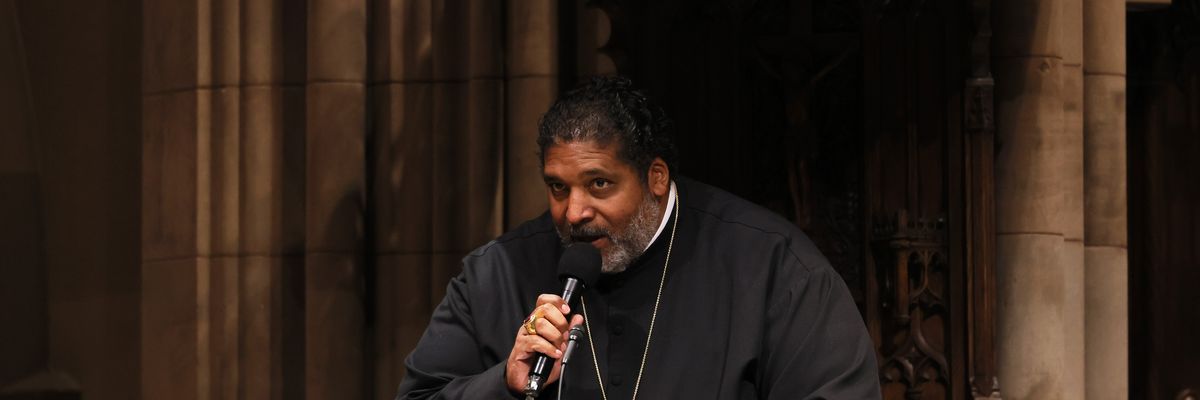
Bishop William Barber II speaks during a moral Mass at Trinity Church on April 11, 2022 in New York City.
"If these extremists who claim to be Republicans were serious about life, they would pass living wages, healthcare, family leave, and fully funded public education."
Ahead of a gathering at the North Carolina General Assembly planned for Friday morning, Bishop William Barber II on Thursday called out the state's Republican lawmakers for trying to ban abortions after 12 weeks, rather than the current 20 weeks.
"Republican extremists in the North Carolina General Assembly are trying to pass an abortion ban that they say is 'pro-life.' But if they were serious about life, they would be addressing the fourth-leading cause of death in the U.S. today—poverty," said Barber, president of Repairers of the Breach and co-chair of the Poor People's Campaign: A National Call for Moral Revival.
"A 12-week abortion ban is not about life," he stressed. "If these extremists who claim to be Republicans were serious about life, they would pass living wages, healthcare, family leave, and fully funded public education. We must respond to this attack on all North Carolinians with a moral coalition that leads a movement against policies directly harming our nation's people."
"We must respond to this attack on all North Carolinians with a moral coalition that leads a movement against policies directly harming our nation's people."
Barber is set to join an interracial, interfaith group of clergy members and leaders of the North Carolina Poor People's Campaign at 11:00 am ET Friday to decry the pending ban as attack on the state's millions of poor and low-income residents.
The North Carolina GOP's push to further restrict reproductive healthcare is part of a national trend that has intensified since the U.S. Supreme Court reversed Roe v. Wade with its Dobbs v. Jackson Women's Health Organization ruling last June.
Although Democratic Gov. Roy Cooper has vowed to veto Senate Bill 20 on Saturday, North Carolina Rep. Tricia Cotham (R-112) suddenly decided to join the Republican Party last month—after years of campaigning and serving as a pro-choice Democrat, and even speaking on the state House floor about her experience having an abortion—giving the GOP a veto-proof majority.
As part of a series of events intended to pressure at least one GOP legislator not to override his veto, Cooper and other critics of S.B. 20 came together Tuesday outside of Charlotte. They targeted Cotham and state Rep. John Bradford (R-98), who both voted for the 12-week ban, which has few exceptions and would also impose other restrictions.
Planned Parenthood South Atlantic spokesperson Molly Rivera recently told the Citizen Times that "we operate six clinics across the state. None of our health centers, including Asheville, meet the requirements that would be mandated by an ambulatory surgical center license."
The looming law and potential clinic closures could impact people seeking abortion care across the Southeast. Riveria said that "right now, the majority of patients that we're seeing, specifically at the Asheville Health Center, are from out of state."
S.B. 20 was swiftly advanced through the North Carolina General Assembly last week. As The News & Observer detailed:
Between Tuesday night and Thursday evening, House and Senate Republicans announced they had reached an agreement on new abortion restrictions, unveiled the 46-page bill, moved the bill out of a joint committee meeting, and passed the bill through each chamber so it could be sent to the governor.
Debates on the bill were fairly extensive. The Senate's floor debate was the longest of the last decade, according to Senate leader Phil Berger's [R-26] office. But critics have slammed the speed with which the bill cleared the Legislature through a special process that meant it didn't need to go through multiple committees and couldn't be amended.
The Reproductive Freedom Alliance, a nonpartisan group of 22 governors including Cooper, said in a statement Thursday that "the state Legislature rushed this legislation through with little transparency or public input and it has become clear why: The more North Carolinians learn about this law, the more they oppose it."
"We support Gov. Cooper's pledge to veto this dangerous measure and we remain committed to strengthening reproductive freedom across the country," the alliance continued, also highlighting that ten of millions of people have already lost access to abortion care in their home states since Roe was overturned.
Justine Orlovsky-Schnitzler of the Carolina Abortion Fund told The Guardian this week that her group's clientele has increased "astronomically" post-Dobbs—going from 100-120 calls a week to that many daily, often from people who live in states with even stricter abortion laws.
"It is an economic punishment as much as a moral judgment that they're casting," Orlovsky-Schnitzler said of S.B. 20, "and I think [it] is really beyond the pale."
"Abortion bans won't stop people from wanting or seeking this care," she added. "There are some lawmakers in the state who have previously indicated that they would not support additional restrictions on abortion care. And if we can push them, there's hope."
Dear Common Dreams reader, It’s been nearly 30 years since I co-founded Common Dreams with my late wife, Lina Newhouser. We had the radical notion that journalism should serve the public good, not corporate profits. It was clear to us from the outset what it would take to build such a project. No paid advertisements. No corporate sponsors. No millionaire publisher telling us what to think or do. Many people said we wouldn't last a year, but we proved those doubters wrong. Together with a tremendous team of journalists and dedicated staff, we built an independent media outlet free from the constraints of profits and corporate control. Our mission has always been simple: To inform. To inspire. To ignite change for the common good. Building Common Dreams was not easy. Our survival was never guaranteed. When you take on the most powerful forces—Wall Street greed, fossil fuel industry destruction, Big Tech lobbyists, and uber-rich oligarchs who have spent billions upon billions rigging the economy and democracy in their favor—the only bulwark you have is supporters who believe in your work. But here’s the urgent message from me today. It's never been this bad out there. And it's never been this hard to keep us going. At the very moment Common Dreams is most needed, the threats we face are intensifying. We need your support now more than ever. We don't accept corporate advertising and never will. We don't have a paywall because we don't think people should be blocked from critical news based on their ability to pay. Everything we do is funded by the donations of readers like you. When everyone does the little they can afford, we are strong. But if that support retreats or dries up, so do we. Will you donate now to make sure Common Dreams not only survives but thrives? —Craig Brown, Co-founder |
Ahead of a gathering at the North Carolina General Assembly planned for Friday morning, Bishop William Barber II on Thursday called out the state's Republican lawmakers for trying to ban abortions after 12 weeks, rather than the current 20 weeks.
"Republican extremists in the North Carolina General Assembly are trying to pass an abortion ban that they say is 'pro-life.' But if they were serious about life, they would be addressing the fourth-leading cause of death in the U.S. today—poverty," said Barber, president of Repairers of the Breach and co-chair of the Poor People's Campaign: A National Call for Moral Revival.
"A 12-week abortion ban is not about life," he stressed. "If these extremists who claim to be Republicans were serious about life, they would pass living wages, healthcare, family leave, and fully funded public education. We must respond to this attack on all North Carolinians with a moral coalition that leads a movement against policies directly harming our nation's people."
"We must respond to this attack on all North Carolinians with a moral coalition that leads a movement against policies directly harming our nation's people."
Barber is set to join an interracial, interfaith group of clergy members and leaders of the North Carolina Poor People's Campaign at 11:00 am ET Friday to decry the pending ban as attack on the state's millions of poor and low-income residents.
The North Carolina GOP's push to further restrict reproductive healthcare is part of a national trend that has intensified since the U.S. Supreme Court reversed Roe v. Wade with its Dobbs v. Jackson Women's Health Organization ruling last June.
Although Democratic Gov. Roy Cooper has vowed to veto Senate Bill 20 on Saturday, North Carolina Rep. Tricia Cotham (R-112) suddenly decided to join the Republican Party last month—after years of campaigning and serving as a pro-choice Democrat, and even speaking on the state House floor about her experience having an abortion—giving the GOP a veto-proof majority.
As part of a series of events intended to pressure at least one GOP legislator not to override his veto, Cooper and other critics of S.B. 20 came together Tuesday outside of Charlotte. They targeted Cotham and state Rep. John Bradford (R-98), who both voted for the 12-week ban, which has few exceptions and would also impose other restrictions.
Planned Parenthood South Atlantic spokesperson Molly Rivera recently told the Citizen Times that "we operate six clinics across the state. None of our health centers, including Asheville, meet the requirements that would be mandated by an ambulatory surgical center license."
The looming law and potential clinic closures could impact people seeking abortion care across the Southeast. Riveria said that "right now, the majority of patients that we're seeing, specifically at the Asheville Health Center, are from out of state."
S.B. 20 was swiftly advanced through the North Carolina General Assembly last week. As The News & Observer detailed:
Between Tuesday night and Thursday evening, House and Senate Republicans announced they had reached an agreement on new abortion restrictions, unveiled the 46-page bill, moved the bill out of a joint committee meeting, and passed the bill through each chamber so it could be sent to the governor.
Debates on the bill were fairly extensive. The Senate's floor debate was the longest of the last decade, according to Senate leader Phil Berger's [R-26] office. But critics have slammed the speed with which the bill cleared the Legislature through a special process that meant it didn't need to go through multiple committees and couldn't be amended.
The Reproductive Freedom Alliance, a nonpartisan group of 22 governors including Cooper, said in a statement Thursday that "the state Legislature rushed this legislation through with little transparency or public input and it has become clear why: The more North Carolinians learn about this law, the more they oppose it."
"We support Gov. Cooper's pledge to veto this dangerous measure and we remain committed to strengthening reproductive freedom across the country," the alliance continued, also highlighting that ten of millions of people have already lost access to abortion care in their home states since Roe was overturned.
Justine Orlovsky-Schnitzler of the Carolina Abortion Fund told The Guardian this week that her group's clientele has increased "astronomically" post-Dobbs—going from 100-120 calls a week to that many daily, often from people who live in states with even stricter abortion laws.
"It is an economic punishment as much as a moral judgment that they're casting," Orlovsky-Schnitzler said of S.B. 20, "and I think [it] is really beyond the pale."
"Abortion bans won't stop people from wanting or seeking this care," she added. "There are some lawmakers in the state who have previously indicated that they would not support additional restrictions on abortion care. And if we can push them, there's hope."
Ahead of a gathering at the North Carolina General Assembly planned for Friday morning, Bishop William Barber II on Thursday called out the state's Republican lawmakers for trying to ban abortions after 12 weeks, rather than the current 20 weeks.
"Republican extremists in the North Carolina General Assembly are trying to pass an abortion ban that they say is 'pro-life.' But if they were serious about life, they would be addressing the fourth-leading cause of death in the U.S. today—poverty," said Barber, president of Repairers of the Breach and co-chair of the Poor People's Campaign: A National Call for Moral Revival.
"A 12-week abortion ban is not about life," he stressed. "If these extremists who claim to be Republicans were serious about life, they would pass living wages, healthcare, family leave, and fully funded public education. We must respond to this attack on all North Carolinians with a moral coalition that leads a movement against policies directly harming our nation's people."
"We must respond to this attack on all North Carolinians with a moral coalition that leads a movement against policies directly harming our nation's people."
Barber is set to join an interracial, interfaith group of clergy members and leaders of the North Carolina Poor People's Campaign at 11:00 am ET Friday to decry the pending ban as attack on the state's millions of poor and low-income residents.
The North Carolina GOP's push to further restrict reproductive healthcare is part of a national trend that has intensified since the U.S. Supreme Court reversed Roe v. Wade with its Dobbs v. Jackson Women's Health Organization ruling last June.
Although Democratic Gov. Roy Cooper has vowed to veto Senate Bill 20 on Saturday, North Carolina Rep. Tricia Cotham (R-112) suddenly decided to join the Republican Party last month—after years of campaigning and serving as a pro-choice Democrat, and even speaking on the state House floor about her experience having an abortion—giving the GOP a veto-proof majority.
As part of a series of events intended to pressure at least one GOP legislator not to override his veto, Cooper and other critics of S.B. 20 came together Tuesday outside of Charlotte. They targeted Cotham and state Rep. John Bradford (R-98), who both voted for the 12-week ban, which has few exceptions and would also impose other restrictions.
Planned Parenthood South Atlantic spokesperson Molly Rivera recently told the Citizen Times that "we operate six clinics across the state. None of our health centers, including Asheville, meet the requirements that would be mandated by an ambulatory surgical center license."
The looming law and potential clinic closures could impact people seeking abortion care across the Southeast. Riveria said that "right now, the majority of patients that we're seeing, specifically at the Asheville Health Center, are from out of state."
S.B. 20 was swiftly advanced through the North Carolina General Assembly last week. As The News & Observer detailed:
Between Tuesday night and Thursday evening, House and Senate Republicans announced they had reached an agreement on new abortion restrictions, unveiled the 46-page bill, moved the bill out of a joint committee meeting, and passed the bill through each chamber so it could be sent to the governor.
Debates on the bill were fairly extensive. The Senate's floor debate was the longest of the last decade, according to Senate leader Phil Berger's [R-26] office. But critics have slammed the speed with which the bill cleared the Legislature through a special process that meant it didn't need to go through multiple committees and couldn't be amended.
The Reproductive Freedom Alliance, a nonpartisan group of 22 governors including Cooper, said in a statement Thursday that "the state Legislature rushed this legislation through with little transparency or public input and it has become clear why: The more North Carolinians learn about this law, the more they oppose it."
"We support Gov. Cooper's pledge to veto this dangerous measure and we remain committed to strengthening reproductive freedom across the country," the alliance continued, also highlighting that ten of millions of people have already lost access to abortion care in their home states since Roe was overturned.
Justine Orlovsky-Schnitzler of the Carolina Abortion Fund told The Guardian this week that her group's clientele has increased "astronomically" post-Dobbs—going from 100-120 calls a week to that many daily, often from people who live in states with even stricter abortion laws.
"It is an economic punishment as much as a moral judgment that they're casting," Orlovsky-Schnitzler said of S.B. 20, "and I think [it] is really beyond the pale."
"Abortion bans won't stop people from wanting or seeking this care," she added. "There are some lawmakers in the state who have previously indicated that they would not support additional restrictions on abortion care. And if we can push them, there's hope."