

SUBSCRIBE TO OUR FREE NEWSLETTER
Daily news & progressive opinion—funded by the people, not the corporations—delivered straight to your inbox.
5
#000000
#FFFFFF
To donate by check, phone, or other method, see our More Ways to Give page.
Daily news & progressive opinion—funded by the people, not the corporations—delivered straight to your inbox.
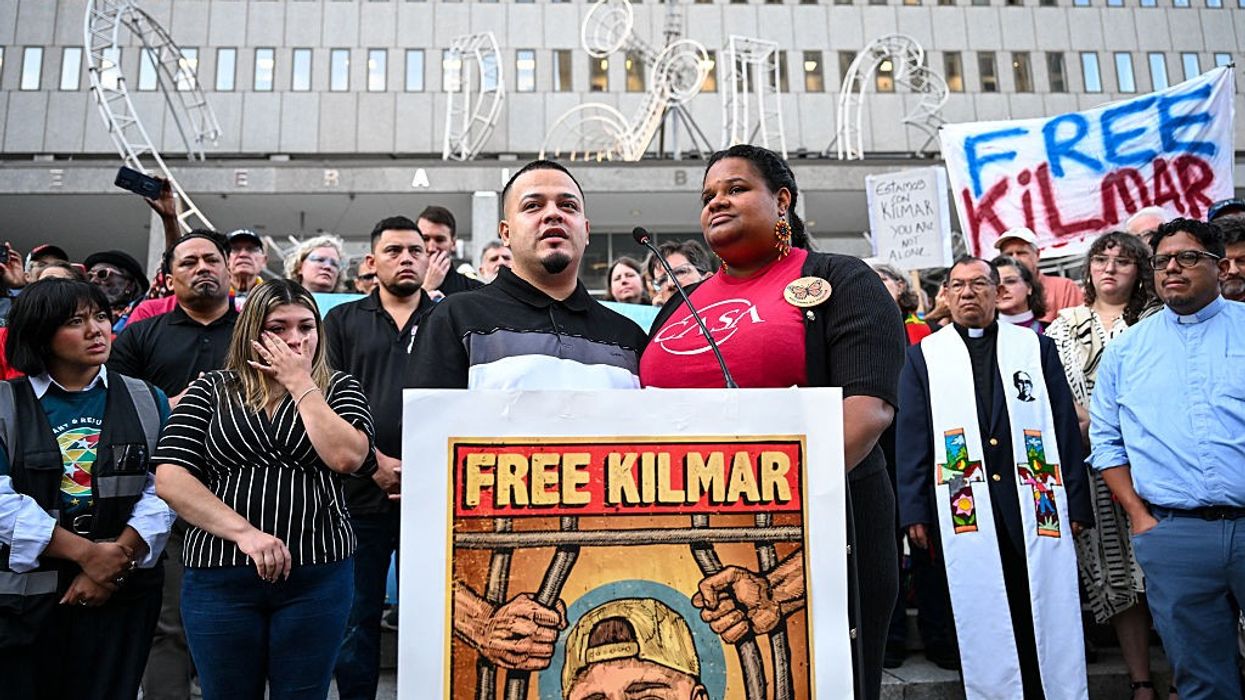
Judge Paula Xinis found that the Trump administration redetained the Salvadoran father of three "without lawful authority."
A federal judge on Thursday ordered the immediate release of Kilmar Ábrego García—who was wrongfully deported to El Salvador by the Trump administration earlier this year—from US Immigration and Customs Enforcement custody.
"Since Ábrego García's return from wrongful detention in El Salvador, he has been redetained, again without lawful authority,” US District Judge Paula Xinis wrote in her ruling. “For this reason, the court will grant Ábrego García's petition for immediate release from ICE custody.”
In early April, Xinis—an appointee of former President Barack Obama—ordered the Trump administration to facilitate Ábrego García's return to the United States after he was deported in March to the abuse-plagued Terrorism Confinement Center (CECOT) maximum security prison in El Salvador. This, after the US Department of Justice (DOJ) admitted in a court filing that Ábrego García was wrongfully deported due to what it called an "administrative error."
The US Supreme Court also weighed in on the case in favor of Xinis' ruling. However, the Trump administration refused to comply with the judge's order, arguing that it had no legal obligation to return Ábrego García to the US and could not force El Salvador's government to free him.
The DOJ dubiously contended that Ábrego García—a 30-year-old Salvadoran father of three who entered the US without authorization when he was a teenager—was a member of the gang MS-13, an allegation based on a statement from an anonymous police informant. The Trump administration deported him despite a judge's 2019 ruling that he could not be removed to El Salvador because he could be tortured there.
An attorney representing Ábrego García said at the time that his client suffered beatings and "psychological torture" while imprisoned at CECOT.
Ábrego García was transferred to a lower security Salvadoran prison before being sent back to the US on June 6 to face DOJ charges for allegedly transporting undocumented immigrants, to which he pleaded not guilty. He was immediately taken into custody and sent to an immigration detention facility in Tennessee.
On July 23, federal Magistrate Judge Barbara Holmes in Tennessee ruled that Ábrego García must be released from custody pending his trial. That same day, Xinis issued a simultaneous ruling in Ábrego García's wrongful deportation case blocking ICE from immediately seizing him once released in Tennessee and ordering the government to provide at least 72 hours' notice before attempting to deport him to any third country.
As Ábrego García was released on August 22, the US Department of Homeland Security (DHS) informed him that he could be deported to Uganda—one of several nations to which the administration has sought to send him. A bid by Ábrego García to reopen a previous bid for asylum in the US was denied in early October by an immigration judge.
Ábrego García is currently being held in an immigration detention center in Pennsylvania. Responding to Xinis' latest ruling, DHS spokesperson Tricia McLaughlin said Thursday that "this is naked judicial activism by an Obama-appointed judge."
"This order lacks any valid legal basis and we will continue to fight this tooth and nail in the courts," she added.
Advocates for Ábrego García welcomed Thursday's ruling.
"For months, the Trump administration has sought to deny Kilmar Ábrego García his rights to due process and fair treatment by our justice system," US Sen. Chris Van Hollen (D-Md.)—who met with Ábrego García in El Salvador in April—said on social media.
"Today’s ruling by Judge Xinis—requiring the government to immediately release him—is a forceful stand for our Constitution and all of our rights," he added.
Lydia Walther-Rodríguez, chief of organizing and leadership at CASA, hailed what she called "a moment of joy and relief."
“Kilmar finally gets to return home to his family, where he belongs," she said. "No one should be separated from their loved ones while fighting for justice.”

"Just spiteful evil for the sake of it," fumed one observer.
On the same day he was released from federal custody, the Trump administration on Friday informed Kilmar Ábrego García—a Maryland man wrongfully deported to a notorious Salvadoran prison rife with abuse—that it may deport him to the East African nation of Uganda.
Ábrego García, a Salvadoran national who entered the US without authorization when he was a teenager, was released Friday from a jail near Nashville, Tennessee, where he had been held since June following his errant deportation to El Salvador and imprisonment in the Terrorism Confinement Center (CECOT) super-maximum security prison.
According to a notice sent by a US Department of Homeland Security (DHS) official to Ábrego García's attorneys on Friday, "DHS may remove your client... to Uganda no earlier than 72 hours from now."
US District Judge Paula Xinis last month issued a ruling barring the Trump administration from immediately arresting Ábrego García upon his release and requiring the government to provide three business days' notice if US Immigration and Customs Enforcement (ICE) intended to initiate deportation proceedings against him.
ICE directed Ábrego García to report to the agency's Baltimore field office on Monday morning.
The Associated Press reported Saturday that the Trump administration decide to pursue deportation of Ábrego García to Uganda after he declined an offer to be sent to Costa Rica if he pleaded guilty to human smuggling charges related to his alleged transportation of undocumented immigrants in Tennessee in 2022.
Uganda is one of four African nations—the others are Eswatini, Rwanda, and South Sudan—that have agreed to take third-country nationals deported from the US.
Noting that Ábrego García "has no connections to Uganda," Washington Monthly contributor David Atkins accused the Trump administration of "just spiteful evil for the sake of it."
Ábrego García was deported to CECOT in March after the Trump administration claimed without credible evidence that he was a gang member. He was one of more than 200 people deported to CECOT without due process. The father of three said he was subjected to beatings and "psychological torture" at the prison.
Although acknowledging wrongfully deporting Ábrego García, the Trump administration argued in court that it lacked jurisdiction to order his return to the United States. However, Xinis—who called Ábrego García's deportation "wholly lawless"—on April 4 ordered the administration to facilitate his stateside return.
As the administration balked, the US Supreme Court intervened, affirming Xinis' order in an April 10 ruling. Ábrego García was finally returned to the US in June, only to be arrested for alleged human smuggling. He pleaded not guilty and asked the court to dismiss the charges against him, contending they are retaliation for challenging his deportation to El Salvador.
In a court filing, Ábrego García's lawyers said their client is being subjected to "vindictive and selective prosecution" by the Trump administration.
"There can be only one interpretation of these events: the [Department of Justice], DHS, and ICE are using their collective powers to force Mr. Ábrego to choose between a guilty plea followed by relative safety, or rendition to Uganda, where his safety and liberty would be under threat," the attorneys wrote.
"It is difficult to imagine a path the government could have taken that would have better emphasized its vindictiveness," they added. "This case should be dismissed."

The "incredible" decision was written by an appointee of former President Ronald Reagan, described by one law professor as "one of the most deferential-to-government-power judges in the country."
A federal appellate court on Thursday forcefully rejected the Trump administration's request to suspend orders from U.S. District Judge Paula Xinis, who has directed the government to "facilitate" the release of Maryland resident Kilmar Abrego Garcia from prison in El Salvador and launched a two-week process of "expedited discovery" set to include depositions from officials.
The U.S. Department of Justice filed a lengthy request for relief from the 4th Circuit Court of Appeals late Wednesday. The three-judge panel then issued a sharply worded seven-page order—written by Judge J. Harvie Wilkinson, an appointee of former President Ronald Reagan—that, as The Hill noted, "came without waiting for Abrego Garcia's lawyers to file their response."
Wilkinson wrote Thursday that "the relief the government is requesting is both extraordinary and premature. While we fully respect the executive's robust assertion of its Article II powers, we shall not micromanage the efforts of a fine district judge attempting to implement the Supreme Court's recent decision."
Abrego Garcia was supposed to be protected from deportation to his native El Salvador by an immigration judge's 2019 decision. Xinis' order for the Trump administration to facilitate his return to the United States as soon as possible has already gone through the 4th Circuit and the U.S. Supreme Court, whose majority affirmed her directive last week.
Despite the Trump administration's admission in court that Abrego Garcia's deportation was an "error," he remains in El Salvador's Terrorism Confinement Center (CECOT). Meanwhile, U.S. President Donald Trump on Monday welcomed Salvadoran President Nayib Bukele to the White House, and both have suggested they lack the ability to return the 29-year-old to the United States.
The Trump administration has also continued to claim—including in its Wednesday filing to the 4th Circuit—that "Abrego Garcia is a member of the designated foreign terrorist organization MS-13," which he and his family have denied. His wife and 5-year-old son are U.S. citizens.
This is indeed incredible. “Conservative judge” doesn’t quite cut it as a description of Wilkinson. He is one of the most deferential-to-government-power judges in the country. When he writes like Justice Sotomayor it’s signs-and-wonders level.
[image or embed]
— Evan Bernick, a finite mode with a resolute floof ( @evanbernick.bsky.social) April 17, 2025 at 4:49 PM
"It is difficult in some cases to get to the very heart of the matter. But in this case, it is not hard at all. The government is asserting a right to stash away residents of this country in foreign prisons without the semblance of due process that is the foundation of our constitutional order," Wilkinson wrote. "Further, it claims in essence that because it has rid itself of custody that there is nothing that can be done. This should be shocking not only to judges, but to the intuitive sense of liberty that Americans far removed from courthouses still hold dear."
"The Supreme Court's decision remains, as always, our guidepost," he stressed. Wilkinson—joined by U.S. Circuit Judges Robert King and Stephanie Thacker, who were respectively appointed by former Presidents Bill Clinton and Barack Obama—continued:
The Supreme Court's decision does not... allow the government to do essentially nothing. It requires the government "to 'facilitate' Abrego Garcia's release from custody in El Salvador and to ensure that his case is handled as it would have been had he not been improperly sent to El Salvador."
[...]
"Facilitation" does not permit the admittedly erroneous deportation of an individual to the one country's prisons that the withholding order forbids and, further, to do so in disregard of a court order that the government not so subtly spurns. "Facilitation" does not sanction the abrogation of habeas corpus through the transfer of custody to foreign detention centers in the manner attempted here. Allowing all this would "facilitate" foreign detention more than it would domestic return. It would reduce the rule of law to lawlessness and tarnish the very values for which Americans of diverse views and persuasions have always stood.
The judge recognized a broader concern raised across the country as this case has garnered widespread attention: "If today the executive claims the right to deport without due process and in disregard of court orders, what assurance will there be tomorrow that it will not deport American citizens and then disclaim responsibility to bring them home? And what assurance shall there be that the executive will not train its broad discretionary powers upon its political enemies?"
Already, at least one U.S. citizen already has been detained at the request of Immigration and Customs Enforcement. The Florida Phoenix on Thursday reported the story of Juan Carlos Lopez-Gomez, a 20-year-old held in the Leon County Jail.
Protest happening at the Leon County jail where Juan Carlos Lopez-Gomez, who was born in the U.S. , is being held after his arrest for illegally entering Florida as an “unauthorized alien.”
[image or embed]
— Jackie Llanos (@llanosjackie.bsky.social) April 17, 2025 at 6:56 PM
In the appellate panel's order, the Reagan appointee also called out the Trump adminstration's recent attacks on the federal judiciary, writing: "The respect that courts must accord the executive must be reciprocated by the executive's respect for the courts. Too often today this has not been the case, as calls for impeachment of judges for decisions the executive disfavors and exhortations to disregard court orders sadly illustrate."
"It is, as we have noted, all too possible to see in this case an incipient crisis, but it may present an opportunity as well," he concluded. "We yet cling to the hope that it is not naïve to believe our good brethren in the executive branch perceive the rule of law as vital to the American ethos. This case presents their unique chance to vindicate that value and to summon the best that is within us while there is still time."
Xinis has asked the administration for regular updates on Abrego Garcia. Aaron Reichlin-Melnick, senior fellow at the American Immigration Council, on Thursday noted a brief new submission from the U.S. Department of Homeland Security's acting general counsel.
"Meanwhile, in the district court, the Trump administration continues to refuse to provide any information to Judge Xinis," Reichlin-Melnick said. "For the last two days, they've even refused to provide the required daily updates confirming Mr. Abrego is in El Salvador."
Others—including Maryland attorney Joe Dudek, who has filed a friend-of-the-court brief—also flagged the filing on social media:
‘We are doing nothing to get Abrego Garcia back, and you can kick rocks for asking.’ - Acting General Counsel
[image or embed]
— Joe Dudek ( @joedudekjd.bsky.social) April 17, 2025 at 5:09 PM
The appellate panel's decision, which can now be appealed to the Supreme Court, came as U.S. Sen. Chris Van Hollen (D-Md.) was in El Salvador attempting to meet with Abrego Garcia to check on his health condition. In a video posted on social media Thursday afternoon, the senator said that he and an attorney were denied entry into CECOT.
The Associated Press reported that "while Van Hollen was denied entry, several House Republicans have visited the notorious gang prison in support of the Trump administration's efforts. Rep. Riley Moore, a West Virginia Republican, posted Tuesday evening that he'd visited the prison where Abrego Garcia is being held. He did not mention Abrego Garcia but said the facility 'houses the country's most brutal criminals.'"
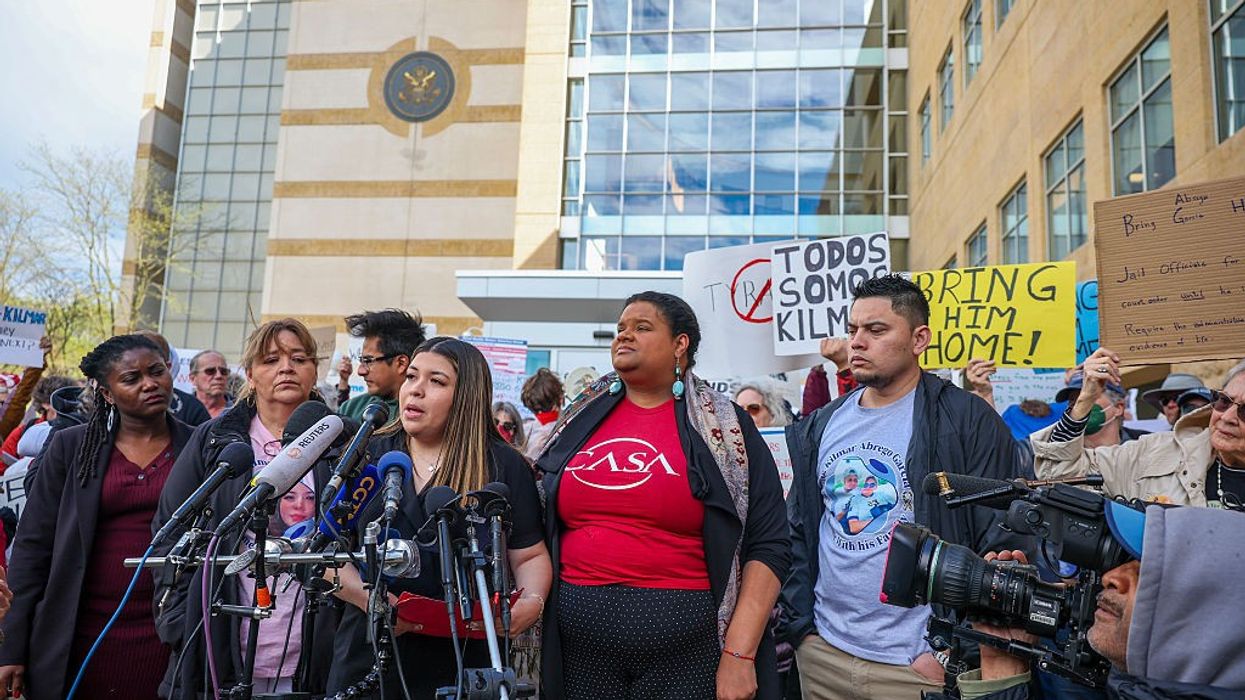
"There will be no tolerance for gamesmanship or grandstanding," the judge said. "Cancel vacations, cancel other appointments... I expect all hands on deck."
As White House Press Secretary Karoline Leavitt on Tuesday had a "full-blown meltdown" after a reporter asked about the Maryland man wrongly deported to a prison in his native El Salvador, U.S. District Judge Paula Xinis launched an inquiry into the Trump administration's refusal to seek the return of Kilmar Abrego Garcia to the United States.
The Trump administration has previously admitted in court that Abrego Garcia was mistakenly sent to the notorious Terrorism Confinement Center (CECOT)—despite an immigration judge's 2019 order barring his deportation to El Salvador—due to an administrative error. Xinis ordered the administration to facilitate his release, a decision unanimously affirmed last week by the U.S. Supreme Court.
However, Abrego Garcia remained imprisoned as the U.S. Department of Justice (DOJ) argued in a Sunday filing that Xinis has "no authority" to compel the administration to bring him home, and as President Donald Trump on Monday welcomed Salvadoran President Nayib Bukele to the White House. Their meeting was followed by a Tuesday court hearing.
According to NBC News: "Attorneys for Abrego Garcia had asked that the administration be found in contempt of court over its inaction. The judge said she wants to review the evidence the administration submits, which is expected to include sworn depositions, before ruling on the matter."
During the hearing, Drew Ensign of the DOJ told Xinis—who was appointed to the District of Maryland by former President Barack Obama—that if Abrego Garcia "appears at a port of entry or U.S. Embassy we will facilitate his return."
Meanwhile, the judge called out the administration, saying: "What the record shows is that nothing has been done. Nothing. I asked for reports from individuals with direct knowledge, and I've gotten very little information of any value."
"We're going to move. There will be no tolerance for gamesmanship or grandstanding," Xinis continued. "There are no business hours while we do this… Cancel vacations, cancel other appointments. I'm usually pretty good about things like that in my court, but not this time. So, I expect all hands on deck."
NEW: Judge Xinis authorizes up to 15 interrogatories, 15 document requests, depositions from all govt declarants (Cerna, Katz, Kozak, and Mazzara) and up to two others to assess what the govt has done to "facilitate" Kilmar Abrego Garcia's release storage.courtlistener.com/recap/gov.us...
[image or embed]
— Joshua J. Friedman (@joshuajfriedman.com) April 15, 2025 at 6:36 PM
At the White House on Tuesday, a reporter asked Leavitt who is responsible for Abrego Garcia and where he is going to end up. The press secretary responded by sharing unfounded allegations that he is a "terrorist" and member of the gang MS-13, and said that "deporting him back to El Salvador was always going to be the end result."
Leavitt also used Bukele's framing from the Oval Office event, when he suggested that returning the Maryland resident would mean smuggling a terrorist into the country. In addition to Abrego Garcia, the Trump administration has sent 238 Venezuelan migrants to CECOT, and the president on Monday expressed interest in sending "homegrown" American prisoners there.
"This is what mass deportation looks like," Vanessa Cárdenas, executive director of the advocacy group America's Voice, said in a Tuesday statement. "The concept of stripping citizenship from U.S. citizens and sending them to El Salvador prisons without due process is the stuff of nightmares and undemocratic regimes, yet here we are."
"It's hard to overstate what the stakes are for our democracy and core American principles given what we're seeing and what the administration is now floating as the next steps in their larger deportation agenda," Cárdenas added. "And it's time Americans of all political perspectives stand up and speak out in opposition."
Some Democrats in Congress have blasted the Trump administration's anti-immigrant agenda and are part of the battle to bring Abrego Garcia home—including U.S. Sen. Chris Van Hollen of Maryland, who is aiming to travel to El Salvador if the deported man is not swiftly returned to his state. Multiple Democratic members of the House of Representatives have signaled that they plan to join the trip.

"This is a massive win for justice and the rule of law," said one Democratic congresswoman. "Now Trump must comply."
The U.S. Supreme Court on Thursday issued a ruling with no noted dissents affirming a federal judge's order compelling President Donald Trump's administration to enable the stateside return of Kilmar Abrego García, a Salvadoran man wrongfully deported to a notorious prison in his native country.
"The rule of law won today," said Andrew Rossman, one of Abrego García's lawyers. "Time to bring him home."
Justice Sonia Sotomayor wrote in Thursday's unsigned order that the Trump administration must "facilitate and effectuate" Abrego García's release from custody "and to ensure that his case is handled as it would have been had he not been improperly sent to El Salvador."
"The intended scope of the term 'effectuate' in the district court's order is, however, unclear, and may exceed the district court's authority," Sotomayor added. "The district court should clarify its directive, with due regard for the deference owed to the executive branch in the conduct of foreign affairs."
Last week, U.S. District Judge Paula Xinis gave the Trump administration until Monday April 7 to return Abrego García, who was deported last month to the Terrorism Confinement Center (CECOT) super-maximum security prison in central El Salvador after the government claimed without credible evidence that he was a gang member.
"Defendants seized Abrego García without any lawful authority; held him in three separate domestic detention centers without legal basis; failed to present him to any immigration judge or officer; and forcibly transported him to El Salvador in direct contravention" of immigration law, she wrote.
A panel of the 4th U.S. Circuit Court of Appeals declined to stay Xinis' order, with one judge on the tribunal writing, "The United States government has no legal authority to snatch a person who is lawfully present in the United States off the street and remove him from the country without due process."
The panel refuted the Trump administration's assertion that it could not return Abrego García, calling the government's argument "that the federal courts are powerless to intervene... unconscionable."
However, on Monday, Supreme Court Chief Justice John Roberts temporarily blocked Xinis' order just before the midnight deadline pending review by all nine justices.
Abrego García's legal team argued that their client was the victim of a "Kafkaesque mistake." Among the so-called evidence the government used to claim he is a member of the MS-13 criminal gang was a Chicago Bulls hat and hoodie he wore, and a snitch's tip. The Trump administration subsequently admitted in a March 31 court filing that Abrego García's deportation was an "administrative error" and an "oversight."
Before he was deported, Abrego García, 29, lived in Maryland with his wife, Jennifer Stefania Vasquez Sura, a U.S. citizen; their autistic, nonverbal 5-year-old child; and two children from Vasquez Sura's previous relationship. His lawyers said he left El Salvador to escape the then-endemic gang violence there.
Advocates for Abrego García welcomed the high court's order, with Congressman Joaquin Castro (D-Texas) writing on the social media site Bluesky that the justices "did the right thing."
"This is about the rule of law and due process," he added. "Kilmar Abrego García should be reunited with his family."
Rep. Pramila Jayapal (D-Wash.) said: "This is a massive win for justice and the rule of law. Now Trump must comply."