SUBSCRIBE TO OUR FREE NEWSLETTER
Daily news & progressive opinion—funded by the people, not the corporations—delivered straight to your inbox.
5
#000000
#FFFFFF
To donate by check, phone, or other method, see our More Ways to Give page.
Daily news & progressive opinion—funded by the people, not the corporations—delivered straight to your inbox.

Palestinian children try to eat from a single bowl inside a tent in Rafah, Gaza on February 14, 2024.
"Avoiding famine cannot be done with ongoing hostilities," said an international coalition.
With Israel blocking aid and decimating all infrastructure that Palestinians in Gaza have used to feed the population, a coalition of international human rights groups on Wednesday said that nothing less than "an immediate and permanent cease-fire" is needed to ensure the enclave does not descend into famine.
Fifteen groups including Save the Children, the Norwegian Refugee Council, and Action Against Hunger issued a joint statement demanding an immediate end to Israel's bombardment of Gaza as it became clear that the Biden administration's efforts to provide aid to civilians are backfiring.
Weeks after high-level White House officials negotiated a shipment of flour to Gaza, where just 15 out of 97 bakeries are operational following Israeli airstrikes and ground attacks, Israeli Finance Minister Bezalel Smotrich blocked the transfer of the flour from the port of Ashdod.
The shipment was supposed to be sent through the Kerem Shalom crossing, but has been held up at Ashdod for several weeks because Smotrich was told the flour was destined for the United Nations Relief and Works Agency for Palestine Refugees in the Near East (UNRWA). The aid agency for Palestinians in Gaza has lost significant funding in recent weeks due to Israel's unsubstantiated claim that 12 of the group's employees were involved in a Hamas-led attack on southern Israel last October.
An Israeli dossier examined by Channel 4 in the U.K. this month provided no evidence that UNRWA workers were involved in the attack, but the U.S. and other countries have nonetheless refused to reinstate funding for the agency, on which Gaza's 2.3 million residents heavily relied for aid even before the war.
In their statement, the aid groups on Wednesday warned that "the only way to comply with the United Nations Security Council Resolution 2417," which condemns the use of starvation as a weapon of war, is to agree to an immediate and permanent cease-fire and allow all humanitarian aid to reach victims in Gaza.
"The siege tactics imposed by Israel on Gaza are one of the key factors impeding the delivery of aid," said the groups. "Under international humanitarian law, parties to the conflict are obliged to facilitate rapid unfettered access to aid."
The groups released the statement as Israel was expected to begin a ground offensive in Rafah, where 1.5 million people are now living following the displacement of about 85% of Gaza residents—as the city has been labeled a "safe zone."
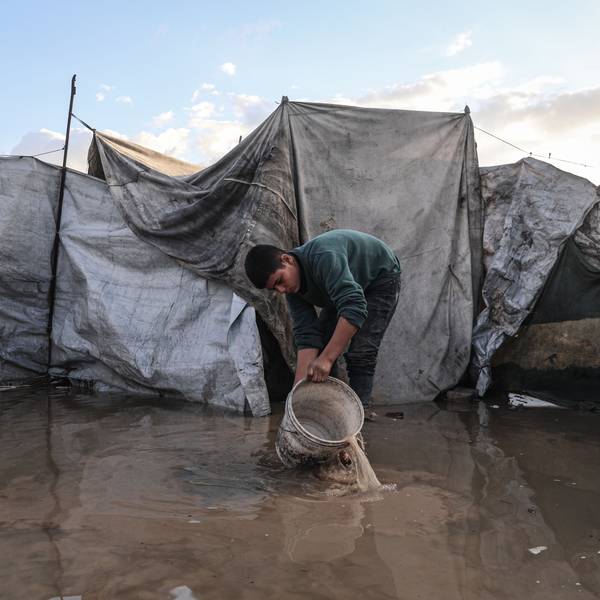
Dozens have been killed in bombings on the city in recent days as Palestinians seek shelter in makeshift tents, all while struggling to feed their families.
Matthew Hollingsworth, Palestine country director for the World Food Program, described how the city is "packed with a throng of humans" who have been forced to spend their days "bustling around, looking for support, for assistance, for fuel to burn to keep warm or cook, looking for food, being elsewhere other than a fairly damp, cold, and miserable [makeshift] home."
The aid groups noted that Integrated Food Security and Nutrition Phase Classification (IPC) analysis from late last year found that the entire population of Gaza was living in a state of "crisis-level hunger," with 1 in 4 households—more than half a million people—facing "catastrophic" hunger, defined as "an extreme lack of food, starvation, and exhaustion of coping capacities."
"This is the highest proportion of any population in food security crisis and above on the IPC's global records," said the groups. "Virtually all households are skipping meals each day. Some families go days and nights without eating."
The groups added that the United Nations has predicted a 27% increase in child wasting—which occurs when a child is too thin for their height as the result of rapid weight loss—in the coming months unless a cease-fire is brokered and humanitarian aid is restored.
Two-thirds of Gaza's population relied on daily aid deliveries before the current Israeli escalation, and now needs have "largely increased and worsened," said the groups, due partially to the destruction of agricultural fields, water pipelines, and other food infrastructure.
"The prevention of sufficient food aid from reaching the population and targeting food production and distribution infrastructure, including farms, water systems, mills, food processing and storing sites, hubs, and means for food transportation are a direct violation of United Nations Security Council Resolution 2417," said the groups.
"The only way to avoid the risk of famine is to immediately stop the deterioration of health, nutrition and food security, and increasing morbidity, through the restoration of health services, water and sanitation services, fisheries and agricultural lands, and markets," they added. "Avoiding famine cannot be done with ongoing hostilities."
Dear Common Dreams reader, It’s been nearly 30 years since I co-founded Common Dreams with my late wife, Lina Newhouser. We had the radical notion that journalism should serve the public good, not corporate profits. It was clear to us from the outset what it would take to build such a project. No paid advertisements. No corporate sponsors. No millionaire publisher telling us what to think or do. Many people said we wouldn't last a year, but we proved those doubters wrong. Together with a tremendous team of journalists and dedicated staff, we built an independent media outlet free from the constraints of profits and corporate control. Our mission has always been simple: To inform. To inspire. To ignite change for the common good. Building Common Dreams was not easy. Our survival was never guaranteed. When you take on the most powerful forces—Wall Street greed, fossil fuel industry destruction, Big Tech lobbyists, and uber-rich oligarchs who have spent billions upon billions rigging the economy and democracy in their favor—the only bulwark you have is supporters who believe in your work. But here’s the urgent message from me today. It's never been this bad out there. And it's never been this hard to keep us going. At the very moment Common Dreams is most needed, the threats we face are intensifying. We need your support now more than ever. We don't accept corporate advertising and never will. We don't have a paywall because we don't think people should be blocked from critical news based on their ability to pay. Everything we do is funded by the donations of readers like you. When everyone does the little they can afford, we are strong. But if that support retreats or dries up, so do we. Will you donate now to make sure Common Dreams not only survives but thrives? —Craig Brown, Co-founder |
With Israel blocking aid and decimating all infrastructure that Palestinians in Gaza have used to feed the population, a coalition of international human rights groups on Wednesday said that nothing less than "an immediate and permanent cease-fire" is needed to ensure the enclave does not descend into famine.
Fifteen groups including Save the Children, the Norwegian Refugee Council, and Action Against Hunger issued a joint statement demanding an immediate end to Israel's bombardment of Gaza as it became clear that the Biden administration's efforts to provide aid to civilians are backfiring.
Weeks after high-level White House officials negotiated a shipment of flour to Gaza, where just 15 out of 97 bakeries are operational following Israeli airstrikes and ground attacks, Israeli Finance Minister Bezalel Smotrich blocked the transfer of the flour from the port of Ashdod.
The shipment was supposed to be sent through the Kerem Shalom crossing, but has been held up at Ashdod for several weeks because Smotrich was told the flour was destined for the United Nations Relief and Works Agency for Palestine Refugees in the Near East (UNRWA). The aid agency for Palestinians in Gaza has lost significant funding in recent weeks due to Israel's unsubstantiated claim that 12 of the group's employees were involved in a Hamas-led attack on southern Israel last October.
An Israeli dossier examined by Channel 4 in the U.K. this month provided no evidence that UNRWA workers were involved in the attack, but the U.S. and other countries have nonetheless refused to reinstate funding for the agency, on which Gaza's 2.3 million residents heavily relied for aid even before the war.
In their statement, the aid groups on Wednesday warned that "the only way to comply with the United Nations Security Council Resolution 2417," which condemns the use of starvation as a weapon of war, is to agree to an immediate and permanent cease-fire and allow all humanitarian aid to reach victims in Gaza.
"The siege tactics imposed by Israel on Gaza are one of the key factors impeding the delivery of aid," said the groups. "Under international humanitarian law, parties to the conflict are obliged to facilitate rapid unfettered access to aid."
The groups released the statement as Israel was expected to begin a ground offensive in Rafah, where 1.5 million people are now living following the displacement of about 85% of Gaza residents—as the city has been labeled a "safe zone."
Dozens have been killed in bombings on the city in recent days as Palestinians seek shelter in makeshift tents, all while struggling to feed their families.
Matthew Hollingsworth, Palestine country director for the World Food Program, described how the city is "packed with a throng of humans" who have been forced to spend their days "bustling around, looking for support, for assistance, for fuel to burn to keep warm or cook, looking for food, being elsewhere other than a fairly damp, cold, and miserable [makeshift] home."
The aid groups noted that Integrated Food Security and Nutrition Phase Classification (IPC) analysis from late last year found that the entire population of Gaza was living in a state of "crisis-level hunger," with 1 in 4 households—more than half a million people—facing "catastrophic" hunger, defined as "an extreme lack of food, starvation, and exhaustion of coping capacities."
"This is the highest proportion of any population in food security crisis and above on the IPC's global records," said the groups. "Virtually all households are skipping meals each day. Some families go days and nights without eating."
The groups added that the United Nations has predicted a 27% increase in child wasting—which occurs when a child is too thin for their height as the result of rapid weight loss—in the coming months unless a cease-fire is brokered and humanitarian aid is restored.
Two-thirds of Gaza's population relied on daily aid deliveries before the current Israeli escalation, and now needs have "largely increased and worsened," said the groups, due partially to the destruction of agricultural fields, water pipelines, and other food infrastructure.
"The prevention of sufficient food aid from reaching the population and targeting food production and distribution infrastructure, including farms, water systems, mills, food processing and storing sites, hubs, and means for food transportation are a direct violation of United Nations Security Council Resolution 2417," said the groups.
"The only way to avoid the risk of famine is to immediately stop the deterioration of health, nutrition and food security, and increasing morbidity, through the restoration of health services, water and sanitation services, fisheries and agricultural lands, and markets," they added. "Avoiding famine cannot be done with ongoing hostilities."
With Israel blocking aid and decimating all infrastructure that Palestinians in Gaza have used to feed the population, a coalition of international human rights groups on Wednesday said that nothing less than "an immediate and permanent cease-fire" is needed to ensure the enclave does not descend into famine.
Fifteen groups including Save the Children, the Norwegian Refugee Council, and Action Against Hunger issued a joint statement demanding an immediate end to Israel's bombardment of Gaza as it became clear that the Biden administration's efforts to provide aid to civilians are backfiring.
Weeks after high-level White House officials negotiated a shipment of flour to Gaza, where just 15 out of 97 bakeries are operational following Israeli airstrikes and ground attacks, Israeli Finance Minister Bezalel Smotrich blocked the transfer of the flour from the port of Ashdod.
The shipment was supposed to be sent through the Kerem Shalom crossing, but has been held up at Ashdod for several weeks because Smotrich was told the flour was destined for the United Nations Relief and Works Agency for Palestine Refugees in the Near East (UNRWA). The aid agency for Palestinians in Gaza has lost significant funding in recent weeks due to Israel's unsubstantiated claim that 12 of the group's employees were involved in a Hamas-led attack on southern Israel last October.
An Israeli dossier examined by Channel 4 in the U.K. this month provided no evidence that UNRWA workers were involved in the attack, but the U.S. and other countries have nonetheless refused to reinstate funding for the agency, on which Gaza's 2.3 million residents heavily relied for aid even before the war.
In their statement, the aid groups on Wednesday warned that "the only way to comply with the United Nations Security Council Resolution 2417," which condemns the use of starvation as a weapon of war, is to agree to an immediate and permanent cease-fire and allow all humanitarian aid to reach victims in Gaza.
"The siege tactics imposed by Israel on Gaza are one of the key factors impeding the delivery of aid," said the groups. "Under international humanitarian law, parties to the conflict are obliged to facilitate rapid unfettered access to aid."
The groups released the statement as Israel was expected to begin a ground offensive in Rafah, where 1.5 million people are now living following the displacement of about 85% of Gaza residents—as the city has been labeled a "safe zone."
Dozens have been killed in bombings on the city in recent days as Palestinians seek shelter in makeshift tents, all while struggling to feed their families.
Matthew Hollingsworth, Palestine country director for the World Food Program, described how the city is "packed with a throng of humans" who have been forced to spend their days "bustling around, looking for support, for assistance, for fuel to burn to keep warm or cook, looking for food, being elsewhere other than a fairly damp, cold, and miserable [makeshift] home."
The aid groups noted that Integrated Food Security and Nutrition Phase Classification (IPC) analysis from late last year found that the entire population of Gaza was living in a state of "crisis-level hunger," with 1 in 4 households—more than half a million people—facing "catastrophic" hunger, defined as "an extreme lack of food, starvation, and exhaustion of coping capacities."
"This is the highest proportion of any population in food security crisis and above on the IPC's global records," said the groups. "Virtually all households are skipping meals each day. Some families go days and nights without eating."
The groups added that the United Nations has predicted a 27% increase in child wasting—which occurs when a child is too thin for their height as the result of rapid weight loss—in the coming months unless a cease-fire is brokered and humanitarian aid is restored.
Two-thirds of Gaza's population relied on daily aid deliveries before the current Israeli escalation, and now needs have "largely increased and worsened," said the groups, due partially to the destruction of agricultural fields, water pipelines, and other food infrastructure.
"The prevention of sufficient food aid from reaching the population and targeting food production and distribution infrastructure, including farms, water systems, mills, food processing and storing sites, hubs, and means for food transportation are a direct violation of United Nations Security Council Resolution 2417," said the groups.
"The only way to avoid the risk of famine is to immediately stop the deterioration of health, nutrition and food security, and increasing morbidity, through the restoration of health services, water and sanitation services, fisheries and agricultural lands, and markets," they added. "Avoiding famine cannot be done with ongoing hostilities."