SUBSCRIBE TO OUR FREE NEWSLETTER
Daily news & progressive opinion—funded by the people, not the corporations—delivered straight to your inbox.
5
#000000
#FFFFFF
To donate by check, phone, or other method, see our More Ways to Give page.

Daily news & progressive opinion—funded by the people, not the corporations—delivered straight to your inbox.
"As long as this reform isn't withdrawn, the mobilization will continue in one form or another," said one union leader.
Workers opposed to French President Emmanuel Macron's deeply unpopular plan to raise the nation's retirement age from 62 to 64 hit the streets Thursday in a final display of anger before the country's top court rules on the measure's constitutionality.
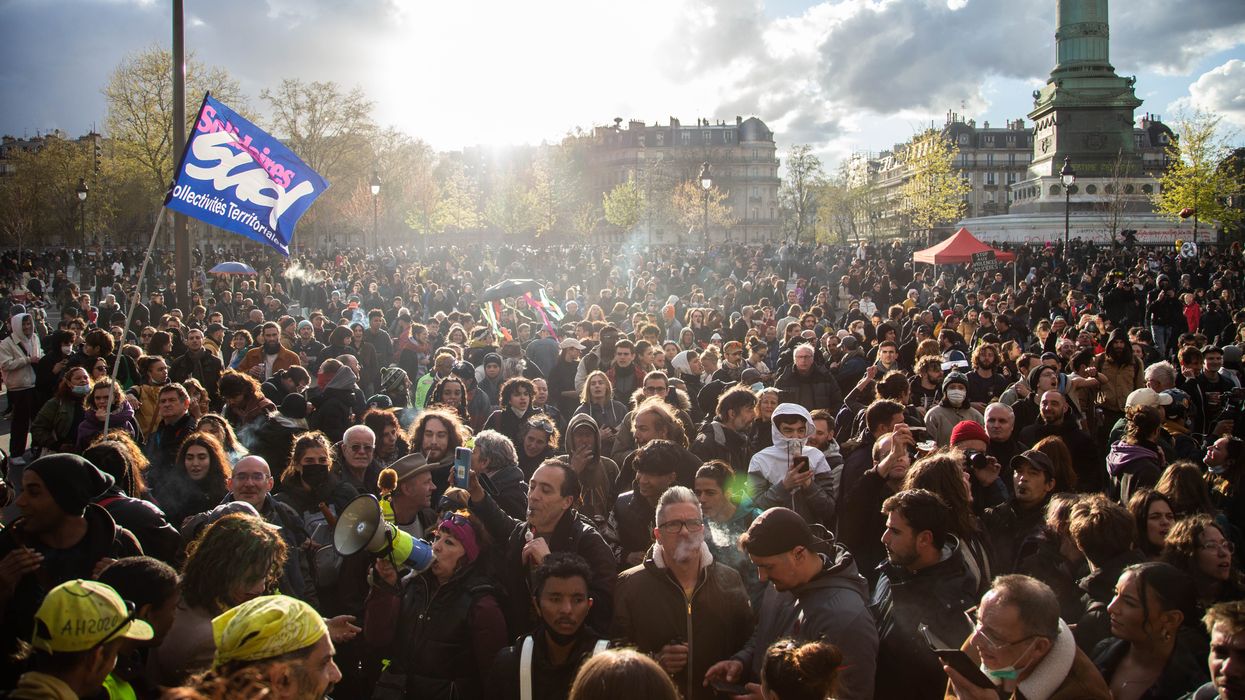
While thousands of people marched along the designated route in Paris, some protesters carrying lit flares diverged to the Constitutional Council, which is set to decide Friday whether to uphold Macron's proposed pension overhaul or rescind it partially or completely.
"They faced off with a large contingent of police deployed outside the building, where hours before the march got underway, other protesters had dumped bags of rubbish," Al Jazeera reported. "The rubbish piles were cleaned up but signaled the start of a new strike by rubbish collectors, timed to begin with the nationwide protest marches. A previous strike last month left the streets of the French capital filled for days with mounds of reeking refuse."

According to CNN, the French government has imposed a ban on protests near the Constitutional Council from Thursday night through Saturday morning.
Last month, Macron advanced his plan to increase the minimum eligible retirement age as well as the number of years one must work to qualify for full benefits through executive order, bypassing the National Assembly once it became clear that his legislative proposal did not have enough support to pass France's lower house. The Senate had already approved the bill, including it in a budget package that expedited the process.
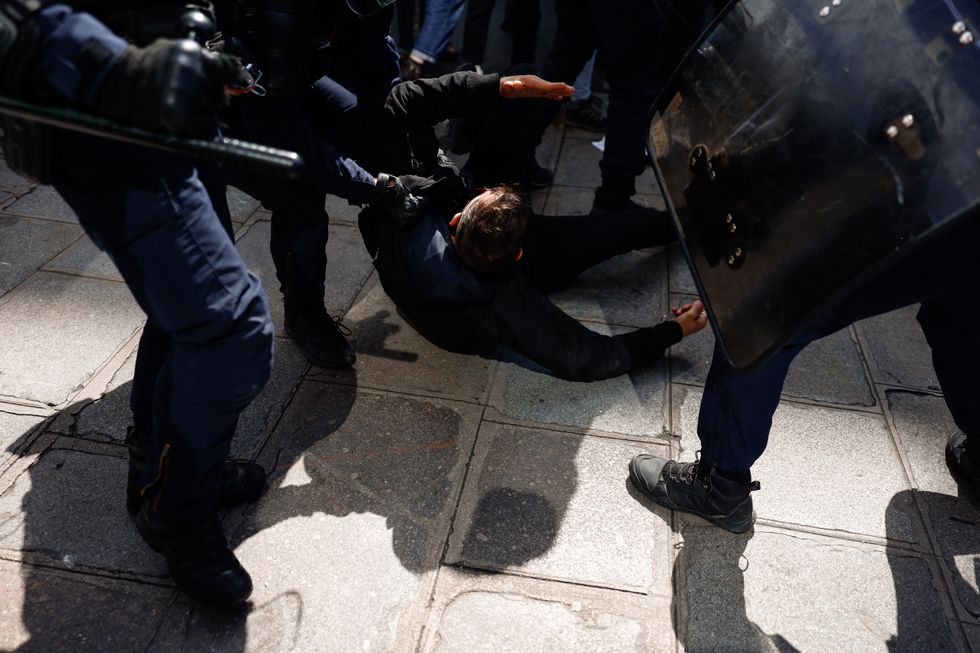
The labor movement has been organizing weekly strikes and peaceful rallies since mid-January, and the president's blatantly anti-democratic move to circumvent a vote only intensified working-class fury. The government, meanwhile, has responded with an increasingly repressive crackdown.
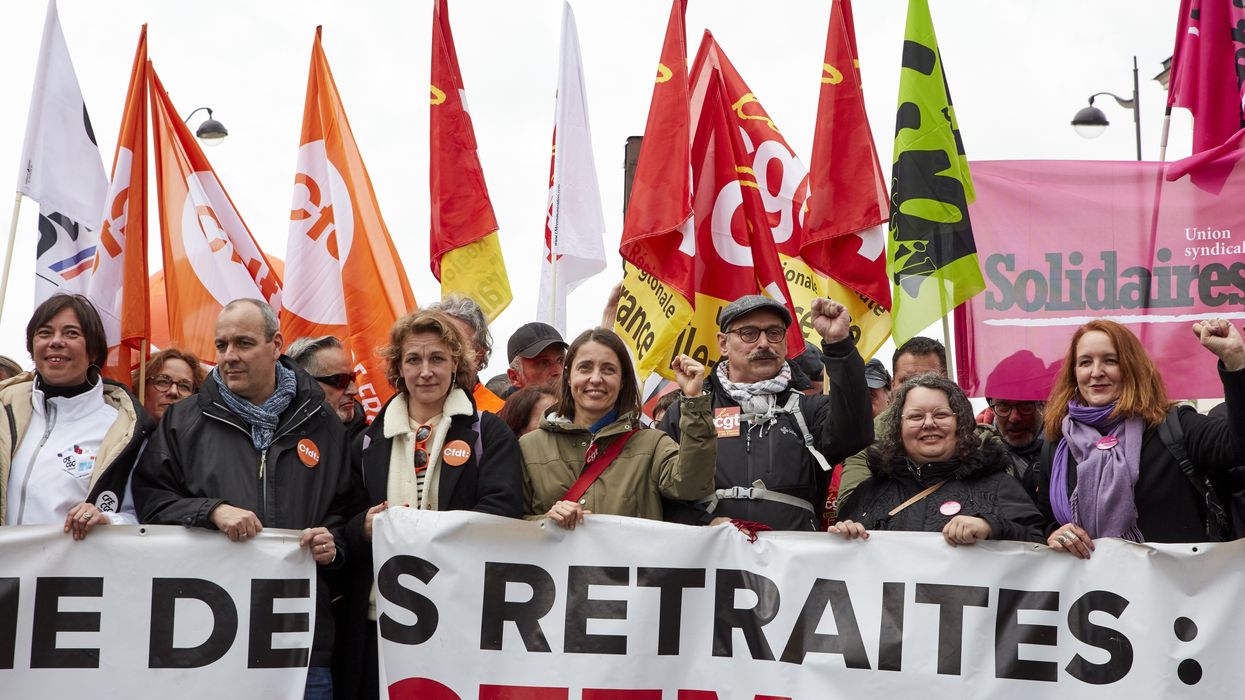
Union leaders, who have implored workers to maintain pressure on the government, called for a 12th round of action on Thursday.
Outside the capital, thousands of people also marched in Marseille, Toulouse, and other cities, including Nantes and Rennes, where a car was set ablaze.
"In Paris, banks and expensive stores secured their front windows with wooden boards but nevertheless, demonstrators broke into the headquarters of the French luxury group LVMH and set off firecrackers," Al Jazeera reported. "The authorities deployed 11,500 police officers, 4,200 of them in Paris alone."
Outside the LVMH building, union leader Fabien Villedieu told CNN affiliate BFMTV that "if Macron wants to find money to finance the pension system, he should come here to find it."
“The mobilization is far from over," General Confederation of Labor leader Sophie Binet said at a trash incineration site south of Paris where hundreds of protesters blocked garbage trucks.
"As long as this reform isn't withdrawn, the mobilization will continue in one form or another," Binet added.
The nine-member Constitutional Council is expected to issue a binding ruling by the end of Friday to "partially approve, fully accept, or reject" Macron's proposed changes, Al Jazeera noted. "On Tuesday and Thursday, left-wing lawmakers visited the council to urge them to completely ban the reform. They have argued that the government's unorthodox method of resorting to a budget law to pass a pension reform, as well as invoking controversial Article 49.3 of the Constitution to bypass a parliament vote, is grounds for it to be thrown out."
Progressive legislators and union leaders have portrayed the left's struggle against Macron's pension attack as a struggle for democracy in France.
A poll released last week found that reactionary lawmaker Marine Le Pen—leader of the far-right National Rally party, the largest opposition force in Parliament—would beat Macron by a margin of 55% to 45% in a head-to-head rematch. The neoliberal incumbent defeated Le Pen in a runoff election last April, but the openly xenophobic and Islamophobic challenger has gained significant ground since their first matchup in 2017.
"Either trade unions win this, or it will be the far right," Villedieu said last week. "If you sicken people—and that is what's happening—the danger is the arrival of the far right."
Ahead of Thursday's protests, Paris Mayor Anne Hidalgo tweeted: "This reform is unjust and violent. The French have been asking for it to be withdrawn for months, the government has to hear them."
A new poll shows that Marine Le Pen would beat French President Emmanuel Macron in a head-to-head rematch, making the left's struggle against Macron's pension attack a struggle for democracy in France.
As French workers intensify their fight against President Emmanuel Macron's deeply unpopular plan to raise the nation's retirement age from 62 to 64, the stakes couldn't be higher.
A poll released Wednesday shows that reactionary lawmaker Marine Le Pen—leader of the far-right National Rally party, the largest opposition force in Parliament—would beat Macron by a margin of 55% to 45% in a head-to-head rematch. The neoliberal incumbent defeated Le Pen in a runoff election last April, but the openly xenophobic and Islamophobic challenger has gained significant ground since their first matchup in 2017.
The new survey was conducted after Macron advanced his planned retirement age hike through executive order on March 16. The president bypassed the National Assembly once it became clear that his legislative proposal did not have enough support to pass France's lower house.
"We're in the middle of a social crisis, a democratic crisis."
Macron's blatantly anti-democratic move provoked an uproar. The labor movement had already been staging weekly nationwide strikes and peaceful marches since mid-January. But the president's decision to circumvent a vote last month has brought more people to the streets, with heightened participation from high school and university students, some of whom have set up barricades on campus.
Progressive lawmakers and union leaders have urged the working class to keep up the pressure, portraying the left's struggle against Macron's pension attack as a struggle for democracy in France.
"Either trade unions win this, or it will be the far right," Fabien Villedieu, a representative of a railway trade union, told France Info radio on Thursday. "If you sicken people—and that is what's happening—the danger is the arrival of the far right."
Laurent Berger, head of the French Democratic Confederation of Labor, told RTL radio that "we're still asking for the reform to be revoked."
"We're in the middle of a social crisis, a democratic crisis," he added.
Macron has so far refused to withdraw his proposed pension overhaul, which includes raising the minimum eligible retirement age and increasing the number of years one must work to qualify for full benefits. France's constitutional council is evaluating the legality of the government's plans and is set to issue a decision next Friday.
According to The Guardian:
The constitutional council, which has the power to strike out some or even all of the legislation, will assess the pension changes based on a strict interpretation of the law. Constitutional experts say the council is unlikely to strike the legislation down fully.
The government is playing for time, hoping protests and strikes will fizzle out. Unions want to show that the protest movement still has momentum, whatever the council's decision.
Hundreds of thousands of people have continued to rally across France in recent weeks. The government has responded with an increasingly repressive crackdown.
An 11th round of strikes on Thursday caused further disruption to schools, public transit, and energy production. In addition, clashes broke out "between demonstrators and police on the edges of protests in cities including Lyon, Nantes, and Paris," The Guardian reported.
Workers' anger is palpable and mounting.
"In the capital, protesters briefly set fire to the awning of the Left Bank brasserie La Rotonde, well known for hosting Macron's controversial evening of celebrations when he led the first-round vote in the 2017 presidential election," The Guardian noted.
Meanwhile, rat catchers threw dead vermin at city hall.
Also on Thursday, striking workers "forced their way into the building that houses BlackRock's office in Paris Thursday, taking their protest against the government's pension reforms to the world's biggest money manager," CNN reported. "About 100 people, including representatives of several labor unions, were on the ground floor of the building for about 10 minutes, chanting anti-reform slogans. BlackRock's office is located on the third floor."
Jerome Schmitt, a spokesperson for the French labor confederation SUD, told reporters: "The meaning of this action is quite simple. We went to the headquarters of BlackRock to tell them: the money of workers, for our pensions, they are taking it."
BlackRock, the world's largest asset manager with a nearly $9 trillion portfolio, has not been involved in Macron's assault on France's public pension system. But workers targeted the financial institution due to its role in overseeing the private pension funds that they may be forced to rely on.
"The government wants to throw away pensions, it wants to force people to fund their own retirement with private pension funds," one teacher told Reuters. "But what we know is that only the rich will be able to benefit from such a setup."
Le Pen, for her part, "has kept a low profile, hoping to increase her support among low-income workers, many of whom began their careers earlier and will be more greatly affected by the pension changes," The Guardian reported.
Earlier this week, left-wing luminaries alarmed by France's escalating repression of pension defenders as well as environmentalists campaigning against water privatization signed a Progressive International petition.
"We stand with the French people in the face of violent crackdowns on popular protest and the criminalization of dissent by Emmanuel Macron's government," it states. "The extreme violence of the police and the criminalization by the interior minister are clearly aimed at suppressing the movement against the pension cuts. This is an unacceptable attack on the democratic freedoms and human rights of French citizens."
"This forced passage with the use of Article 49.3 must be met with a response in line with this show of contempt toward the people," declared one union leader as MPs introduced no-confidence motions.
Protests in Paris and across France have ramped up since President Emmanuel Macron's government on Thursday used a controversial constitutional measure to force through a pension reform plan without a National Assembly vote.
Fears that the Senate-approved measure—which would raise the retirement age from 62 to 64—did not have enough support to pass the lower house of Parliament led to a Council of Ministers meeting, during which Macron reportedly said that "my political interest would have been to submit to a vote… But I consider that the financial, economic risks are too great at this stage."
"This reform is outrageous, punishing women and the working class, and denying the hardship of those who have the toughest jobs."
After the meeting, French Prime Minister Élisabeth Borne announced the decision to go with the "nuclear option," invoking Article 49.3 of the French Constitution—a calculated risk considering the potential for a resulting motion of no-confidence.
Members of Parliament opposed to the overhaul filed a pair of no-confidence motions on Friday, and votes are expected on Monday. Although unlikely, given the current makeup of the legislature, passing such a motion would not only reject the looming pension law but also oust Macron's prime minister and Cabinet, and likely lead to early elections in France.
As Deutsche Welle reported:
"The vote on this motion will allow us to get out on top of a deep political crisis," said the head of the so-called LIOT group Bertrand Pancher, whose motion was co-signed by members of the broad left-wing NUPES coalition.
The far-right National Rally (RN) filed a second motion, but that was expected to get less backing. RN lawmaker Laure Lavalette however said her party would vote for "all" no-confidence motions filed. "What counts is scuppering this unfair reform bill," she said.
Leaders of the Les Republicains (LR) are not sponsoring any such motions. Reuters explained that individuals in the conservative party "have said they could break ranks, but the no-confidence bill would require all of the other opposition lawmakers and half of LR's 61 lawmakers to go through, which is a tall order."
Still, Green MP Julien Bayou said, "it's maybe the first time that a motion of no-confidence may overthrow the government."
Meanwhile, protests against the pension proposal—which have been happening throughout the year—continue in the streets, with some drawing comparisons to France's "Yellow Vests" movement sparked by fuel prices and economic conditions in 2018.
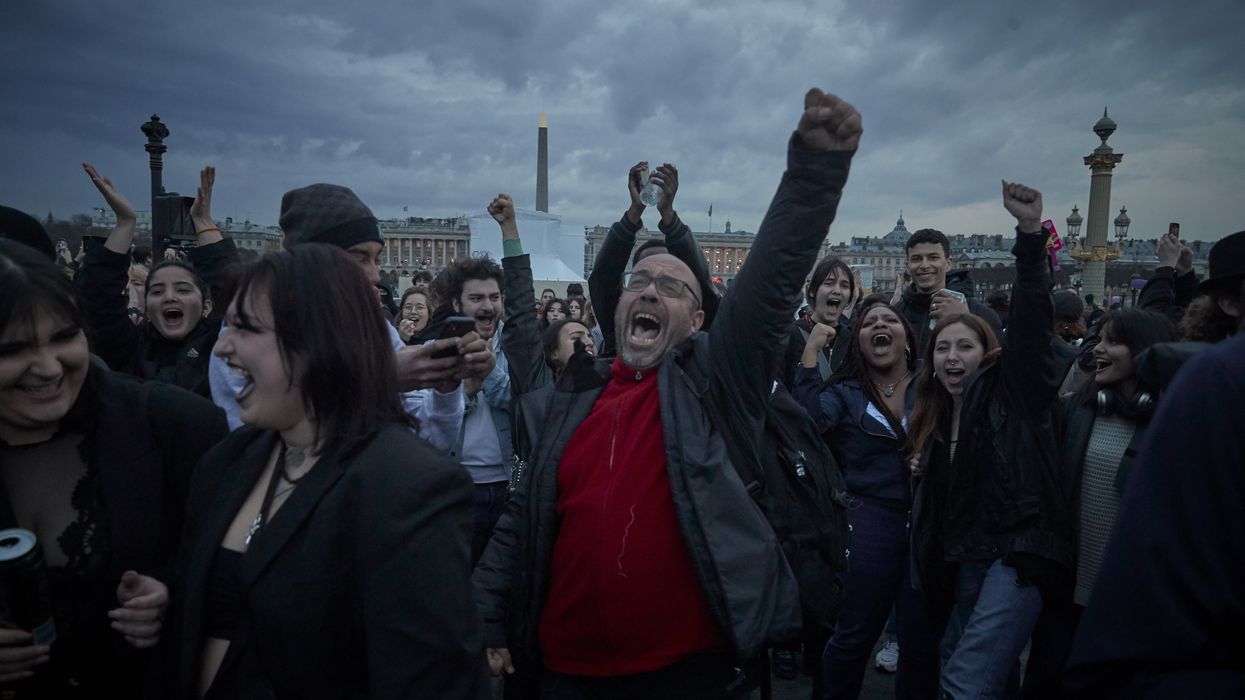
Not long after Borne's Article 49.3 announcement on Thursday, "protesters began to converge on the sprawling Place de la Concorde in central Paris, a mere bridge away from the heavily guarded National Assembly," according to France 24.
As the news outlet detailed:
There were the usual suspects, like leftist firebrand Jean-Luc Mélenchon, thundering against a reform he said had "no legitimacy—neither in Parliament, nor in the street." Unionists were also out in strength, hailing a moral victory even as they denounced Macron's "violation of democracy."
Many more were ordinary protesters who had flocked to the Concorde after class or work. One brandished a giant fork made of cardboard as the crowd chanted "Macron démission" (Macron resign). Another spray-painted an ominous message on a metal barrier—"The shadow of the guillotine is nearing"—in the exact spot where Louis XVI was executed 230 years ago.
Police used tear gas to disperse the Concorde crowd. Interior Minister Gérald Darmanin told RTL radio 310 people were arrested nationwide—258 of them in Paris. He said, "The opposition is legitimate, the protests are legitimate, but wreaking havoc is not."
Anna Neiva Cardante is a 23-year-old student whose parents, a bricklayer and a cleaner, "are among those who stand to lose most."
"A vote in the National Assembly was the government’s only chance of securing a measure of legitimacy for its reform," Neiva Cardante told France 24 as police cleared the crowd Thursday. "Now it has a full-blown crisis on its hands."
"This reform is outrageous," she added, "punishing women and the working class, and denying the hardship of those who have the toughest jobs."
Across the French capital early Friday, "traffic, garbage collection, and university campuses in the city were disrupted, as unions threatened open-ended strikes," DW noted. "Elsewhere in the country, striking sanitation workers blocked a waste collection plant that is home to Europe's largest incinerator to underline their determination."
"Article 49.3 constitutes a triple defeat for the executive: popular, political, and moral," declared Laurent Escure, secretary general of the labor union UNSA. "It opens up a new stage for the protests."
Philippe Martinez of the CGT union asserted that "this forced passage with the use of Article 49.3 must be met with a response in line with this show of contempt toward the people."
"What the government is doing makes people sick of politics. It should improve people's lives, not destroy them," said Rachel Keke, a leftist in France's National Assembly.
Amid protests against French President Emmanuel Macron's unpopular plan to overhaul the country's pension system, his government on Thursday chose the "nuclear option," opting to use a constitutional procedure to force through reforms, including raising the retirement age from 62 to 64, without a vote in the lower house of Parliament.
While the proposal passed the Senate, the upper chamber of Parliament, 193-114 Thursday morning, "reports indicated that the ruling party, which lost its overall majority in elections last year, was a handful of votes short" in the National Assembly, which led to an emergency Council of Ministers meeting about triggering Article 49.3,
Le Monde explained.
After announcing the government was invoking executive privilege, French Prime Minister Élisabeth Borne "faced scenes of anger and unrest in the National Assembly," reported Politico. "Far-left lawmakers belonging to the France Unbowed party booed and chanted the national hymn the Marseillaise as far-right National Rally MPs shouted 'Resign! Resign!'"
Using the controversial procedure to push through the plan is risky for Macron—founder of the Renaissance party—because it allows members of Parliament "to submit motions of no-confidence within 24 hours," Politico added. "While the government has survived motions of no-confidence in recent months, the stakes are much higher this time around. If a majority of MPs vote in favor of a motion, Borne's government would be forced to resign."
While multiple opposition groups in Parliament may respond with no-confidence motions, Marine Le Pen's far-right National Rally party has already pledged to do so.
"It's a total failure for the government," Le Pen told reporters of the Article 49.3 decision, calling for Borne's resignation. "From the beginning, the government fooled itself into thinking it had a majority."
Socialist Party chief Olivier Faure also criticized the approach, saying that "when a president has no majority in the country, no majority in the National Assembly, he must withdraw his bill."
Fabien Roussel, head of the French Communist Party, declared that "this government is not worthy of our Fifth Republic, of French democracy. Until the very end, Parliament has been ridiculed, humiliated."
MP Rachel Keke of the leftist party La France Insoumise stressed that "what the government is doing makes people sick of politics. It should improve people's lives, not destroy them."
Former French presidential candidate and MP Jean-Luc Mélenchon, who launched La France Insoumise, tweeted: "It is a spectacular failure and a collapse of the presidential minority. United unions call for continued action. This is what we are going to focus on."
French trade unions have led national demonstrations and strikes against the overhaul since January. While protesters were oscillating "between rage and resignation" earlier this week, they filled the streets of Paris on Thursday, and "the leader of the CFDT labor union, Laurent Berger, announced there would be new protest dates," according to Le Monde.
The General Confederation of Labor (CGT) said in a statement that "this reform is unfair, unjustified, and unjustifiable, this is what millions of people have been asserting forcefully for weeks in the demonstrations, with the strike, and in all the initiatives. These massive mobilizations are supported by a very large majority of the population and almost all workers."
"The only response from the government and employers is repression: requisitions, police interventions on workplace occupations, arrests, intimidation, questioning of the right to strike," the confederation added. "We won't let it happen! What the CGT denounced as unfair yesterday is even more so today! This can only encourage us to step up mobilizations and strikes, the fight continues!"
"To defend workers' rights means defending a social model based on solidarity," said one participant.
Hundreds of thousands of French workers walked off the job Tuesday and marched against the government's effort, led by neoliberal President Emmanuel Macron, to raise the nation's retirement age from 62 to 64.
For the sixth time this year, French unions organized strikes and rallies to protest Macron and his legislative allies' deeply unpopular attack on pension benefits. Police anticipated between 1.1 million and 1.4 million participants at more than 260 demonstrations nationwide. Laurent Berger, secretary-general of the French Democratic Confederation of Labor, estimated, based on initial figures, that Tuesday's protests were the biggest since mobilizations started in mid-January.
"The strike has begun everywhere," said Eric Sellini of the General Confederation of Labor (CGT), which urged people to "bring France to a halt."
"If Emmanuel Macron doesn't want France to come to a standstill and a dark week for the energy industry, it would be better for him to withdraw his reforms."
Energy workers impeded fuel deliveries, transit workers shut down most services, teacher walkouts prompted the closure of many schools, and garbage collectors' ongoing work stoppage has led to a build-up of trash. Meanwhile, BBC News reported that "there will be calls to extend the strikes to include power generation" in the coming days.
Thirty-eight-year-old activist Sarah Durieux, part of a massive, largely family-friendly crowd in Paris, told The Associated Press, "To see so many people today gives me hope."
"The movement has spread because to defend workers' rights means defending a social model based on solidarity," she added.
Unionized workers blocked the exits to all eight oil refineries in mainland France on Tuesday, striking fear in Thierry Cotillard, president of Les Mousquetaires retail chain, who warned that "if the refineries are blocked we could run out of petrol by the end of the week."
It is unclear how long the blockades will last. But Emmanuel Lépine, leader of a trade union representing refinery workers, said last week that the aim is to "bring the French economy to its knees."
Prior to Tuesday's actions, labor leader Sébastien Ménesplier declared that "if Emmanuel Macron doesn't want France to come to a standstill and a dark week for the energy industry, it would be better for him to withdraw his reforms."
As BBC News noted Tuesday, the campaign so far "has caused little damage to the economy, and the bill is proceeding through parliament."
The legislation, discussed last month in the National Assembly—where members of the New Ecological and Social People's Union, a leftist opposition coalition, tried to derail debate by proposing thousands of amendments—is being considered in the Senate this week. A vote on the final version is expected later this month.
"Unions and the left know time is running out before the reform becomes a reality—which is all the more reason for them to up the pressure now," BBC News observed.
Macron and his supporters have called the proposed changes "essential," citing projected budget deficits. But union leaders and left-wing lawmakers have stressed that parliament could bolster France's pension system—without raising the retirement age or increasing the number of years workers must contribute before qualifying for full benefits—by hiking taxes on the wealthy.
"The mobilizations will continue and grow until the government listens to workers."
"The job of a garbage collector is painful. We usually work very early or late... 365 days per year," Regis Viecili, a 56-year-old garbage worker, told AP. "We usually have to carry heavy weight or stand up for hours to sweep."
Trash collectors' early retirement age would be raised from 57 to 59 if the reform proposal is enacted.
"A lot of garbage workers die before the retirement age," said Viecili.
A record 1.3 million people took part in mass demonstrations against the legislation on January 31. At subsequent protests, the number of people hitting the streets—while still in the hundreds of thousands—began to decrease.
According to BBC News, "Union leaders now believe rolling strikes are their best hope of success."
Citing CGT secretary-general Philippe Martinez, AP reported that unionized workers "will decide locally" on Tuesday night whether to engage in open-ended strikes.
A majority of French citizens support the ongoing strikes. According to an opinion poll conducted recently by the French survey group Elabe, two-thirds of the public supports the movement against the government's planned pension changes in general, 59% back efforts to bring the country "to a standstill," and 56% support rolling strikes.
Martinez said in an interview Sunday that unions "are moving up a gear."
"The mobilizations," he predicted, "will continue and grow until the government listens to workers."
Xavier Bregail, a 40-year-old train driver in northern Paris, told AP on Tuesday that "the government will step back only if we block the economy."
"The subject behind this is inflation, soaring food and energy prices," he added. "I just want to live decently from my work."
"I don't want my parents to die at work," one Paris protester's placard pleaded.
Nearly a million people took to the streets of cities across France on Saturday during the fourth round of nationwide protests against President Emmanuel Macron's plan to raise the country's pension eligibility age from 62 to 64.
The French Interior Ministry said an estimated 963,000 protesters rallied in Paris, Marseilles, Nantes, Nice, Toulouse, and other cities and towns large and small for the fourth straight day of demonstrations, Agence France-Presse reports.
Authorities in Paris said nearly 100,000 people turned out to Saturday's demonstrations, which included many young people who could not make it to the previous three days' protests. Union leaders said the number of Paris protesters was five times as high.
One teen protesting in the capital's Place de la République carried a placard reading, "I don't want my parents to die at work."
Others held banners declaring, "No to working longer," Not one year more, not one euro less", and other slogans.
There were reports of police brutality in cities including Rennes, where water cannons and other "less-lethal" weapons were used against protesters, the overwhelming majority of whom marched peacefully.
The massive demonstrations are a critical test for Macron's government, and for the opposition. Macron's centrist Renaissance party faces an uphill battle to get the pension plan passed in a parliament where it no longer enjoys majority control. Renaissance needs the support of right-wing opposition lawmakers in order to avert a highly controversial constitutional measure that would allow the pension reform to be forced through without a vote.
Macron steadfastly insists he's delivering upon a campaign promise to reform France's pension system, one of the world's most generous. The president asserts raising the retirement age is an "indispensable" move to guarantee the future survival of the pension system, while pointing to higher retirement ages in other European Union countries.
An inter-union coalition of 13 labor groups said in a joint statement on Saturday that "since January 19, the population has continued to demonstrate its very strong determination to refuse the government's pension reform project through strikes, demonstrations, and also the online petition, which has reached one million signatures."
"Over the weeks, the polls also show an increase in this massive rejection since now, more than 7 out of 10 French people and 9 out of 10 workers say they are opposed to the reform project," the coalition continued. "This social movement, unprecedented in its scope, is therefore now anchored in the social landscape. The government, like parliamentarians, cannot remain deaf to it."
"If, despite everything, the government and the parliamentarians remained deaf to popular protest, the inter-union would call on workers, young people, and retirees to harden the movement by bringing France to a halt in all sectors on March 7."
The inter-union coalition said it would meet Thursday evening and that "in the meantime, we call on the government to withdraw its bill and on parliamentarians to take their responsibilities in the face of the massive rejection of the population [of this] unjust and brutal project."
"If, despite everything, the government and the parliamentarians remained deaf to popular protest, the inter-union would call on workers, young people, and retirees to harden the movement by bringing France to a halt in all sectors on March 7," the unions vowed, adding that the coalition "will take advantage of March 8, the international day of struggle for women's rights, to highlight the major social injustice of this reform against women."
"Retirement should be a second life, not a waiting room for death," said one pensioner.
For the third time in less than a month, hundreds of thousands of workers across France participated Tuesday in strikes and rallies to protest President Emmanuel Macron's unpopular plan to force people to work longer before they qualify for a full pension.
The latest nationwide mobilization against Macron's assault on French retirement benefits brought at least 750,000 people to the streets, with turnout lower than on January 19 and January 31. Tuesday's walkouts and marches came one day after the National Assembly began debating legislation that would raise France's official retirement age from 62 to 64 by 2030.
"Those of you who support this reform don't understand how tough jobs are, what it's like to wake up with an aching back," Rachel Keke, the first cleaner in France to become a lawmaker, said during a tense debate in parliament on Monday.
"You don't understand what it's like to take medication to get through the work day. You don't understand because it's not a world you live in," the leftist continued, garnering applause from fellow opposition lawmakers.
During a Tuesday rally in the city of Nice, pensioner Bernard Chevalier echoed Keke, saying that "we're worn out by work."
"Retirement should be a second life, not a waiting room for death," he added.
Opposition to pushing back France's retirement age is widespread, with recent polling showing that approximately three-fourths of the population is against such a move. Nevertheless, many of Macron's allies remain determined to fulfill his campaign pledge to overhaul the nation's pension system.
Last week, Macron characterized his effort to hike the retirement age as "essential," while Prime Minister Élisabeth Borne claimed that doing so is "no longer negotiable."
On Tuesday, Labor Minister Olivier Dussopt dismissed opposition lawmakers' accusations that the government is in denial over the scale of protests and doubled down on the supposed need for change.
"The pension system is loss-making and if we care about the system, we must save it," Dussopt told RMC radio.
But as Agence France-Presse reported, "some of the government’s own experts have said the pension system is in relatively good shape and would likely eventually return to a balanced budget even without reforms."
Union leaders and left-wing lawmakers, meanwhile, "say the money can be found elsewhere, notably from the wealthy," Reuters reported.
Organized labor, for its part, intends to launch repeated waves of mass demonstrations until Macron and others who insist on the need to cut retirement benefits are defeated.
"This reform will upend the lives of several generations," Philippe Martinez, general secretary of the General Confederation of Labor (CGT), said Tuesday at a march in Paris. "If the government stubbornly forges ahead, we will step up our protest with longer and harder actions."
Striking workers in strategic sectors—including electricity production, transportation, and education—disrupted multiple aspects of daily life on Tuesday, though to a lesser degree than they did twice last month.
Macron's bill faces an uphill battle in the National Assembly.
Notably, the New Ecological and Social People's Union (NUPES)—a coalition of four left-wing parties recently formed by Jean-Luc Mélenchon—won 131 seats in last June's parliamentary elections, denying Macron's neoliberal alliance Ensemble the absolute majority it needed to ram through his unwanted austerity agenda.
However, journalist Marlon Ettinger, citing French Communist Party lawmaker André Chassaigne, warned recently that "the government might try to pass the reform through a social security financing bill (known as PLFRSS), which would allow for a series of constitutional delays that would significantly limit the amount of time deputies can discuss the bill. It would also block the possibility for the opposition to present their own counterproposals."
In addition, "although Macron has no popular assent, nor a parliamentary majority for his reform, he does have constitutional tools he can use to push the package through," Ettinger explained in Jacobin. "One, known as 49.3 (after the article of the Constitution which grants the president this power), essentially lets him bypass the National Assembly. The constitution of the current Fifth Republic grants the president these authoritarian powers to hedge against any popular sentiment that might make its way into the lower house. The use of 49.3 would suspend the debate in the National Assembly, then send the bill directly to the Senate, which is controlled by Les Républicains."
Laurent Berger, general secretary of the French Democratic Confederation of Labor (CFDT), told a Parisian crowd on Tuesday that concessions offered by the government, such as allowing people who start working early to retire early, "are just patches."
"Increasing the legal retirement to 64 is the core of this reform and it is deeply unfair," said Berger. "It is a democratic folly for the government to turn a deaf ear to the protest."
Another day of action is planned for Saturday.
"It's not often that we see such a mass mobilization," said leftist leader Jean-Luc Mélenchon.
Hundreds of thousands of enraged workers across France walked off the job and hit the streets Tuesday to protest President Emmanuel Macron's unpopular plan to raise the nation's official retirement age from 62 to 64.
It marks the second time this month that French workers have mobilized against Macron's attack on the country's pension system. Nationwide strikes and marches on January 19 brought out between one million and two million people, and labor unions aimed to match or exceed those numbers on Tuesday, with roughly 250 demonstrations planned around the country.
Longtime leftist leader Jean-Luc Mélenchon predicted Tuesday morning that "a historic day" of protests would help defeat Macron's proposal once and for all, as massive crowds rallied in cities and towns outside Paris—prior to a major march that shut down the French capital on Tuesday afternoon.
“It's not often that we see such a mass mobilization," Mélenchon said from the southern city of Marseille. "It's a form of citizens' insurrection."
On the small western island of Ouessant, about 100 people gathered early in the day for a protest outside the office of Mayor Denis Palluel.
In a phone interview with The Associated Press, Palluel noted that the threat of having to work longer to qualify for a full pension dismayed mariners on the island who have grueling ocean-based jobs.
"Retiring at a reasonable age is important," he said, "because life expectancy isn't very long."
"Retiring at a reasonable age is important because life expectancy isn't very long."
Despite widespread opposition to pushing back France's retirement age—approximately three-fourths of the population is against such a move, according to recent polling—many lawmakers remain determined to fulfill Macron's election pledge to overhaul the nation's pension system.
On Monday, Macron described his effort to hike the retirement age as "essential." Prime Minister Élisabeth Borne, for her part, asserted this past weekend that raising the retirement age to 64 by 2030 is "no longer negotiable."
"Strikers and protesters intend to prove otherwise," Agence France-Presse reported Tuesday. "Labor unions and left-wing legislators fighting in parliament against Macron's plans are counting on protesters to turn out massively to strengthen their efforts to kill the bill."
As they did earlier this month, strikes on Tuesday upended multiple aspects of daily life, including electricity production, transportation, and education.
"TotalEnegies says between 75% and 100% of workers at its refineries and fuel depots are on strike, while electricity supplier EDF said they're monitoring a drop in power to the national grid equivalent to three nuclear power plants," Euronews reported.
According to AP: "Rail operator SNCF reported major disruptions, with strikes knocking out most trains in the Paris region, in all other regions, and on France’s flagship high-speed network linking cities and major towns. The Paris Metro was also hard hit by station closures and cancellations."
France's Education Ministry, meanwhile, reported that around a quarter of the nation's teachers were on strike Tuesday, down from 70% during the first round of protests.
Macron's proposed pension reform, the text of which Borne presented to the National Assembly earlier this month, faces an uphill battle.
For one thing, the New Ecological and Social People's Union (NUPES)—a coalition of four left-wing parties recently formed by Mélenchon—won 131 seats in last June's parliamentary elections, helping to prevent the neoliberal alliance Ensemble from securing the absolute majority it needed to ram through Macron's unwanted austerity agenda.
According to AFP, even the president's own allies from his ruling alliance have expressed concerns about some aspects of the legislation.
"We can feel a certain nervousness from the majority as we begin our work," Mathilde Panot, head of the left-wing France Unbowed party in the National Assembly, told the news outlet on Tuesday. "When we see this opposition growing, I understand why they are wavering."
However, journalist Marlon Ettinger, citing French Communist Party MP André Chassaigne, warned recently that "the government might try to pass the reform through a social security financing bill (known as PLFRSS), which would allow for a series of constitutional delays that would significantly limit the amount of time deputies can discuss the bill. It would also block the possibility for the opposition to present their own counterproposals."
In addition, "although Macron has no popular assent, nor a parliamentary majority for his reform, he does have constitutional tools he can use to push the package through," Ettinger explained in Jacobin. "One, known as 49.3 (after the article of the Constitution which grants the president this power), essentially lets him bypass the National Assembly. The constitution of the current Fifth Republic grants the president these authoritarian powers to hedge against any popular sentiment that might make its way into the lower house. The use of 49.3 would suspend the debate in the National Assembly, then send the bill directly to the Senate, which is controlled by Les Républicains."
Aware that such anti-democratic maneuvers are on the table, Mélenchon and other opponents of the assault on France's pension system have called on Macron to withdraw his proposal for good.
"If there is no positive response from the government, today is a first step, and there will be a second step," said one union leader.
The streets of France filled with outraged workers on Thursday as rail employees, teachers, and others walked off the job to protest President Emmanuel Macron's deeply unpopular plan to overhaul the nation's pension system by raising the official retirement age from 62 to 64.
The union-led demonstrations—which ground significant portions of the country, including many schools and transportation systems, to a halt—come as Macron is attempting to steamroll far-reaching opposition to his pension overhaul, declaring that "we must work longer."
Macron's government formally presented its draft law last week, the first step in the process of enacting a reform that would force French citizens to work longer to qualify for a full pension.
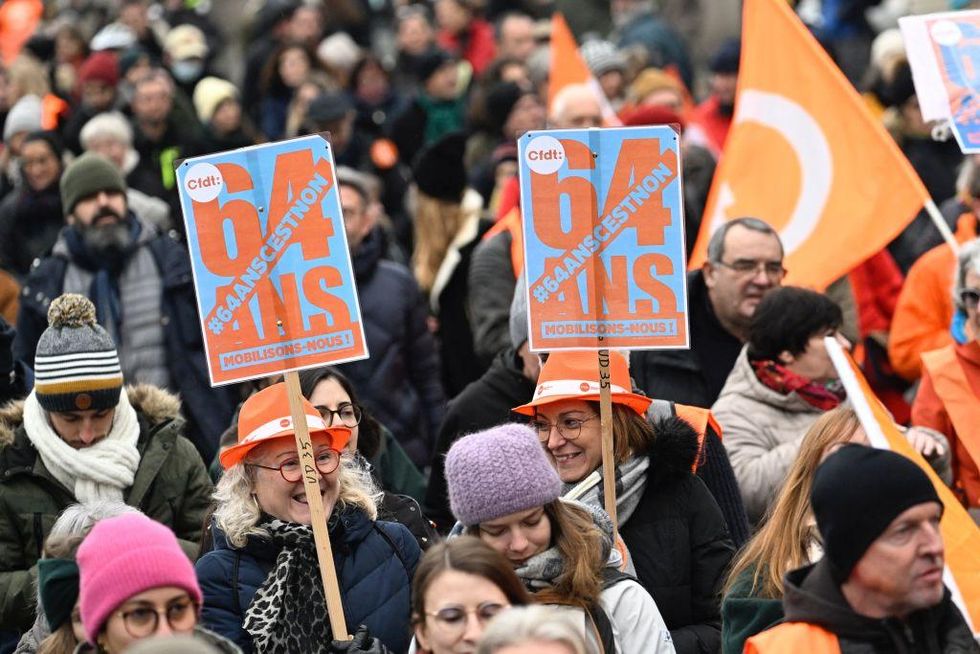
(Photo: Damien Meyer/AFP via Getty Images)
Philippe Martinez, the head of France's General Confederation of Labor union, told reporters that Thursday's strikes are just the beginning of widespread worker unrest if Macron doesn't abandon his attempt to hike the retirement age by 2030.
"If there is no positive response from the government, today is a first step, and there will be a second step," Martinez declared ahead of a march in Paris.
Eric Sellini, the union's coordinator for the French petroleum company TotalEnergies, echoed that sentiment.
"For the moment, we're sticking to our schedule," Sellini said. "Depending on how the situation in the country evolves, and if employees don't want to stop the strike, there could be an extension."
Reuters reported Thursday that the mass protests "led to a substantial fall in electricity output and halted deliveries from refineries operated by TotalEnergies and Esso."
"The CGT union expects that at least 70% of its refinery sector employees at TotalEnergies' four refining sites have joined the strike in opposition to the government plan to raise the retirement age," the outlet noted.
French unions also estimated that around 70% of the country's primary schoolteachers were on strike Thursday.
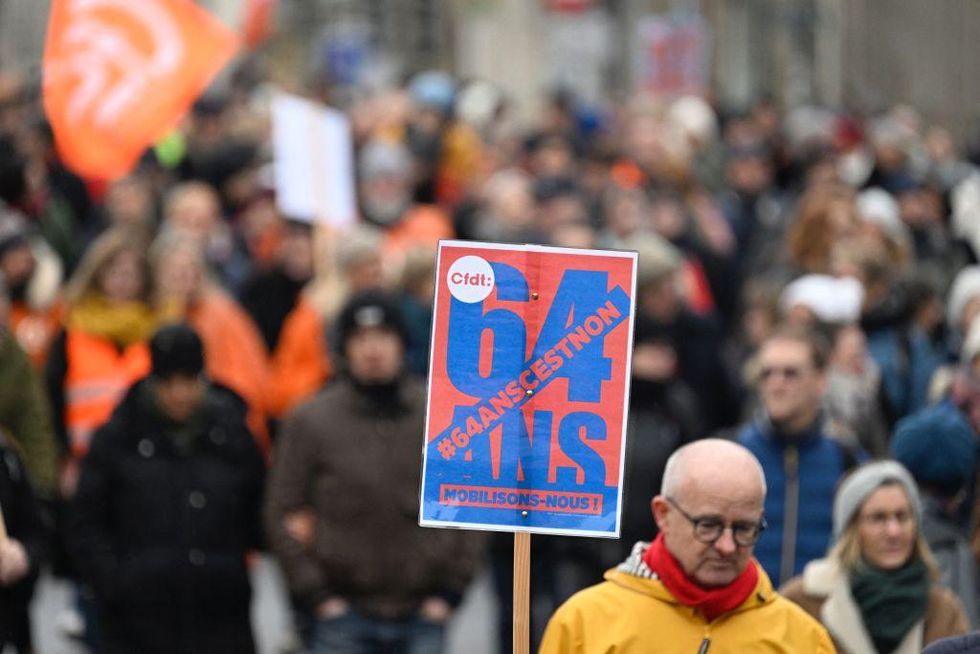
(Photo: Damien Meyer/AFP via Getty Images)
A survey conducted earlier this month by the polling firm Elabe found that roughly three-fifths of the French public opposes Macron's proposed pension overhaul, the latest iteration of a plan that the president has repeatedly put forth and subsequently delayed due to furious opposition.
"When he sought reelection last year amid an emboldened far right, Macron sent mixed messages on the issue," The Washington Post reported. "After first announcing that he wanted to raise the minimum retirement age even higher than planned, from 62 to 65, he later backtracked and said that '65 years is not a dogma.'"
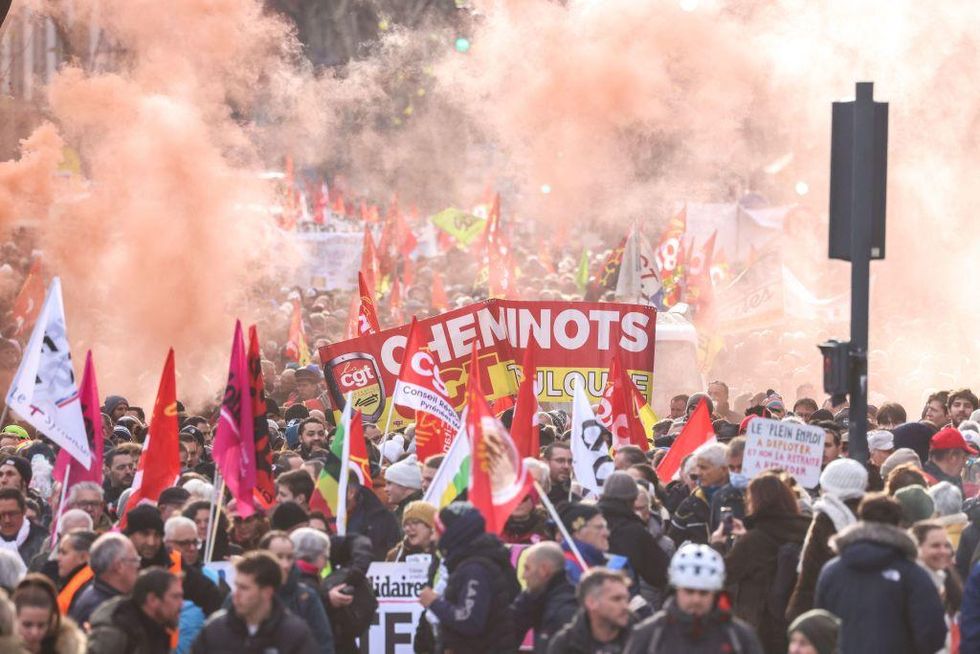
(Photo: Charly Triballeau/AFP via Getty Images)
Opponents of the pension attack—including the leftist leader of the France Unbowed party, Jean-Luc Mélenchon—are pushing Macron to drop the proposal for good as mass protests signal sustained opposition from workers.
"It is time for Macron to withdraw his reform," Mélenchon said Thursday.