

SUBSCRIBE TO OUR FREE NEWSLETTER
Daily news & progressive opinion—funded by the people, not the corporations—delivered straight to your inbox.
5
#000000
#FFFFFF
To donate by check, phone, or other method, see our More Ways to Give page.
Daily news & progressive opinion—funded by the people, not the corporations—delivered straight to your inbox.
At the bond hearing, grieving loved ones forgave Dylann Roof. This was reported as news, but it was so much more than that. It was the light embracing the darkness.
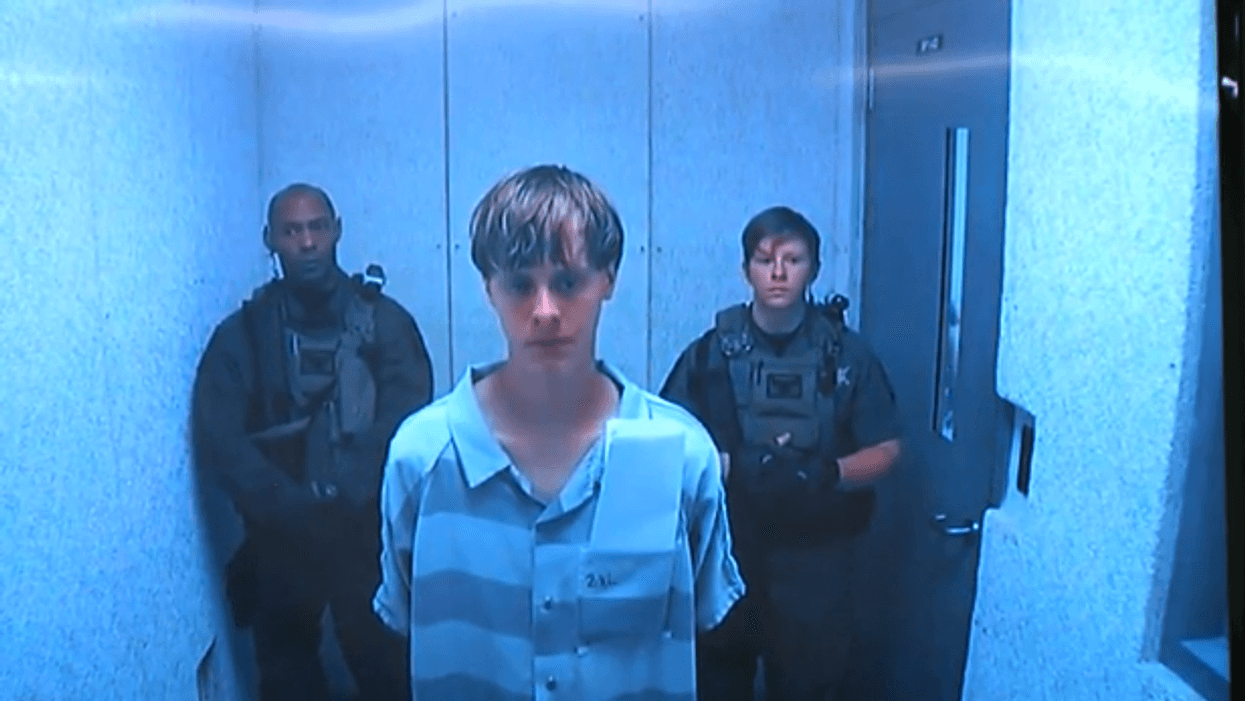
And white America absorbed this forgiveness through the eyes of the 21-year-old terrorist, who watched the proceedings on a video screen from his jail cell. Whatever he heard and felt is unknown, but beyond him, in the world he believed he was saving, something gave. The solidarity of whiteness -- the quiet assumption of white supremacy -- shuddered ever so slightly.
The flag, the flag . . .
The fate of this symbolic relic of the slave era is now the big story in the aftermath of Roof's murder of nine African-Americans. He acted in such clear allegiance to the Confederate flag that politicians everywhere -- even Republican presidential candidates -- are demanding, or at least acquiescing to, its removal from public and official locations, such as in front of the South Carolina State House.
Not only that, "Walmart and Sears, two of the country's largest retailers, will remove all Confederate flag merchandise from their stores," CNN reported.
This is what atonement looks like in a consumer culture.
"The announcements," according to CNN, "are the latest indication that the flag, a symbol of the slave-holding South, has become toxic in the aftermath of a shooting last week at a historic African-American church in Charleston, South Carolina."
A few days later, Amazon and eBay also announced they would remove Confederate flag merchandise from their sites. No longer available, CNN reported, would be such flag-decorated items as folding knives, T-shirts, blankets or (God help us) shower curtains.
Oh Lord. The news so quickly becomes theater of the absurd. Roof's act of terror has forced mainstream America to begin consciously disassociating itself from the lethal margins of white solidarity, to wake up to what it really means. But this waking up, so far, seems limited to the symbolism of Confederate paraphernalia. All our guilt is being dumped here, while the pain that Roof's act of terror has caused ebbs and slowly vanishes from the social mainstream.
In fact, an undead racism still stalks the American consciousness and it will, once again, regroup, Confederate flag or no Confederate flag. What this moment of awareness calls for is true atonement for our history.
"I forgive you." These are the words of Nadine Collier, the daughter of 70-year-old Ethel Lance, one of Roof's victims. "You took something very precious from me. I will never talk to her again. I will never, ever hold her again. But I forgive you. And have mercy on your soul."
Atonement begins with cradling the pain.
"We welcomed you Wednesday night in our Bible study with open arms," said Felicia Sanders, who was not only present in the church during the murders but the mother of Tywanza Sanders, 26, the youngest of those killed. As we cradle the pain, we must cradle this as well: the open souls of the murder victims.
What do we value as a nation? Do we value such openness? The killer -- who was, as he entered the church, simply an unknown young man -- did not go through security clearance as he walked through the open door. He had complete freedom of movement as he entered the historic African-American church, where he was accepted simply for his humanity. Yes, such openness and acceptance are also part of who we are as a nation, but . . . do we value these qualities? Do we have the least faith that they matter now more than ever, now that they've been so violated?
A participant at one of the vigils last week for the murder victims "noted how a church's doors are always open, especially to those in need," a Daily Beast story reported. "She wonders now how churches can square their mission of public service, charity and acceptance with security concerns."
Roof's act of terror has opened a gaping hole in the social fabric. Can we no longer pray together?
But all such questions lead back into the depth of American history and the need for atonement and transformation. A Reuters story, addressing the segregated nature of most American churches (11 a.m. Sunday is "the most segregated hour in the nation," Martin Luther King once said), pointed out: "The story of this division began in America's earliest moments, when slaves and freed African-Americans alike were often expected to pray in the same churches as whites, but in areas cordoned off, often called 'slave galleries.'"
Imagine praying in a setting that defines you as semi-human. Now imagine Dylann Roof walking into Emanuel African Methodist Episcopal Church with a gun in his backpack. Roof was the self-defined semi-human in the church that night, his soul wrapped in a Confederate flag.
The U.S. is enslaved by its past. That's what no one has said yet. One hundred fifty years after the Civil War ended, we're thinking maybe it's time to lower the flag that symbolizes this enslavement.
The massacre of nine African-American worshippers at the Emanuel African Methodist Episcopal Church in Charleston, S.C., has sent shock waves through the nation and could well blow the roof off the Confederacy. Dylann Storm Roof is accused of methodically killing the congregants, reloading his Glock pistol at least twice. He let one victim live, according to a person who spoke with the survivor, so she could tell the world what happened. This brutal mass killing was blatantly racist, an overt act of terrorism.
Those murdered included the minister of the historic church, 41-year-old Rev. Clementa Pinckney, who also was an elected state senator in South Carolina and who was leading a Wednesday night Bible-study group. Roof actually sat in on the group for an hour before the massacre.
What little we know of Roof's motivation for his alleged crime comes from a website he is believed to have created. A manifesto posted on the site says: "I chose Charleston because it is most historic city in my state, and at one time had the highest ratio of blacks to Whites in the country. We have no skinheads, no real KKK, no one doing anything but talking on the internet. Well someone has to have the bravery to take it to the real world, and I guess that has to be me." A survivor of the shooting said that Roof told a victim begging for him to stop the killing: "I have to do it. You're raping our women and taking over the country. You have to go."
The website includes photos of Roof brandishing a gun, the .45-caliber Glock that is likely the murder weapon, and the Confederate flag, leading to renewed efforts to remove this symbol of racism and hate from flying on public property. For decades, the Confederate flag flew above the South Carolina Statehouse, along with the U.S. flag and the state flag of South Carolina. After the NAACP began a boycott of the state in the year 2000, a compromise was reached. The Confederate flag was removed from the state Capitol dome and placed on statehouse grounds, alongside a Confederate war memorial.
Among those who first stood up last week in favor of removing the flag was a white Republican serving in the South Carolina legislature, Doug Brannon. He told us on "Democracy Now!": "I woke up Thursday morning to the news of the death of these nine wonderful people. I knew something had to be done then. ... Clementa Pinckney deserves this. Those nine people deserve this. Our state Capitol needs to be free of the flag." When we asked him if he would consider a memorial to the victims of the Emanuel AME massacre, he said it was "a wonderful idea."
The Rev. Dr. William J. Barber III is the president of the North Carolina NAACP. He heard about the slaughter on Wednesday night while in jail. "About 10 of us had been arrested in the state House in North Carolina for challenging extremist politicians who have passed the worst voter-suppression law in the country," he said. Barber has led the "Moral Mondays" movement, with hundreds to thousands of people protesting weekly against the agenda being passed by North Carolina's Republican-controlled state government. He favors removal of the Confederate flag, which he calls "vulgar," but suggested that passing policy would be a more potent memorial to Clementa Pinckney and the other victims.
"Reverend Pinckney was not just opposed to the flag, he was opposed to the denial of Medicaid expansion," Barber continued. "He was opposed to those who have celebrated the ending of the Voting Rights Act. He was opposed to the lack of funding for public education. He wanted to see living wages raised." Addressing state Rep. Doug Brannon, Barber said: "Let's put together an omnibus bill in the name of the nine martyrs. And all of the things Reverend Pinckney was standing for, if we say we love him and his colleagues, let's put all of those things in a one big omnibus bill and pass that and bring it to the funeral on Friday."
Wal-Mart, Amazon and other major retailers have pulled Confederate paraphernalia from their shelves. Alabama has taken down the flag, and other states, including South Carolina, are following. The symbol of the Southern states' rebellion and secession, of waging war to protect slavery, will be less visible. But the fight for equality, waged 200 years ago by the very founders of Charleston's Emanuel AME church, continues. As the Rev. Barber says, systemic change is essential: "The perpetrator has been arrested, but the killer is still at large."
Denis Moynihan contributed research to this column.
The recent mass murder of worshippers in an African-American church in Charleston, South Carolina raises troubling questions for all Americans. First among them: How could this have happened?
I think the answer to that one is easy.
We live in a heavily armed society. And hundreds of groups in our country still openly proselytize violence against people of color and other minorities.
So perhaps a better question is, how could this not have happened?
Most Americans were outraged in December 2012 when a mentally ill teenager murdered 26 people -- including 20 first-graders -- in an elementary school in Newtown, Connecticut. What happened afterward?
Almost nothing. President Barack Obama signed a handful of executive orders calling for background checks for gun purchasers, but Congress rejected new federal legislation to restrict guns. Indeed, in the year after the shootings, over 20 states passed 70 laws that actually relaxed gun restrictions.
It was a familiar script even then.
Just a few months before the Newtown shooting, a deranged man had opened fire in a packed movie theater in Aurora, Colorado, killing 12 people and wounding 70. Gun sales spiked after the shootings -- not just in Colorado, but in the surrounding states as well.
Charleston is even more disturbing, for a variety of reasons. Dylann Roof, who allegedly carried out the attack, didn't just perpetrate a mass shooting against people in a house of prayer. He committed an act of terrorism.
This wasn't just a case of a lunatic opening fire in a public place. Roof had a political agenda: He told friends he wanted to attack the church to start a new civil war. He specifically meant to kill black Americans. That makes this case different.
By all accounts, Roof grew up in an environment that espoused and encouraged racism. His Facebook page was full of racist rants. Friends recalled that he frequently told racist jokes and made racist comments. He was "big into segregation," according to his roommate.
Why didn't these friends stop him or report him? Maybe it's because of a racist subculture that still exists in the southern United States.
Racist groups can crop up anywhere in America, but they especially thrive in the South. Roof named one of them -- the Council of Conservative Citizens -- as a particularly important influence on his racist worldview.
This racist group came out of the defunct White Citizens' Councils of the 1950s and 1960s. Despite its unsavory roots and its openly white supremacist ideology, many southern politicians still pander to the organization.
For example, Republican presidential candidate and former Arkansas governor Mike Huckabee delivered a keynote address to a Council of Conservative Citizens convention in 1993. High-ranking GOP members of Congress, including Senator Trent Lott and Representative Bob Barr, also addressed the group around that time.
Its leader, Earl Holt, has donated over $65,000 to Republican politicians in recent years, including GOP presidential candidates Rand Paul, Ted Cruz, and Rick Santorum.
Our elected leaders must make a stand. They must condemn not just racism, but racist groups they may consider a part of their base. They must have nothing to do with groups that espouse separation of the races. And they must allow the Confederate flag, that most obvious symbol of racism, to fade into history.
There's no easy way to move on after an atrocity like the Charleston massacre. But this much is clear: Out-of-control racism and a staunch anti-gun control lobby make for a lethal combination. Unless both of these deadly forces are disarmed, Charleston won't be the last bloody tragedy we ruefully remember.
"...It is time for you and me now to let the world know how peaceful we are, how well-meaning we are, how law-abiding we wish to be. But at the same time we have to let the same world know we'll blow their world sky-high if we're not respected and recognized and treated the same as other human beings are treated." --Malcolm X
"...It is time for you and me now to let the world know how peaceful we are, how well-meaning we are, how law-abiding we wish to be. But at the same time we have to let the same world know we'll blow their world sky-high if we're not respected and recognized and treated the same as other human beings are treated." --Malcolm X
Two hundred years ago, it is quite likely that Denmark Vesey, an enslaved African who managed to purchase his freedom and co-found the Emanuel African Methodist Episcopal Church, met in the relative safe space of that church to plan the slave rebellion that marked his entry into history. Set for June 17 1822, his audacious plan was to free as many Africans as possible, commandeer a ship from the Charleston Harbor and set sail for the free territory of Haiti, which had defeated Napoleon's army and established itself as the first African republic on the planet. After Vesey was betrayed and his plot uncovered, local whites burned the church to the ground, only to be rebuilt again by the Africans of Charleston.
In what can be seen as a metaphor for the African American experience in the U.S., almost two centuries later, Dylann Storm Roof, a militant white nationalist, stood up in the sacred space of Emanuel AME church on June 17, the anniversary of Vesey's planned rebellion and unleashed a murderous attack on a small gathering of Black worshippers.
This latest outrage followed on the heels of the execution of Walter Scott by a Charleston police officer a few months ago. The video of the Scott murder and the constant images of brutal cops behaving with an air of impunity as they murder and beat Black men, women and children across the country have generated a growing sense among African Americans, even the pro-American apologists, that Black people are under a racist siege.
Yet, for Dylann Storm Roof, the Black people in that church were the aggressors and he was the defender of white civilization, the "American" way of life and spirit that President Obama praised in his speech in Selma. Obama pushes the liberal version of the white nationalist narrative of inclusiveness and integration into the U.S. settler project by the subordinate racialized peoples. But Roof and many other white settlers are committed to upholding an unaltered view of the U.S. shared by the "founding fathers," who established the U.S. as the first racist republic in history.
Roof is reported to have said that black people are rapists and are taking over his country. While it is easy for everyone to condemn and even pathologize Roof for his views, an honest assessment of the racialized discourse used to mobilize public support for U.S. military interventions would reveal an ideological consistency between Roof's fear and loathing of the non-European "other" and the messages conveyed in recruitment posters for the U.S. military that depict soldiers waging war in far-off places to protect our freedoms in the United States. Military propagandists know that the representation of the "non-white other" informs the imagination of most Americans when they think of foreign threats to the "homeland."
A new generation of African Americans are slowing coming to the conclusion that it does not matter if it is the streets of Bagdad or Ferguson--they/we are the enemies, who, as Roof said, must be stopped.
The irrational, violence-prone racialized "other" occupies a permanent space in the consciousness of so many in the U.S., which is why it has been so easy to mobilize public support for U.S. military interventions and campaigns of political subversion, from Iraq to Venezuela.
Sermons have already started condemning violence in the U.S., while the U.S. continues to send arms to known Islamic extremists in Syria, provide logistical and political support to the Saudi's brutal and illegal war in Yemen, arm and train neo-Nazi fascists in Ukraine while militarily pivoting to Asia - and no one in the corporate media will call it hypocrisy.
Obama and the ruling class in the U.S. are not concerned with violence. Obama just wants to make sure that the violence is state-sanctioned. While he moralizes about gun violence and the availability of weapons, he continues to allow massive military arms to be passed from the federal government to police forces through the government's 1033 program. And the fact that the U.S. is the biggest arms merchant in the world is information that Obama will never share with the public.
Quotes by Dr. King about the need for a non-violent response to the racist assault we are under in the U.S. are once again being pulled out. The Dr. King quotes they don't repeat, however, are those about the U.S. being the greatest purveyor of violence in the world. And they certainly will not remind the people that Dr. King argued that the only way the U.S. might hope to cure itself of the maladies of racism, materialism and militarism is through a radical restructuring of society. No, we won't hear that Dr. King, and few will know about Vesey and his connection to the Emanuel African Methodist Episcopal Church. But we know Malcolm, and Malcolm's words bring the clarity we need today to close the circle of struggle.
After last week's massacre in Charleston, South Carolina, there should have been no question of guilt, or motivation. Dylann Roof made it clear what he did, and why, long before his confession. And yet, the media has bungled so much of it, from beginning to, if not the end, then the point at which we continue, which today saw South Carolina Governor Nikki Haley call for the immediate removal of the Confederate flag.
Why did it take this event to lead to that? How can we re-examine the assumptions we hold and expand our inventory of ideas about the way we talk about race in America? Here are five points, just for a start.
1. Everything Slick Don't Slide
Never in my media career have I seen media outlets refuse to show the face of any adult black murderer. Never. Quite the opposite: They loop it. All day, all night. We tend to see black men on television in one of two positions: handcuffs in the front, or handcuffs in the back. So what was with the burst of momentary morality that had certain talk show hosts refusing to show the killer's face? Really? To all of a sudden decide to not show Roof's face seemed not only disingenuous, but racial.
2. If you quote King, Vote King
Can we stop letting pundits and politicians get away with selectively quoting Dr. King when black tragedies happen? Sure, King is the quintessential example of "nonviolence" and "love thy neighbor as thyself," but he was also felled by an assassin's bullet, and six years after his death, his mother was shot and killed as she sat playing the organ at the Ebenezer Baptist Church in Atlanta. Never mind that the black folk for whom he risked his life are still overwhelmingly the victims of gun violence in America.
To quote King about the "beloved community" and not get serious about gun violence in America is, at best, empty rhetoric, and at worst, a malignant mangling of his message. If you're going to quote King, then vote King: Get serious about gun control.
3. To Do Nothing, One Excuse is as good as another
It didn't take long for partisan politicians and the chattering class to start manufacturing excuses about this tragedy. First it was an attack on faith. Then it was an "accident" that might have had more to do with drugs than guns, bumbled former Texas governor and Republican presidential candidate Rick Perry. Or it was all about quickly casting Roof as "mentally ill" and "unstable," not a thug, criminal or terrorist. (Sidenote here: For all our handwringing, we are no more serious about adequately addressing America's mental health crisis than we are about addressing the gun epidemic.) Truly unbelievably, a board member of the NRA actually blamed one of the victims of the shooting for his political position on concealed-carry gun laws. Finally, the media seized on Roof's statement to police investigators that he "almost didn't go through with it." But he did.
Any excuse to do nothing, any route to circumvent the ugly truth! And what is the ugly truth? Lack of gun control. Personal and systemic racism. A political system undermined by corporate interests. Politicians who put personal gain and fleeting support above the needs of the citizens.
4. The Terrorist Test
When is a terrorist not a terrorist? Apparently when he's a 21-year-old white male in America. Were he a 21-year-old Muslim attacking a sacred site in America, the media would have declared him a "terrorist" sooner than right now and quicker than at once.
Jim Naureckas, editor at FAIR.org, said it best:
If media are going to use the word 'terrorist' they need to have a single standard for its application. By applying the word to a [Boston Marathon] bombing with initially unknown perpetrators, and largely declining to use it in connection with a massacre allegedly perpetrated by a white supremacist hoping to spark a race war, media failed that test.
The media is a runner coming off the blocks. How it frames a breaking story is critical to both initial public perception and eventual public policy.
5. The Power of Love
The most important message to come out of this tragedy is, sadly, the lesson that we will likely forget soonest: forgiveness.
Maybe it's just me, but given our society's unconscious biases about black men, I have a hard time believing that a 21-year-old black male in the South could just roll up into an all-white prayer circle, cop a seat next to the pastor and be welcomed like a Christian brother, no questions asked.
I was at a dinner party after Roof's confession, and even the black folk at the table thought it was strange and abnormal that the black prayer warriors let this out-of-place white male just randomly stroll up in the church.
I didn't agree. That's love. Growing up in a black church, I've seen it happen countless times with all kinds of random visitors. Indeed, our church's welcome, uttered in unison, went like this, "Welcome to the church where everybody is somebody, nobody is a stranger, and you belong here. Welcome!"
Sadly in this world, sometimes trust makes you vulnerable and love can get you killed. And, yet, love is the only antidote to hate. What else is there?
For a true Christian, there really is no more noble way to die. Refusing to judge folk, meeting them where they are, and sharing the Good News. Black America has learned to love this country in spite of, not because of. Even when the victim of the most heinous of assaults, at our best, we forgive so that we might live.
The next time this happens, the media won't likely remind us of the extraordinary grace we're witnessing. So, remember Charleston.
Corporate media are demonstrably reluctant to use the word "terrorist" with regards to Charleston shooting suspect Dylann Roof-even though the massacre would seem to meet the
Corporate media are demonstrably reluctant to use the word "terrorist" with regards to Charleston shooting suspect Dylann Roof-even though the massacre would seem to meet the legal definition of terrorism, as violent crimes that "appear to be intended...to intimidate or coerce a civilian population."
Generally, news outlets don't explain why they aren't calling Roof a terrorist suspect; they just rarely use the word. But the Washington Post's Philip Bump gave it a shot in a piece headlined "Why We Shouldn't Call Dylann Roof a Terrorist" (6/19/15), and his rationale is worth taking a look at.
Bump starts out by acknowledging that "a terroristic act, which this was, is treated and identified differently when the actor is a young white man." He contrasts the treatment of the Charleston massacre with the attack on the Mohammad cartoon contest in Texas:
In each case, someone hoping to prove a political point attacked a gathering because of who was in attendance. In the case where the only deaths were the attackers, we call it terrorism. In the case where the only deaths were the innocent people, we debate it.
"But," Bump then says, "we shouldn't call Dylann Roof a terrorist." His argument for this:
Roof wants to be a terrorist--for us to admit that he terrorized us. He likes the attention, telling the police as he admitted to his acts that he wanted to make sure they were "known."... What if we just call him a racist, grotesque person. What if we laughed at him instead of telling him he scared us?
This makes as much sense as arguing that you shouldn't charge someone with kidnapping because the person they abducted wasn't a kid. "Terrorism" is the name of a crime, and the relevant question isn't whether we like the etymology of the term, but whether the murders fit the elements of the definition--which has to do with intent to intimidate or coerce, not with whether anyone actually felt "terror."
On some level, Bump understands that "terrorism" is a legal term with serious legal consequences, and that the fact that it's unevenly applied based on the race and religion of the perpetrators is a real problem:
When Dzhokhar Tsarnaev was arrested in Boston in 2013, the debate was over how to treat him given that he was a terror suspect--as manifested by Sen. Lindsey Graham--not over whether or not he was a terror suspect. That's part of why Tsarnaev and the Texas cartoon attackers were so quickly identified as terrorists.
This, Bump notes, "reflects the same racial chasm that Roof wanted to exacerbate."
He also notes that the word has become politicized by the "War on Terror"--"which is, in essence, a war on certain groups of Middle Easterners and Muslims." As Bump observes, "Calling more non-American people terrorists also serves to bolster the arguments of those calling for more military intervention." Which leads him to conclude that "the problem...isn't that we're too slow to call Roof a terrorist. It's that we're often too quick to call everyone else a terrorist."
Yet Bump doesn't seem to have written a column about how "we're too quick to call everyone else a terrorist"; he didn't seem to have any problem referring to the Boston Marathon bombing as "terrorism," for example. ("The key component to any terrorist attack is luck" was the lead sentence for a piece he wrote on the Tsarnaev brothers, for instance--The Wire, 4/22/13.) So why write this piece, urging people to do what most journalists are already doing--avoiding saying "terrorism" in connection to Charleston?
The answer seems to be in a remarkably revealing passage in the middle of the piece, where Bump acknowledges that he identifies with Roof because they share a skin color:
Most Americans are white, and we see white people like ourselves. When I see Dylann Roof, I remember being a white male his age, barely out of my teenage years and experiencing weird anger in a difficult time.... We can identify much more easily with who he is.
Huh. You would think a self-respecting journalist, recognizing this kind of irrational bias in himself, would try to avoid letting it influence his work--would certainly not want to call for giving a criminal suspect special journalistic treatment based on this identification. Yet there's not really any other explanation offered in the column as to why it was written about Roof and not about Dzhokhar Tsarnaev.
Bump closes his column by rejecting the arguments that referring to the Charleston massacre as "racial terrorism" would "help...America come to terms with the fact that the ideology he assumed is dangerous and urgent" and put Roof in line for stiffer penalties. "Fine," he says--but
each of these is predicated on our insistence that terrorism is somehow a higher order of evil than simply murdering elderly people for being black even as they held their Bibles in a church. It implies that his mass murder was one thing, but that his scaring us was made things more problematic. Perhaps we should demonstrate to him--and every other angry young man like him--that we aren't scared of his dumb Internet rhetoric. Not in the least.
And let's reel in our use of the word "terrorism" back in.
Let me note parenthetically that the law constantly takes intent into account--it's the difference between murder and manslaughter, to name just one example--so suggesting that there's something odd about taking the intent of a murder into account is specious.
But the real debate here is not about whether terrorism is worse than mass murder with no political motive; it's whether we're going to call some acts of politically motivated murder "terrorism" while withholding that label from other murders that are equally politically motivated--when we know that this label has real consequences, legally and politically.
"We aren't scared by his dumb Internet rhetoric," says Bump. If he's still using "we" to mean "white people like ourselves," it is certainly true that whites generally don't feel personally afraid of white supremacist terrorist who target African-Americans. They're much more likely to be afraid of Muslim terrorists who target Americans in general--even though right-wing extremists (not all of whom are white supremacists, of course) killed five times as many people in this country as Muslim extremists in the decade after 9/11, according to a study from the US Military Academy (New York Times, 6/16/15).
If you really think the word "terrorism" is being used too much, you should argue against it in the cases where it's actually frequently used--which is mostly in cases involving Muslim suspects. But that would mean going against conventional wisdom, possibly with some professional cost. To argue instead that journalists are right to avoid the label with regard to a suspect with whom "we can identify much more easily"--well, there's never much of price to be paid for endorsing institutional prejudices.
Dylann Roof, a young white man armed with a virulent, toxic hatred and a 45 caliber pistol, walked into a historic black church and was welcomed with open arms as a stranger into a Bible study. Taking advantage of the well-known hospitality of this sanctuary, he sat for an hour with a group of 10 people, none of whom had any idea that nine of them would be dead within an hour.
The massacre in Charleston is not just an isolated hate crime carried out by a mentally ill racist in South Carolina. It is simultaneously representative and starkly indicative of the rampant racism structurally embedded in America, the responsibility for which, it might be argued, bears no exemption for any American, especially white Americans, north or south, republican or democrat. As Richard Wright wrote in his 1945 non-fiction memoir, Black Boy, America "insists upon seeing the world in terms of good and bad, the holy and the evil, the high and the low, the white and the black; our America is frightened of fact, of history, of processes, of necessity. It hugs the easy way of damning those whom it cannot understand, of excluding those who look different, and it salves its conscience with a self-draped cloak of righteousness."
That cloak of righteousness shields white America from having to face their contemporary prejudices and the historical biases from which they are a result. This cloak of invisibility also inhibits their moral and psychological capacity to acknowledge and understand the magnitude of those historical and contemporary prejudices and their effects on our society. The Charleston shooting was not an anomaly but a manifestation of the violence cultivated in America toward black communities. The shooter, Dylann Roof, is a product of a system that has been breeding hatred and bigotry in America since the first Africans were kidnapped and forcibly transported here in the 15th century as slaves under deplorable, maliciously inhumane conditions.
Prophetic voices in African American literature and the arts have long challenged these deadly views, calling all Americans to "stand in the gap" and risk lifting the cloak of invisibility that surrounds racial violence to see what lies beneath. In an August 9, 2012 interview, Dr. Maya Angelou argued that transatlantic slaving, as an inherently violent institution, connected with colonial conquests, put an imprint of violence on American culture that needs to be addressed on a systematic and systemic level. Today her voice rises from among the dead: "It is imperative that Americans, all Americans, recognize the imprint of the first Africans brought here and the first white women brought here in bondage. I'm trying to say that the word slavery and the term enslavement has lost so much of its weight until people mouth the words without realizing what they're saying, what they're calling up. We have not moved on. We have made some steps toward fair play, but we have not really moved on. It is ignorant, not wise, to think that we can get on without remembering what happened, who did what to whom, to what success, and for what reasons."
Today, this systematic analysis is needed perhaps more than at any other time in our history. As Rev. Clyde Grubbs of Tuckerman Creative Ministries for Justice and Healing noted on Facebook: "The son tells everyone he knew that Black people were taking over the country, and he wore racist decals on his clothing. He told everyone he knew that something must be done to save the white race. He was public in his attitudes, attitudes that were dangerous. He was able to live at home and access the propaganda of racist hate groups (organized terrorists.) His father gifted the gun to his son. The state doesn't require registration of gun, nor notice of selling gun, or gifting gun. Son kills people with gun in an act of racist terrorism. But somehow the killer is a disturbed INDIVIDUAL. So? Are Racism and Psychopathology completely unrelated phenomena? Are Racism and Patriarchy and Privatism and Violence and Destruction of God's Creation really all separate, discrete, separate realities that need to be taken up in isolation from each other?"
Racism kills. In fact, the prevalence of racial epithets in Google searches has been linked to rates of black mortality by Daniel Chae, University of Maryland professor of epidemiology and biostatistics whose research has shown that "African-Americans living in areas where many people are Google-searching for a racial epithet are 8.2 percent more likely than whites to die of any cause." Racism, says Chae, is an environmental hazard. Quoted in the Huffington Post, "I view racism as being a social toxin that over time leads to premature mortality," he said. "Racism kills people," Chae said. "That's not breaking news at all." Meanwhile, in South Carolina the Confederate battle flag flies high as highways throughout the state tout the names of Confederate soldiers that fought to the death to preserve racist institutions while some excuse Dylan Roof's actions as being the result of an alleged mental illness or try to fit it into some other neatly packaged narrative that defers from having to face the real issue at hand; racism.
He sat with them for an hour in prayer. Then he pulled his gun out and started shooting.
And today our national numbness is wrapped in a Confederate flag. The young man who killed nine members of Charleston's Emanuel African Methodist Episcopal Church on Wednesday night was an old-school racist. "I have to do it," Dylann Storm Roof is said to have explained. "You rape our women and you're taking over our country. And you have to go."
Roof's roommate told ABC News the next day that he was "big into segregation and other stuff" and "he wanted to start a civil war." And this is America, where we have the freedom to manifest our lethal fantasies.
But this is bigger than racism and the pathetic monster of white supremacy. Racism is a name for one of the currents of righteous hatred that coils through our collective unconscious, and over the decades and centuries it has motivated terrible crimes against humanity. But the "civil war" that Roof participated in is, I think, much larger and much more meaningless. And not all the participants are loners.
"In a pattern that has become achingly familiar to him and the nation," the New York Times reported, "Mr. Obama on Thursday strode down to the White House briefing room to issue a statement of mourning and grief as he called on the country to unify in the face of tragedy."
Indeed, it's the fourteenth time, according to The Guardian, he has done this since he's been in office. It's the fourteenth time he has said words like: "I am confident that the outpouring of unity and strength and fellowship and love across Charleston today from all races, from all faiths, from all places of worship indicates the degree to which those old vestiges of hatred can be overcome."
America, America, land of the mass murderer.
Mass murders have increased fourteenfold in the United States since the 1960s, sociologist Peter Turchin wrote two and a half years ago, after the Sandy Hook killings. In his essay, called "Canaries in a Coal Mine," Turchin made a disturbing comparison: Mass murderers kill the same way soldiers do, without personal hatred for their victims but to right some large social wrong. He called it the "principle of social substitutability" -- substituting a particular group of people for a general wrong.
"On the battlefield," Turchin wrote, "you are supposed to try to kill a person whom you've never met before. You are not trying to kill this particular person, you are shooting because he is wearing the enemy uniform. . . . Enemy soldiers are socially substitutable."
"That is to say," I noted at the time, "the definition and practice of war and the definition and practice of mass murder have eerie congruencies. Might this not be the source of the social poison? We divide and slice the human race; some people become the enemy, not in a personal but merely an abstract sense -- 'them' -- and we lavish a staggering amount of our wealth and creativity on devising ways to kill them. When we call it war, it's as familiar and wholesome as apple pie. When we call it mass murder, it's not so nice."
Dylann Roof had a toxic "cause" -- to reclaim the Old South, to reclaim the country, from an unwelcome human subgroup -- but the solidarity in which he acted wasn't so much with his fellow racists as with the strategists and planners of war. Any war. Every war.
Perhaps this is why, when I hear Barack Obama laud "the outpouring of unity and strength and fellowship and love" in the wake of the Charleston murders, I feel only despair: despair as deep as a knife wound. War, not love, is structured into the nation's economic and social fabric. We invest trillions of dollars into its perpetuation, across Central Asia and the Middle East and wherever else the strategists and planners see evil, which is to say, opportunity.
Every murderer believes the violence he is wielding is "good violence." Think Timothy McVeigh, whose fertilizer bomb killed 168 people at the Alfred P. Murrah Federal Building in Oklahoma City in 1995. He called his victims "collateral damage," co-opting the official language of the Gulf War in which he served. Mass murderers mimic and find their inspiration in the official wars we wage as a nation. Take away the massive public relations machinery that surrounds these wars and the deaths they cause are just as cruel, just as wrong. The abstract "enemy" dead, in every case, turn out to be human beings, who deserved to live.
And every war and every mass murder spread fear and hatred -- and inspiration -- in their aftermath. We can't go to war without spawning imitators. The next day, USA Today reported, the vigils at two South Carolina churches, in Charleston and Greenville, were disrupted by bomb threats and the churches had to be evacuated. So did Charleston's county building.
"At some point," Obama said, "we as a country will have to reckon with the fact that this type of mass violence does not happen in other advanced countries. It doesn't happen in other places with this kind of frequency -- and it is in our power to do something about it."
Until we begin demilitarizing our relationship with the world, such words uttered by presidents are as empty as the words Dylann Roof uttered in prayer at Emanuel African Methodist Episcopal Church on Wednesday night.
When I was growing up in Columbia, South Carolina, I was awoken by one singular task from my mother. "Get out of South Carolina," she would sermonize. This would be repeated to me regularly and in different ways. "Get out of South Carolina and don't come back." Sometimes she would say, "Don't get trapped here."
My mother, who birthed me at 14-years old, and was the first to graduate college in her family, pushed me to pursue college outside the state and to never return because, she would say, South Carolina would trap and kill me. Maybe it was the way my uncle was coerced to admit to a crime he didn't commit that resulted in him being sentenced to 14 years in prison. Maybe it's the way South Carolina unapologetically praises its racist history by flying the confederate flag on the state grounds. Or maybe it was the way my guidance counselor suggested I go to community college because "that's all you'll probably get."
As a black boy growing up there, South Carolina was never my home. I've felt more at home at Howard University, when I could share a similar sentiment of displacement, pride and fury for the way in which black people like me are treated in America. I realized I was not a South Carolinian (nor did I want to be) when I recognized South Carolina didn't care about me or anyone who looked like me--nothing had changed for black life since I was kid. Black children are shipped from poverty-stricken neighborhoods to sub-par schools with little to no resources and excess police that patrol neighborhoods, some of which have a curfew. If you're black and lucky enough not to be arrested, you may get a service job and be able to make minimum wage. My mother wanted to break that cycle.
When I recognized this trend, I began to believe I had no home and was seemingly alone. It turns out I was only partially right: I am not alone--the Charleston massacre is a stark reminder of that.
My blood and the blood of the oppressed is boiling to extraordinary proportions as we learn that a young white man, Dylann Storm Roof, entered the Emanuel African Methodist Episcopal Church in Charleston, South Carolina, where he slaughtered nine church members during a prayer meeting, claiming, "I have to do it. You rape our women and you're taking over our country, and you have to go."
The feeling I feel right now is being felt across the country. It is the rebirth of the black radical--the generational development of a group of activists indignant over the subjugation, demise, and murder of its people. And it's not the first time. It has reemerged through the history of America.
It was in the early 1900s, following the Civil War, when we saw it in the rise of the New Negro Movement. Progressive minds such as Hubert Harrison, W.E.B. Du Bois, and Alain Locke--individuals that used art, literature and intellect to combat Jim Crow laws--were the apparent black radicals of their time. Again in the 1950s, following the murder of 14-year old Emmett Till, and in the 1960s with the assassination of civil rights activist Medgar Evers and incessant police repression, there was an extreme surge in the civil rights movement. Led by the likes of Malcolm X, Martin Luther King Jr., and Ella Baker, the movement used a diverse series of protest tactics to focus on policy and social change--emphasis on social change.
There were the Birmingham Riots of 1963, the Selma and Montgomery marches, and the March on Washington, where King delivered the speech that made him what the FBI called, "the most dangerous and effective Negro" in America. This was also America's introduction to the Black Panther Party, which focused on reducing poverty and improving health in the black community but also staunchly protesting against police brutality, the murder of black people, and the all-too-common terrorism inflicted on black communities. In this sense, black radicalism proved to be a diverse and cross-generational practice from a variety of activists. That is similar to what we see growing today--from the #BlackLivesMatter movement and #SayHerName to the recently launched StayWoke.org. We take different avenues, but there is one thing we share: the burning need for justice and the end of racism.
The apathy of drive-by social media activism has waned with every publicized example of unchecked police brutality and domestic terrorism. The Charleston massacre is no different; it will show that there is not, and never has been, a question of whether we as black Americans are capable of galvanizing beyond the gabs of activists, politicians and talking-heads. It is only a question of when, in what form and concentration. It could be in the form of black Twitter or it could be a series of marches. It could be political conversations and campaigns or it could be rioting, but if the past has taught us anything, it is that activism against racism and police violence is diverse and, at time, interdependent.
It is happening now--on the campuses of colleges and universities across the nation, in the community and church centers of predominantly black neighborhoods, in barbershops and hair salons, on group chats, on Instagram and black Twitter. Watching what's unfolded in Charleston, we're looking beyond mythic stories to discuss more impactful and radical actions and to leverage that shared feeling of hurt when we heard that nine people were slaughtered in a black church.
I am not a South Carolinian; I am the re-birth of the black radical and this time, the cause du jour is serving as a catalyst more so than a trending topic. And when the radicalism of my generation fully emerges from behind the curtain of traditional marches and tactics, there will be little acquiescence offered. The seemingly hollow musings of President Obama will go unnoticed, and the gait of the disenfranchised and attacked black youth will move like a levanter out of the concrete. The only thing to stop it will be drastic and unequivocal change in American policies, practices and moral consciousness.
In the wake of mass violence, a nation struggling to understand turns to its news outlets to see how they frame events. The language journalists use in the immediate aftermath of a bloodbath helps form public attitudes and has a major impact on official reactions.
When two bombs went off at the Boston Marathon on April 15, 2013, killing three and injuring hundreds, it was inevitably a huge story: A search of the Nexis news database for US newspapers on the next day turns up 2,593 stories mentioning the marathon, virtually all of them about the bombing. Of these, 887, or 34 percent, used the word "terrorism" or a variant ("terrorist," "terroristic" etc.)-even though the bombers, let alone the bombers' motivations, would not be known until days later.
When nine people were killed at Emanuel African Methodist Episcopal Church on April 17, 2015, there were 367 stories in the next day's papers that mentioned "Charleston" and "church," according to Nexis-a big story, though not given the blockbuster treatment of the Boston Marathon bombing. Of these 367 stories, 24 mentioned "terrorism" or "terrorist"-just 7 percent, even though a suspect, Dylann Roof, was named on the first day, with evidence presented that he was motivated by a white supremacist ideology and a desire "to start a civil war" (Columbia, S.C. State, 6/18/15).
Some suggest that the word "terrorism" has been so politically manipulated and selectively applied that we would do well to drop the whole concept. But politically motivated violence that targets civilians-which is the core of the various definitions of "terrorism"-is an actual phenomenon that is hard to talk about without a label.
If media are going to use the word, though, they need to have a single standard for its application. By applying the word to a bombing with initially unknown perpetrators, and largely declining to use it in connection with a massacre allegedly perpetrated by a white supremacist hoping to spark a race war, media failed that test.