SUBSCRIBE TO OUR FREE NEWSLETTER
Daily news & progressive opinion—funded by the people, not the corporations—delivered straight to your inbox.
5
#000000
#FFFFFF
To donate by check, phone, or other method, see our More Ways to Give page.
Daily news & progressive opinion—funded by the people, not the corporations—delivered straight to your inbox.
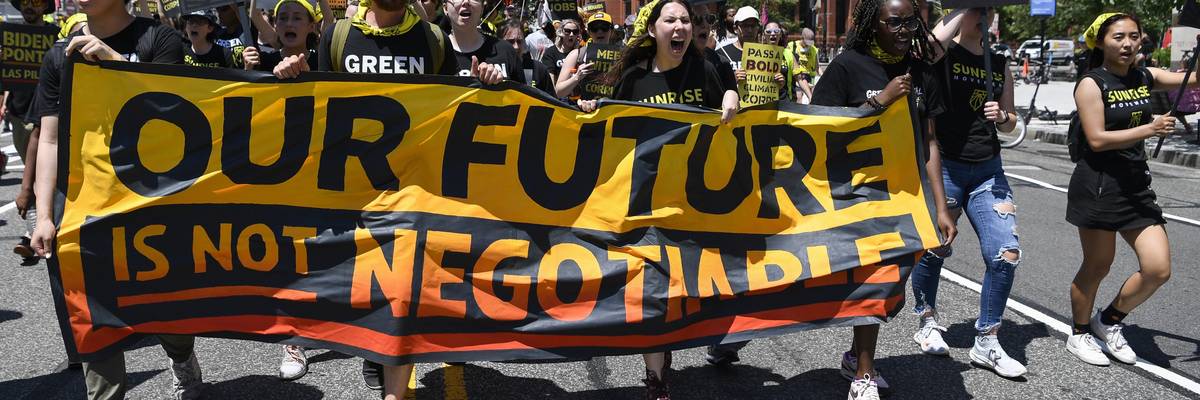
Youth activists march in Washington, D.C.'s Lafayette Square on June 28, 2021.
While we can’t count on certain stubborn politicians to save our only planet, we can count on the young people at the heart of the climate movement.
The past 20 years have been critical in the fight for bold and sustainable climate solutions. The next five years will be even more vital—and young people like me are fighting hard to make sure our leaders get it right.
Research shows we have about five years left to avert global warming beyond 1.5°C, the tipping point when even more severe climate disruptions could exacerbate hunger, conflict, and drought worldwide.
Climate change—long-term shifts in temperatures and weather patterns primarily due to the burning of fossil fuels like coal and oil—impacts our livelihoods and our lives. It harms our health and well-being and threatens our access to vital resources, from water to food to housing.
We’re the last generation that can save the world from climate disaster—and we’re giving the fight for our lives and for a better future everything we’ve got.
Communities on the front lines of the climate crisis are already paying the price for inadequate climate action. Pacific islands like Tuvalu are already sinking and expected to be completely submerged in coming years. Meanwhile, scientists predict that rising sea levels will leave 60% of Miami-Dade County under water by 2060.
While we can’t count on certain stubborn politicians to save our only planet, we can count on the young people at the heart of the climate movement.
The global youth-led climate movement has a long history of standing up to corporate giants and their political allies who exacerbate climate change. Despite failed attempts by some politicians to patronize, belittle, or discredit the teenagers and 20-somethings leading protests and driving policy demands, young climate activists are fueling hope—and winning change.
In June 2023, youth climate activists won a landmark lawsuit, Held v. Montana, when a judge ruled that the state’s failure to consider climate change when approving fossil fuel projects was unconstitutional. Similar suits are underway in many other states.
Universities also have a prime role to play in encouraging students to practice sustainability and foster social change. At my university, Virginia Tech, students can participate in a Climate Action Living Laboratory (CALL), where they work with faculty and staff on sustainability projects and research, using our campus and surrounding community networks to work towards the university’s climate action goals.
In my Virginia Tech coursework, I got to harvest food for our dining facilities at our campus farm, compost on an Indigenous farm, visit a local community garden, and tour a food sorting facility—all while working closely with campus partners I wouldn’t have met otherwise.
Across the country, institutions like Colorado State, the University of California at Berkeley, Cornell, Dickinson College, Furman, and the University of Vermont have implemented living learning labs of their own. In addition to advancing sustainability initiatives, these labs combine disciplines and skills—and unite diverse groups of people—to incubate innovative climate solutions.
You can help us grow the movement, too. Consider supporting domestic climate activist youth movements in your local community and organizations like Sunrise D.C., a local branch of the youth climate organization where activists in the nation’s capital get involved at both the local and national level.
We’re the last generation that can save the world from climate disaster—and we’re giving the fight for our lives and for a better future everything we’ve got. Join us.
Dear Common Dreams reader, It’s been nearly 30 years since I co-founded Common Dreams with my late wife, Lina Newhouser. We had the radical notion that journalism should serve the public good, not corporate profits. It was clear to us from the outset what it would take to build such a project. No paid advertisements. No corporate sponsors. No millionaire publisher telling us what to think or do. Many people said we wouldn't last a year, but we proved those doubters wrong. Together with a tremendous team of journalists and dedicated staff, we built an independent media outlet free from the constraints of profits and corporate control. Our mission has always been simple: To inform. To inspire. To ignite change for the common good. Building Common Dreams was not easy. Our survival was never guaranteed. When you take on the most powerful forces—Wall Street greed, fossil fuel industry destruction, Big Tech lobbyists, and uber-rich oligarchs who have spent billions upon billions rigging the economy and democracy in their favor—the only bulwark you have is supporters who believe in your work. But here’s the urgent message from me today. It's never been this bad out there. And it's never been this hard to keep us going. At the very moment Common Dreams is most needed, the threats we face are intensifying. We need your support now more than ever. We don't accept corporate advertising and never will. We don't have a paywall because we don't think people should be blocked from critical news based on their ability to pay. Everything we do is funded by the donations of readers like you. When everyone does the little they can afford, we are strong. But if that support retreats or dries up, so do we. Will you donate now to make sure Common Dreams not only survives but thrives? —Craig Brown, Co-founder |
The past 20 years have been critical in the fight for bold and sustainable climate solutions. The next five years will be even more vital—and young people like me are fighting hard to make sure our leaders get it right.
Research shows we have about five years left to avert global warming beyond 1.5°C, the tipping point when even more severe climate disruptions could exacerbate hunger, conflict, and drought worldwide.
Climate change—long-term shifts in temperatures and weather patterns primarily due to the burning of fossil fuels like coal and oil—impacts our livelihoods and our lives. It harms our health and well-being and threatens our access to vital resources, from water to food to housing.
We’re the last generation that can save the world from climate disaster—and we’re giving the fight for our lives and for a better future everything we’ve got.
Communities on the front lines of the climate crisis are already paying the price for inadequate climate action. Pacific islands like Tuvalu are already sinking and expected to be completely submerged in coming years. Meanwhile, scientists predict that rising sea levels will leave 60% of Miami-Dade County under water by 2060.
While we can’t count on certain stubborn politicians to save our only planet, we can count on the young people at the heart of the climate movement.
The global youth-led climate movement has a long history of standing up to corporate giants and their political allies who exacerbate climate change. Despite failed attempts by some politicians to patronize, belittle, or discredit the teenagers and 20-somethings leading protests and driving policy demands, young climate activists are fueling hope—and winning change.
In June 2023, youth climate activists won a landmark lawsuit, Held v. Montana, when a judge ruled that the state’s failure to consider climate change when approving fossil fuel projects was unconstitutional. Similar suits are underway in many other states.
Universities also have a prime role to play in encouraging students to practice sustainability and foster social change. At my university, Virginia Tech, students can participate in a Climate Action Living Laboratory (CALL), where they work with faculty and staff on sustainability projects and research, using our campus and surrounding community networks to work towards the university’s climate action goals.
In my Virginia Tech coursework, I got to harvest food for our dining facilities at our campus farm, compost on an Indigenous farm, visit a local community garden, and tour a food sorting facility—all while working closely with campus partners I wouldn’t have met otherwise.
Across the country, institutions like Colorado State, the University of California at Berkeley, Cornell, Dickinson College, Furman, and the University of Vermont have implemented living learning labs of their own. In addition to advancing sustainability initiatives, these labs combine disciplines and skills—and unite diverse groups of people—to incubate innovative climate solutions.
You can help us grow the movement, too. Consider supporting domestic climate activist youth movements in your local community and organizations like Sunrise D.C., a local branch of the youth climate organization where activists in the nation’s capital get involved at both the local and national level.
We’re the last generation that can save the world from climate disaster—and we’re giving the fight for our lives and for a better future everything we’ve got. Join us.
The past 20 years have been critical in the fight for bold and sustainable climate solutions. The next five years will be even more vital—and young people like me are fighting hard to make sure our leaders get it right.
Research shows we have about five years left to avert global warming beyond 1.5°C, the tipping point when even more severe climate disruptions could exacerbate hunger, conflict, and drought worldwide.
Climate change—long-term shifts in temperatures and weather patterns primarily due to the burning of fossil fuels like coal and oil—impacts our livelihoods and our lives. It harms our health and well-being and threatens our access to vital resources, from water to food to housing.
We’re the last generation that can save the world from climate disaster—and we’re giving the fight for our lives and for a better future everything we’ve got.
Communities on the front lines of the climate crisis are already paying the price for inadequate climate action. Pacific islands like Tuvalu are already sinking and expected to be completely submerged in coming years. Meanwhile, scientists predict that rising sea levels will leave 60% of Miami-Dade County under water by 2060.
While we can’t count on certain stubborn politicians to save our only planet, we can count on the young people at the heart of the climate movement.
The global youth-led climate movement has a long history of standing up to corporate giants and their political allies who exacerbate climate change. Despite failed attempts by some politicians to patronize, belittle, or discredit the teenagers and 20-somethings leading protests and driving policy demands, young climate activists are fueling hope—and winning change.
In June 2023, youth climate activists won a landmark lawsuit, Held v. Montana, when a judge ruled that the state’s failure to consider climate change when approving fossil fuel projects was unconstitutional. Similar suits are underway in many other states.
Universities also have a prime role to play in encouraging students to practice sustainability and foster social change. At my university, Virginia Tech, students can participate in a Climate Action Living Laboratory (CALL), where they work with faculty and staff on sustainability projects and research, using our campus and surrounding community networks to work towards the university’s climate action goals.
In my Virginia Tech coursework, I got to harvest food for our dining facilities at our campus farm, compost on an Indigenous farm, visit a local community garden, and tour a food sorting facility—all while working closely with campus partners I wouldn’t have met otherwise.
Across the country, institutions like Colorado State, the University of California at Berkeley, Cornell, Dickinson College, Furman, and the University of Vermont have implemented living learning labs of their own. In addition to advancing sustainability initiatives, these labs combine disciplines and skills—and unite diverse groups of people—to incubate innovative climate solutions.
You can help us grow the movement, too. Consider supporting domestic climate activist youth movements in your local community and organizations like Sunrise D.C., a local branch of the youth climate organization where activists in the nation’s capital get involved at both the local and national level.
We’re the last generation that can save the world from climate disaster—and we’re giving the fight for our lives and for a better future everything we’ve got. Join us.