5
#000000
#FFFFFF
To donate by check, phone, or other method, see our More Ways to Give page.
Daily news & progressive opinion—funded by the people, not the corporations—delivered straight to your inbox.
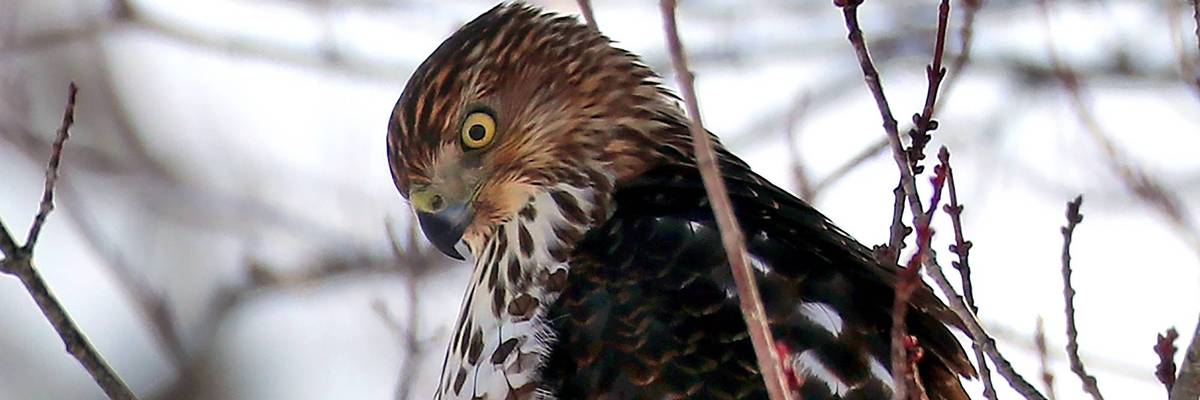
A red-tailed hawk sits in a tree at the Mass Audubon's Daniel Webster Wildlife Sanctuary on January 28, 2026.
I suspect this hawk has never once felt the nag of the question, “What can I do?” Not about the climate crisis. Perhaps not about anything. What to do is something other animals seem to know innately and intimately, or perhaps don't need to know at all.
I live in the very heart of Atlanta, Georgia, affectionately called the "city in a forest." From my desk, where I work most days, I look out onto a stand of trees. Right at canopy height, it is the perfect view for getting distracted, especially by our resident red-tailed hawk, who is strikingly visible in the loose thatching of bare winter limbs.
Sudden squirrel scatter, and she alights on the branch of a maple tree to scan for potential prey. Her fleet perch and keen watch, her grandeur of feather and hunt—it breaks through the primacy of my screen and shakes me from the fathomless digital world. Interruption gladly received.
Each time the hawk stops through these trees, I am struck by the sudden proximity of a taloned huntress to me, encased in my condo-version of captivity. More than once, I have grabbed my phone to quickly frame the hawk and catch ill-focused evidence that I too am alert and alive. Enraptured by a raptor, I have "Slacked" the flattened scene to my colleagues: “Afternoon visitor!” With a feather and a heart emoji afterword. (As if icons in miniature could limn her.)
But I am struck by another proximity, too, between what the hawk does and who the hawk seems to be. Her doingness and her beingness are so close as to become one.
What might open up for us if we shift the question ever so slightly—from What can I do? to Who can I be? Or, Who am I already?
I suspect this hawk has never once felt the nag of the question, “What can I do?” Not about the climate crisis. Perhaps not about anything. What to do is something other animals seem to know innately and intimately, or perhaps don't need to know at all.
Evolution has made things more complicated for us Homo sapiens, who ponder and puzzle. As essayist and author Margaret Renkl writes, "Every living thing—every bird and mammal and reptile and amphibian, every tree and shrub and flower and moss—is pursuing its own vital purpose, a purpose that sets my human concerns in a larger context." As I watch the hawk's wings lift and lower and propel her back into the air, I marvel and muse whether life itself might offer another way in.
What might open up for us if we shift the question ever so slightly—from What can I do? to Who can I be? Or, Who am I already?
The hawk, like all of us existing on this planet, is an inheritor of a 3.8-billion-year history: From single-celled organisms to plants and vertebrates, life has continued to move forward toward more life, overcoming unthinkable odds. Weighty and unwavering and in so many ways impenetrable—this dynamic defines Earth as a living planet. When we think about a hive of honeybees gathering their ingredients from flowers, or black corals siphoning plankton over centuries, or the sudden emergence of mushrooms from a shrouded fungal network, we can see this dynamic in action. Even kudzu offers testimony with its rampant return, however unwelcome, each spring.
Who can we be? One thing we already are: an expression of Earth's life force, right here, right now, made possible by a series of miracles that have blossomed over eons. This is true simply by virtue of breathing.
Life force unfurls through each of us in such beautifully different ways. We explore the unknown and document our discoveries. We design new things and give them form. We expose what's ruptured and source the means to mend it. We reflect, wonder, and imagine. We craft stories and art and shows. We make ritual. We convene people and foster conversation and collaboration. We care for one another. We strategize, organize, and orchestrate. We engineer and implement. We manage the details. We show up, stand up, and speak up. We share wisdom and tell jokes. We cook and sing and clean and plant and build and nap. And all of that is just the briefest inventory of human beings' doings.
There are things we do that are so wholly connected with who we are—that spring up from within us in such an organic way—that the space between our doing and our being shrinks or even vanishes. In those moments, our small expression of the vast life force we've inherited and embody is especially effervescent. We may find ourselves buzzing, flowing, or sensing a particular warmth. We may be especially porous and focused both.
It is a radical act to believe in our ability to thrive, both individually and as a planet, by being who we are.
I imagine this is how the hawk might feel as she swoops into the circle of life. It's how I wish many more of us to feel as we take wing to heal the climate crisis.
In Climate Wayfinding, we think of the ways we each express life force as our unique talents, gifts, or superpowers—all of which are so very needed in this era of change. Two lenses help illuminate them: authentic power and deep joy.
Authentic power is something that rises up from within us—internal and genuine, not gained at others' expense or expended upon them. It's a feeling of ability, capacity, strength, weight, energy, vigor. It aligns what swells within us with how we move in the world.
Deep joy is a feeling of great pleasure, happiness, delight, exhilaration, radiance, bliss. It, too, rises from within and spills out, intermingling with the world around us. It is often the emotional glow of meaning or connection. Joy may also feel out of place in the face of the climate crisis. Who are we to taste joy when so much is hurting? But joy is all the more necessary, and all the more holy, in difficult times.
As Dr. Robin Wall Kimmerer writes in Braiding Sweetgrass: "Even a wounded world is feeding us. Even a wounded world holds us, giving us moments of wonder and joy. I choose joy over despair. Not because I have my head in the sand, but because joy is what the Earth gives me daily and I must return the gift."
In my own experience, moving at the nexus of authentic power and deep joy might be our closest approximation to life force itself. When I have strayed far into zones of not-power and not-joy—most often for employment or another hard-tugging should—I have found myself in struggle, disconnection, and even depression. Stubborn is the soul, intent on a space where it belongs.
It is a radical act to believe in our ability to thrive, both individually and as a planet, by being who we are. I mean radical in the fullest sense: from the root, fundamental, and far-reaching. A person anchored and aglow—that is the kind of revolutionary that's called for in this time.
Looking inward to shape our outward contributions—this, I think, is a form of courage. When we refuse to lose touch with our sources of authentic power and deep joy, and when we dare to center them somehow in our lives, we reach toward calling. Whether loudly or in a whisper, these things summon us, insisting that our lives can be alive—sprouting and blooming, swooping and flying high—and that we can be part of making it so.
Just now, the red-tailed hawk draws my eye. It's a beautiful, bewitching thing to behold a being in the fullness of herself. But I realize, watching her in motion, that I am rapt by more than the solitary bird. At the edges of the self, there is a zone, almost an aura, of arising. We find there, at the periphery, a space populated by all that is emergent with, and only with, the world around us.
For the hawk, that emergent edge exists in the remarkable everyday interplay of hunger and wing and wind. And perhaps it is so for all of us, along our own edges, as we muster skill and strength for a planet in want, in wish.
Perhaps you, too, can feel the vibration at the eager verge of doingness and beingness and the wide, long, insistent breath of life.
This piece was adapted from Climate Wayfinding: Healing Ourselves and the Planet We Call Home by Katharine K. Wilkinson (Andrews McMeel, 2026). Used with permission of the publisher. Do not republish.
Dear Common Dreams reader, It’s been nearly 30 years since I co-founded Common Dreams with my late wife, Lina Newhouser. We had the radical notion that journalism should serve the public good, not corporate profits. It was clear to us from the outset what it would take to build such a project. No paid advertisements. No corporate sponsors. No millionaire publisher telling us what to think or do. Many people said we wouldn't last a year, but we proved those doubters wrong. Together with a tremendous team of journalists and dedicated staff, we built an independent media outlet free from the constraints of profits and corporate control. Our mission has always been simple: To inform. To inspire. To ignite change for the common good. Building Common Dreams was not easy. Our survival was never guaranteed. When you take on the most powerful forces—Wall Street greed, fossil fuel industry destruction, Big Tech lobbyists, and uber-rich oligarchs who have spent billions upon billions rigging the economy and democracy in their favor—the only bulwark you have is supporters who believe in your work. But here’s the urgent message from me today. It's never been this bad out there. And it's never been this hard to keep us going. At the very moment Common Dreams is most needed, the threats we face are intensifying. We need your support now more than ever. We don't accept corporate advertising and never will. We don't have a paywall because we don't think people should be blocked from critical news based on their ability to pay. Everything we do is funded by the donations of readers like you. When everyone does the little they can afford, we are strong. But if that support retreats or dries up, so do we. Will you donate now to make sure Common Dreams not only survives but thrives? —Craig Brown, Co-founder |
I live in the very heart of Atlanta, Georgia, affectionately called the "city in a forest." From my desk, where I work most days, I look out onto a stand of trees. Right at canopy height, it is the perfect view for getting distracted, especially by our resident red-tailed hawk, who is strikingly visible in the loose thatching of bare winter limbs.
Sudden squirrel scatter, and she alights on the branch of a maple tree to scan for potential prey. Her fleet perch and keen watch, her grandeur of feather and hunt—it breaks through the primacy of my screen and shakes me from the fathomless digital world. Interruption gladly received.
Each time the hawk stops through these trees, I am struck by the sudden proximity of a taloned huntress to me, encased in my condo-version of captivity. More than once, I have grabbed my phone to quickly frame the hawk and catch ill-focused evidence that I too am alert and alive. Enraptured by a raptor, I have "Slacked" the flattened scene to my colleagues: “Afternoon visitor!” With a feather and a heart emoji afterword. (As if icons in miniature could limn her.)
But I am struck by another proximity, too, between what the hawk does and who the hawk seems to be. Her doingness and her beingness are so close as to become one.
What might open up for us if we shift the question ever so slightly—from What can I do? to Who can I be? Or, Who am I already?
I suspect this hawk has never once felt the nag of the question, “What can I do?” Not about the climate crisis. Perhaps not about anything. What to do is something other animals seem to know innately and intimately, or perhaps don't need to know at all.
Evolution has made things more complicated for us Homo sapiens, who ponder and puzzle. As essayist and author Margaret Renkl writes, "Every living thing—every bird and mammal and reptile and amphibian, every tree and shrub and flower and moss—is pursuing its own vital purpose, a purpose that sets my human concerns in a larger context." As I watch the hawk's wings lift and lower and propel her back into the air, I marvel and muse whether life itself might offer another way in.
What might open up for us if we shift the question ever so slightly—from What can I do? to Who can I be? Or, Who am I already?
The hawk, like all of us existing on this planet, is an inheritor of a 3.8-billion-year history: From single-celled organisms to plants and vertebrates, life has continued to move forward toward more life, overcoming unthinkable odds. Weighty and unwavering and in so many ways impenetrable—this dynamic defines Earth as a living planet. When we think about a hive of honeybees gathering their ingredients from flowers, or black corals siphoning plankton over centuries, or the sudden emergence of mushrooms from a shrouded fungal network, we can see this dynamic in action. Even kudzu offers testimony with its rampant return, however unwelcome, each spring.
Who can we be? One thing we already are: an expression of Earth's life force, right here, right now, made possible by a series of miracles that have blossomed over eons. This is true simply by virtue of breathing.
Life force unfurls through each of us in such beautifully different ways. We explore the unknown and document our discoveries. We design new things and give them form. We expose what's ruptured and source the means to mend it. We reflect, wonder, and imagine. We craft stories and art and shows. We make ritual. We convene people and foster conversation and collaboration. We care for one another. We strategize, organize, and orchestrate. We engineer and implement. We manage the details. We show up, stand up, and speak up. We share wisdom and tell jokes. We cook and sing and clean and plant and build and nap. And all of that is just the briefest inventory of human beings' doings.
There are things we do that are so wholly connected with who we are—that spring up from within us in such an organic way—that the space between our doing and our being shrinks or even vanishes. In those moments, our small expression of the vast life force we've inherited and embody is especially effervescent. We may find ourselves buzzing, flowing, or sensing a particular warmth. We may be especially porous and focused both.
It is a radical act to believe in our ability to thrive, both individually and as a planet, by being who we are.
I imagine this is how the hawk might feel as she swoops into the circle of life. It's how I wish many more of us to feel as we take wing to heal the climate crisis.
In Climate Wayfinding, we think of the ways we each express life force as our unique talents, gifts, or superpowers—all of which are so very needed in this era of change. Two lenses help illuminate them: authentic power and deep joy.
Authentic power is something that rises up from within us—internal and genuine, not gained at others' expense or expended upon them. It's a feeling of ability, capacity, strength, weight, energy, vigor. It aligns what swells within us with how we move in the world.
Deep joy is a feeling of great pleasure, happiness, delight, exhilaration, radiance, bliss. It, too, rises from within and spills out, intermingling with the world around us. It is often the emotional glow of meaning or connection. Joy may also feel out of place in the face of the climate crisis. Who are we to taste joy when so much is hurting? But joy is all the more necessary, and all the more holy, in difficult times.
As Dr. Robin Wall Kimmerer writes in Braiding Sweetgrass: "Even a wounded world is feeding us. Even a wounded world holds us, giving us moments of wonder and joy. I choose joy over despair. Not because I have my head in the sand, but because joy is what the Earth gives me daily and I must return the gift."
In my own experience, moving at the nexus of authentic power and deep joy might be our closest approximation to life force itself. When I have strayed far into zones of not-power and not-joy—most often for employment or another hard-tugging should—I have found myself in struggle, disconnection, and even depression. Stubborn is the soul, intent on a space where it belongs.
It is a radical act to believe in our ability to thrive, both individually and as a planet, by being who we are. I mean radical in the fullest sense: from the root, fundamental, and far-reaching. A person anchored and aglow—that is the kind of revolutionary that's called for in this time.
Looking inward to shape our outward contributions—this, I think, is a form of courage. When we refuse to lose touch with our sources of authentic power and deep joy, and when we dare to center them somehow in our lives, we reach toward calling. Whether loudly or in a whisper, these things summon us, insisting that our lives can be alive—sprouting and blooming, swooping and flying high—and that we can be part of making it so.
Just now, the red-tailed hawk draws my eye. It's a beautiful, bewitching thing to behold a being in the fullness of herself. But I realize, watching her in motion, that I am rapt by more than the solitary bird. At the edges of the self, there is a zone, almost an aura, of arising. We find there, at the periphery, a space populated by all that is emergent with, and only with, the world around us.
For the hawk, that emergent edge exists in the remarkable everyday interplay of hunger and wing and wind. And perhaps it is so for all of us, along our own edges, as we muster skill and strength for a planet in want, in wish.
Perhaps you, too, can feel the vibration at the eager verge of doingness and beingness and the wide, long, insistent breath of life.
This piece was adapted from Climate Wayfinding: Healing Ourselves and the Planet We Call Home by Katharine K. Wilkinson (Andrews McMeel, 2026). Used with permission of the publisher. Do not republish.
I live in the very heart of Atlanta, Georgia, affectionately called the "city in a forest." From my desk, where I work most days, I look out onto a stand of trees. Right at canopy height, it is the perfect view for getting distracted, especially by our resident red-tailed hawk, who is strikingly visible in the loose thatching of bare winter limbs.
Sudden squirrel scatter, and she alights on the branch of a maple tree to scan for potential prey. Her fleet perch and keen watch, her grandeur of feather and hunt—it breaks through the primacy of my screen and shakes me from the fathomless digital world. Interruption gladly received.
Each time the hawk stops through these trees, I am struck by the sudden proximity of a taloned huntress to me, encased in my condo-version of captivity. More than once, I have grabbed my phone to quickly frame the hawk and catch ill-focused evidence that I too am alert and alive. Enraptured by a raptor, I have "Slacked" the flattened scene to my colleagues: “Afternoon visitor!” With a feather and a heart emoji afterword. (As if icons in miniature could limn her.)
But I am struck by another proximity, too, between what the hawk does and who the hawk seems to be. Her doingness and her beingness are so close as to become one.
What might open up for us if we shift the question ever so slightly—from What can I do? to Who can I be? Or, Who am I already?
I suspect this hawk has never once felt the nag of the question, “What can I do?” Not about the climate crisis. Perhaps not about anything. What to do is something other animals seem to know innately and intimately, or perhaps don't need to know at all.
Evolution has made things more complicated for us Homo sapiens, who ponder and puzzle. As essayist and author Margaret Renkl writes, "Every living thing—every bird and mammal and reptile and amphibian, every tree and shrub and flower and moss—is pursuing its own vital purpose, a purpose that sets my human concerns in a larger context." As I watch the hawk's wings lift and lower and propel her back into the air, I marvel and muse whether life itself might offer another way in.
What might open up for us if we shift the question ever so slightly—from What can I do? to Who can I be? Or, Who am I already?
The hawk, like all of us existing on this planet, is an inheritor of a 3.8-billion-year history: From single-celled organisms to plants and vertebrates, life has continued to move forward toward more life, overcoming unthinkable odds. Weighty and unwavering and in so many ways impenetrable—this dynamic defines Earth as a living planet. When we think about a hive of honeybees gathering their ingredients from flowers, or black corals siphoning plankton over centuries, or the sudden emergence of mushrooms from a shrouded fungal network, we can see this dynamic in action. Even kudzu offers testimony with its rampant return, however unwelcome, each spring.
Who can we be? One thing we already are: an expression of Earth's life force, right here, right now, made possible by a series of miracles that have blossomed over eons. This is true simply by virtue of breathing.
Life force unfurls through each of us in such beautifully different ways. We explore the unknown and document our discoveries. We design new things and give them form. We expose what's ruptured and source the means to mend it. We reflect, wonder, and imagine. We craft stories and art and shows. We make ritual. We convene people and foster conversation and collaboration. We care for one another. We strategize, organize, and orchestrate. We engineer and implement. We manage the details. We show up, stand up, and speak up. We share wisdom and tell jokes. We cook and sing and clean and plant and build and nap. And all of that is just the briefest inventory of human beings' doings.
There are things we do that are so wholly connected with who we are—that spring up from within us in such an organic way—that the space between our doing and our being shrinks or even vanishes. In those moments, our small expression of the vast life force we've inherited and embody is especially effervescent. We may find ourselves buzzing, flowing, or sensing a particular warmth. We may be especially porous and focused both.
It is a radical act to believe in our ability to thrive, both individually and as a planet, by being who we are.
I imagine this is how the hawk might feel as she swoops into the circle of life. It's how I wish many more of us to feel as we take wing to heal the climate crisis.
In Climate Wayfinding, we think of the ways we each express life force as our unique talents, gifts, or superpowers—all of which are so very needed in this era of change. Two lenses help illuminate them: authentic power and deep joy.
Authentic power is something that rises up from within us—internal and genuine, not gained at others' expense or expended upon them. It's a feeling of ability, capacity, strength, weight, energy, vigor. It aligns what swells within us with how we move in the world.
Deep joy is a feeling of great pleasure, happiness, delight, exhilaration, radiance, bliss. It, too, rises from within and spills out, intermingling with the world around us. It is often the emotional glow of meaning or connection. Joy may also feel out of place in the face of the climate crisis. Who are we to taste joy when so much is hurting? But joy is all the more necessary, and all the more holy, in difficult times.
As Dr. Robin Wall Kimmerer writes in Braiding Sweetgrass: "Even a wounded world is feeding us. Even a wounded world holds us, giving us moments of wonder and joy. I choose joy over despair. Not because I have my head in the sand, but because joy is what the Earth gives me daily and I must return the gift."
In my own experience, moving at the nexus of authentic power and deep joy might be our closest approximation to life force itself. When I have strayed far into zones of not-power and not-joy—most often for employment or another hard-tugging should—I have found myself in struggle, disconnection, and even depression. Stubborn is the soul, intent on a space where it belongs.
It is a radical act to believe in our ability to thrive, both individually and as a planet, by being who we are. I mean radical in the fullest sense: from the root, fundamental, and far-reaching. A person anchored and aglow—that is the kind of revolutionary that's called for in this time.
Looking inward to shape our outward contributions—this, I think, is a form of courage. When we refuse to lose touch with our sources of authentic power and deep joy, and when we dare to center them somehow in our lives, we reach toward calling. Whether loudly or in a whisper, these things summon us, insisting that our lives can be alive—sprouting and blooming, swooping and flying high—and that we can be part of making it so.
Just now, the red-tailed hawk draws my eye. It's a beautiful, bewitching thing to behold a being in the fullness of herself. But I realize, watching her in motion, that I am rapt by more than the solitary bird. At the edges of the self, there is a zone, almost an aura, of arising. We find there, at the periphery, a space populated by all that is emergent with, and only with, the world around us.
For the hawk, that emergent edge exists in the remarkable everyday interplay of hunger and wing and wind. And perhaps it is so for all of us, along our own edges, as we muster skill and strength for a planet in want, in wish.
Perhaps you, too, can feel the vibration at the eager verge of doingness and beingness and the wide, long, insistent breath of life.
This piece was adapted from Climate Wayfinding: Healing Ourselves and the Planet We Call Home by Katharine K. Wilkinson (Andrews McMeel, 2026). Used with permission of the publisher. Do not republish.