SUBSCRIBE TO OUR FREE NEWSLETTER
Daily news & progressive opinion—funded by the people, not the corporations—delivered straight to your inbox.
5
#000000
#FFFFFF
To donate by check, phone, or other method, see our More Ways to Give page.
Daily news & progressive opinion—funded by the people, not the corporations—delivered straight to your inbox.
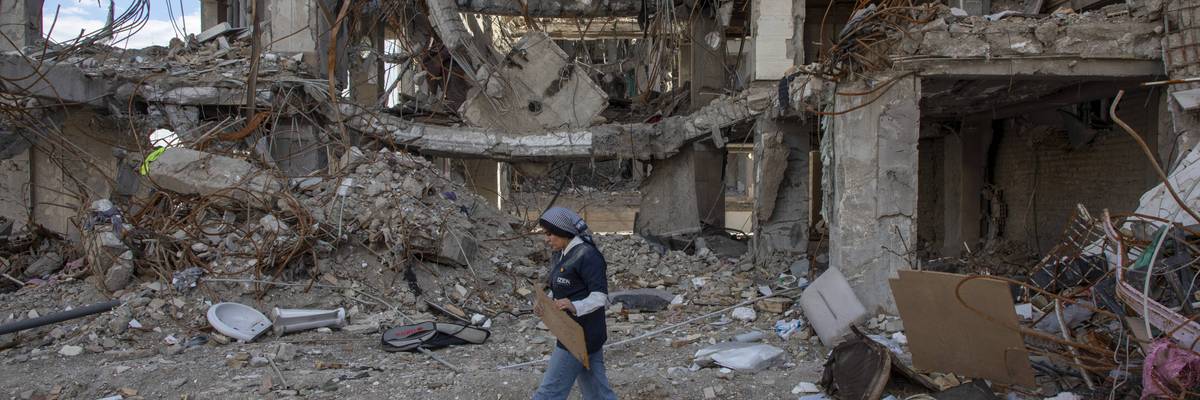
A woman walks among buildings destroyed in a joint attack by Israel and the United States on April 6, 2026, in Tehran, Iran.
The United States cutting off refugee resettlement domestically while waging a war that forces people to flee their homes abroad is a flagrant act of hypocrisy that is incompatible with the American Dream.
“Hip hip, hypocrisy! Hip hip, hypocrisy!” My teenage son pumped his fist in the air. I can’t remember the chain of conversation that ultimately produced this sardonic version of “hip hip, hooray!”, but the phrase has quickly become a way to get each other to smile or self-reflect, and it often leads to a bout of shared laughter. But recently, this chant has also allowed me to reflect on the fraught crossroads of my homeland and my emerging life’s work; specifically, the troubling hypocrisy of the United States’ recent actions on two interconnected global issues—forced migration and war.
I grew up in small-town Virginia, in a family that nurtured an honorable form of gratitude-based patriotism. As a doctoral student who studies refugee issues and forced migration, I have long been proud of the United States’ global leadership in refugee resettlement (while also believing that we should do more to support refugees). From the 1980s to early 2000s, the US routinelyresettled more refugees annually than all other nations combined. While this began to shift following the 9/11 attacks in 2001, there were only four years between 2002 and 2022 in which the US did not resettle the most refugees of any country in the world, coming in second to Canada in each of those four years. In 2023, our nation welcomed more than double the number of refugees resettled the previous year, and in 2024, we resettled over 100,000 refugees for the first time in 30 years. But unfortunately, US resettlement took an abrupt turn in 2025.
In an executive order issued on January 20th, 2025—the first day of President Donald Trump’s second term—the Trump presidency announced the suspension of the US refugee resettlement program. Another executive order followed on February 7, identifying South African Afrikaners as a group worthy of resettlement despite unverified claims of race-based persecution and misalignment with the globally recognized definition of refugeehood. Since October 2025, approximately 4,500 Afrikaners and three refugees from Afghanistan have been admitted under the US refugee resettlement program.
At the same time, our country’s leaders have waged war in the Middle East, creating “a new cycle of displacement” that continues to worsen. Whether or not you agree with the rationale behind this war, our country’s actions are increasing forced displacement on a global scale. Recent estimates project that this war has already forced up to 3.2 million Iranians and 1.3 million Lebanese citizens to flee their homes, and this number will almost certainly increase as the conflict continues. Furthermore, areas of the Middle East affected by the current war already host 24.3 million forcibly displaced people. As a scholar-in-training who cares deeply about both forced migrants and the United States, the hypocrisy of cutting off refugee resettlement domestically while acting in ways that force people to flee their homes abroad is excruciating.
The United States is simultaneously closing our doors to refugees and actively increasing the number of forcibly displaced people in the world.
But there’s also a double hypocrisy here, a vocal hypocrisy layered on top of this more tacit one. For years, President Trump has complained that other countries don’t pull their weight in NATO and the US shoulders an oversized portion of defense spending among the alliance. By the same logic, the US should pull our weight in supporting refugees, period—and especially when we are contributing to increases in global forced displacement. “Hip hip, hypocrisy.”
I hear you—don’t we have enough unmet needs among US citizens? Shouldn’t we fix everything in this country before we offer others permanent protection here? While there are many responses to these questions, for me the most compelling is summed up by Rabbi Sharon Braus, who maintains that “ultimately, the problem of the world is that we draw the circle of our family too small.”
The figures I’ve presented here are so much more than numbers—each one is a living, breathing person who has loved ones and a favorite color, and who also happens to have survived the harrowing experience of being forced to flee their home due to circumstances entirely outside of their control. Refugees are exceptionally resilient and resourceful people who contribute strength, wisdom, talent, tenacity, (and yes, taxes) to our society, helping us to address our collective needs together. Refugees are part of “we” and “our”—part of [the] “US.”
And yet, the United States is simultaneously closing our doors to refugees and actively increasing the number of forcibly displaced people in the world. The promise of America is not zero-sum—it is generative and generous and transformative. The American Dream I believe in includes not only those of us who were born in the US and have benefited from living here through no virtue of our own, but those who were born elsewhere and have been displaced from their home nations through no fault of their own.
As a future forced migration scholar, a deep longing for my homeland to treat refugees and other forced migrants with compassion, respect, and dignity has become a central feature of my own personal American Dream. Join me and make it an indispensable part of our collective American Dream!
Together, let’s not shy away from this needed and worthy work. Stand with me by imagining what it would be like to start over in a new place, talking about refugees and other migrants in humanizing ways, befriending a newcomer who might benefit from connection, or sharing this op-ed with a friend or loved one who might need to read it. The circle of our family grows as we expand it together, until the day we reach a full-throated “hip hip, hooray!”
Dear Common Dreams reader, It’s been nearly 30 years since I co-founded Common Dreams with my late wife, Lina Newhouser. We had the radical notion that journalism should serve the public good, not corporate profits. It was clear to us from the outset what it would take to build such a project. No paid advertisements. No corporate sponsors. No millionaire publisher telling us what to think or do. Many people said we wouldn't last a year, but we proved those doubters wrong. Together with a tremendous team of journalists and dedicated staff, we built an independent media outlet free from the constraints of profits and corporate control. Our mission has always been simple: To inform. To inspire. To ignite change for the common good. Building Common Dreams was not easy. Our survival was never guaranteed. When you take on the most powerful forces—Wall Street greed, fossil fuel industry destruction, Big Tech lobbyists, and uber-rich oligarchs who have spent billions upon billions rigging the economy and democracy in their favor—the only bulwark you have is supporters who believe in your work. But here’s the urgent message from me today. It's never been this bad out there. And it's never been this hard to keep us going. At the very moment Common Dreams is most needed, the threats we face are intensifying. We need your support now more than ever. We don't accept corporate advertising and never will. We don't have a paywall because we don't think people should be blocked from critical news based on their ability to pay. Everything we do is funded by the donations of readers like you. When everyone does the little they can afford, we are strong. But if that support retreats or dries up, so do we. Will you donate now to make sure Common Dreams not only survives but thrives? —Craig Brown, Co-founder |
“Hip hip, hypocrisy! Hip hip, hypocrisy!” My teenage son pumped his fist in the air. I can’t remember the chain of conversation that ultimately produced this sardonic version of “hip hip, hooray!”, but the phrase has quickly become a way to get each other to smile or self-reflect, and it often leads to a bout of shared laughter. But recently, this chant has also allowed me to reflect on the fraught crossroads of my homeland and my emerging life’s work; specifically, the troubling hypocrisy of the United States’ recent actions on two interconnected global issues—forced migration and war.
I grew up in small-town Virginia, in a family that nurtured an honorable form of gratitude-based patriotism. As a doctoral student who studies refugee issues and forced migration, I have long been proud of the United States’ global leadership in refugee resettlement (while also believing that we should do more to support refugees). From the 1980s to early 2000s, the US routinelyresettled more refugees annually than all other nations combined. While this began to shift following the 9/11 attacks in 2001, there were only four years between 2002 and 2022 in which the US did not resettle the most refugees of any country in the world, coming in second to Canada in each of those four years. In 2023, our nation welcomed more than double the number of refugees resettled the previous year, and in 2024, we resettled over 100,000 refugees for the first time in 30 years. But unfortunately, US resettlement took an abrupt turn in 2025.
In an executive order issued on January 20th, 2025—the first day of President Donald Trump’s second term—the Trump presidency announced the suspension of the US refugee resettlement program. Another executive order followed on February 7, identifying South African Afrikaners as a group worthy of resettlement despite unverified claims of race-based persecution and misalignment with the globally recognized definition of refugeehood. Since October 2025, approximately 4,500 Afrikaners and three refugees from Afghanistan have been admitted under the US refugee resettlement program.
At the same time, our country’s leaders have waged war in the Middle East, creating “a new cycle of displacement” that continues to worsen. Whether or not you agree with the rationale behind this war, our country’s actions are increasing forced displacement on a global scale. Recent estimates project that this war has already forced up to 3.2 million Iranians and 1.3 million Lebanese citizens to flee their homes, and this number will almost certainly increase as the conflict continues. Furthermore, areas of the Middle East affected by the current war already host 24.3 million forcibly displaced people. As a scholar-in-training who cares deeply about both forced migrants and the United States, the hypocrisy of cutting off refugee resettlement domestically while acting in ways that force people to flee their homes abroad is excruciating.
The United States is simultaneously closing our doors to refugees and actively increasing the number of forcibly displaced people in the world.
But there’s also a double hypocrisy here, a vocal hypocrisy layered on top of this more tacit one. For years, President Trump has complained that other countries don’t pull their weight in NATO and the US shoulders an oversized portion of defense spending among the alliance. By the same logic, the US should pull our weight in supporting refugees, period—and especially when we are contributing to increases in global forced displacement. “Hip hip, hypocrisy.”
I hear you—don’t we have enough unmet needs among US citizens? Shouldn’t we fix everything in this country before we offer others permanent protection here? While there are many responses to these questions, for me the most compelling is summed up by Rabbi Sharon Braus, who maintains that “ultimately, the problem of the world is that we draw the circle of our family too small.”
The figures I’ve presented here are so much more than numbers—each one is a living, breathing person who has loved ones and a favorite color, and who also happens to have survived the harrowing experience of being forced to flee their home due to circumstances entirely outside of their control. Refugees are exceptionally resilient and resourceful people who contribute strength, wisdom, talent, tenacity, (and yes, taxes) to our society, helping us to address our collective needs together. Refugees are part of “we” and “our”—part of [the] “US.”
And yet, the United States is simultaneously closing our doors to refugees and actively increasing the number of forcibly displaced people in the world. The promise of America is not zero-sum—it is generative and generous and transformative. The American Dream I believe in includes not only those of us who were born in the US and have benefited from living here through no virtue of our own, but those who were born elsewhere and have been displaced from their home nations through no fault of their own.
As a future forced migration scholar, a deep longing for my homeland to treat refugees and other forced migrants with compassion, respect, and dignity has become a central feature of my own personal American Dream. Join me and make it an indispensable part of our collective American Dream!
Together, let’s not shy away from this needed and worthy work. Stand with me by imagining what it would be like to start over in a new place, talking about refugees and other migrants in humanizing ways, befriending a newcomer who might benefit from connection, or sharing this op-ed with a friend or loved one who might need to read it. The circle of our family grows as we expand it together, until the day we reach a full-throated “hip hip, hooray!”
“Hip hip, hypocrisy! Hip hip, hypocrisy!” My teenage son pumped his fist in the air. I can’t remember the chain of conversation that ultimately produced this sardonic version of “hip hip, hooray!”, but the phrase has quickly become a way to get each other to smile or self-reflect, and it often leads to a bout of shared laughter. But recently, this chant has also allowed me to reflect on the fraught crossroads of my homeland and my emerging life’s work; specifically, the troubling hypocrisy of the United States’ recent actions on two interconnected global issues—forced migration and war.
I grew up in small-town Virginia, in a family that nurtured an honorable form of gratitude-based patriotism. As a doctoral student who studies refugee issues and forced migration, I have long been proud of the United States’ global leadership in refugee resettlement (while also believing that we should do more to support refugees). From the 1980s to early 2000s, the US routinelyresettled more refugees annually than all other nations combined. While this began to shift following the 9/11 attacks in 2001, there were only four years between 2002 and 2022 in which the US did not resettle the most refugees of any country in the world, coming in second to Canada in each of those four years. In 2023, our nation welcomed more than double the number of refugees resettled the previous year, and in 2024, we resettled over 100,000 refugees for the first time in 30 years. But unfortunately, US resettlement took an abrupt turn in 2025.
In an executive order issued on January 20th, 2025—the first day of President Donald Trump’s second term—the Trump presidency announced the suspension of the US refugee resettlement program. Another executive order followed on February 7, identifying South African Afrikaners as a group worthy of resettlement despite unverified claims of race-based persecution and misalignment with the globally recognized definition of refugeehood. Since October 2025, approximately 4,500 Afrikaners and three refugees from Afghanistan have been admitted under the US refugee resettlement program.
At the same time, our country’s leaders have waged war in the Middle East, creating “a new cycle of displacement” that continues to worsen. Whether or not you agree with the rationale behind this war, our country’s actions are increasing forced displacement on a global scale. Recent estimates project that this war has already forced up to 3.2 million Iranians and 1.3 million Lebanese citizens to flee their homes, and this number will almost certainly increase as the conflict continues. Furthermore, areas of the Middle East affected by the current war already host 24.3 million forcibly displaced people. As a scholar-in-training who cares deeply about both forced migrants and the United States, the hypocrisy of cutting off refugee resettlement domestically while acting in ways that force people to flee their homes abroad is excruciating.
The United States is simultaneously closing our doors to refugees and actively increasing the number of forcibly displaced people in the world.
But there’s also a double hypocrisy here, a vocal hypocrisy layered on top of this more tacit one. For years, President Trump has complained that other countries don’t pull their weight in NATO and the US shoulders an oversized portion of defense spending among the alliance. By the same logic, the US should pull our weight in supporting refugees, period—and especially when we are contributing to increases in global forced displacement. “Hip hip, hypocrisy.”
I hear you—don’t we have enough unmet needs among US citizens? Shouldn’t we fix everything in this country before we offer others permanent protection here? While there are many responses to these questions, for me the most compelling is summed up by Rabbi Sharon Braus, who maintains that “ultimately, the problem of the world is that we draw the circle of our family too small.”
The figures I’ve presented here are so much more than numbers—each one is a living, breathing person who has loved ones and a favorite color, and who also happens to have survived the harrowing experience of being forced to flee their home due to circumstances entirely outside of their control. Refugees are exceptionally resilient and resourceful people who contribute strength, wisdom, talent, tenacity, (and yes, taxes) to our society, helping us to address our collective needs together. Refugees are part of “we” and “our”—part of [the] “US.”
And yet, the United States is simultaneously closing our doors to refugees and actively increasing the number of forcibly displaced people in the world. The promise of America is not zero-sum—it is generative and generous and transformative. The American Dream I believe in includes not only those of us who were born in the US and have benefited from living here through no virtue of our own, but those who were born elsewhere and have been displaced from their home nations through no fault of their own.
As a future forced migration scholar, a deep longing for my homeland to treat refugees and other forced migrants with compassion, respect, and dignity has become a central feature of my own personal American Dream. Join me and make it an indispensable part of our collective American Dream!
Together, let’s not shy away from this needed and worthy work. Stand with me by imagining what it would be like to start over in a new place, talking about refugees and other migrants in humanizing ways, befriending a newcomer who might benefit from connection, or sharing this op-ed with a friend or loved one who might need to read it. The circle of our family grows as we expand it together, until the day we reach a full-throated “hip hip, hooray!”