SUBSCRIBE TO OUR FREE NEWSLETTER
Daily news & progressive opinion—funded by the people, not the corporations—delivered straight to your inbox.
5
#000000
#FFFFFF
To donate by check, phone, or other method, see our More Ways to Give page.
Daily news & progressive opinion—funded by the people, not the corporations—delivered straight to your inbox.
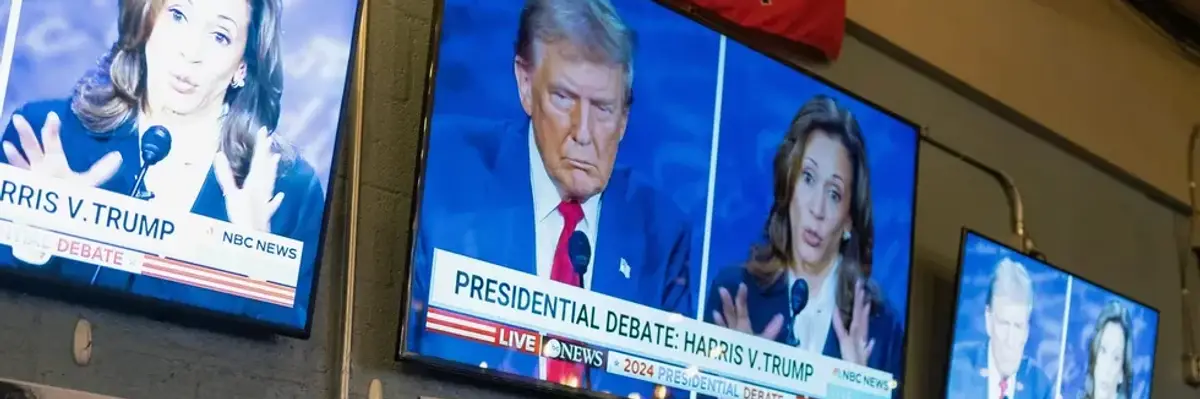
A watch party for the U.S. presidential debate between Vice President Kamala Harris and Republican presidential nominee Donald Trump takes place at American Eat Co. in Tucson, Arizona on September 10, 2024.
How do we transcend our collective awareness beyond the artificial borders we’ve created?
If you want to play the game of politics, here’s step one: Reduce everything to a linear political viewpoint: “right” or “left.” No matter how deep and large and complex that viewpoint is, politicize it, turn it into something that’s either right or wrong. It’s all about winning or losing.
Did U.S. Vice President Kamala Harris lean too far left? Oh gosh. Neither Liz Cheney nor Taylor Swift could save her.
I’m still immersed in my own recovery process—recovery from the election, of course. And yes, I’m feeling pain because “my side” lost, but my emotions are complicated by the fact that I didn’t really have a side in the election. It wasn’t simply that I was frustrated with the campaigns and claims of both major parties (the only ones that mattered, right?). I’ve apparently reached a point in my life where the entire political game feels problematic; it minimizes our world in a way I can no longer tolerate.
I feel the need to embrace and transcend this paradox: the reduction of our deepest values to a “cause,” which then frees us from actually having to honor those values and reduces the process to winning vs. losing.
How do we transcend our collective awareness beyond the artificial borders we’ve created? I ask this question not from some higher state of awareness, but from the middle of it all. How do we reach a collective state that isn’t competitive? How do we actually live our values rather than simply attempt to impose them—and in the process of doing so, oh so often, completely disregard and violate those values?
Suddenly I’m thinking about the good old Crusades, summarized thus by History.com: “The Crusades were a series of religious wars between Christians and Muslims started primarily to secure control of holy sites considered sacred by both groups. In all, eight major Crusade expeditions—varying in size, strength, and degree of success—occurred between 1096 and 1291. The costly, violent, and often ruthless conflicts enhanced the status of European Christians, making them major players in the fight for land in the Middle East.”
Now it’s all just history, which is the story we tell about ourselves from one war to the next. But, come on: “violent and often ruthless” battles to reclaim, good God, holy sites? Do unto others as you would have them do unto you? Actually, that biblical quote sums up the cost of war pretty precisely. But the paradox sits there like an open wound. Love thy neighbor, love thy enemy—but first you’re going to have to kill him. And his children. Charge!
I’m not saying all this simply to point a moral finger at the political leaders of the world. Rather, I feel the need to embrace and transcend this paradox: the reduction of our deepest values to a “cause,” which then frees us from actually having to honor those values and reduces the process to winning vs. losing. Apparently, we can’t have a cause without an enemy, or at least an inconvenience (Palestinians, for example), which... uh, needs to be eliminated.
It always seems to come down to this: some glaring irritation that stands in the way of the good we want to do. And yes, there are many pushbacks against this mindset—many people who, in defiance of the cynics, believe in, practice and, indeed, create loving and courageous approaches to conflict resolution. But such approaches cannot be reduced to simple stories of good vs. evil, and thus lack large social resonance.
So here I am, dealing with my own frustrations in the present moment—the ongoing genocide in Palestine that the U.S. funds, the possibility of President-elect Donald Trump’s increased militarization of our southern border, the ever-intensifying climate crisis, the ongoing possibility of nuclear war... and oh my God, it gets ever more insane. For that reason, I bring back a story I wrote about a decade ago, which remains close to my heart. It’s a small story: a single incident in the midst of the brutal civil war going on in South Sudan.
It involves the international peacekeeping NGO, Nonviolent Peaceforce, which had several of its members in the country to help facilitate communication between the various sides in the conflict. They were unarmed, of course, which gave them credibility and trust among the warring sides. As I wrote at the time:
Being unarmed doesn’t mean being disempowered. This is worth paying attention to. In South Sudan, unarmed, international peacekeepers have credibility. They stand above the local conflict, facilitating communication between the various sides but not taking sides themselves.
What happened was that armed men attacked a United Nations base on the perimeter of the city of Bor, where thousands of civilians had sought refuge. Two Nonviolence Peaceforce representatives found themselves in the middle of the chaos and took refuge inside a mud hut, which was occupied as well by four women and nine children. On three separate occasions, I noted, armed men came and ordered the peacekeepers out so they could kill the women and kids. The peacekeepers refused, holding up their Nonviolent Peaceforce IDs and saying they were unarmed. They were there to protect civilians and would not leave. After the third time, the armed men left for good.
Some 60 people were killed in the assault, but 13 precious lives were saved. As one of the peacekeepers said afterward: “I think if we had a gun we would have been shot immediately.”
The peacekeepers had had intense training in nonviolence and were able to keep their cool. They didn’t panic.
And, crucially, Nonviolent Peaceforce had credibility in South Sudan. They stood beyond the conflict. “We also had a humanitarian mandate,” one of the peacekeepers said. Being unarmed “opens the doors to look for solutions. If we were armed peacekeepers, the solution is you shoot back. Because we were unarmed, we could find other ways.”
This story transcends the moment of its occurrence. I wish I could multiply it by a million. All I can do is repeat: Being unarmed opens the door to look for solutions.
Dear Common Dreams reader, It’s been nearly 30 years since I co-founded Common Dreams with my late wife, Lina Newhouser. We had the radical notion that journalism should serve the public good, not corporate profits. It was clear to us from the outset what it would take to build such a project. No paid advertisements. No corporate sponsors. No millionaire publisher telling us what to think or do. Many people said we wouldn't last a year, but we proved those doubters wrong. Together with a tremendous team of journalists and dedicated staff, we built an independent media outlet free from the constraints of profits and corporate control. Our mission has always been simple: To inform. To inspire. To ignite change for the common good. Building Common Dreams was not easy. Our survival was never guaranteed. When you take on the most powerful forces—Wall Street greed, fossil fuel industry destruction, Big Tech lobbyists, and uber-rich oligarchs who have spent billions upon billions rigging the economy and democracy in their favor—the only bulwark you have is supporters who believe in your work. But here’s the urgent message from me today. It's never been this bad out there. And it's never been this hard to keep us going. At the very moment Common Dreams is most needed, the threats we face are intensifying. We need your support now more than ever. We don't accept corporate advertising and never will. We don't have a paywall because we don't think people should be blocked from critical news based on their ability to pay. Everything we do is funded by the donations of readers like you. When everyone does the little they can afford, we are strong. But if that support retreats or dries up, so do we. Will you donate now to make sure Common Dreams not only survives but thrives? —Craig Brown, Co-founder |
If you want to play the game of politics, here’s step one: Reduce everything to a linear political viewpoint: “right” or “left.” No matter how deep and large and complex that viewpoint is, politicize it, turn it into something that’s either right or wrong. It’s all about winning or losing.
Did U.S. Vice President Kamala Harris lean too far left? Oh gosh. Neither Liz Cheney nor Taylor Swift could save her.
I’m still immersed in my own recovery process—recovery from the election, of course. And yes, I’m feeling pain because “my side” lost, but my emotions are complicated by the fact that I didn’t really have a side in the election. It wasn’t simply that I was frustrated with the campaigns and claims of both major parties (the only ones that mattered, right?). I’ve apparently reached a point in my life where the entire political game feels problematic; it minimizes our world in a way I can no longer tolerate.
I feel the need to embrace and transcend this paradox: the reduction of our deepest values to a “cause,” which then frees us from actually having to honor those values and reduces the process to winning vs. losing.
How do we transcend our collective awareness beyond the artificial borders we’ve created? I ask this question not from some higher state of awareness, but from the middle of it all. How do we reach a collective state that isn’t competitive? How do we actually live our values rather than simply attempt to impose them—and in the process of doing so, oh so often, completely disregard and violate those values?
Suddenly I’m thinking about the good old Crusades, summarized thus by History.com: “The Crusades were a series of religious wars between Christians and Muslims started primarily to secure control of holy sites considered sacred by both groups. In all, eight major Crusade expeditions—varying in size, strength, and degree of success—occurred between 1096 and 1291. The costly, violent, and often ruthless conflicts enhanced the status of European Christians, making them major players in the fight for land in the Middle East.”
Now it’s all just history, which is the story we tell about ourselves from one war to the next. But, come on: “violent and often ruthless” battles to reclaim, good God, holy sites? Do unto others as you would have them do unto you? Actually, that biblical quote sums up the cost of war pretty precisely. But the paradox sits there like an open wound. Love thy neighbor, love thy enemy—but first you’re going to have to kill him. And his children. Charge!
I’m not saying all this simply to point a moral finger at the political leaders of the world. Rather, I feel the need to embrace and transcend this paradox: the reduction of our deepest values to a “cause,” which then frees us from actually having to honor those values and reduces the process to winning vs. losing. Apparently, we can’t have a cause without an enemy, or at least an inconvenience (Palestinians, for example), which... uh, needs to be eliminated.
It always seems to come down to this: some glaring irritation that stands in the way of the good we want to do. And yes, there are many pushbacks against this mindset—many people who, in defiance of the cynics, believe in, practice and, indeed, create loving and courageous approaches to conflict resolution. But such approaches cannot be reduced to simple stories of good vs. evil, and thus lack large social resonance.
So here I am, dealing with my own frustrations in the present moment—the ongoing genocide in Palestine that the U.S. funds, the possibility of President-elect Donald Trump’s increased militarization of our southern border, the ever-intensifying climate crisis, the ongoing possibility of nuclear war... and oh my God, it gets ever more insane. For that reason, I bring back a story I wrote about a decade ago, which remains close to my heart. It’s a small story: a single incident in the midst of the brutal civil war going on in South Sudan.
It involves the international peacekeeping NGO, Nonviolent Peaceforce, which had several of its members in the country to help facilitate communication between the various sides in the conflict. They were unarmed, of course, which gave them credibility and trust among the warring sides. As I wrote at the time:
Being unarmed doesn’t mean being disempowered. This is worth paying attention to. In South Sudan, unarmed, international peacekeepers have credibility. They stand above the local conflict, facilitating communication between the various sides but not taking sides themselves.
What happened was that armed men attacked a United Nations base on the perimeter of the city of Bor, where thousands of civilians had sought refuge. Two Nonviolence Peaceforce representatives found themselves in the middle of the chaos and took refuge inside a mud hut, which was occupied as well by four women and nine children. On three separate occasions, I noted, armed men came and ordered the peacekeepers out so they could kill the women and kids. The peacekeepers refused, holding up their Nonviolent Peaceforce IDs and saying they were unarmed. They were there to protect civilians and would not leave. After the third time, the armed men left for good.
Some 60 people were killed in the assault, but 13 precious lives were saved. As one of the peacekeepers said afterward: “I think if we had a gun we would have been shot immediately.”
The peacekeepers had had intense training in nonviolence and were able to keep their cool. They didn’t panic.
And, crucially, Nonviolent Peaceforce had credibility in South Sudan. They stood beyond the conflict. “We also had a humanitarian mandate,” one of the peacekeepers said. Being unarmed “opens the doors to look for solutions. If we were armed peacekeepers, the solution is you shoot back. Because we were unarmed, we could find other ways.”
This story transcends the moment of its occurrence. I wish I could multiply it by a million. All I can do is repeat: Being unarmed opens the door to look for solutions.
If you want to play the game of politics, here’s step one: Reduce everything to a linear political viewpoint: “right” or “left.” No matter how deep and large and complex that viewpoint is, politicize it, turn it into something that’s either right or wrong. It’s all about winning or losing.
Did U.S. Vice President Kamala Harris lean too far left? Oh gosh. Neither Liz Cheney nor Taylor Swift could save her.
I’m still immersed in my own recovery process—recovery from the election, of course. And yes, I’m feeling pain because “my side” lost, but my emotions are complicated by the fact that I didn’t really have a side in the election. It wasn’t simply that I was frustrated with the campaigns and claims of both major parties (the only ones that mattered, right?). I’ve apparently reached a point in my life where the entire political game feels problematic; it minimizes our world in a way I can no longer tolerate.
I feel the need to embrace and transcend this paradox: the reduction of our deepest values to a “cause,” which then frees us from actually having to honor those values and reduces the process to winning vs. losing.
How do we transcend our collective awareness beyond the artificial borders we’ve created? I ask this question not from some higher state of awareness, but from the middle of it all. How do we reach a collective state that isn’t competitive? How do we actually live our values rather than simply attempt to impose them—and in the process of doing so, oh so often, completely disregard and violate those values?
Suddenly I’m thinking about the good old Crusades, summarized thus by History.com: “The Crusades were a series of religious wars between Christians and Muslims started primarily to secure control of holy sites considered sacred by both groups. In all, eight major Crusade expeditions—varying in size, strength, and degree of success—occurred between 1096 and 1291. The costly, violent, and often ruthless conflicts enhanced the status of European Christians, making them major players in the fight for land in the Middle East.”
Now it’s all just history, which is the story we tell about ourselves from one war to the next. But, come on: “violent and often ruthless” battles to reclaim, good God, holy sites? Do unto others as you would have them do unto you? Actually, that biblical quote sums up the cost of war pretty precisely. But the paradox sits there like an open wound. Love thy neighbor, love thy enemy—but first you’re going to have to kill him. And his children. Charge!
I’m not saying all this simply to point a moral finger at the political leaders of the world. Rather, I feel the need to embrace and transcend this paradox: the reduction of our deepest values to a “cause,” which then frees us from actually having to honor those values and reduces the process to winning vs. losing. Apparently, we can’t have a cause without an enemy, or at least an inconvenience (Palestinians, for example), which... uh, needs to be eliminated.
It always seems to come down to this: some glaring irritation that stands in the way of the good we want to do. And yes, there are many pushbacks against this mindset—many people who, in defiance of the cynics, believe in, practice and, indeed, create loving and courageous approaches to conflict resolution. But such approaches cannot be reduced to simple stories of good vs. evil, and thus lack large social resonance.
So here I am, dealing with my own frustrations in the present moment—the ongoing genocide in Palestine that the U.S. funds, the possibility of President-elect Donald Trump’s increased militarization of our southern border, the ever-intensifying climate crisis, the ongoing possibility of nuclear war... and oh my God, it gets ever more insane. For that reason, I bring back a story I wrote about a decade ago, which remains close to my heart. It’s a small story: a single incident in the midst of the brutal civil war going on in South Sudan.
It involves the international peacekeeping NGO, Nonviolent Peaceforce, which had several of its members in the country to help facilitate communication between the various sides in the conflict. They were unarmed, of course, which gave them credibility and trust among the warring sides. As I wrote at the time:
Being unarmed doesn’t mean being disempowered. This is worth paying attention to. In South Sudan, unarmed, international peacekeepers have credibility. They stand above the local conflict, facilitating communication between the various sides but not taking sides themselves.
What happened was that armed men attacked a United Nations base on the perimeter of the city of Bor, where thousands of civilians had sought refuge. Two Nonviolence Peaceforce representatives found themselves in the middle of the chaos and took refuge inside a mud hut, which was occupied as well by four women and nine children. On three separate occasions, I noted, armed men came and ordered the peacekeepers out so they could kill the women and kids. The peacekeepers refused, holding up their Nonviolent Peaceforce IDs and saying they were unarmed. They were there to protect civilians and would not leave. After the third time, the armed men left for good.
Some 60 people were killed in the assault, but 13 precious lives were saved. As one of the peacekeepers said afterward: “I think if we had a gun we would have been shot immediately.”
The peacekeepers had had intense training in nonviolence and were able to keep their cool. They didn’t panic.
And, crucially, Nonviolent Peaceforce had credibility in South Sudan. They stood beyond the conflict. “We also had a humanitarian mandate,” one of the peacekeepers said. Being unarmed “opens the doors to look for solutions. If we were armed peacekeepers, the solution is you shoot back. Because we were unarmed, we could find other ways.”
This story transcends the moment of its occurrence. I wish I could multiply it by a million. All I can do is repeat: Being unarmed opens the door to look for solutions.