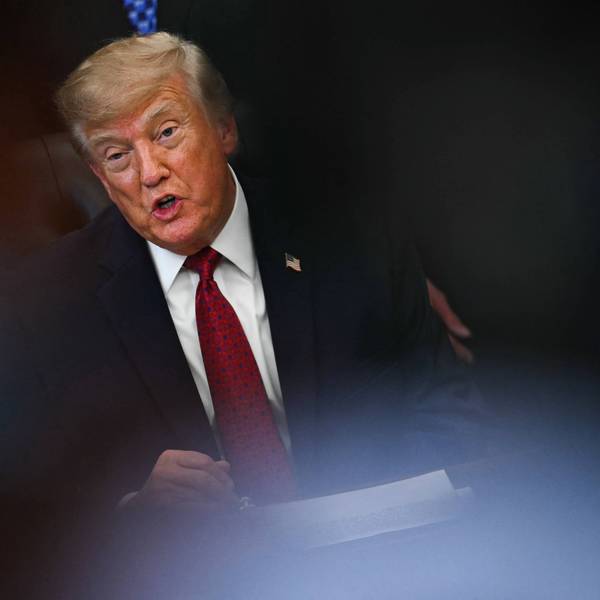
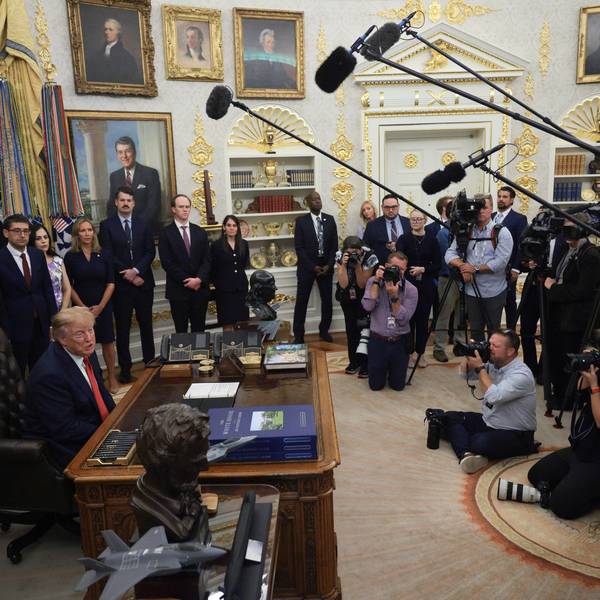
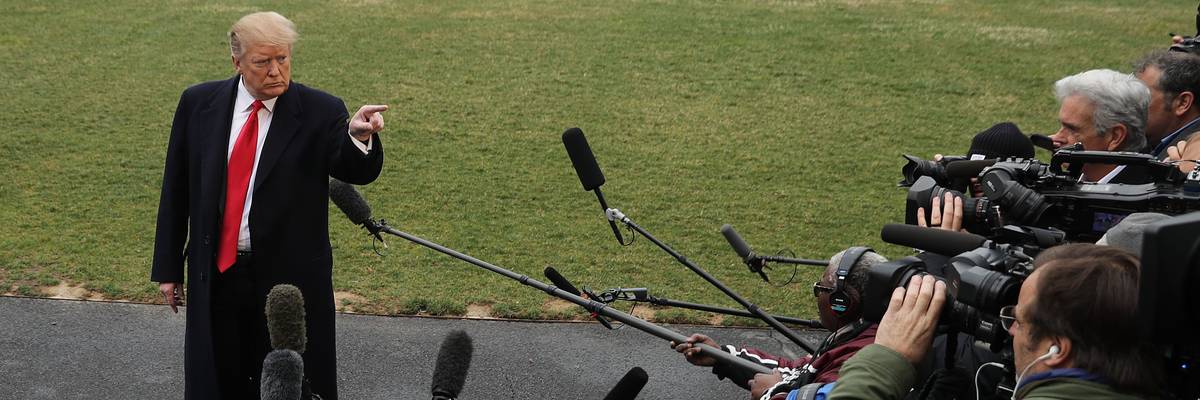
US President Donald Trump talks to reporters before departing the White House on March 22, 2019 in Washington, DC.
When Trump Targets the Media, the World's Autocrats Are Taking Notes
Trump's words and actions against the news media at home are inspiring copycat behavior by authoritarians and dictators around the world, fueling a growing global crisis of press freedom.
Only a day after President Donald Trump spoke of unity following a gunman’s abhorrent attempt to kill him and members of his administration at the White House Correspondents' dinner, the president quickly returned to his regularly scheduled programming of berating members of the press that ask him unwanted questions.
In a "60 Minutes" interview with CBS correspondent Norah O’Donnell taped and aired the day following the assassination attempt, Trump repeated many of his now-tired insults about the press, referring to the media in general as “horrible people,” and calling O’Donnell a “disgrace” who should be “ashamed” of herself for raising excerpts of the alleged gunman’s manifesto in a question to the president.
At this point, understandably, many of us have simply begun to tune out Trump’s now-frequent diatribes against the press. Nearly a decade since Trump first tweeted the now-ubiquitous phrase “fake news” and infamously labelled the news media the "enemies of the American people," such insults just don't land like they used to.
Yet Trump's words do in fact matter. While many of Trump’s rhetorical attacks against the press during his first term were dismissed as bluster from a president known for his flair for the dramatic, they laid the groundwork for the broad attack on the media that we’re seeing under Trump 2.0.
Under Trump, attacks on the media have been a leading contributor to the US’ year-over-year tumble in global democracy indexes.
Under his second presidency, the Trump administration has waged a multifaceted campaign against free speech and independent journalism, characterized by retaliatory lawsuits against major media outlets; legal harassment and intimidation of journalists; slashed budgets for public broadcasting; and regulatory pressure, taking aim at reporting not to the administration’s liking.
Even as the First Amendment comes under unprecedented pressure in the US, the impact of the Trump administration’s attacks on the news media hasn’t stopped at the US border. The linguistic framing Trump popularized to villainize the press (and justify executive action against them) has also contributed to a growing crisis of press freedom worldwide.
Trump’s attacks on the media have inspired copycat behavior from press freedom pariahs around the world. From Hungary to Turkey, authoritarian or illiberal leaders have echoed Trump’s hostile rhetoric against the press, adding their own spin in remarks designed to discredit the news outlets and journalists intent on exposing corruption and holding their leaders accountable to their people.
Autocratic regimes in Russia, China, and Egypt have seized on to Trump’s “fake news” framing with actual legislation barring the spread of “false” or “misleading” news and information. What actually defines fake news usually isn’t clear—the vague, ambiguous wording of many of these laws gives the government wide latitude to decide how they are applied.
Amid a rise in global conflict, governments around the world are increasingly using “national security” as a pretext to censor critical war reporting. Only weeks prior to the Correspondents’ dinner, Trump threatened to jail an unnamed journalist from an unnamed media outlet if they did not reveal the identity of the government source who gave the press information about a US military operation to rescue a pilot whose plane was downed in Iran.
While Trump hasn’t yet followed through on this particular threat, other countries have not hesitated to lock up journalists that report inconvenient truths about the conflict. In early March, the government of Kuwait arrested Kuwaiti-American journalist Ahmed Shihab-Eldin, a day after he shared a verified CNN video depicting the downing of a US F-15E fighter jet by the Kuwaiti military during a friendly fire incident. Luckily, after a wave of international pressure on the part of the press freedom community, Shihab-Eldin was released and was able to safely leave Kuwait—at the cost of his citizenship.
Despite the bad news, there are still a few bright spots as journalists and independent media outlets in places like Hungary have demonstrated remarkable resilience and strength in the face of sustained political and economic pressure.
Perhaps no one has better mastered the art of media capture than Hungary’s now-ousted prime minister, Viktor Orbán. Despite Trump’s ill-fated bid to save Orbán’s reelection campaign, the Hungarian people in April proved that government pressure on the media has its limits, and that public interest reporting that holds leaders responsible for corruption and abuses of power cannot be so easily silenced.
At this critical time for democracy around the world, we must not become complacent to rhetorical threats against the media, no matter how banal or flippant they may seem. As history has proven, over and over again, attacks on the press are a harbinger of broader crackdowns on civil liberties and personal freedoms.
The US is not immune to democratic backsliding. Under Trump, attacks on the media have been a leading contributor to the US’ year-over-year tumble in global democracy indexes. We must not make the mistake of normalizing Trump-style attacks on the press. When the president makes a threat against the media, we should listen to what he says. The world’s autocrats certainly are.
We are at a crossroads
This country and this world are at a monumental crossroads. In a few short weeks, US voters will have an opportunity to beat back the forces of fascism and confront the billionaires who are rigging the economy, our media system, and our democracy, making it increasingly impossible for ordinary people to get by. We’re not just talking about the election. We’re talking about what must be done once these fascist elements are vanquished from power. We need a bolder set of solutions than what either major party has so far been willing to offer and a working-class movement ready to fight like hell for it. Trump didn't emerge from nowhere. The conditions that fueled MAGA authoritarianism were created by decades of radical neoliberal economic policies and a corrupt political system dominated by corporate interests. They slashed taxes on the super-rich, promising that the benefits would trickle down. They said giveaways to the corporate titans would make life more affordable for the rest of us. It was all bullshit. And when a bitter, betrayed populace searches for someone to blame, right-wing demagogues have little trouble finding scapegoats. People know when they're being lied to, but you won't hear any of this from the corporate media. Only independent journalism—powered and funded by people who believe in building a better world—can deliver truly trustworthy daily news. Our Fall Campaign is underway, and we need your help. To power our newsroom through the rest of the year, we need to raise $125,000 by midnight on October 31. So if you share our vision, please contribute whatever you can to sustain our work. |
Only a day after President Donald Trump spoke of unity following a gunman’s abhorrent attempt to kill him and members of his administration at the White House Correspondents' dinner, the president quickly returned to his regularly scheduled programming of berating members of the press that ask him unwanted questions.
In a "60 Minutes" interview with CBS correspondent Norah O’Donnell taped and aired the day following the assassination attempt, Trump repeated many of his now-tired insults about the press, referring to the media in general as “horrible people,” and calling O’Donnell a “disgrace” who should be “ashamed” of herself for raising excerpts of the alleged gunman’s manifesto in a question to the president.
At this point, understandably, many of us have simply begun to tune out Trump’s now-frequent diatribes against the press. Nearly a decade since Trump first tweeted the now-ubiquitous phrase “fake news” and infamously labelled the news media the "enemies of the American people," such insults just don't land like they used to.
Yet Trump's words do in fact matter. While many of Trump’s rhetorical attacks against the press during his first term were dismissed as bluster from a president known for his flair for the dramatic, they laid the groundwork for the broad attack on the media that we’re seeing under Trump 2.0.
Under Trump, attacks on the media have been a leading contributor to the US’ year-over-year tumble in global democracy indexes.
Under his second presidency, the Trump administration has waged a multifaceted campaign against free speech and independent journalism, characterized by retaliatory lawsuits against major media outlets; legal harassment and intimidation of journalists; slashed budgets for public broadcasting; and regulatory pressure, taking aim at reporting not to the administration’s liking.
Even as the First Amendment comes under unprecedented pressure in the US, the impact of the Trump administration’s attacks on the news media hasn’t stopped at the US border. The linguistic framing Trump popularized to villainize the press (and justify executive action against them) has also contributed to a growing crisis of press freedom worldwide.
Trump’s attacks on the media have inspired copycat behavior from press freedom pariahs around the world. From Hungary to Turkey, authoritarian or illiberal leaders have echoed Trump’s hostile rhetoric against the press, adding their own spin in remarks designed to discredit the news outlets and journalists intent on exposing corruption and holding their leaders accountable to their people.
Autocratic regimes in Russia, China, and Egypt have seized on to Trump’s “fake news” framing with actual legislation barring the spread of “false” or “misleading” news and information. What actually defines fake news usually isn’t clear—the vague, ambiguous wording of many of these laws gives the government wide latitude to decide how they are applied.
Amid a rise in global conflict, governments around the world are increasingly using “national security” as a pretext to censor critical war reporting. Only weeks prior to the Correspondents’ dinner, Trump threatened to jail an unnamed journalist from an unnamed media outlet if they did not reveal the identity of the government source who gave the press information about a US military operation to rescue a pilot whose plane was downed in Iran.
While Trump hasn’t yet followed through on this particular threat, other countries have not hesitated to lock up journalists that report inconvenient truths about the conflict. In early March, the government of Kuwait arrested Kuwaiti-American journalist Ahmed Shihab-Eldin, a day after he shared a verified CNN video depicting the downing of a US F-15E fighter jet by the Kuwaiti military during a friendly fire incident. Luckily, after a wave of international pressure on the part of the press freedom community, Shihab-Eldin was released and was able to safely leave Kuwait—at the cost of his citizenship.
Despite the bad news, there are still a few bright spots as journalists and independent media outlets in places like Hungary have demonstrated remarkable resilience and strength in the face of sustained political and economic pressure.
Perhaps no one has better mastered the art of media capture than Hungary’s now-ousted prime minister, Viktor Orbán. Despite Trump’s ill-fated bid to save Orbán’s reelection campaign, the Hungarian people in April proved that government pressure on the media has its limits, and that public interest reporting that holds leaders responsible for corruption and abuses of power cannot be so easily silenced.
At this critical time for democracy around the world, we must not become complacent to rhetorical threats against the media, no matter how banal or flippant they may seem. As history has proven, over and over again, attacks on the press are a harbinger of broader crackdowns on civil liberties and personal freedoms.
The US is not immune to democratic backsliding. Under Trump, attacks on the media have been a leading contributor to the US’ year-over-year tumble in global democracy indexes. We must not make the mistake of normalizing Trump-style attacks on the press. When the president makes a threat against the media, we should listen to what he says. The world’s autocrats certainly are.
- Countering Trump's 'Hostility' Toward Media, Bill Would Protect Journalists From Intimidation and Assault ›
- Trump Targets Another Late Night Comedian, Saying It's 'Probably Illegal' to Make Fun of Him ›
- ABC News Shows What It Looks Like When Corporate Media Bows to Trump ›
- Trump, a Fascist Tyrant, Targets Universities and the Media ›
- Trump Floats 'Charges for Treason' Against Media Outlets Over Iran War Coverage ›
- Trump Threatens to Strip Broadcast Licenses for Networks Giving Him 'Bad Press,' Ramping Up His 'Campaign of Censorship and Control' ›
Only a day after President Donald Trump spoke of unity following a gunman’s abhorrent attempt to kill him and members of his administration at the White House Correspondents' dinner, the president quickly returned to his regularly scheduled programming of berating members of the press that ask him unwanted questions.
In a "60 Minutes" interview with CBS correspondent Norah O’Donnell taped and aired the day following the assassination attempt, Trump repeated many of his now-tired insults about the press, referring to the media in general as “horrible people,” and calling O’Donnell a “disgrace” who should be “ashamed” of herself for raising excerpts of the alleged gunman’s manifesto in a question to the president.
At this point, understandably, many of us have simply begun to tune out Trump’s now-frequent diatribes against the press. Nearly a decade since Trump first tweeted the now-ubiquitous phrase “fake news” and infamously labelled the news media the "enemies of the American people," such insults just don't land like they used to.
Yet Trump's words do in fact matter. While many of Trump’s rhetorical attacks against the press during his first term were dismissed as bluster from a president known for his flair for the dramatic, they laid the groundwork for the broad attack on the media that we’re seeing under Trump 2.0.
Under Trump, attacks on the media have been a leading contributor to the US’ year-over-year tumble in global democracy indexes.
Under his second presidency, the Trump administration has waged a multifaceted campaign against free speech and independent journalism, characterized by retaliatory lawsuits against major media outlets; legal harassment and intimidation of journalists; slashed budgets for public broadcasting; and regulatory pressure, taking aim at reporting not to the administration’s liking.
Even as the First Amendment comes under unprecedented pressure in the US, the impact of the Trump administration’s attacks on the news media hasn’t stopped at the US border. The linguistic framing Trump popularized to villainize the press (and justify executive action against them) has also contributed to a growing crisis of press freedom worldwide.
Trump’s attacks on the media have inspired copycat behavior from press freedom pariahs around the world. From Hungary to Turkey, authoritarian or illiberal leaders have echoed Trump’s hostile rhetoric against the press, adding their own spin in remarks designed to discredit the news outlets and journalists intent on exposing corruption and holding their leaders accountable to their people.
Autocratic regimes in Russia, China, and Egypt have seized on to Trump’s “fake news” framing with actual legislation barring the spread of “false” or “misleading” news and information. What actually defines fake news usually isn’t clear—the vague, ambiguous wording of many of these laws gives the government wide latitude to decide how they are applied.
Amid a rise in global conflict, governments around the world are increasingly using “national security” as a pretext to censor critical war reporting. Only weeks prior to the Correspondents’ dinner, Trump threatened to jail an unnamed journalist from an unnamed media outlet if they did not reveal the identity of the government source who gave the press information about a US military operation to rescue a pilot whose plane was downed in Iran.
While Trump hasn’t yet followed through on this particular threat, other countries have not hesitated to lock up journalists that report inconvenient truths about the conflict. In early March, the government of Kuwait arrested Kuwaiti-American journalist Ahmed Shihab-Eldin, a day after he shared a verified CNN video depicting the downing of a US F-15E fighter jet by the Kuwaiti military during a friendly fire incident. Luckily, after a wave of international pressure on the part of the press freedom community, Shihab-Eldin was released and was able to safely leave Kuwait—at the cost of his citizenship.
Despite the bad news, there are still a few bright spots as journalists and independent media outlets in places like Hungary have demonstrated remarkable resilience and strength in the face of sustained political and economic pressure.
Perhaps no one has better mastered the art of media capture than Hungary’s now-ousted prime minister, Viktor Orbán. Despite Trump’s ill-fated bid to save Orbán’s reelection campaign, the Hungarian people in April proved that government pressure on the media has its limits, and that public interest reporting that holds leaders responsible for corruption and abuses of power cannot be so easily silenced.
At this critical time for democracy around the world, we must not become complacent to rhetorical threats against the media, no matter how banal or flippant they may seem. As history has proven, over and over again, attacks on the press are a harbinger of broader crackdowns on civil liberties and personal freedoms.
The US is not immune to democratic backsliding. Under Trump, attacks on the media have been a leading contributor to the US’ year-over-year tumble in global democracy indexes. We must not make the mistake of normalizing Trump-style attacks on the press. When the president makes a threat against the media, we should listen to what he says. The world’s autocrats certainly are.
- Countering Trump's 'Hostility' Toward Media, Bill Would Protect Journalists From Intimidation and Assault ›
- Trump Targets Another Late Night Comedian, Saying It's 'Probably Illegal' to Make Fun of Him ›
- ABC News Shows What It Looks Like When Corporate Media Bows to Trump ›
- Trump, a Fascist Tyrant, Targets Universities and the Media ›
- Trump Floats 'Charges for Treason' Against Media Outlets Over Iran War Coverage ›
- Trump Threatens to Strip Broadcast Licenses for Networks Giving Him 'Bad Press,' Ramping Up His 'Campaign of Censorship and Control' ›