SUBSCRIBE TO OUR FREE NEWSLETTER
Daily news & progressive opinion—funded by the people, not the corporations—delivered straight to your inbox.
5
#000000
#FFFFFF
To donate by check, phone, or other method, see our More Ways to Give page.
Daily news & progressive opinion—funded by the people, not the corporations—delivered straight to your inbox.
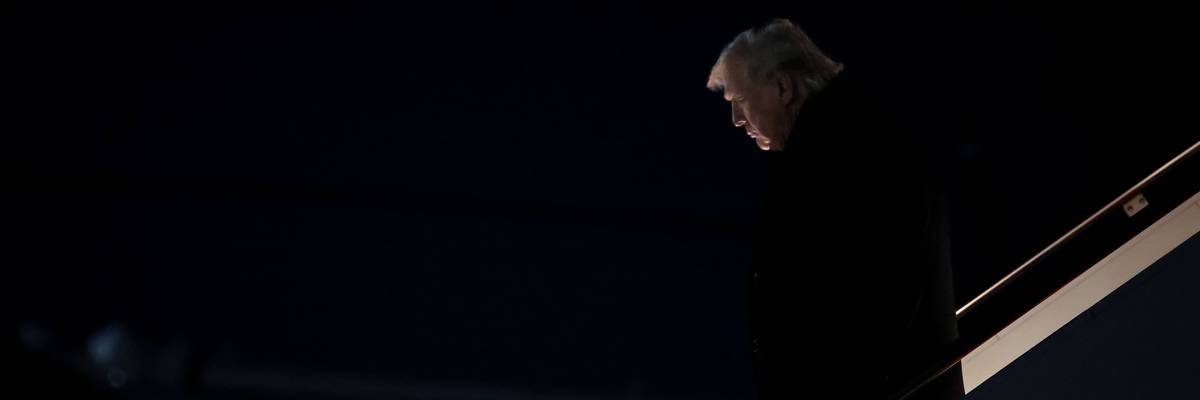
US President Donald Trump steps off of Air Force One after landing on February 9, 2026 at Joint Base Andrews, Maryland. Trump spent the weekend at his private club Mar-a-Lago in Palm Beach, Florida.
We are entering uncharted waters.
News broke this week that President Donald Trump was conditioning approval of an infrastructure spending bill on renaming New York City’s Penn Station and Washington’s Dulles Airport in his honor. It was unsurprising because there’s a disturbing pattern in Mr. Trump’s approach to governing that includes the glorification of the leader, the erasure of norms, the use of threats of retribution to stifle critics, and a reliance on “alternate facts” to keep the faithful in tow.
Because I am once again writing about President Trump, I know that some will accuse me of having what the president calls “Trump Derangement Syndrome.” I confess to being obsessed with his incendiary speech, his behavior, and the movement he has inspired, precisely because of the danger they pose to American democracy.
During Mr. Trump’s first term we dreaded turning on the news each morning and learning about the threatening tweets he had posted overnight. But because there were guardrails in place—senior staff who would slow walk his demands or simply refuse to act on them, or Congress or the courts that served as a check on his behavior—most often the threats turned out to be hollow.
As has been noted, in his second term, because the guardrails are gone, the president has become emboldened to move beyond empty words to actions which his minions faithfully attempt to execute. As a result, we are entering uncharted waters in which an imperial presidency is testing the resilience of our system of “checks and balances.”
Entering the second year of his second term in office, the pattern is clear. He employs bullying tactics to get his way—with other individuals, institutions, or countries. He “floods the zone,” disorienting opponents by daily confronting them with a barrage of new challenges. And following lessons learned from his mentor, Roy Cohn, he always attacks, never admits mistakes, and always claims victory.
In just the past few weeks, Mr. Trump has undertaken several deeply disturbing initiatives. Individually, each pose a problem, but when viewed collectively they suggest something far more ominous.
He ordered the FBI to seize the 2020 election ballots from Fulton County, Georgia, presumably because he still believes he was cheated out of victory—even though the official who controlled the Georgia balloting in 2020 was a Republican. It is unprecedented for a president to take an action of this sort and to accompany it with a statement saying:
"Remember, the states are merely an 'agent' for the Federal Government in counting and tabulating the votes…They must do what the Federal Government, as represented by the President of the United States, tells them, FOR THE GOOD OF OUR COUNTRY, to do.”
In this one statement, the president calls for violating the Constitution and the prerogative it gives states in running elections. And by equating himself with the federal government and saying that when he speaks, he does so on behalf of and for the good of the country, he is laying the groundwork for an imperial presidency.
The president also made what appears to be a spur of the moment decision to shutter the Kennedy Center for the Performing Arts. He said that the reason for closing the Center was that the building was in such disrepair that it was a danger to patrons. However, given that just a few days before the announced closure, the White House had used this very same venue to host the premiere of the documentary about his wife “Melania,” insiders suggest another reason behind the abrupt decision to shutter the Center.
Unilaterally changing the name of the Center, removing its board, and adding his supporters as board members with himself as chair has made the once-revered institution partisan and toxic. It was losing members and donors, performers were cancelling, and it was bleeding money. Rather than admit defeat, the president shut it down.
One of the president’s earliest actions was to try to bring the nation’s most prestigious universities to heel. He did so by charging them with chronic antisemitism and using “diversity quotas” in hiring and admissions. Because these two issues resonate with his base, he was determined to win. He began by withholding federal grants until universities complied with his demands to rid their campuses of antisemitism (which meant ending protests against Israel) and make admissions and hiring blind. A number of smaller schools submitted to the threats, but Harvard held out. Finally, after a year or fruitless negotiations and threats, the story came out that the White House was backing down on its threat to fine Harvard. This suggestion of defeat so enraged the president that he both denied it and announced that instead of penalizing Harvard $200 million if they didn’t agree to his demands, he was raising Harvard’s penalty to $1 billion, an example of personal peeve becoming policy.
These recent actions by the president are part of a pattern that grows more pronounced each day. He makes decisions unilaterally without regard to the Constitution or established procedure. He acts to punish those who do not submit to his dictates. And he governs as if “L’État, c’est moi.” With the support of a compliant Congress and a base of true believers, right now this president appears to be untouchable. But should he push too far or should Republicans lose control of Congress in November, the tide could turn, leaving Mr. Trump’s effort to create an “Imperial Presidency” to die on the vine.
Dear Common Dreams reader, It’s been nearly 30 years since I co-founded Common Dreams with my late wife, Lina Newhouser. We had the radical notion that journalism should serve the public good, not corporate profits. It was clear to us from the outset what it would take to build such a project. No paid advertisements. No corporate sponsors. No millionaire publisher telling us what to think or do. Many people said we wouldn't last a year, but we proved those doubters wrong. Together with a tremendous team of journalists and dedicated staff, we built an independent media outlet free from the constraints of profits and corporate control. Our mission has always been simple: To inform. To inspire. To ignite change for the common good. Building Common Dreams was not easy. Our survival was never guaranteed. When you take on the most powerful forces—Wall Street greed, fossil fuel industry destruction, Big Tech lobbyists, and uber-rich oligarchs who have spent billions upon billions rigging the economy and democracy in their favor—the only bulwark you have is supporters who believe in your work. But here’s the urgent message from me today. It's never been this bad out there. And it's never been this hard to keep us going. At the very moment Common Dreams is most needed, the threats we face are intensifying. We need your support now more than ever. We don't accept corporate advertising and never will. We don't have a paywall because we don't think people should be blocked from critical news based on their ability to pay. Everything we do is funded by the donations of readers like you. When everyone does the little they can afford, we are strong. But if that support retreats or dries up, so do we. Will you donate now to make sure Common Dreams not only survives but thrives? —Craig Brown, Co-founder |
News broke this week that President Donald Trump was conditioning approval of an infrastructure spending bill on renaming New York City’s Penn Station and Washington’s Dulles Airport in his honor. It was unsurprising because there’s a disturbing pattern in Mr. Trump’s approach to governing that includes the glorification of the leader, the erasure of norms, the use of threats of retribution to stifle critics, and a reliance on “alternate facts” to keep the faithful in tow.
Because I am once again writing about President Trump, I know that some will accuse me of having what the president calls “Trump Derangement Syndrome.” I confess to being obsessed with his incendiary speech, his behavior, and the movement he has inspired, precisely because of the danger they pose to American democracy.
During Mr. Trump’s first term we dreaded turning on the news each morning and learning about the threatening tweets he had posted overnight. But because there were guardrails in place—senior staff who would slow walk his demands or simply refuse to act on them, or Congress or the courts that served as a check on his behavior—most often the threats turned out to be hollow.
As has been noted, in his second term, because the guardrails are gone, the president has become emboldened to move beyond empty words to actions which his minions faithfully attempt to execute. As a result, we are entering uncharted waters in which an imperial presidency is testing the resilience of our system of “checks and balances.”
Entering the second year of his second term in office, the pattern is clear. He employs bullying tactics to get his way—with other individuals, institutions, or countries. He “floods the zone,” disorienting opponents by daily confronting them with a barrage of new challenges. And following lessons learned from his mentor, Roy Cohn, he always attacks, never admits mistakes, and always claims victory.
In just the past few weeks, Mr. Trump has undertaken several deeply disturbing initiatives. Individually, each pose a problem, but when viewed collectively they suggest something far more ominous.
He ordered the FBI to seize the 2020 election ballots from Fulton County, Georgia, presumably because he still believes he was cheated out of victory—even though the official who controlled the Georgia balloting in 2020 was a Republican. It is unprecedented for a president to take an action of this sort and to accompany it with a statement saying:
"Remember, the states are merely an 'agent' for the Federal Government in counting and tabulating the votes…They must do what the Federal Government, as represented by the President of the United States, tells them, FOR THE GOOD OF OUR COUNTRY, to do.”
In this one statement, the president calls for violating the Constitution and the prerogative it gives states in running elections. And by equating himself with the federal government and saying that when he speaks, he does so on behalf of and for the good of the country, he is laying the groundwork for an imperial presidency.
The president also made what appears to be a spur of the moment decision to shutter the Kennedy Center for the Performing Arts. He said that the reason for closing the Center was that the building was in such disrepair that it was a danger to patrons. However, given that just a few days before the announced closure, the White House had used this very same venue to host the premiere of the documentary about his wife “Melania,” insiders suggest another reason behind the abrupt decision to shutter the Center.
Unilaterally changing the name of the Center, removing its board, and adding his supporters as board members with himself as chair has made the once-revered institution partisan and toxic. It was losing members and donors, performers were cancelling, and it was bleeding money. Rather than admit defeat, the president shut it down.
One of the president’s earliest actions was to try to bring the nation’s most prestigious universities to heel. He did so by charging them with chronic antisemitism and using “diversity quotas” in hiring and admissions. Because these two issues resonate with his base, he was determined to win. He began by withholding federal grants until universities complied with his demands to rid their campuses of antisemitism (which meant ending protests against Israel) and make admissions and hiring blind. A number of smaller schools submitted to the threats, but Harvard held out. Finally, after a year or fruitless negotiations and threats, the story came out that the White House was backing down on its threat to fine Harvard. This suggestion of defeat so enraged the president that he both denied it and announced that instead of penalizing Harvard $200 million if they didn’t agree to his demands, he was raising Harvard’s penalty to $1 billion, an example of personal peeve becoming policy.
These recent actions by the president are part of a pattern that grows more pronounced each day. He makes decisions unilaterally without regard to the Constitution or established procedure. He acts to punish those who do not submit to his dictates. And he governs as if “L’État, c’est moi.” With the support of a compliant Congress and a base of true believers, right now this president appears to be untouchable. But should he push too far or should Republicans lose control of Congress in November, the tide could turn, leaving Mr. Trump’s effort to create an “Imperial Presidency” to die on the vine.
News broke this week that President Donald Trump was conditioning approval of an infrastructure spending bill on renaming New York City’s Penn Station and Washington’s Dulles Airport in his honor. It was unsurprising because there’s a disturbing pattern in Mr. Trump’s approach to governing that includes the glorification of the leader, the erasure of norms, the use of threats of retribution to stifle critics, and a reliance on “alternate facts” to keep the faithful in tow.
Because I am once again writing about President Trump, I know that some will accuse me of having what the president calls “Trump Derangement Syndrome.” I confess to being obsessed with his incendiary speech, his behavior, and the movement he has inspired, precisely because of the danger they pose to American democracy.
During Mr. Trump’s first term we dreaded turning on the news each morning and learning about the threatening tweets he had posted overnight. But because there were guardrails in place—senior staff who would slow walk his demands or simply refuse to act on them, or Congress or the courts that served as a check on his behavior—most often the threats turned out to be hollow.
As has been noted, in his second term, because the guardrails are gone, the president has become emboldened to move beyond empty words to actions which his minions faithfully attempt to execute. As a result, we are entering uncharted waters in which an imperial presidency is testing the resilience of our system of “checks and balances.”
Entering the second year of his second term in office, the pattern is clear. He employs bullying tactics to get his way—with other individuals, institutions, or countries. He “floods the zone,” disorienting opponents by daily confronting them with a barrage of new challenges. And following lessons learned from his mentor, Roy Cohn, he always attacks, never admits mistakes, and always claims victory.
In just the past few weeks, Mr. Trump has undertaken several deeply disturbing initiatives. Individually, each pose a problem, but when viewed collectively they suggest something far more ominous.
He ordered the FBI to seize the 2020 election ballots from Fulton County, Georgia, presumably because he still believes he was cheated out of victory—even though the official who controlled the Georgia balloting in 2020 was a Republican. It is unprecedented for a president to take an action of this sort and to accompany it with a statement saying:
"Remember, the states are merely an 'agent' for the Federal Government in counting and tabulating the votes…They must do what the Federal Government, as represented by the President of the United States, tells them, FOR THE GOOD OF OUR COUNTRY, to do.”
In this one statement, the president calls for violating the Constitution and the prerogative it gives states in running elections. And by equating himself with the federal government and saying that when he speaks, he does so on behalf of and for the good of the country, he is laying the groundwork for an imperial presidency.
The president also made what appears to be a spur of the moment decision to shutter the Kennedy Center for the Performing Arts. He said that the reason for closing the Center was that the building was in such disrepair that it was a danger to patrons. However, given that just a few days before the announced closure, the White House had used this very same venue to host the premiere of the documentary about his wife “Melania,” insiders suggest another reason behind the abrupt decision to shutter the Center.
Unilaterally changing the name of the Center, removing its board, and adding his supporters as board members with himself as chair has made the once-revered institution partisan and toxic. It was losing members and donors, performers were cancelling, and it was bleeding money. Rather than admit defeat, the president shut it down.
One of the president’s earliest actions was to try to bring the nation’s most prestigious universities to heel. He did so by charging them with chronic antisemitism and using “diversity quotas” in hiring and admissions. Because these two issues resonate with his base, he was determined to win. He began by withholding federal grants until universities complied with his demands to rid their campuses of antisemitism (which meant ending protests against Israel) and make admissions and hiring blind. A number of smaller schools submitted to the threats, but Harvard held out. Finally, after a year or fruitless negotiations and threats, the story came out that the White House was backing down on its threat to fine Harvard. This suggestion of defeat so enraged the president that he both denied it and announced that instead of penalizing Harvard $200 million if they didn’t agree to his demands, he was raising Harvard’s penalty to $1 billion, an example of personal peeve becoming policy.
These recent actions by the president are part of a pattern that grows more pronounced each day. He makes decisions unilaterally without regard to the Constitution or established procedure. He acts to punish those who do not submit to his dictates. And he governs as if “L’État, c’est moi.” With the support of a compliant Congress and a base of true believers, right now this president appears to be untouchable. But should he push too far or should Republicans lose control of Congress in November, the tide could turn, leaving Mr. Trump’s effort to create an “Imperial Presidency” to die on the vine.