
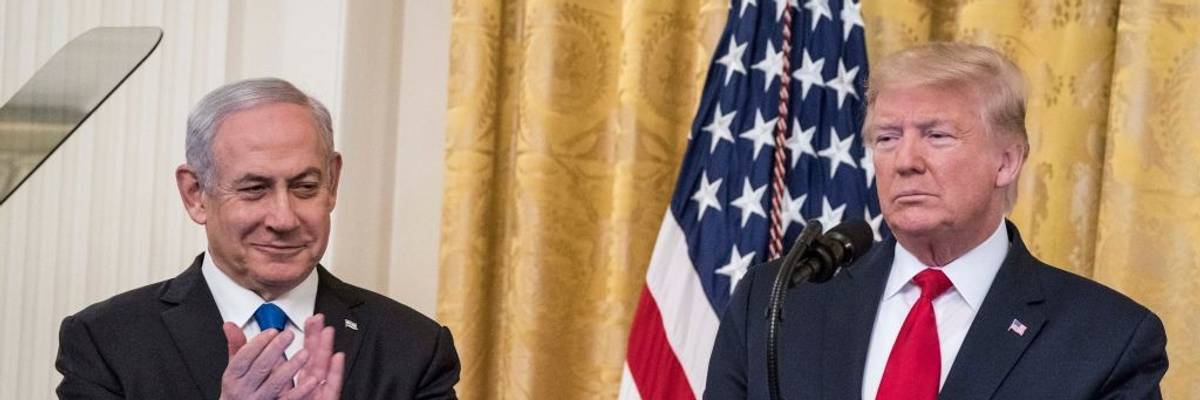
U.S. President Donald Trump and Israeli Prime Minister Benjamin Netanyahu participate in a joint statement in the East Room of the White House on January 28, 2020 in Washington, D.C.
What’s So Dangerous About Trump’s Plan for Ethnically Cleansing Gaza?
The risk is less that the U.S. would actually invade and more that Trump’s words would give Israel the green light to push Palestinians out of the West Bank or renew its offensive in Gaza.
Let’s be clear: The forced displacement of Palestinians is not a new idea. U.S. President Donald Trump’s latest proposal to take “long-term ownership” of Gaza, to “clean out” the “mess,” and to turn it into a “Riviera of the Middle East” is just the latest iteration of efforts aimed at ethnically cleansing Palestinians from their homeland.
What makes Trump’s comments dangerous is not the immediate threat of U.S. military intervention in Gaza followed by the expulsion of its 2.2 million residents. The real danger lies elsewhere.
First, Israel may interpret Trump’s words as a green light to push Palestinians out of Gaza or the West Bank. Second, the U.S. could tacitly endorse another Israeli offensive under the guise of fulfilling the president’s wishes. Third, Trump’s remarks suggest his foreign policy on Palestine will remain largely unchanged from his predecessor’s.
Trump’s so-called “humanitarian” ethnic cleansing proposal will similarly go down in history as another failed attempt, particularly as Arab and international solidarity with the steadfast Palestinian people is stronger than it has been in years.
Some Democrats have seized this moment to criticize Arab and Palestinian Americans who voted for Trump or abstained from supporting Democratic presidential nominee Kamala Harris in the last elections. However, the idea of ethnic cleansing was already being floated during the Biden administration.
While then-Secretary of State Antony Blinken reiterated that “Palestinian civilians... must not be pressed to leave Gaza,” former President Joe Biden created the conditions for displacement through unconditional military support for Israel. This allowed one of the most devastating wars in modern Middle Eastern history to unfold.
Just days into the war, on October 13, 2023, Jordan’s King Abdullah II warned Blinken in Amman against any Israeli attempt to “forcibly displace Palestinians from all Palestinian territories or cause their internal displacement.”
The latter displacement became a reality as most of northern Gaza’s population was crammed into overcrowded refugee encampments in central and southern Gaza, where conditions have been and remain inhumane for over 16 months.
At the same time, another displacement campaign is underway in the West Bank, particularly in its northern regions, accelerating in recent weeks. Thousands of Palestinian families have already been displaced in the Jenin governorate and other areas.
Despite this, the Biden administration has done little to pressure Israel to stop.
Arab concerns over Palestinian expulsion were real from the war’s outset. Almost every Arab leader raised the alarm, often repeatedly.
Egyptian President Abdel Fattah el-Sisi addressed the issue multiple times, warning of Israeli efforts—and possibly U.S. involvement—in a “population transfer” scheme.
“What is happening now in Gaza is an attempt to force civilian residents to seek refuge and migrate to Egypt,” Sisi stated, insisting that such an outcome “should not be accepted.”
Fifteen months later, under Trump, he repeated his rejection, vowing that Egypt would not participate in this “act of injustice.”
The Saudi statement was issued almost immediately after Trump doubled down on the idea during a joint press conference with Israeli Prime Minister Benjamin Netanyahu on February 4. The Saudi foreign ministry went further than rejecting Trump’s “ownership” of Gaza but articulated a political discourse that summarized Riyad’s, in fact, the Arab League’s position on Palestine.
“The Ministry of Foreign Affairs affirms that the Kingdom of Saudi Arabia’s position on the establishment of a Palestinian state is firm and unwavering,” the statement said, adding that the Kingdom “also reaffirms its unequivocal rejection of any infringement on the legitimate rights of the Palestinian people, whether through Israeli settlement policies, land annexation, or attempts to displace the Palestinian people from their land.”
The new U.S. administration, however, seems oblivious to Palestinian history. Given the mass displacement of Palestinians in 1948, no Arab government—let alone the Palestinian leadership—would support another Israeli-U.S. effort to ethnically cleanse millions into neighboring states.
Beyond the immorality of expelling an Indigenous population, history has shown that such actions destabilize the region for generations. The 1948 Nakba, which saw the ethnic cleansing of Palestine, ignited the Arab-Israeli conflict, whose repercussions continue today.
History also teaches us that the Nakba was not an isolated event. Israel has repeatedly attempted ethnic cleansing, starting with its intense attacks on Palestinian refugee camps in Gaza in the early 1950s, and ever since.
The 1967 war, known as the Naksa or “Setback,” led to the ethnic cleansing of hundreds of thousands of Palestinians, both internally and externally. In the years that followed, various U.S.-Israeli initiatives throughout the 1970s sought to relocate the Palestinian population to the Sinai desert. However, these efforts failed due to the steadfastness and collective resistance of the people of Gaza.
Trump’s so-called “humanitarian” ethnic cleansing proposal will similarly go down in history as another failed attempt, particularly as Arab and international solidarity with the steadfast Palestinian people is stronger than it has been in years.
The key question now is whether Arabs and other supporters of Palestine worldwide will go beyond merely rejecting such sinister proposals and take the initiative to push for the restoration of the Palestinian homeland. This requires a justice-based international campaign, rooted in international law and driven by the aspirations of the Palestinian people themselves.
We are at a crossroads
This country and this world are at a monumental crossroads. In a few short weeks, US voters will have an opportunity to beat back the forces of fascism and confront the billionaires who are rigging the economy, our media system, and our democracy, making it increasingly impossible for ordinary people to get by. We’re not just talking about the election. We’re talking about what must be done once these fascist elements are vanquished from power. We need a bolder set of solutions than what either major party has so far been willing to offer and a working-class movement ready to fight like hell for it. Trump didn't emerge from nowhere. The conditions that fueled MAGA authoritarianism were created by decades of radical neoliberal economic policies and a corrupt political system dominated by corporate interests. They slashed taxes on the super-rich, promising that the benefits would trickle down. They said giveaways to the corporate titans would make life more affordable for the rest of us. It was all bullshit. And when a bitter, betrayed populace searches for someone to blame, right-wing demagogues have little trouble finding scapegoats. People know when they're being lied to, but you won't hear any of this from the corporate media. Only independent journalism—powered and funded by people who believe in building a better world—can deliver truly trustworthy daily news. Our Fall Campaign is underway, and we need your help. To power our newsroom through the rest of the year, we need to raise $125,000 by midnight on October 31. So if you share our vision, please contribute whatever you can to sustain our work. |
Let’s be clear: The forced displacement of Palestinians is not a new idea. U.S. President Donald Trump’s latest proposal to take “long-term ownership” of Gaza, to “clean out” the “mess,” and to turn it into a “Riviera of the Middle East” is just the latest iteration of efforts aimed at ethnically cleansing Palestinians from their homeland.
What makes Trump’s comments dangerous is not the immediate threat of U.S. military intervention in Gaza followed by the expulsion of its 2.2 million residents. The real danger lies elsewhere.
First, Israel may interpret Trump’s words as a green light to push Palestinians out of Gaza or the West Bank. Second, the U.S. could tacitly endorse another Israeli offensive under the guise of fulfilling the president’s wishes. Third, Trump’s remarks suggest his foreign policy on Palestine will remain largely unchanged from his predecessor’s.
Trump’s so-called “humanitarian” ethnic cleansing proposal will similarly go down in history as another failed attempt, particularly as Arab and international solidarity with the steadfast Palestinian people is stronger than it has been in years.
Some Democrats have seized this moment to criticize Arab and Palestinian Americans who voted for Trump or abstained from supporting Democratic presidential nominee Kamala Harris in the last elections. However, the idea of ethnic cleansing was already being floated during the Biden administration.
While then-Secretary of State Antony Blinken reiterated that “Palestinian civilians... must not be pressed to leave Gaza,” former President Joe Biden created the conditions for displacement through unconditional military support for Israel. This allowed one of the most devastating wars in modern Middle Eastern history to unfold.
Just days into the war, on October 13, 2023, Jordan’s King Abdullah II warned Blinken in Amman against any Israeli attempt to “forcibly displace Palestinians from all Palestinian territories or cause their internal displacement.”
The latter displacement became a reality as most of northern Gaza’s population was crammed into overcrowded refugee encampments in central and southern Gaza, where conditions have been and remain inhumane for over 16 months.
At the same time, another displacement campaign is underway in the West Bank, particularly in its northern regions, accelerating in recent weeks. Thousands of Palestinian families have already been displaced in the Jenin governorate and other areas.
Despite this, the Biden administration has done little to pressure Israel to stop.
Arab concerns over Palestinian expulsion were real from the war’s outset. Almost every Arab leader raised the alarm, often repeatedly.
Egyptian President Abdel Fattah el-Sisi addressed the issue multiple times, warning of Israeli efforts—and possibly U.S. involvement—in a “population transfer” scheme.
“What is happening now in Gaza is an attempt to force civilian residents to seek refuge and migrate to Egypt,” Sisi stated, insisting that such an outcome “should not be accepted.”
Fifteen months later, under Trump, he repeated his rejection, vowing that Egypt would not participate in this “act of injustice.”
The Saudi statement was issued almost immediately after Trump doubled down on the idea during a joint press conference with Israeli Prime Minister Benjamin Netanyahu on February 4. The Saudi foreign ministry went further than rejecting Trump’s “ownership” of Gaza but articulated a political discourse that summarized Riyad’s, in fact, the Arab League’s position on Palestine.
“The Ministry of Foreign Affairs affirms that the Kingdom of Saudi Arabia’s position on the establishment of a Palestinian state is firm and unwavering,” the statement said, adding that the Kingdom “also reaffirms its unequivocal rejection of any infringement on the legitimate rights of the Palestinian people, whether through Israeli settlement policies, land annexation, or attempts to displace the Palestinian people from their land.”
The new U.S. administration, however, seems oblivious to Palestinian history. Given the mass displacement of Palestinians in 1948, no Arab government—let alone the Palestinian leadership—would support another Israeli-U.S. effort to ethnically cleanse millions into neighboring states.
Beyond the immorality of expelling an Indigenous population, history has shown that such actions destabilize the region for generations. The 1948 Nakba, which saw the ethnic cleansing of Palestine, ignited the Arab-Israeli conflict, whose repercussions continue today.
History also teaches us that the Nakba was not an isolated event. Israel has repeatedly attempted ethnic cleansing, starting with its intense attacks on Palestinian refugee camps in Gaza in the early 1950s, and ever since.
The 1967 war, known as the Naksa or “Setback,” led to the ethnic cleansing of hundreds of thousands of Palestinians, both internally and externally. In the years that followed, various U.S.-Israeli initiatives throughout the 1970s sought to relocate the Palestinian population to the Sinai desert. However, these efforts failed due to the steadfastness and collective resistance of the people of Gaza.
Trump’s so-called “humanitarian” ethnic cleansing proposal will similarly go down in history as another failed attempt, particularly as Arab and international solidarity with the steadfast Palestinian people is stronger than it has been in years.
The key question now is whether Arabs and other supporters of Palestine worldwide will go beyond merely rejecting such sinister proposals and take the initiative to push for the restoration of the Palestinian homeland. This requires a justice-based international campaign, rooted in international law and driven by the aspirations of the Palestinian people themselves.
- Shock, Awe, and Ethnic Cleansing: Trump's Policy in Gaza ›
- 100+ Groups 'Decry and Oppose' Trump Push to Ethnically Cleanse Gaza ›
- Trump’s Ethnic Cleansing of Gaza Is a Brutal Form of Colonial Capitalism ›
- Palestinians Reclaiming Their Gaza Homes Is a Profound Response to Trump's Ethnic Cleansing Threat ›
- Trump Son-in-Law Jared Kushner Calls for Ethnic Cleansing of Gaza to 'Finish the Job' ›
- 'We'll Own It': Trump Floats US Takeover of Gaza—After Ethnically Cleansing Palestinians ›
- Opinion | Who Is Ready to Die for Trump’s Gaza Plan? So Far, Nobody | Common Dreams ›
Let’s be clear: The forced displacement of Palestinians is not a new idea. U.S. President Donald Trump’s latest proposal to take “long-term ownership” of Gaza, to “clean out” the “mess,” and to turn it into a “Riviera of the Middle East” is just the latest iteration of efforts aimed at ethnically cleansing Palestinians from their homeland.
What makes Trump’s comments dangerous is not the immediate threat of U.S. military intervention in Gaza followed by the expulsion of its 2.2 million residents. The real danger lies elsewhere.
First, Israel may interpret Trump’s words as a green light to push Palestinians out of Gaza or the West Bank. Second, the U.S. could tacitly endorse another Israeli offensive under the guise of fulfilling the president’s wishes. Third, Trump’s remarks suggest his foreign policy on Palestine will remain largely unchanged from his predecessor’s.
Trump’s so-called “humanitarian” ethnic cleansing proposal will similarly go down in history as another failed attempt, particularly as Arab and international solidarity with the steadfast Palestinian people is stronger than it has been in years.
Some Democrats have seized this moment to criticize Arab and Palestinian Americans who voted for Trump or abstained from supporting Democratic presidential nominee Kamala Harris in the last elections. However, the idea of ethnic cleansing was already being floated during the Biden administration.
While then-Secretary of State Antony Blinken reiterated that “Palestinian civilians... must not be pressed to leave Gaza,” former President Joe Biden created the conditions for displacement through unconditional military support for Israel. This allowed one of the most devastating wars in modern Middle Eastern history to unfold.
Just days into the war, on October 13, 2023, Jordan’s King Abdullah II warned Blinken in Amman against any Israeli attempt to “forcibly displace Palestinians from all Palestinian territories or cause their internal displacement.”
The latter displacement became a reality as most of northern Gaza’s population was crammed into overcrowded refugee encampments in central and southern Gaza, where conditions have been and remain inhumane for over 16 months.
At the same time, another displacement campaign is underway in the West Bank, particularly in its northern regions, accelerating in recent weeks. Thousands of Palestinian families have already been displaced in the Jenin governorate and other areas.
Despite this, the Biden administration has done little to pressure Israel to stop.
Arab concerns over Palestinian expulsion were real from the war’s outset. Almost every Arab leader raised the alarm, often repeatedly.
Egyptian President Abdel Fattah el-Sisi addressed the issue multiple times, warning of Israeli efforts—and possibly U.S. involvement—in a “population transfer” scheme.
“What is happening now in Gaza is an attempt to force civilian residents to seek refuge and migrate to Egypt,” Sisi stated, insisting that such an outcome “should not be accepted.”
Fifteen months later, under Trump, he repeated his rejection, vowing that Egypt would not participate in this “act of injustice.”
The Saudi statement was issued almost immediately after Trump doubled down on the idea during a joint press conference with Israeli Prime Minister Benjamin Netanyahu on February 4. The Saudi foreign ministry went further than rejecting Trump’s “ownership” of Gaza but articulated a political discourse that summarized Riyad’s, in fact, the Arab League’s position on Palestine.
“The Ministry of Foreign Affairs affirms that the Kingdom of Saudi Arabia’s position on the establishment of a Palestinian state is firm and unwavering,” the statement said, adding that the Kingdom “also reaffirms its unequivocal rejection of any infringement on the legitimate rights of the Palestinian people, whether through Israeli settlement policies, land annexation, or attempts to displace the Palestinian people from their land.”
The new U.S. administration, however, seems oblivious to Palestinian history. Given the mass displacement of Palestinians in 1948, no Arab government—let alone the Palestinian leadership—would support another Israeli-U.S. effort to ethnically cleanse millions into neighboring states.
Beyond the immorality of expelling an Indigenous population, history has shown that such actions destabilize the region for generations. The 1948 Nakba, which saw the ethnic cleansing of Palestine, ignited the Arab-Israeli conflict, whose repercussions continue today.
History also teaches us that the Nakba was not an isolated event. Israel has repeatedly attempted ethnic cleansing, starting with its intense attacks on Palestinian refugee camps in Gaza in the early 1950s, and ever since.
The 1967 war, known as the Naksa or “Setback,” led to the ethnic cleansing of hundreds of thousands of Palestinians, both internally and externally. In the years that followed, various U.S.-Israeli initiatives throughout the 1970s sought to relocate the Palestinian population to the Sinai desert. However, these efforts failed due to the steadfastness and collective resistance of the people of Gaza.
Trump’s so-called “humanitarian” ethnic cleansing proposal will similarly go down in history as another failed attempt, particularly as Arab and international solidarity with the steadfast Palestinian people is stronger than it has been in years.
The key question now is whether Arabs and other supporters of Palestine worldwide will go beyond merely rejecting such sinister proposals and take the initiative to push for the restoration of the Palestinian homeland. This requires a justice-based international campaign, rooted in international law and driven by the aspirations of the Palestinian people themselves.
- Shock, Awe, and Ethnic Cleansing: Trump's Policy in Gaza ›
- 100+ Groups 'Decry and Oppose' Trump Push to Ethnically Cleanse Gaza ›
- Trump’s Ethnic Cleansing of Gaza Is a Brutal Form of Colonial Capitalism ›
- Palestinians Reclaiming Their Gaza Homes Is a Profound Response to Trump's Ethnic Cleansing Threat ›
- Trump Son-in-Law Jared Kushner Calls for Ethnic Cleansing of Gaza to 'Finish the Job' ›
- 'We'll Own It': Trump Floats US Takeover of Gaza—After Ethnically Cleansing Palestinians ›
- Opinion | Who Is Ready to Die for Trump’s Gaza Plan? So Far, Nobody | Common Dreams ›