SUBSCRIBE TO OUR FREE NEWSLETTER
Daily news & progressive opinion—funded by the people, not the corporations—delivered straight to your inbox.
5
#000000
#FFFFFF
To donate by check, phone, or other method, see our More Ways to Give page.
Daily news & progressive opinion—funded by the people, not the corporations—delivered straight to your inbox.
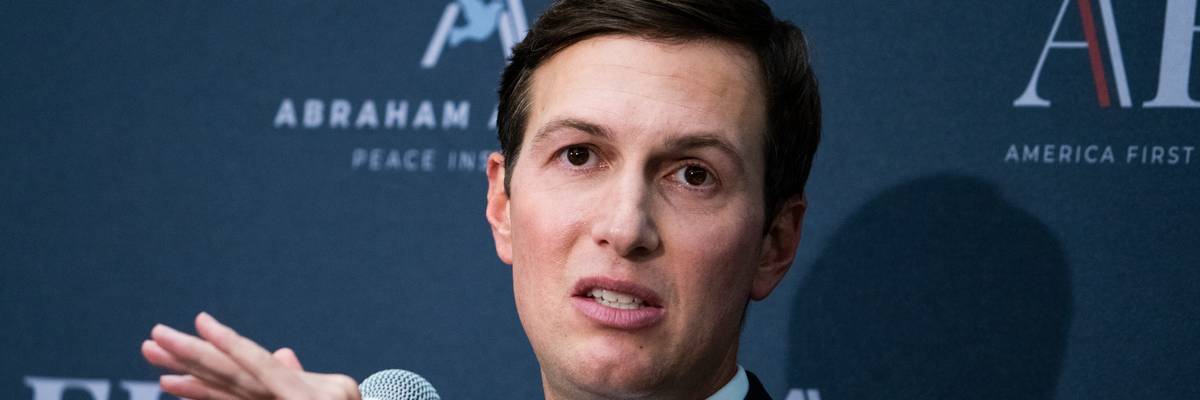
Jared Kushner, son-in-law of former President Donald Trump, participates in a discussion in Washington, D.C. on September 12, 2022.
Kushner, who served as a key Middle East adviser to Trump, said that Gaza's "waterfront property could be very valuable" and urged Israel to "clean it up."
Jared Kushner, the son-in-law of former president and presumptive 2024 Republican nominee Donald Trump, said in a recent interview that if he were in charge of Israeli policy, he would push Gaza civilians into Egypt or Israel's Negev desert—a proposal that critics denounced as ethnic cleansing.
"You want to get as many civilians out of Rafah as possible," Kushner told the faculty chair of Harvard University's Middle East Initiative, Tarek Masoud, in a March 8 interview that was first reported widely on Tuesday. "I think that you want to try to clear that out. I know that with diplomacy maybe you get them into Egypt."
"I know that that's been refused, but [with] the right diplomacy I think it would be possible," Kushner added. "But in addition to that, the thing that I would try to do if I was Israel right now is I would just bulldoze something in the Negev, I would try to move people in there. I know that won't be the popular thing to do, but I think that that's a better option to do so you can go in and finish the job."
Kushner played a central role in crafting Trump's Middle East policy during his first four years in the White House, and the former president's son-in-law's remarks provided a potential glimpse of how the U.S. would approach Gaza if Trump wins another term in November.
Earlier this month, Trump said he wants Israel to "finish the problem" in Gaza—a remark that Kushner echoed just three days later in his March 8 interview.
In addition to advocating the removal of civilians from Rafah—which is currently packed with more than 1.5 million people, including hundreds of thousands of children—Kushner said Gaza's "waterfront property could be very valuable."
"It's a little bit of an unfortunate situation there, but from Israel's perspective I would do my best to move the people out and then clean it up," Kushner said.
Just days after the @ADL’s @JGreenblattADL gave him an award for “his record of policy work,” Donald Trump’s son-in-law Jared Kushner openly advocates for the ethnic cleansing of Gaza: https://t.co/VFhidPf60W
— Dylan Williams (@dylanotes) March 19, 2024
Kushner responded flippantly to concerns that if Gazans were forced out of their territory, the Israeli government wouldn't let them return—something that top Israeli officials have publicly advocated.
"Maybe," he said, "but I'm not sure there's much left of Gaza at this point."
Kushner also claimed that Israel has gone "way more out of its way" than other countries would to protect civilians—despite the
abundance of evidence to the contrary.
Dear Common Dreams reader, It’s been nearly 30 years since I co-founded Common Dreams with my late wife, Lina Newhouser. We had the radical notion that journalism should serve the public good, not corporate profits. It was clear to us from the outset what it would take to build such a project. No paid advertisements. No corporate sponsors. No millionaire publisher telling us what to think or do. Many people said we wouldn't last a year, but we proved those doubters wrong. Together with a tremendous team of journalists and dedicated staff, we built an independent media outlet free from the constraints of profits and corporate control. Our mission has always been simple: To inform. To inspire. To ignite change for the common good. Building Common Dreams was not easy. Our survival was never guaranteed. When you take on the most powerful forces—Wall Street greed, fossil fuel industry destruction, Big Tech lobbyists, and uber-rich oligarchs who have spent billions upon billions rigging the economy and democracy in their favor—the only bulwark you have is supporters who believe in your work. But here’s the urgent message from me today. It's never been this bad out there. And it's never been this hard to keep us going. At the very moment Common Dreams is most needed, the threats we face are intensifying. We need your support now more than ever. We don't accept corporate advertising and never will. We don't have a paywall because we don't think people should be blocked from critical news based on their ability to pay. Everything we do is funded by the donations of readers like you. When everyone does the little they can afford, we are strong. But if that support retreats or dries up, so do we. Will you donate now to make sure Common Dreams not only survives but thrives? —Craig Brown, Co-founder |
Jared Kushner, the son-in-law of former president and presumptive 2024 Republican nominee Donald Trump, said in a recent interview that if he were in charge of Israeli policy, he would push Gaza civilians into Egypt or Israel's Negev desert—a proposal that critics denounced as ethnic cleansing.
"You want to get as many civilians out of Rafah as possible," Kushner told the faculty chair of Harvard University's Middle East Initiative, Tarek Masoud, in a March 8 interview that was first reported widely on Tuesday. "I think that you want to try to clear that out. I know that with diplomacy maybe you get them into Egypt."
"I know that that's been refused, but [with] the right diplomacy I think it would be possible," Kushner added. "But in addition to that, the thing that I would try to do if I was Israel right now is I would just bulldoze something in the Negev, I would try to move people in there. I know that won't be the popular thing to do, but I think that that's a better option to do so you can go in and finish the job."
Kushner played a central role in crafting Trump's Middle East policy during his first four years in the White House, and the former president's son-in-law's remarks provided a potential glimpse of how the U.S. would approach Gaza if Trump wins another term in November.
Earlier this month, Trump said he wants Israel to "finish the problem" in Gaza—a remark that Kushner echoed just three days later in his March 8 interview.
In addition to advocating the removal of civilians from Rafah—which is currently packed with more than 1.5 million people, including hundreds of thousands of children—Kushner said Gaza's "waterfront property could be very valuable."
"It's a little bit of an unfortunate situation there, but from Israel's perspective I would do my best to move the people out and then clean it up," Kushner said.
Just days after the @ADL’s @JGreenblattADL gave him an award for “his record of policy work,” Donald Trump’s son-in-law Jared Kushner openly advocates for the ethnic cleansing of Gaza: https://t.co/VFhidPf60W
— Dylan Williams (@dylanotes) March 19, 2024
Kushner responded flippantly to concerns that if Gazans were forced out of their territory, the Israeli government wouldn't let them return—something that top Israeli officials have publicly advocated.
"Maybe," he said, "but I'm not sure there's much left of Gaza at this point."
Kushner also claimed that Israel has gone "way more out of its way" than other countries would to protect civilians—despite the
abundance of evidence to the contrary.
Jared Kushner, the son-in-law of former president and presumptive 2024 Republican nominee Donald Trump, said in a recent interview that if he were in charge of Israeli policy, he would push Gaza civilians into Egypt or Israel's Negev desert—a proposal that critics denounced as ethnic cleansing.
"You want to get as many civilians out of Rafah as possible," Kushner told the faculty chair of Harvard University's Middle East Initiative, Tarek Masoud, in a March 8 interview that was first reported widely on Tuesday. "I think that you want to try to clear that out. I know that with diplomacy maybe you get them into Egypt."
"I know that that's been refused, but [with] the right diplomacy I think it would be possible," Kushner added. "But in addition to that, the thing that I would try to do if I was Israel right now is I would just bulldoze something in the Negev, I would try to move people in there. I know that won't be the popular thing to do, but I think that that's a better option to do so you can go in and finish the job."
Kushner played a central role in crafting Trump's Middle East policy during his first four years in the White House, and the former president's son-in-law's remarks provided a potential glimpse of how the U.S. would approach Gaza if Trump wins another term in November.
Earlier this month, Trump said he wants Israel to "finish the problem" in Gaza—a remark that Kushner echoed just three days later in his March 8 interview.
In addition to advocating the removal of civilians from Rafah—which is currently packed with more than 1.5 million people, including hundreds of thousands of children—Kushner said Gaza's "waterfront property could be very valuable."
"It's a little bit of an unfortunate situation there, but from Israel's perspective I would do my best to move the people out and then clean it up," Kushner said.
Just days after the @ADL’s @JGreenblattADL gave him an award for “his record of policy work,” Donald Trump’s son-in-law Jared Kushner openly advocates for the ethnic cleansing of Gaza: https://t.co/VFhidPf60W
— Dylan Williams (@dylanotes) March 19, 2024
Kushner responded flippantly to concerns that if Gazans were forced out of their territory, the Israeli government wouldn't let them return—something that top Israeli officials have publicly advocated.
"Maybe," he said, "but I'm not sure there's much left of Gaza at this point."
Kushner also claimed that Israel has gone "way more out of its way" than other countries would to protect civilians—despite the
abundance of evidence to the contrary.