SUBSCRIBE TO OUR FREE NEWSLETTER
Daily news & progressive opinion—funded by the people, not the corporations—delivered straight to your inbox.
5
#000000
#FFFFFF
To donate by check, phone, or other method, see our More Ways to Give page.
Daily news & progressive opinion—funded by the people, not the corporations—delivered straight to your inbox.
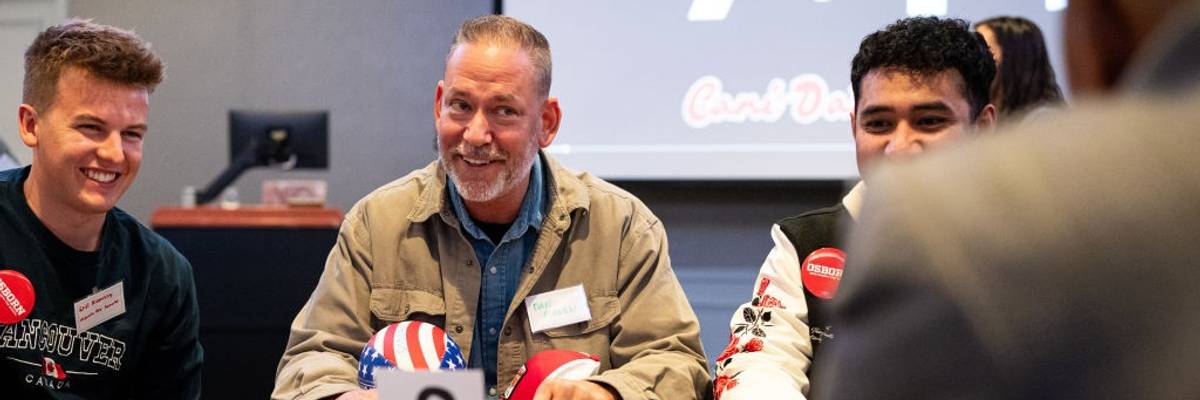
Independent Senate candidate Dan Osborn, challenger to Sen. Deb Fischer, R-Neb., speaks with students during the candidate forum at the UNO (University of Nebraska Omaha) candidate forum in Omaha, Neb., on Tuesday, October 15, 2024.
The sad truth is that in 130 congressional districts there is, in reality, only one party, and the Democrats lose by 25 percent or more time after time, that is, if they even run a candidate at all.
When you write a book called The Billionaires Have Two Parties, We Need a Party of Our Own: How Working People Can Build Independent Political Power, you provoke a lot of angst in some of your readers. More than a few are still haunted by the memory of Ralph Nader and his quixotic 2000 presidential campaign, good fun until, as many believe, he took the election away from Al Gore, the Democrat, and gave it to George W. Bush, the Republican.
Spoiler, spoiler, spoiler echoes in their minds as this year’s make-or-break November elections approach. Won’t talk of third parties encourage defections from the Democrats and risk helping MAGA? Better, it is thought by the worriers, to bury all such discussion.
Even my friend Bob Kuttner, the astute political commentator, knocks me down with the age-old observation that the “American constitutional system, with its lack of proportional representation for minor parties, makes it almost impossible for new parties to gain a lasting foothold.”
That’s certainly the case when the focus is on presidential races. The story, however, is entirely different at the state and local level, where independent third parties have won thousands of offices and have helped to reshape America. The Populists did it in the 1880s and 1890s, the Socialist Party did it in the early 20th century, and the Minnesota Farm-Labor Party did it in the 1920s. These third parties led the charge to stop child labor, legalize labor unions, and rein in the corporate robber barons. They, not the Democrats, constructed the foundation of the New Deal that elevated the lives of working people.
I would like third party skeptics to take a four-step cure:
Step one: Close your eyes and recall what happens on just about every election night. What do you see about five seconds after the polls close? Half the voting districts in the country flash red. They are immediately lost to the Democrats again and again and again. The sad truth is that in 130 congressional districts there is, in reality, only one party, and the Democrats lose by 25 percent or more time after time, that is, if they even run a candidate at all.
Step two: Admit that in those districts the Democratic Party is ineffectual and therefore the spoiler issue isn’t an issue. Repeat once a day: The spoiler problem does not exist in the 130 congressional districts that the Democrats lose by 25 percent or more.
Step three: Take a strong dose of Dan Osborn, the working-class candidate who is running for Senate in Nebraska as an independent and is doing better than any Democrat has done in decades. Why? In deep red America the Democratic brand is poison, but progressive populism can take hold and grow when contested by independent working-class candidates. Run as a Democrat and you’re defeated before you start.
Step four: Think more carefully about what works. While progressive groups like the Working Families Party do admirable work reforming the Democrats in blue and purple districts, their identity as progressive Democrats makes it almost impossible for them to have any impact in red America. (See Chapter 6 of my book.)
I hope that these four steps make it easier for the worriers to hear the central argument of my book:
Working people are alienated from the Democratic Party and need a political home of their own, especially in red America.
We need to understand the causes of that alienation and how a new political home can be built outside the two major parties without becoming a spoiler in any shape or form.
It’s time to put aside the spoiler canard. In fact, it’s time to get used to the fact that more and more independents are running in red America, attacking both billionaire parties. The Democrats, not the independents, are becoming the new spoilers as they realize that they are now the third party. (See Montana right now.)
You may find other points of contention in my new book, and I’m happy to talk about them all, but the third-party spoiler problem isn’t one of them. Take a look and decide for yourself.
Dear Common Dreams reader, It’s been nearly 30 years since I co-founded Common Dreams with my late wife, Lina Newhouser. We had the radical notion that journalism should serve the public good, not corporate profits. It was clear to us from the outset what it would take to build such a project. No paid advertisements. No corporate sponsors. No millionaire publisher telling us what to think or do. Many people said we wouldn't last a year, but we proved those doubters wrong. Together with a tremendous team of journalists and dedicated staff, we built an independent media outlet free from the constraints of profits and corporate control. Our mission has always been simple: To inform. To inspire. To ignite change for the common good. Building Common Dreams was not easy. Our survival was never guaranteed. When you take on the most powerful forces—Wall Street greed, fossil fuel industry destruction, Big Tech lobbyists, and uber-rich oligarchs who have spent billions upon billions rigging the economy and democracy in their favor—the only bulwark you have is supporters who believe in your work. But here’s the urgent message from me today. It's never been this bad out there. And it's never been this hard to keep us going. At the very moment Common Dreams is most needed, the threats we face are intensifying. We need your support now more than ever. We don't accept corporate advertising and never will. We don't have a paywall because we don't think people should be blocked from critical news based on their ability to pay. Everything we do is funded by the donations of readers like you. When everyone does the little they can afford, we are strong. But if that support retreats or dries up, so do we. Will you donate now to make sure Common Dreams not only survives but thrives? —Craig Brown, Co-founder |
Les Leopold is the executive director of the Labor Institute and author of the new book, “The Billionaires Have Two Parties, We Need a Party of Our Own” (2026). His previous books include: “Wall Street’s War on Workers: How Mass Layoffs and Greed Are Destroying the Working Class and What to Do About It" (2024); "Runaway Inequality: An Activist's Guide to Economic Justice" (2015); and “The Man Who Hated Work and Loved Labor: The Life and Times of Tony Mazzocchi” (2007). Read more of his work on his substack here.
When you write a book called The Billionaires Have Two Parties, We Need a Party of Our Own: How Working People Can Build Independent Political Power, you provoke a lot of angst in some of your readers. More than a few are still haunted by the memory of Ralph Nader and his quixotic 2000 presidential campaign, good fun until, as many believe, he took the election away from Al Gore, the Democrat, and gave it to George W. Bush, the Republican.
Spoiler, spoiler, spoiler echoes in their minds as this year’s make-or-break November elections approach. Won’t talk of third parties encourage defections from the Democrats and risk helping MAGA? Better, it is thought by the worriers, to bury all such discussion.
Even my friend Bob Kuttner, the astute political commentator, knocks me down with the age-old observation that the “American constitutional system, with its lack of proportional representation for minor parties, makes it almost impossible for new parties to gain a lasting foothold.”
That’s certainly the case when the focus is on presidential races. The story, however, is entirely different at the state and local level, where independent third parties have won thousands of offices and have helped to reshape America. The Populists did it in the 1880s and 1890s, the Socialist Party did it in the early 20th century, and the Minnesota Farm-Labor Party did it in the 1920s. These third parties led the charge to stop child labor, legalize labor unions, and rein in the corporate robber barons. They, not the Democrats, constructed the foundation of the New Deal that elevated the lives of working people.
I would like third party skeptics to take a four-step cure:
Step one: Close your eyes and recall what happens on just about every election night. What do you see about five seconds after the polls close? Half the voting districts in the country flash red. They are immediately lost to the Democrats again and again and again. The sad truth is that in 130 congressional districts there is, in reality, only one party, and the Democrats lose by 25 percent or more time after time, that is, if they even run a candidate at all.
Step two: Admit that in those districts the Democratic Party is ineffectual and therefore the spoiler issue isn’t an issue. Repeat once a day: The spoiler problem does not exist in the 130 congressional districts that the Democrats lose by 25 percent or more.
Step three: Take a strong dose of Dan Osborn, the working-class candidate who is running for Senate in Nebraska as an independent and is doing better than any Democrat has done in decades. Why? In deep red America the Democratic brand is poison, but progressive populism can take hold and grow when contested by independent working-class candidates. Run as a Democrat and you’re defeated before you start.
Step four: Think more carefully about what works. While progressive groups like the Working Families Party do admirable work reforming the Democrats in blue and purple districts, their identity as progressive Democrats makes it almost impossible for them to have any impact in red America. (See Chapter 6 of my book.)
I hope that these four steps make it easier for the worriers to hear the central argument of my book:
Working people are alienated from the Democratic Party and need a political home of their own, especially in red America.
We need to understand the causes of that alienation and how a new political home can be built outside the two major parties without becoming a spoiler in any shape or form.
It’s time to put aside the spoiler canard. In fact, it’s time to get used to the fact that more and more independents are running in red America, attacking both billionaire parties. The Democrats, not the independents, are becoming the new spoilers as they realize that they are now the third party. (See Montana right now.)
You may find other points of contention in my new book, and I’m happy to talk about them all, but the third-party spoiler problem isn’t one of them. Take a look and decide for yourself.
Les Leopold is the executive director of the Labor Institute and author of the new book, “The Billionaires Have Two Parties, We Need a Party of Our Own” (2026). His previous books include: “Wall Street’s War on Workers: How Mass Layoffs and Greed Are Destroying the Working Class and What to Do About It" (2024); "Runaway Inequality: An Activist's Guide to Economic Justice" (2015); and “The Man Who Hated Work and Loved Labor: The Life and Times of Tony Mazzocchi” (2007). Read more of his work on his substack here.
When you write a book called The Billionaires Have Two Parties, We Need a Party of Our Own: How Working People Can Build Independent Political Power, you provoke a lot of angst in some of your readers. More than a few are still haunted by the memory of Ralph Nader and his quixotic 2000 presidential campaign, good fun until, as many believe, he took the election away from Al Gore, the Democrat, and gave it to George W. Bush, the Republican.
Spoiler, spoiler, spoiler echoes in their minds as this year’s make-or-break November elections approach. Won’t talk of third parties encourage defections from the Democrats and risk helping MAGA? Better, it is thought by the worriers, to bury all such discussion.
Even my friend Bob Kuttner, the astute political commentator, knocks me down with the age-old observation that the “American constitutional system, with its lack of proportional representation for minor parties, makes it almost impossible for new parties to gain a lasting foothold.”
That’s certainly the case when the focus is on presidential races. The story, however, is entirely different at the state and local level, where independent third parties have won thousands of offices and have helped to reshape America. The Populists did it in the 1880s and 1890s, the Socialist Party did it in the early 20th century, and the Minnesota Farm-Labor Party did it in the 1920s. These third parties led the charge to stop child labor, legalize labor unions, and rein in the corporate robber barons. They, not the Democrats, constructed the foundation of the New Deal that elevated the lives of working people.
I would like third party skeptics to take a four-step cure:
Step one: Close your eyes and recall what happens on just about every election night. What do you see about five seconds after the polls close? Half the voting districts in the country flash red. They are immediately lost to the Democrats again and again and again. The sad truth is that in 130 congressional districts there is, in reality, only one party, and the Democrats lose by 25 percent or more time after time, that is, if they even run a candidate at all.
Step two: Admit that in those districts the Democratic Party is ineffectual and therefore the spoiler issue isn’t an issue. Repeat once a day: The spoiler problem does not exist in the 130 congressional districts that the Democrats lose by 25 percent or more.
Step three: Take a strong dose of Dan Osborn, the working-class candidate who is running for Senate in Nebraska as an independent and is doing better than any Democrat has done in decades. Why? In deep red America the Democratic brand is poison, but progressive populism can take hold and grow when contested by independent working-class candidates. Run as a Democrat and you’re defeated before you start.
Step four: Think more carefully about what works. While progressive groups like the Working Families Party do admirable work reforming the Democrats in blue and purple districts, their identity as progressive Democrats makes it almost impossible for them to have any impact in red America. (See Chapter 6 of my book.)
I hope that these four steps make it easier for the worriers to hear the central argument of my book:
Working people are alienated from the Democratic Party and need a political home of their own, especially in red America.
We need to understand the causes of that alienation and how a new political home can be built outside the two major parties without becoming a spoiler in any shape or form.
It’s time to put aside the spoiler canard. In fact, it’s time to get used to the fact that more and more independents are running in red America, attacking both billionaire parties. The Democrats, not the independents, are becoming the new spoilers as they realize that they are now the third party. (See Montana right now.)
You may find other points of contention in my new book, and I’m happy to talk about them all, but the third-party spoiler problem isn’t one of them. Take a look and decide for yourself.