SUBSCRIBE TO OUR FREE NEWSLETTER
Daily news & progressive opinion—funded by the people, not the corporations—delivered straight to your inbox.
5
#000000
#FFFFFF
To donate by check, phone, or other method, see our More Ways to Give page.
Daily news & progressive opinion—funded by the people, not the corporations—delivered straight to your inbox.
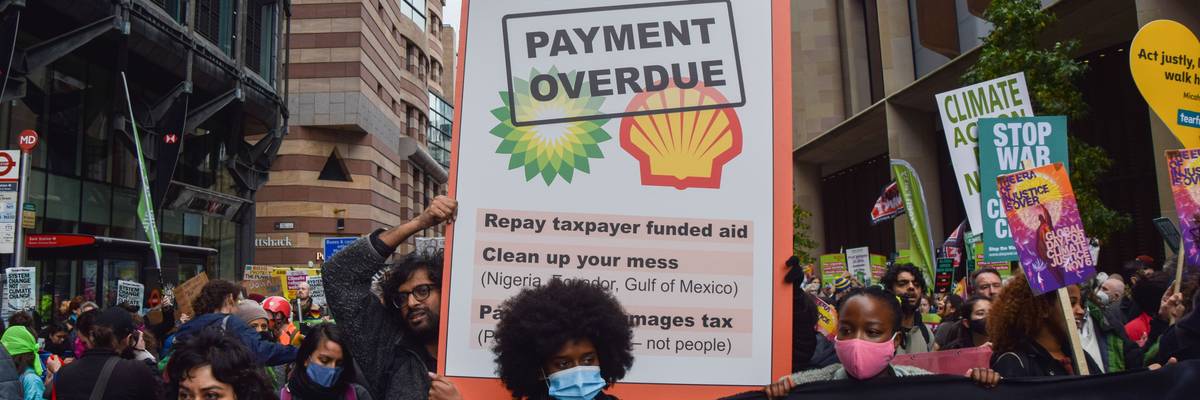
A protester holds a placard demanding that fossil fuel companies BP and Shell repay taxpayer-funded aid during a protest in London on November 6, 2021.
Fossil fuel companies must be made to pay for both the damage they cause and the pathway out of the climate crisis.
As international oil companies’ announcements of their annual profits roll in, executives may already be looking back fondly at 2023 while planning their next private-island holiday or real estate purchase. Yet for billions of us, one of the most lucrative years on record for oil and gas companies will be remembered as the hottest year on record, punctuated by extreme weather events and the ever-spiraling cost of living.
Growing up between two countries, Senegal and the Gambia, I did not need to be an activist or climate scientist to have first-hand knowledge of these crises. Detrimental impacts are felt in all sectors of these countries’ economies, with irregular rains causing farmers indescribable anguish as they lose their livestock and as grasslands turn into drylands. The climate crisis is a leading driver of desertification—a rapidly growing threat to water and food sovereignty—which pushes proud and self-sustaining communities into poverty. As a last resort, some are even pushed out of their homes and consider migration, risking their lives and adding to social and political tensions both at home and abroad.
The answer to climate change-fueled extreme weather events is two-fold: Avoid further emissions of planet-heating gases and invest in local solutions. The annual profits of just six major oil and gas companies—BP, Chevron, Equinor, Exxonmobil, Shell, and Total—which together scooped up almost $140 billion, are made from our collective loss. Not only does their business cause destructive climate change, but their profits do little to address these impacts. These companies must be made to pay for both the damage they cause and the pathway out of the climate crisis.
We must mark a turning point in expectations from the world’s largest polluting sectors, not least the fossil fuel industry, to pay towards the costs of climate action in developing countries.
Is it right for just a single company to earn off pollution in one year as much as it would cost for Senegal to address land degradation impacts for decades, not to mention a host of other climate disasters? Anyone who isn’t getting to line their pockets will say no. Despite the “economic wins” of these international oil companies, there is another more critical story to tell. Ordinary people everywhere are being penalized for the financial gains of oil and gas and their backers—from soaring energy bills to climate-related loss and damage. Their profits are our loss.
The oil and gas industry’s cumulative profits for 2023 far exceed the economic cost of weather and climate events for the same year, and payouts are similarly expected to crush record levels as just the six companies mentioned above have already distributed over $127 billion to their shareholders. This surpasses a global goal of $100 billion in climate finance to which rich governments have committed. Some of these costs—like the loss of loved ones, memories, cultural assets, connection to home, and ancestral ties that bind communities together—cannot be measured.
Polluters will never voluntarily stop drilling and start paying for the energy transition and the climate impacts they have caused. The fossil fuel industry knew of its climate impacts for decades, but has deliberately hidden or ignored the truth, discredited scientific evidence, and has broken countless laws in pursuit of its dirty business and enormous profits. Furthermore, the industry’s profits are overwhelmingly invested in new fossil fuel projects and in maximizing shareholder profits, instead of a shift to renewable energy sources.
Governments must step up to provide accountability and deliver justice. They need to help communities around the globe and deliver a rapid and just phaseout of all fossil fuels, as well as levy taxes on the fossil fuel industry for the costs associated with surviving the climate crisis. As a start, introducing a permanent excess profits tax on oil and gas producers and redirecting subsidies could generate substantial finance for climate action.
Both the oil and gas giants and the climate crisis that they’ve caused are global. Our solutions should be, too. Global events such as COP29 must also deliver an ambitious needs-based global finance goal supported by rich countries, going beyond the previous $100 billion goal. We must mark a turning point in expectations from the world’s largest polluting sectors, not least the fossil fuel industry, to pay towards the costs of climate action in developing countries.
In 2023, hundreds of thousands of people took action worldwide—from Nairobi to Norway, from the Philippines to New York—and called for a fast and fair fossil fuel phaseout. 2024 will be the year when the oil and gas industry starts losing and we all start winning, and the climate movement intends to be there to stand with those most impacted.
Dear Common Dreams reader, It’s been nearly 30 years since I co-founded Common Dreams with my late wife, Lina Newhouser. We had the radical notion that journalism should serve the public good, not corporate profits. It was clear to us from the outset what it would take to build such a project. No paid advertisements. No corporate sponsors. No millionaire publisher telling us what to think or do. Many people said we wouldn't last a year, but we proved those doubters wrong. Together with a tremendous team of journalists and dedicated staff, we built an independent media outlet free from the constraints of profits and corporate control. Our mission has always been simple: To inform. To inspire. To ignite change for the common good. Building Common Dreams was not easy. Our survival was never guaranteed. When you take on the most powerful forces—Wall Street greed, fossil fuel industry destruction, Big Tech lobbyists, and uber-rich oligarchs who have spent billions upon billions rigging the economy and democracy in their favor—the only bulwark you have is supporters who believe in your work. But here’s the urgent message from me today. It's never been this bad out there. And it's never been this hard to keep us going. At the very moment Common Dreams is most needed, the threats we face are intensifying. We need your support now more than ever. We don't accept corporate advertising and never will. We don't have a paywall because we don't think people should be blocked from critical news based on their ability to pay. Everything we do is funded by the donations of readers like you. When everyone does the little they can afford, we are strong. But if that support retreats or dries up, so do we. Will you donate now to make sure Common Dreams not only survives but thrives? —Craig Brown, Co-founder |
As international oil companies’ announcements of their annual profits roll in, executives may already be looking back fondly at 2023 while planning their next private-island holiday or real estate purchase. Yet for billions of us, one of the most lucrative years on record for oil and gas companies will be remembered as the hottest year on record, punctuated by extreme weather events and the ever-spiraling cost of living.
Growing up between two countries, Senegal and the Gambia, I did not need to be an activist or climate scientist to have first-hand knowledge of these crises. Detrimental impacts are felt in all sectors of these countries’ economies, with irregular rains causing farmers indescribable anguish as they lose their livestock and as grasslands turn into drylands. The climate crisis is a leading driver of desertification—a rapidly growing threat to water and food sovereignty—which pushes proud and self-sustaining communities into poverty. As a last resort, some are even pushed out of their homes and consider migration, risking their lives and adding to social and political tensions both at home and abroad.
The answer to climate change-fueled extreme weather events is two-fold: Avoid further emissions of planet-heating gases and invest in local solutions. The annual profits of just six major oil and gas companies—BP, Chevron, Equinor, Exxonmobil, Shell, and Total—which together scooped up almost $140 billion, are made from our collective loss. Not only does their business cause destructive climate change, but their profits do little to address these impacts. These companies must be made to pay for both the damage they cause and the pathway out of the climate crisis.
We must mark a turning point in expectations from the world’s largest polluting sectors, not least the fossil fuel industry, to pay towards the costs of climate action in developing countries.
Is it right for just a single company to earn off pollution in one year as much as it would cost for Senegal to address land degradation impacts for decades, not to mention a host of other climate disasters? Anyone who isn’t getting to line their pockets will say no. Despite the “economic wins” of these international oil companies, there is another more critical story to tell. Ordinary people everywhere are being penalized for the financial gains of oil and gas and their backers—from soaring energy bills to climate-related loss and damage. Their profits are our loss.
The oil and gas industry’s cumulative profits for 2023 far exceed the economic cost of weather and climate events for the same year, and payouts are similarly expected to crush record levels as just the six companies mentioned above have already distributed over $127 billion to their shareholders. This surpasses a global goal of $100 billion in climate finance to which rich governments have committed. Some of these costs—like the loss of loved ones, memories, cultural assets, connection to home, and ancestral ties that bind communities together—cannot be measured.
Polluters will never voluntarily stop drilling and start paying for the energy transition and the climate impacts they have caused. The fossil fuel industry knew of its climate impacts for decades, but has deliberately hidden or ignored the truth, discredited scientific evidence, and has broken countless laws in pursuit of its dirty business and enormous profits. Furthermore, the industry’s profits are overwhelmingly invested in new fossil fuel projects and in maximizing shareholder profits, instead of a shift to renewable energy sources.
Governments must step up to provide accountability and deliver justice. They need to help communities around the globe and deliver a rapid and just phaseout of all fossil fuels, as well as levy taxes on the fossil fuel industry for the costs associated with surviving the climate crisis. As a start, introducing a permanent excess profits tax on oil and gas producers and redirecting subsidies could generate substantial finance for climate action.
Both the oil and gas giants and the climate crisis that they’ve caused are global. Our solutions should be, too. Global events such as COP29 must also deliver an ambitious needs-based global finance goal supported by rich countries, going beyond the previous $100 billion goal. We must mark a turning point in expectations from the world’s largest polluting sectors, not least the fossil fuel industry, to pay towards the costs of climate action in developing countries.
In 2023, hundreds of thousands of people took action worldwide—from Nairobi to Norway, from the Philippines to New York—and called for a fast and fair fossil fuel phaseout. 2024 will be the year when the oil and gas industry starts losing and we all start winning, and the climate movement intends to be there to stand with those most impacted.
As international oil companies’ announcements of their annual profits roll in, executives may already be looking back fondly at 2023 while planning their next private-island holiday or real estate purchase. Yet for billions of us, one of the most lucrative years on record for oil and gas companies will be remembered as the hottest year on record, punctuated by extreme weather events and the ever-spiraling cost of living.
Growing up between two countries, Senegal and the Gambia, I did not need to be an activist or climate scientist to have first-hand knowledge of these crises. Detrimental impacts are felt in all sectors of these countries’ economies, with irregular rains causing farmers indescribable anguish as they lose their livestock and as grasslands turn into drylands. The climate crisis is a leading driver of desertification—a rapidly growing threat to water and food sovereignty—which pushes proud and self-sustaining communities into poverty. As a last resort, some are even pushed out of their homes and consider migration, risking their lives and adding to social and political tensions both at home and abroad.
The answer to climate change-fueled extreme weather events is two-fold: Avoid further emissions of planet-heating gases and invest in local solutions. The annual profits of just six major oil and gas companies—BP, Chevron, Equinor, Exxonmobil, Shell, and Total—which together scooped up almost $140 billion, are made from our collective loss. Not only does their business cause destructive climate change, but their profits do little to address these impacts. These companies must be made to pay for both the damage they cause and the pathway out of the climate crisis.
We must mark a turning point in expectations from the world’s largest polluting sectors, not least the fossil fuel industry, to pay towards the costs of climate action in developing countries.
Is it right for just a single company to earn off pollution in one year as much as it would cost for Senegal to address land degradation impacts for decades, not to mention a host of other climate disasters? Anyone who isn’t getting to line their pockets will say no. Despite the “economic wins” of these international oil companies, there is another more critical story to tell. Ordinary people everywhere are being penalized for the financial gains of oil and gas and their backers—from soaring energy bills to climate-related loss and damage. Their profits are our loss.
The oil and gas industry’s cumulative profits for 2023 far exceed the economic cost of weather and climate events for the same year, and payouts are similarly expected to crush record levels as just the six companies mentioned above have already distributed over $127 billion to their shareholders. This surpasses a global goal of $100 billion in climate finance to which rich governments have committed. Some of these costs—like the loss of loved ones, memories, cultural assets, connection to home, and ancestral ties that bind communities together—cannot be measured.
Polluters will never voluntarily stop drilling and start paying for the energy transition and the climate impacts they have caused. The fossil fuel industry knew of its climate impacts for decades, but has deliberately hidden or ignored the truth, discredited scientific evidence, and has broken countless laws in pursuit of its dirty business and enormous profits. Furthermore, the industry’s profits are overwhelmingly invested in new fossil fuel projects and in maximizing shareholder profits, instead of a shift to renewable energy sources.
Governments must step up to provide accountability and deliver justice. They need to help communities around the globe and deliver a rapid and just phaseout of all fossil fuels, as well as levy taxes on the fossil fuel industry for the costs associated with surviving the climate crisis. As a start, introducing a permanent excess profits tax on oil and gas producers and redirecting subsidies could generate substantial finance for climate action.
Both the oil and gas giants and the climate crisis that they’ve caused are global. Our solutions should be, too. Global events such as COP29 must also deliver an ambitious needs-based global finance goal supported by rich countries, going beyond the previous $100 billion goal. We must mark a turning point in expectations from the world’s largest polluting sectors, not least the fossil fuel industry, to pay towards the costs of climate action in developing countries.
In 2023, hundreds of thousands of people took action worldwide—from Nairobi to Norway, from the Philippines to New York—and called for a fast and fair fossil fuel phaseout. 2024 will be the year when the oil and gas industry starts losing and we all start winning, and the climate movement intends to be there to stand with those most impacted.