

SUBSCRIBE TO OUR FREE NEWSLETTER
Daily news & progressive opinion—funded by the people, not the corporations—delivered straight to your inbox.
5
#000000
#FFFFFF
To donate by check, phone, or other method, see our More Ways to Give page.
Daily news & progressive opinion—funded by the people, not the corporations—delivered straight to your inbox.
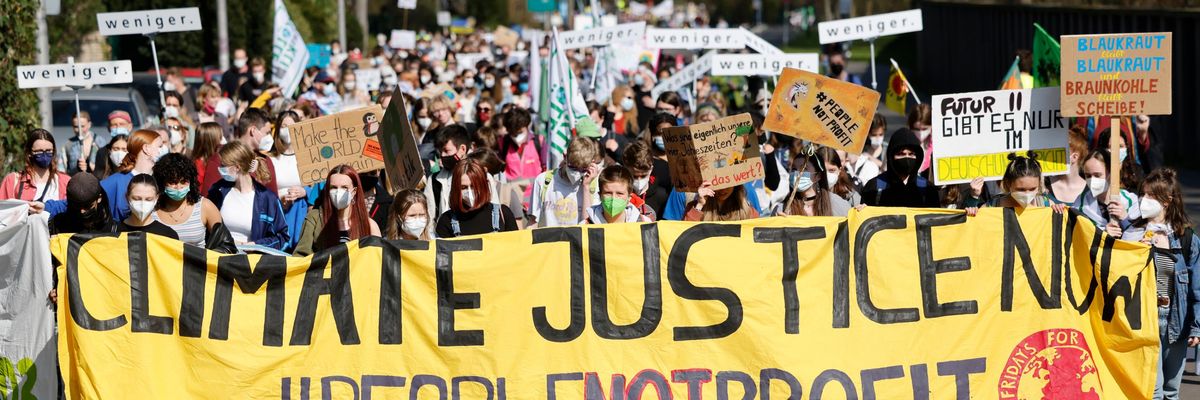
Participants in the Fridays For Future climate strike march in Cologne, Germany on March 25, 2022. (Photo: Thomas Banneyer/picture alliance via Getty Images)
From Dhaka, Bangladesh to Turin, Italy and beyond, youth climate strikers took to the streets across the globe Friday to demand that political leaders stop ignoring the scientific community's deafening alarm bells and take action to slash carbon emissions before it's too late.
"The current system is widening the inequality gap--it has no place in our society."
Organized by the international Fridays For Future movement, the latest mass demonstrations stressed that worsening global class inequities and the climate emergency are deeply intertwined and must be tackled together--a message encapsulated in strikers' rallying cry of "People Not Profit."
"We live in a broken system, one where the richest 1% of the world population are responsible for more than twice the pollution as the poorest 50%," Iris Zhan, campaign coordinator for Fridays For Future Digital, said in a statement. "That's why we strike today to demand climate reparations to kickstart a transformative justice process in which political power returns to the people."
As Fridays For Future organizers put it in their preview of the new global strikes, "Climate struggle is class struggle."
On top of the in-person demonstrations worldwide, youth climate leaders on Friday also launched online campaigns urging ordinary people and political leaders to take three actions:
"The wealthier countries that have had the greatest impact on climate change need to provide the necessary funding and aid," Chukwama Paul, communications lead for the Loss and Damage Youth Coalition, said Friday. "The estimated cost of loss and damage in developing countries will be 290 USD and 580 USD billion per year by 2030 and the current financial commitment to support developing countries is 100 billion USD annually."
"We are amplifying the need for the redistribution of wealth to help victims of loss and damage," said Paul.
The worldwide strikes come nearly a month after the Intergovernmental Panel on Climate Change (IPCC) released its latest report warning that the continued burning of fossil fuels is driving a "dangerous and widespread disruption in nature," doing "irreversible" damage to marine and coastal ecosystems, and threatening the prospect of a livable planet for future generations.
"The facts are undeniable. This abdication of leadership is criminal," United Nations Secretary-General Antonio Guterres said in response to the report. "The world's biggest polluters are guilty of arson of our only home."
A separate analysis published earlier this week by the United Kingdom-based Tyndall Centre for Climate Change Research estimated that rich countries must cut off their oil and gas production entirely by 2034 to give the world a 50% chance of limiting warming to 1.5degC by the end of the century.
The report emphasized that "an equitable transition will require wealthy high-emitting nations make substantial and ongoing financial transfers to poorer nations to facilitate their low-carbon development, against a backdrop of dangerous and increasing climate impacts."
Farzana Faruk Jhumu, a climate activist with Fridays for Future in Bangladesh, wrote in an op-ed Friday that young people across the globe "are asking world leaders to put #PeopleNotProfit at the center of the planet's future."
"Bangladesh, where I am from, contributes to only 0.21% of global carbon emissions, but we are facing cyclones, floods, and droughts every year caused by global warming," Jhumu continued. "To ensure justice for the Global South, world leaders must understand their responsibility. The current system is widening the inequality gap--it has no place in our society."
Dear Common Dreams reader, It’s been nearly 30 years since I co-founded Common Dreams with my late wife, Lina Newhouser. We had the radical notion that journalism should serve the public good, not corporate profits. It was clear to us from the outset what it would take to build such a project. No paid advertisements. No corporate sponsors. No millionaire publisher telling us what to think or do. Many people said we wouldn't last a year, but we proved those doubters wrong. Together with a tremendous team of journalists and dedicated staff, we built an independent media outlet free from the constraints of profits and corporate control. Our mission has always been simple: To inform. To inspire. To ignite change for the common good. Building Common Dreams was not easy. Our survival was never guaranteed. When you take on the most powerful forces—Wall Street greed, fossil fuel industry destruction, Big Tech lobbyists, and uber-rich oligarchs who have spent billions upon billions rigging the economy and democracy in their favor—the only bulwark you have is supporters who believe in your work. But here’s the urgent message from me today. It's never been this bad out there. And it's never been this hard to keep us going. At the very moment Common Dreams is most needed, the threats we face are intensifying. We need your support now more than ever. We don't accept corporate advertising and never will. We don't have a paywall because we don't think people should be blocked from critical news based on their ability to pay. Everything we do is funded by the donations of readers like you. When everyone does the little they can afford, we are strong. But if that support retreats or dries up, so do we. Will you donate now to make sure Common Dreams not only survives but thrives? —Craig Brown, Co-founder |
From Dhaka, Bangladesh to Turin, Italy and beyond, youth climate strikers took to the streets across the globe Friday to demand that political leaders stop ignoring the scientific community's deafening alarm bells and take action to slash carbon emissions before it's too late.
"The current system is widening the inequality gap--it has no place in our society."
Organized by the international Fridays For Future movement, the latest mass demonstrations stressed that worsening global class inequities and the climate emergency are deeply intertwined and must be tackled together--a message encapsulated in strikers' rallying cry of "People Not Profit."
"We live in a broken system, one where the richest 1% of the world population are responsible for more than twice the pollution as the poorest 50%," Iris Zhan, campaign coordinator for Fridays For Future Digital, said in a statement. "That's why we strike today to demand climate reparations to kickstart a transformative justice process in which political power returns to the people."
As Fridays For Future organizers put it in their preview of the new global strikes, "Climate struggle is class struggle."
On top of the in-person demonstrations worldwide, youth climate leaders on Friday also launched online campaigns urging ordinary people and political leaders to take three actions:
"The wealthier countries that have had the greatest impact on climate change need to provide the necessary funding and aid," Chukwama Paul, communications lead for the Loss and Damage Youth Coalition, said Friday. "The estimated cost of loss and damage in developing countries will be 290 USD and 580 USD billion per year by 2030 and the current financial commitment to support developing countries is 100 billion USD annually."
"We are amplifying the need for the redistribution of wealth to help victims of loss and damage," said Paul.
The worldwide strikes come nearly a month after the Intergovernmental Panel on Climate Change (IPCC) released its latest report warning that the continued burning of fossil fuels is driving a "dangerous and widespread disruption in nature," doing "irreversible" damage to marine and coastal ecosystems, and threatening the prospect of a livable planet for future generations.
"The facts are undeniable. This abdication of leadership is criminal," United Nations Secretary-General Antonio Guterres said in response to the report. "The world's biggest polluters are guilty of arson of our only home."
A separate analysis published earlier this week by the United Kingdom-based Tyndall Centre for Climate Change Research estimated that rich countries must cut off their oil and gas production entirely by 2034 to give the world a 50% chance of limiting warming to 1.5degC by the end of the century.
The report emphasized that "an equitable transition will require wealthy high-emitting nations make substantial and ongoing financial transfers to poorer nations to facilitate their low-carbon development, against a backdrop of dangerous and increasing climate impacts."
Farzana Faruk Jhumu, a climate activist with Fridays for Future in Bangladesh, wrote in an op-ed Friday that young people across the globe "are asking world leaders to put #PeopleNotProfit at the center of the planet's future."
"Bangladesh, where I am from, contributes to only 0.21% of global carbon emissions, but we are facing cyclones, floods, and droughts every year caused by global warming," Jhumu continued. "To ensure justice for the Global South, world leaders must understand their responsibility. The current system is widening the inequality gap--it has no place in our society."
From Dhaka, Bangladesh to Turin, Italy and beyond, youth climate strikers took to the streets across the globe Friday to demand that political leaders stop ignoring the scientific community's deafening alarm bells and take action to slash carbon emissions before it's too late.
"The current system is widening the inequality gap--it has no place in our society."
Organized by the international Fridays For Future movement, the latest mass demonstrations stressed that worsening global class inequities and the climate emergency are deeply intertwined and must be tackled together--a message encapsulated in strikers' rallying cry of "People Not Profit."
"We live in a broken system, one where the richest 1% of the world population are responsible for more than twice the pollution as the poorest 50%," Iris Zhan, campaign coordinator for Fridays For Future Digital, said in a statement. "That's why we strike today to demand climate reparations to kickstart a transformative justice process in which political power returns to the people."
As Fridays For Future organizers put it in their preview of the new global strikes, "Climate struggle is class struggle."
On top of the in-person demonstrations worldwide, youth climate leaders on Friday also launched online campaigns urging ordinary people and political leaders to take three actions:
"The wealthier countries that have had the greatest impact on climate change need to provide the necessary funding and aid," Chukwama Paul, communications lead for the Loss and Damage Youth Coalition, said Friday. "The estimated cost of loss and damage in developing countries will be 290 USD and 580 USD billion per year by 2030 and the current financial commitment to support developing countries is 100 billion USD annually."
"We are amplifying the need for the redistribution of wealth to help victims of loss and damage," said Paul.
The worldwide strikes come nearly a month after the Intergovernmental Panel on Climate Change (IPCC) released its latest report warning that the continued burning of fossil fuels is driving a "dangerous and widespread disruption in nature," doing "irreversible" damage to marine and coastal ecosystems, and threatening the prospect of a livable planet for future generations.
"The facts are undeniable. This abdication of leadership is criminal," United Nations Secretary-General Antonio Guterres said in response to the report. "The world's biggest polluters are guilty of arson of our only home."
A separate analysis published earlier this week by the United Kingdom-based Tyndall Centre for Climate Change Research estimated that rich countries must cut off their oil and gas production entirely by 2034 to give the world a 50% chance of limiting warming to 1.5degC by the end of the century.
The report emphasized that "an equitable transition will require wealthy high-emitting nations make substantial and ongoing financial transfers to poorer nations to facilitate their low-carbon development, against a backdrop of dangerous and increasing climate impacts."
Farzana Faruk Jhumu, a climate activist with Fridays for Future in Bangladesh, wrote in an op-ed Friday that young people across the globe "are asking world leaders to put #PeopleNotProfit at the center of the planet's future."
"Bangladesh, where I am from, contributes to only 0.21% of global carbon emissions, but we are facing cyclones, floods, and droughts every year caused by global warming," Jhumu continued. "To ensure justice for the Global South, world leaders must understand their responsibility. The current system is widening the inequality gap--it has no place in our society."

