SUBSCRIBE TO OUR FREE NEWSLETTER
Daily news & progressive opinion—funded by the people, not the corporations—delivered straight to your inbox.
5
#000000
#FFFFFF
To donate by check, phone, or other method, see our More Ways to Give page.
Daily news & progressive opinion—funded by the people, not the corporations—delivered straight to your inbox.
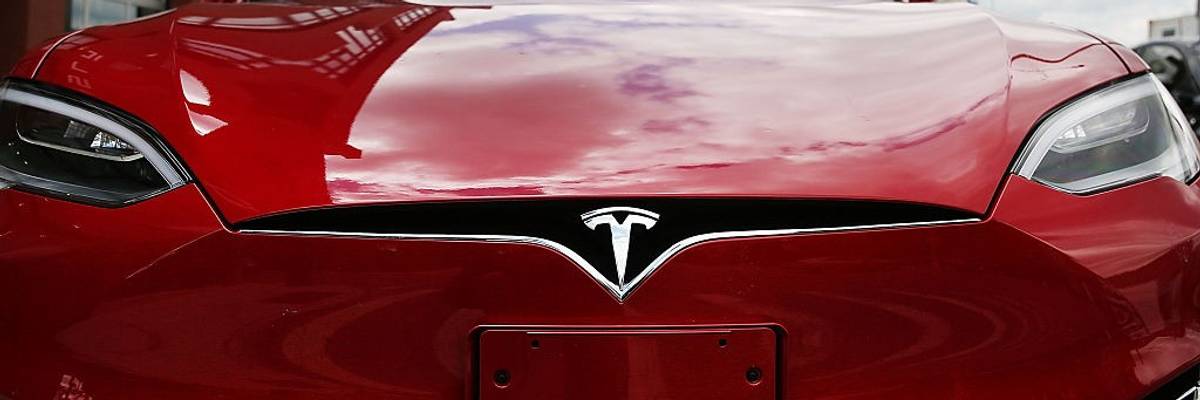
A Tesla from the front.
Workers at Tesla plants all labor without union contracts, earning per hour about one-third less than what workers at Detroit’s unionized auto makers are making.
Elon Musk, the world’s single richest individual, believes in sharing the wealth. Or so Tesla chief financial officer Zachary Kirkhorn can certainly attest.
Kirkhorn announced earlier this month that he’s stepping down after four years as Tesla’s CFO. Over those four years, Kirkhorn has pocketed some $590 million, a tidy sum that averages out to an annual take-home not all that far from $150 million.
But Musk’s share-the-wealth inclinations, Tesla workers can attest, don’t extend much beyond Tesla’s executive suites. Workers at Tesla plants all labor without union contracts. They earn per hour from Tesla about one-third less than what workers at Detroit’s unionized Big Three auto makers are making.
UAW President Shawn Fain has tagged this auto industry got-to-be-more-competitive pitch “nothing more” than a prescription for “a continued race to the bottom in a quest to follow the lowest bidder to pay poverty wages.”
Workers at those Big Three firms―General Motors, Ford, and Chrysler, now part of the new auto group Stellantis―are now feeling Tesla’s low-wage pressure. Their union, the United Auto Workers, has begun bargaining a new Big Three contract, and those negotiations, a Reuters analysis noted last month, most definitely have Musk’s Tesla as a shadow participant.
Tesla’s shadow, adds Reuters, has essentially replaced the looming presence of the “Japanese automaker Toyota and its lean production system.”
That analogy between today’s Testa and yesterday’s Toyota only goes so far. The Tesla and Toyota shadows have impacted Detroit’s top auto execs in strikingly different ways. Toyota posed a personal threat to Detroit auto execs. Tesla offers those execs a personal opportunity.
Toyota’s threat came on the executive compensation front. Japanese corporate chiefs have over recent decades consistently made substantially less than their U.S. counterparts. In 2012, for instance, Toyota’s top exec pocketed $1.8 million. Ford’s CEO that same year took home nearly $21 million.
This past June, Toyota’s top-paid exec, Akio Toyoda, saw his annual compensation rise to an all-time Toyota executive pay record. His take-home: $6.9 million. The 2022 total take-home of GM’s CEO: $29 million.
The mega millions that go to Tesla’s top execs, by contrast, provide top execs at America’s unionized auto companies a much more personally useful payday benchmark. The UAW, these execs are now demanding, must allow their companies to be “competitive” with the likes of Tesla.
UAW President Shawn Fain has tagged this auto industry got-to-be-more-competitive pitch “nothing more” than a prescription for “a continued race to the bottom in a quest to follow the lowest bidder to pay poverty wages.”
The UAW has a counter proposal for this summer’s bargaining. Detroit’s auto CEOs, the union points out, have seen their compensation rise 40% over the past four years. The UAW is now calling for a 40% raise for Big Three auto workers over the next four years.
A new contract that incorporates that notion would bring significant gains for auto workers. But even more significant gains―for all U.S. workers―could start flowing if U.S. lawmakers started linking the massive subsidies currently flowing to Corporate America to the stunningly wide pay gaps between U.S. workers and corporate top execs.
Tesla’s exiting chief financial officer Zach Kirkhorn earlier this year told reporters his company was expecting federal tax credits ranging up to $250 million per quarter in 2023, as much as $1 billion for the entire year. All those subsidy dollars, as matters now stand, will be disproportionately enriching the already rich. That doesn’t have to be the case.
In the quarter-century after World War II, the vast majority of major U.S. corporations paid their top execs no more than 20 or 30 times what their workers were taking home. Today’s top corporate execs routinely make more in a day than their workers can make in a year.
We could help change that if we pressed our lawmakers―at all levels―to limit corporate eligibility for government subsidies to companies that maintained modest gaps between executive and worker compensation. Corporations that can afford to pay their top execs hundreds of times more than what they pay their workers, we need to make politically clear, can afford to do without our tax dollars.
Dear Common Dreams reader, It’s been nearly 30 years since I co-founded Common Dreams with my late wife, Lina Newhouser. We had the radical notion that journalism should serve the public good, not corporate profits. It was clear to us from the outset what it would take to build such a project. No paid advertisements. No corporate sponsors. No millionaire publisher telling us what to think or do. Many people said we wouldn't last a year, but we proved those doubters wrong. Together with a tremendous team of journalists and dedicated staff, we built an independent media outlet free from the constraints of profits and corporate control. Our mission has always been simple: To inform. To inspire. To ignite change for the common good. Building Common Dreams was not easy. Our survival was never guaranteed. When you take on the most powerful forces—Wall Street greed, fossil fuel industry destruction, Big Tech lobbyists, and uber-rich oligarchs who have spent billions upon billions rigging the economy and democracy in their favor—the only bulwark you have is supporters who believe in your work. But here’s the urgent message from me today. It's never been this bad out there. And it's never been this hard to keep us going. At the very moment Common Dreams is most needed, the threats we face are intensifying. We need your support now more than ever. We don't accept corporate advertising and never will. We don't have a paywall because we don't think people should be blocked from critical news based on their ability to pay. Everything we do is funded by the donations of readers like you. When everyone does the little they can afford, we are strong. But if that support retreats or dries up, so do we. Will you donate now to make sure Common Dreams not only survives but thrives? —Craig Brown, Co-founder |
Elon Musk, the world’s single richest individual, believes in sharing the wealth. Or so Tesla chief financial officer Zachary Kirkhorn can certainly attest.
Kirkhorn announced earlier this month that he’s stepping down after four years as Tesla’s CFO. Over those four years, Kirkhorn has pocketed some $590 million, a tidy sum that averages out to an annual take-home not all that far from $150 million.
But Musk’s share-the-wealth inclinations, Tesla workers can attest, don’t extend much beyond Tesla’s executive suites. Workers at Tesla plants all labor without union contracts. They earn per hour from Tesla about one-third less than what workers at Detroit’s unionized Big Three auto makers are making.
UAW President Shawn Fain has tagged this auto industry got-to-be-more-competitive pitch “nothing more” than a prescription for “a continued race to the bottom in a quest to follow the lowest bidder to pay poverty wages.”
Workers at those Big Three firms―General Motors, Ford, and Chrysler, now part of the new auto group Stellantis―are now feeling Tesla’s low-wage pressure. Their union, the United Auto Workers, has begun bargaining a new Big Three contract, and those negotiations, a Reuters analysis noted last month, most definitely have Musk’s Tesla as a shadow participant.
Tesla’s shadow, adds Reuters, has essentially replaced the looming presence of the “Japanese automaker Toyota and its lean production system.”
That analogy between today’s Testa and yesterday’s Toyota only goes so far. The Tesla and Toyota shadows have impacted Detroit’s top auto execs in strikingly different ways. Toyota posed a personal threat to Detroit auto execs. Tesla offers those execs a personal opportunity.
Toyota’s threat came on the executive compensation front. Japanese corporate chiefs have over recent decades consistently made substantially less than their U.S. counterparts. In 2012, for instance, Toyota’s top exec pocketed $1.8 million. Ford’s CEO that same year took home nearly $21 million.
This past June, Toyota’s top-paid exec, Akio Toyoda, saw his annual compensation rise to an all-time Toyota executive pay record. His take-home: $6.9 million. The 2022 total take-home of GM’s CEO: $29 million.
The mega millions that go to Tesla’s top execs, by contrast, provide top execs at America’s unionized auto companies a much more personally useful payday benchmark. The UAW, these execs are now demanding, must allow their companies to be “competitive” with the likes of Tesla.
UAW President Shawn Fain has tagged this auto industry got-to-be-more-competitive pitch “nothing more” than a prescription for “a continued race to the bottom in a quest to follow the lowest bidder to pay poverty wages.”
The UAW has a counter proposal for this summer’s bargaining. Detroit’s auto CEOs, the union points out, have seen their compensation rise 40% over the past four years. The UAW is now calling for a 40% raise for Big Three auto workers over the next four years.
A new contract that incorporates that notion would bring significant gains for auto workers. But even more significant gains―for all U.S. workers―could start flowing if U.S. lawmakers started linking the massive subsidies currently flowing to Corporate America to the stunningly wide pay gaps between U.S. workers and corporate top execs.
Tesla’s exiting chief financial officer Zach Kirkhorn earlier this year told reporters his company was expecting federal tax credits ranging up to $250 million per quarter in 2023, as much as $1 billion for the entire year. All those subsidy dollars, as matters now stand, will be disproportionately enriching the already rich. That doesn’t have to be the case.
In the quarter-century after World War II, the vast majority of major U.S. corporations paid their top execs no more than 20 or 30 times what their workers were taking home. Today’s top corporate execs routinely make more in a day than their workers can make in a year.
We could help change that if we pressed our lawmakers―at all levels―to limit corporate eligibility for government subsidies to companies that maintained modest gaps between executive and worker compensation. Corporations that can afford to pay their top execs hundreds of times more than what they pay their workers, we need to make politically clear, can afford to do without our tax dollars.
Elon Musk, the world’s single richest individual, believes in sharing the wealth. Or so Tesla chief financial officer Zachary Kirkhorn can certainly attest.
Kirkhorn announced earlier this month that he’s stepping down after four years as Tesla’s CFO. Over those four years, Kirkhorn has pocketed some $590 million, a tidy sum that averages out to an annual take-home not all that far from $150 million.
But Musk’s share-the-wealth inclinations, Tesla workers can attest, don’t extend much beyond Tesla’s executive suites. Workers at Tesla plants all labor without union contracts. They earn per hour from Tesla about one-third less than what workers at Detroit’s unionized Big Three auto makers are making.
UAW President Shawn Fain has tagged this auto industry got-to-be-more-competitive pitch “nothing more” than a prescription for “a continued race to the bottom in a quest to follow the lowest bidder to pay poverty wages.”
Workers at those Big Three firms―General Motors, Ford, and Chrysler, now part of the new auto group Stellantis―are now feeling Tesla’s low-wage pressure. Their union, the United Auto Workers, has begun bargaining a new Big Three contract, and those negotiations, a Reuters analysis noted last month, most definitely have Musk’s Tesla as a shadow participant.
Tesla’s shadow, adds Reuters, has essentially replaced the looming presence of the “Japanese automaker Toyota and its lean production system.”
That analogy between today’s Testa and yesterday’s Toyota only goes so far. The Tesla and Toyota shadows have impacted Detroit’s top auto execs in strikingly different ways. Toyota posed a personal threat to Detroit auto execs. Tesla offers those execs a personal opportunity.
Toyota’s threat came on the executive compensation front. Japanese corporate chiefs have over recent decades consistently made substantially less than their U.S. counterparts. In 2012, for instance, Toyota’s top exec pocketed $1.8 million. Ford’s CEO that same year took home nearly $21 million.
This past June, Toyota’s top-paid exec, Akio Toyoda, saw his annual compensation rise to an all-time Toyota executive pay record. His take-home: $6.9 million. The 2022 total take-home of GM’s CEO: $29 million.
The mega millions that go to Tesla’s top execs, by contrast, provide top execs at America’s unionized auto companies a much more personally useful payday benchmark. The UAW, these execs are now demanding, must allow their companies to be “competitive” with the likes of Tesla.
UAW President Shawn Fain has tagged this auto industry got-to-be-more-competitive pitch “nothing more” than a prescription for “a continued race to the bottom in a quest to follow the lowest bidder to pay poverty wages.”
The UAW has a counter proposal for this summer’s bargaining. Detroit’s auto CEOs, the union points out, have seen their compensation rise 40% over the past four years. The UAW is now calling for a 40% raise for Big Three auto workers over the next four years.
A new contract that incorporates that notion would bring significant gains for auto workers. But even more significant gains―for all U.S. workers―could start flowing if U.S. lawmakers started linking the massive subsidies currently flowing to Corporate America to the stunningly wide pay gaps between U.S. workers and corporate top execs.
Tesla’s exiting chief financial officer Zach Kirkhorn earlier this year told reporters his company was expecting federal tax credits ranging up to $250 million per quarter in 2023, as much as $1 billion for the entire year. All those subsidy dollars, as matters now stand, will be disproportionately enriching the already rich. That doesn’t have to be the case.
In the quarter-century after World War II, the vast majority of major U.S. corporations paid their top execs no more than 20 or 30 times what their workers were taking home. Today’s top corporate execs routinely make more in a day than their workers can make in a year.
We could help change that if we pressed our lawmakers―at all levels―to limit corporate eligibility for government subsidies to companies that maintained modest gaps between executive and worker compensation. Corporations that can afford to pay their top execs hundreds of times more than what they pay their workers, we need to make politically clear, can afford to do without our tax dollars.