SUBSCRIBE TO OUR FREE NEWSLETTER
Daily news & progressive opinion—funded by the people, not the corporations—delivered straight to your inbox.
5
#000000
#FFFFFF
To donate by check, phone, or other method, see our More Ways to Give page.
Daily news & progressive opinion—funded by the people, not the corporations—delivered straight to your inbox.
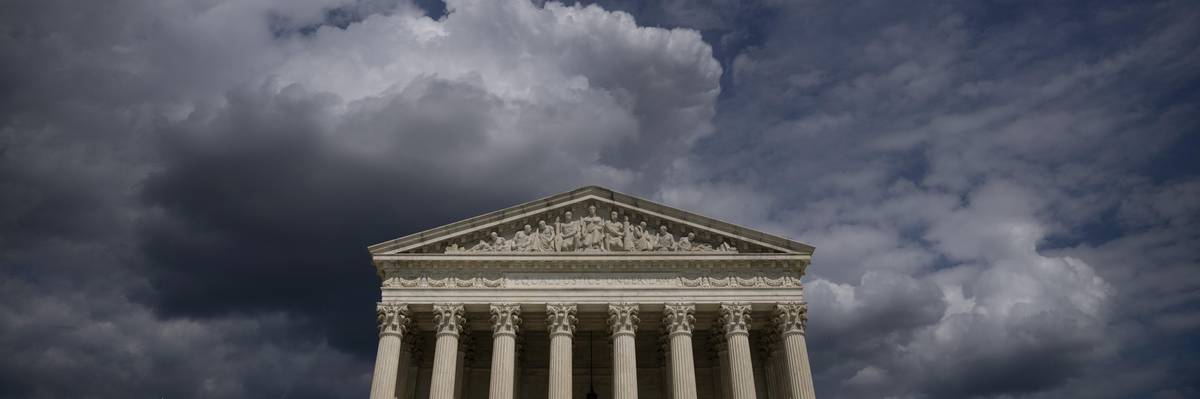
Clouds are seen above the U.S. Supreme Court building on May 17, 2021 in Washington, D.C.
How the nation's highest court supercharged the nation’s gun violence epidemic.
If you’re looking for someone to blame for the gun violence that has left our schools, streets, and communities soaked in blood, don’t point just at the National Rifle Association and their lackeys in the Republican Party. Raise another finger, ideally your middle one, toward a Supreme Court that has enabled the unceasing rise of gun-related carnage in all its ever-more-obscene forms.
The key decision came in 2008, when a 5-4 majority led by the late Justice Antonin Scalia ruled in District of Columbia v. Heller that the Second Amendment protects an individual right to own firearms. Prior to Heller, the combined weight of academic scholarship and legal precedent had construed the Second Amendment as protecting civilian gun ownership only in connection with long-antiquated state militias. This view was long seen as reflecting the spirit of the actual debates held during the Constitutional Convention of 1787.
Scalia and the other members of the conservative Heller majority purported to base their radical reinterpretation of the Second Amendment on their “originalist” understanding of the Founding Fathers’ intentions. But their novel conclusion essentially ignored the first 13 words of the Second Amendment regarding the necessity of preserving the militias.
This amounted to a distortion of American history. State militias played a critical role in the American Revolution, and before that, in maintaining order in the 13 colonies. As the Second Amendment historian Noah Shusterman has written:
The men writing the Bill of Rights wanted every citizen to be in the militia, and they wanted everyone in the militia to be armed. If someone was prohibited from participating in the militia, the leaders of the founders’ generation would not have wanted them to have access to weapons… Read the debates about the Constitution and the Bill of Rights, and the militia’s importance leaps off the page. Alexander Hamilton, writing in the Federalist Papers, called a well-regulated militia “the most natural defense of a free country.” His anti-Federalist critics agreed with the need for a citizens’ militia, writing that “a well-regulated militia, composed of the Yeomanry of the country, have ever been considered as the bulwark of a free people.”
Few errors of constitutional interpretation have had such deadly real-world consequences as Heller. Justice John Paul Stevens, who authored the principal dissent in Heller, later condemned the ruling as “the worst self-inflicted wound in the court’s history.”
Since Heller, both guns and gun deaths have surged in tandem in what the American Enlightenment Project calls the “Heller Inflection.” In 2008, there were 305 million guns in circulation and 31,500 reported gun deaths; there are now 470 million guns in circulation and over 45,000 reported gun deaths per year. Mass shootings, defined as events involving four or more victims, have grown as well—from 272 in 2014 to 653 last year, according to the Gun Violence Archive.
But as bad as Heller was, it still recognized that certain gun control measures remained “presumptively lawful.” In the words of Scalia:
Nothing in our opinion should be taken to cast doubt on longstanding prohibitions on the possession of firearms by felons and the mentally ill, or laws forbidding the carrying of firearms in sensitive places such as schools and government buildings, or laws imposing conditions and qualifications on the commercial sale of arms.
In 2010, in McDonald v. Chicago, the court extended Heller’s Second Amendment analysis to cover state and local governments in addition to federal enclaves. But in 2022, with Clarence Thomas’ 6-3 majority opinion in New York Rifle & Pistol Association v. Bruen, the court cast aside the limiting language of Heller about presumptively lawful gun-control restrictions.
Bruen struck down New York’s firearm permit system that had been on the books since 1909. To reach that result, the court rejected the traditional methods of judicial scrutiny used to determine the constitutionality of state and federal statutes that required judges to balance the governmental interests advanced by legislation against the competing rights of individuals. In place of interest balancing, Thomas and his cohorts substituted a specious “history and tradition” test based on the justices’ highly selective and subjective reading of history and their sense of tradition.
In fact, gun-control regulations like the New York permit system have been commonplace in the United States from colonial times to the present. The founders supported a variety of strict measures, including the registration of guns issued to militia members and prohibitions against carrying firearms in public. By the early 1900s, nearly every state had enacted laws requiring firearm licenses and banning concealed carry.
As a result of Bruen, however, that history has effectively been neutered. Judges now must regard gun-control measures as presumptively invalid. To overcome the presumption, the government must prove that even the most commonsense laws are firmly rooted, either explicitly or by analogy, in the “nation’s historical tradition of firearm regulation.”
Together with Heller and McDonald, Bruen has led to a surge in Second Amendment challenges to gun laws since 2008. Pre-Heller, the lower federal courts decided an average of 26 gun cases per year; they now hear nearly 700 per year. The challengers are also winning a higher percentage of cases compared to the pre-Heller era, especially in cases decided by Donald Trump-appointed judges appointed. “Trump judges are close to casting 50% of their votes in favor of gun rights, when the average for other Republicans is 28%,” one study has found.
Last term, the Supreme Court surprised many by upholding a federal law that bars anyone subject to a domestic-violence restraining order from possessing a gun. However, it did so without signaling that it is prepared to modify the hard Second Amendment lines drawn in Heller and Bruen. As long as the court is controlled by right-wing activists beholden to the gun lobby and the Republican Party, those lines and their horrendous consequences are here to stay.
Dear Common Dreams reader, It’s been nearly 30 years since I co-founded Common Dreams with my late wife, Lina Newhouser. We had the radical notion that journalism should serve the public good, not corporate profits. It was clear to us from the outset what it would take to build such a project. No paid advertisements. No corporate sponsors. No millionaire publisher telling us what to think or do. Many people said we wouldn't last a year, but we proved those doubters wrong. Together with a tremendous team of journalists and dedicated staff, we built an independent media outlet free from the constraints of profits and corporate control. Our mission has always been simple: To inform. To inspire. To ignite change for the common good. Building Common Dreams was not easy. Our survival was never guaranteed. When you take on the most powerful forces—Wall Street greed, fossil fuel industry destruction, Big Tech lobbyists, and uber-rich oligarchs who have spent billions upon billions rigging the economy and democracy in their favor—the only bulwark you have is supporters who believe in your work. But here’s the urgent message from me today. It's never been this bad out there. And it's never been this hard to keep us going. At the very moment Common Dreams is most needed, the threats we face are intensifying. We need your support now more than ever. We don't accept corporate advertising and never will. We don't have a paywall because we don't think people should be blocked from critical news based on their ability to pay. Everything we do is funded by the donations of readers like you. When everyone does the little they can afford, we are strong. But if that support retreats or dries up, so do we. Will you donate now to make sure Common Dreams not only survives but thrives? —Craig Brown, Co-founder |
If you’re looking for someone to blame for the gun violence that has left our schools, streets, and communities soaked in blood, don’t point just at the National Rifle Association and their lackeys in the Republican Party. Raise another finger, ideally your middle one, toward a Supreme Court that has enabled the unceasing rise of gun-related carnage in all its ever-more-obscene forms.
The key decision came in 2008, when a 5-4 majority led by the late Justice Antonin Scalia ruled in District of Columbia v. Heller that the Second Amendment protects an individual right to own firearms. Prior to Heller, the combined weight of academic scholarship and legal precedent had construed the Second Amendment as protecting civilian gun ownership only in connection with long-antiquated state militias. This view was long seen as reflecting the spirit of the actual debates held during the Constitutional Convention of 1787.
Scalia and the other members of the conservative Heller majority purported to base their radical reinterpretation of the Second Amendment on their “originalist” understanding of the Founding Fathers’ intentions. But their novel conclusion essentially ignored the first 13 words of the Second Amendment regarding the necessity of preserving the militias.
This amounted to a distortion of American history. State militias played a critical role in the American Revolution, and before that, in maintaining order in the 13 colonies. As the Second Amendment historian Noah Shusterman has written:
The men writing the Bill of Rights wanted every citizen to be in the militia, and they wanted everyone in the militia to be armed. If someone was prohibited from participating in the militia, the leaders of the founders’ generation would not have wanted them to have access to weapons… Read the debates about the Constitution and the Bill of Rights, and the militia’s importance leaps off the page. Alexander Hamilton, writing in the Federalist Papers, called a well-regulated militia “the most natural defense of a free country.” His anti-Federalist critics agreed with the need for a citizens’ militia, writing that “a well-regulated militia, composed of the Yeomanry of the country, have ever been considered as the bulwark of a free people.”
Few errors of constitutional interpretation have had such deadly real-world consequences as Heller. Justice John Paul Stevens, who authored the principal dissent in Heller, later condemned the ruling as “the worst self-inflicted wound in the court’s history.”
Since Heller, both guns and gun deaths have surged in tandem in what the American Enlightenment Project calls the “Heller Inflection.” In 2008, there were 305 million guns in circulation and 31,500 reported gun deaths; there are now 470 million guns in circulation and over 45,000 reported gun deaths per year. Mass shootings, defined as events involving four or more victims, have grown as well—from 272 in 2014 to 653 last year, according to the Gun Violence Archive.
But as bad as Heller was, it still recognized that certain gun control measures remained “presumptively lawful.” In the words of Scalia:
Nothing in our opinion should be taken to cast doubt on longstanding prohibitions on the possession of firearms by felons and the mentally ill, or laws forbidding the carrying of firearms in sensitive places such as schools and government buildings, or laws imposing conditions and qualifications on the commercial sale of arms.
In 2010, in McDonald v. Chicago, the court extended Heller’s Second Amendment analysis to cover state and local governments in addition to federal enclaves. But in 2022, with Clarence Thomas’ 6-3 majority opinion in New York Rifle & Pistol Association v. Bruen, the court cast aside the limiting language of Heller about presumptively lawful gun-control restrictions.
Bruen struck down New York’s firearm permit system that had been on the books since 1909. To reach that result, the court rejected the traditional methods of judicial scrutiny used to determine the constitutionality of state and federal statutes that required judges to balance the governmental interests advanced by legislation against the competing rights of individuals. In place of interest balancing, Thomas and his cohorts substituted a specious “history and tradition” test based on the justices’ highly selective and subjective reading of history and their sense of tradition.
In fact, gun-control regulations like the New York permit system have been commonplace in the United States from colonial times to the present. The founders supported a variety of strict measures, including the registration of guns issued to militia members and prohibitions against carrying firearms in public. By the early 1900s, nearly every state had enacted laws requiring firearm licenses and banning concealed carry.
As a result of Bruen, however, that history has effectively been neutered. Judges now must regard gun-control measures as presumptively invalid. To overcome the presumption, the government must prove that even the most commonsense laws are firmly rooted, either explicitly or by analogy, in the “nation’s historical tradition of firearm regulation.”
Together with Heller and McDonald, Bruen has led to a surge in Second Amendment challenges to gun laws since 2008. Pre-Heller, the lower federal courts decided an average of 26 gun cases per year; they now hear nearly 700 per year. The challengers are also winning a higher percentage of cases compared to the pre-Heller era, especially in cases decided by Donald Trump-appointed judges appointed. “Trump judges are close to casting 50% of their votes in favor of gun rights, when the average for other Republicans is 28%,” one study has found.
Last term, the Supreme Court surprised many by upholding a federal law that bars anyone subject to a domestic-violence restraining order from possessing a gun. However, it did so without signaling that it is prepared to modify the hard Second Amendment lines drawn in Heller and Bruen. As long as the court is controlled by right-wing activists beholden to the gun lobby and the Republican Party, those lines and their horrendous consequences are here to stay.
If you’re looking for someone to blame for the gun violence that has left our schools, streets, and communities soaked in blood, don’t point just at the National Rifle Association and their lackeys in the Republican Party. Raise another finger, ideally your middle one, toward a Supreme Court that has enabled the unceasing rise of gun-related carnage in all its ever-more-obscene forms.
The key decision came in 2008, when a 5-4 majority led by the late Justice Antonin Scalia ruled in District of Columbia v. Heller that the Second Amendment protects an individual right to own firearms. Prior to Heller, the combined weight of academic scholarship and legal precedent had construed the Second Amendment as protecting civilian gun ownership only in connection with long-antiquated state militias. This view was long seen as reflecting the spirit of the actual debates held during the Constitutional Convention of 1787.
Scalia and the other members of the conservative Heller majority purported to base their radical reinterpretation of the Second Amendment on their “originalist” understanding of the Founding Fathers’ intentions. But their novel conclusion essentially ignored the first 13 words of the Second Amendment regarding the necessity of preserving the militias.
This amounted to a distortion of American history. State militias played a critical role in the American Revolution, and before that, in maintaining order in the 13 colonies. As the Second Amendment historian Noah Shusterman has written:
The men writing the Bill of Rights wanted every citizen to be in the militia, and they wanted everyone in the militia to be armed. If someone was prohibited from participating in the militia, the leaders of the founders’ generation would not have wanted them to have access to weapons… Read the debates about the Constitution and the Bill of Rights, and the militia’s importance leaps off the page. Alexander Hamilton, writing in the Federalist Papers, called a well-regulated militia “the most natural defense of a free country.” His anti-Federalist critics agreed with the need for a citizens’ militia, writing that “a well-regulated militia, composed of the Yeomanry of the country, have ever been considered as the bulwark of a free people.”
Few errors of constitutional interpretation have had such deadly real-world consequences as Heller. Justice John Paul Stevens, who authored the principal dissent in Heller, later condemned the ruling as “the worst self-inflicted wound in the court’s history.”
Since Heller, both guns and gun deaths have surged in tandem in what the American Enlightenment Project calls the “Heller Inflection.” In 2008, there were 305 million guns in circulation and 31,500 reported gun deaths; there are now 470 million guns in circulation and over 45,000 reported gun deaths per year. Mass shootings, defined as events involving four or more victims, have grown as well—from 272 in 2014 to 653 last year, according to the Gun Violence Archive.
But as bad as Heller was, it still recognized that certain gun control measures remained “presumptively lawful.” In the words of Scalia:
Nothing in our opinion should be taken to cast doubt on longstanding prohibitions on the possession of firearms by felons and the mentally ill, or laws forbidding the carrying of firearms in sensitive places such as schools and government buildings, or laws imposing conditions and qualifications on the commercial sale of arms.
In 2010, in McDonald v. Chicago, the court extended Heller’s Second Amendment analysis to cover state and local governments in addition to federal enclaves. But in 2022, with Clarence Thomas’ 6-3 majority opinion in New York Rifle & Pistol Association v. Bruen, the court cast aside the limiting language of Heller about presumptively lawful gun-control restrictions.
Bruen struck down New York’s firearm permit system that had been on the books since 1909. To reach that result, the court rejected the traditional methods of judicial scrutiny used to determine the constitutionality of state and federal statutes that required judges to balance the governmental interests advanced by legislation against the competing rights of individuals. In place of interest balancing, Thomas and his cohorts substituted a specious “history and tradition” test based on the justices’ highly selective and subjective reading of history and their sense of tradition.
In fact, gun-control regulations like the New York permit system have been commonplace in the United States from colonial times to the present. The founders supported a variety of strict measures, including the registration of guns issued to militia members and prohibitions against carrying firearms in public. By the early 1900s, nearly every state had enacted laws requiring firearm licenses and banning concealed carry.
As a result of Bruen, however, that history has effectively been neutered. Judges now must regard gun-control measures as presumptively invalid. To overcome the presumption, the government must prove that even the most commonsense laws are firmly rooted, either explicitly or by analogy, in the “nation’s historical tradition of firearm regulation.”
Together with Heller and McDonald, Bruen has led to a surge in Second Amendment challenges to gun laws since 2008. Pre-Heller, the lower federal courts decided an average of 26 gun cases per year; they now hear nearly 700 per year. The challengers are also winning a higher percentage of cases compared to the pre-Heller era, especially in cases decided by Donald Trump-appointed judges appointed. “Trump judges are close to casting 50% of their votes in favor of gun rights, when the average for other Republicans is 28%,” one study has found.
Last term, the Supreme Court surprised many by upholding a federal law that bars anyone subject to a domestic-violence restraining order from possessing a gun. However, it did so without signaling that it is prepared to modify the hard Second Amendment lines drawn in Heller and Bruen. As long as the court is controlled by right-wing activists beholden to the gun lobby and the Republican Party, those lines and their horrendous consequences are here to stay.