
SUBSCRIBE TO OUR FREE NEWSLETTER
Daily news & progressive opinion—funded by the people, not the corporations—delivered straight to your inbox.
5
#000000
#FFFFFF
To donate by check, phone, or other method, see our More Ways to Give page.


Daily news & progressive opinion—funded by the people, not the corporations—delivered straight to your inbox.
How the nation's highest court supercharged the nation’s gun violence epidemic.
If you’re looking for someone to blame for the gun violence that has left our schools, streets, and communities soaked in blood, don’t point just at the National Rifle Association and their lackeys in the Republican Party. Raise another finger, ideally your middle one, toward a Supreme Court that has enabled the unceasing rise of gun-related carnage in all its ever-more-obscene forms.
The key decision came in 2008, when a 5-4 majority led by the late Justice Antonin Scalia ruled in District of Columbia v. Heller that the Second Amendment protects an individual right to own firearms. Prior to Heller, the combined weight of academic scholarship and legal precedent had construed the Second Amendment as protecting civilian gun ownership only in connection with long-antiquated state militias. This view was long seen as reflecting the spirit of the actual debates held during the Constitutional Convention of 1787.
Scalia and the other members of the conservative Heller majority purported to base their radical reinterpretation of the Second Amendment on their “originalist” understanding of the Founding Fathers’ intentions. But their novel conclusion essentially ignored the first 13 words of the Second Amendment regarding the necessity of preserving the militias.
This amounted to a distortion of American history. State militias played a critical role in the American Revolution, and before that, in maintaining order in the 13 colonies. As the Second Amendment historian Noah Shusterman has written:
The men writing the Bill of Rights wanted every citizen to be in the militia, and they wanted everyone in the militia to be armed. If someone was prohibited from participating in the militia, the leaders of the founders’ generation would not have wanted them to have access to weapons… Read the debates about the Constitution and the Bill of Rights, and the militia’s importance leaps off the page. Alexander Hamilton, writing in the Federalist Papers, called a well-regulated militia “the most natural defense of a free country.” His anti-Federalist critics agreed with the need for a citizens’ militia, writing that “a well-regulated militia, composed of the Yeomanry of the country, have ever been considered as the bulwark of a free people.”
Few errors of constitutional interpretation have had such deadly real-world consequences as Heller. Justice John Paul Stevens, who authored the principal dissent in Heller, later condemned the ruling as “the worst self-inflicted wound in the court’s history.”
Since Heller, both guns and gun deaths have surged in tandem in what the American Enlightenment Project calls the “Heller Inflection.” In 2008, there were 305 million guns in circulation and 31,500 reported gun deaths; there are now 470 million guns in circulation and over 45,000 reported gun deaths per year. Mass shootings, defined as events involving four or more victims, have grown as well—from 272 in 2014 to 653 last year, according to the Gun Violence Archive.
But as bad as Heller was, it still recognized that certain gun control measures remained “presumptively lawful.” In the words of Scalia:
Nothing in our opinion should be taken to cast doubt on longstanding prohibitions on the possession of firearms by felons and the mentally ill, or laws forbidding the carrying of firearms in sensitive places such as schools and government buildings, or laws imposing conditions and qualifications on the commercial sale of arms.
In 2010, in McDonald v. Chicago, the court extended Heller’s Second Amendment analysis to cover state and local governments in addition to federal enclaves. But in 2022, with Clarence Thomas’ 6-3 majority opinion in New York Rifle & Pistol Association v. Bruen, the court cast aside the limiting language of Heller about presumptively lawful gun-control restrictions.
Bruen struck down New York’s firearm permit system that had been on the books since 1909. To reach that result, the court rejected the traditional methods of judicial scrutiny used to determine the constitutionality of state and federal statutes that required judges to balance the governmental interests advanced by legislation against the competing rights of individuals. In place of interest balancing, Thomas and his cohorts substituted a specious “history and tradition” test based on the justices’ highly selective and subjective reading of history and their sense of tradition.
In fact, gun-control regulations like the New York permit system have been commonplace in the United States from colonial times to the present. The founders supported a variety of strict measures, including the registration of guns issued to militia members and prohibitions against carrying firearms in public. By the early 1900s, nearly every state had enacted laws requiring firearm licenses and banning concealed carry.
As a result of Bruen, however, that history has effectively been neutered. Judges now must regard gun-control measures as presumptively invalid. To overcome the presumption, the government must prove that even the most commonsense laws are firmly rooted, either explicitly or by analogy, in the “nation’s historical tradition of firearm regulation.”
Together with Heller and McDonald, Bruen has led to a surge in Second Amendment challenges to gun laws since 2008. Pre-Heller, the lower federal courts decided an average of 26 gun cases per year; they now hear nearly 700 per year. The challengers are also winning a higher percentage of cases compared to the pre-Heller era, especially in cases decided by Donald Trump-appointed judges appointed. “Trump judges are close to casting 50% of their votes in favor of gun rights, when the average for other Republicans is 28%,” one study has found.
Last term, the Supreme Court surprised many by upholding a federal law that bars anyone subject to a domestic-violence restraining order from possessing a gun. However, it did so without signaling that it is prepared to modify the hard Second Amendment lines drawn in Heller and Bruen. As long as the court is controlled by right-wing activists beholden to the gun lobby and the Republican Party, those lines and their horrendous consequences are here to stay.

"The Supreme Court's gifts shouldn't be a secret—Congress must pass a binding code of ethics now," said one advocate.
U.S. Supreme Court justices have received millions of dollars in gifts over the past two decades—with far-right Justice Clarence Thomas being the main beneficiary of this largesse, according to a detailed analysis published Thursday.
The advocacy group Fix the Court published a database listing 546 total gifts valued at over $4.7 million given to 18 current and former justices mostly between 2004 and 2023, as identified by the U.S. Federal Trade Commission (FTC). The database also lists "likely" gifts received by the justices and their estimated values, bringing the grand total to 672 gifts valued at nearly $6.6 million.
The database was published a day before the justices are expected to release their financial disclosure reports.
"Supreme Court justices should not be accepting gifts, let alone the hundreds of freebies worth millions of dollars they've received over the years," Fix the Court executive director Gabe Roth said in a statement Thursday.
Thomas led the pack with 193 FTC-identified gifts collectively valued at over $4 million. Of these, he listed only 27 in financial disclosure reports.
According to Fix the Court, Thomas' gifts consisted mainly of
free trips to Bohemian Grove—a secretive, men-only retreat in Northern California—and Topridge, the private lakeside resort in upstate New York owned by billionaire Republican megadonor Harlan Crow.
By dollar amount, the late Justice Antonin Scalia came in a distant second with 67 gifts worth over $210,000 combined, while Justice Samuel Alito took 16 gifts valued collectively at just over $170,000. At the low end of the database, Justice Brett Kavanaugh received a single gift worth $100, while former Justice David Souter was also given one gift with a value of $349.
According to the analysis:
The tally includes the amount of principal and interest—$253,686—we believe Tony Welters forgave in 2008 for the luxury RV he gifted to Thomas the decade before. FTC's numbers include the tuition gifts, $144,400 across six years, Thomas received for his grandnephew... It captures the value of Thomas' yacht trips to Russia, the Greek Isles, and Indonesia, as well as some new information on the Thomas flights Tony Novelly paid for and the Scalia and Alito fishing trips Robin Arkley paid for that's included in the congressional record. The value of the gifts Scalia received on his ill-fated trip to Marfa, Texas, in 2016 are also included.
"Public servants who make four times the median local salary, and who can make millions writing books on any topic they like, can afford to pay for their own vacations, vehicles, hunting excursions, and club memberships," said Roth, "to say nothing of the influence the gift-givers are buying with their 'generosity.'"
"The ethics crisis at the court won't begin to abate until justices adopt stricter gift acceptance rules," he added.
Thomas' gifts from billionaire Republican donors—and his refusal to report them—have fueled calls for his recusal from some cases and even resignation.
Following intense public pressure, the Supreme Court last November announced it had formally adopted a code of conduct that was promptly slammed as a "toothless PR stunt" by the watchdog Revolving Door Project and others.
"The ethics crisis at the court won't begin to abate until justices adopt stricter gift acceptance rules."
"Headline after headline about Supreme Court justices accepting lavish vacations and eye-poppingly expensive gifts is bound to erode trust in the court," U.S. Sen. Jeff Merkley (D-Ore.) said on social media Wednesday. "We need to pass the Supreme Court Ethics, Recusal, and Transparency Act and enforce a real code of ethics."
Fix the Court and other groups also support the Supreme Court Ethics and Investigations Act, which was introduced earlier this week by Congressman Dan Goldman (D-N.Y.) and would create a Supreme Court Office of Investigative Counsel tasked with investigating ethical improprieties and reporting them to Congress.
Reacting to the new analysis, the pro-democracy group Stand Up America said, "The Supreme Court's gifts shouldn't be a secret—Congress must pass a binding code of ethics now."
Of the five-member majority that scuttled much of Arizona’s Papers Please law, which has similarities to Texas’ SB 4, Kennedy, Ginsburg, and Breyer are no longer on the bench.
Texas Republican Gov. Greg Abbott may be a grandstanding demagogue, but he is no dummy. He knew exactly what he was doing, legally and politically, when he signed Senate Bill 4 into law last December, empowering the state to set up its own deportation system for undocumented immigrants.
SB 4 makes it a state crime to cross the Texas-Mexico border other than at official ports of entry. If the law survives court challenges, local police will be authorized to arrest anyone in the state suspected of illegal entry. First-time offenders will be charged with misdemeanors, exposing them to sentences of six months in jail. Repeat offenders could be charged with second-degree felonies that could land them in prison for 20 years. For both misdemeanors and felonies, state court judges would be authorized to order offenders deported to Mexico, regardless of their countries of origin.
For Abbott, the enactment of SB 4 caps years of loud posturing and badmouthing of the Biden administration on the dangers of immigration and “open borders.” Among other provocations, Abbott has ordered the state’s national guard to line the Rio Grande with razor wire, bused over a hundred thousand migrants to so-called “sanctuary cities” like New York and Chicago, and declared that Texas is facing an “invasion” akin to a state of war. Such maneuvers play to the MAGA base of the Republican party, and align closely with former President Donald Trump’s campaign promises to stage the “largest deportation effort in the history of our country” should Trump win back the White House in November.
The question arises: Could Antonin Scalia, the famed right-wing judicial “originalist” who died in 2016, rise from the grave and provide constitutional cover for SB 4?
SB 4 was supposed to go into effect on March 1, but has been tied up in court as a result of lawsuits brought by the U.S. Justice Department and the ACLU on behalf of two Texas-based immigration advocacy organizations and the County of El Paso. The litigation has ping-ponged through the federal system, briefly reaching the Supreme Court, which on March 19 issued an order allowing the law to go into effect pending a decision on its constitutionality by the 5th Circuit Court of Appeals, which has jurisdiction over Texas. In the meantime, the Circuit has put the law on hold. A three-judge panel heard oral arguments on April 3, and a ruling is expected in the coming weeks.
At first glance, as the plaintiffs contend, SB 4 appears unconstitutional on its face for conflicting with federal immigration law and running afoul of the Supreme Court’s 2012 decision in Arizona v. United States, which struck down several provisions of a similar anti-immigration state statute.
The ACLU and the advocacy groups it represents also contend SB 4 will lead to family separation and rampant racial profiling. Even the government of Mexico has weighed in, advising that it will not accept migrants deported from Texas as a result of SB 4.
Abbott, whose resumé includes stints as a justice of the Texas Supreme Court and the state’s attorney general, understands the criticisms and seems eager for a fight. “We think that Texas already has the constitutional authority to do this, but we also welcome a Supreme Court decision that would overturn the precedent set in the Arizona case,” he said at the December signing ceremony for the law. What’s more, he added, “Justice Scalia wrote a dissenting opinion in that case, pretty much laying out a pathway that he thought would be a legal way for a state to go about the process of enforcing immigration laws.”
The question arises: Could Antonin Scalia, the famed right-wing judicial “originalist” who died in 2016, rise from the grave and provide constitutional cover for SB 4? The answer depends on the current Supreme Court’s willingness to overturn or significantly modify its holding in Arizona v. United States.
In the Arizona case, the Supreme Court reviewed a statute that made it a crime to be present in the state without lawfully registering with the federal government, and to work in the state without federal authorization. Local police were permitted to verify the immigration status of those suspected of being undocumented, arrest suspected violators without warrants, and transmit their findings to federal immigration authorities to facilitate deportation proceedings. The provisions gave rise to the statute’s nickname as the “Papers Please” law.
By a margin of 5-3, with Justice Anthony Kennedy writing for the majority and Justice Elena Kagan recusing herself due to her prior involvement in the case as U.S. solicitor general, the Supreme Court overturned the provisions that created new immigration-based state crimes and approved of warrantless arrests. The court, however, upheld the immigration-status check provision, but narrowed it to checks made during otherwise lawful arrests for ordinary non-immigration crimes.
Justices Clarence Thomas and Samuel Alito, Justice Scalia wrote separate opinions concurring with the majority’s ruling on status checks but dissenting from the remainder.
At the heart of both the majority opinion and the dissents is a thorny constitutional doctrine called “preemption.” In the most basic sense, the doctrine instructs that when state and federal law conflict, federal law displaces, or preempts, state law because of the Supremacy Clause (Article VI) of the U.S. Constitution. Kennedy and the majority determined the three Arizona provisions they invalidated were preempted by the federal government’s “broad, undoubted power over the subject of immigration and the status of aliens.”
Scalia took strong and colorful exception to Kennedy’s reasoning. Like Gov. Abbott today, he argued that the Arizona statute did not conflict with federal law, but complemented the federal system, making immigration enforcement more effective.
Referring to the United States as “an indivisible union of sovereign states,” Scalia argued: “As a sovereign, Arizona has the inherent power to exclude persons from its territory, subject only to those limitations expressed in the Constitution or constitutionally imposed by Congress.”
It was a “myth,” he continued, that the states had no power under the Constitution to exclude people from their borders. To the contrary, he wrote: “[I]n the first 100 years of the Republic, the states enacted numerous laws restricting the immigration of certain classes of aliens, including convicted criminals, indigents, persons with contagious diseases, and (in Southern States) freed blacks.”
Prefiguring Gov. Abbott’s “invasion” rhetoric with almost eerie precision, Scalia cited the Constitution’s “Invasion Clause” (Art. I, §10, cl. 3), which stipulates:
“[N]o State shall, without the Consent of Congress,... engage in War, unless actually invaded, or in such imminent Danger as will not admit of delay.” [Emphasis in the original.]
It’s tempting to dismiss Scalia’s dissent as “extreme and outdated,” as Los Angeles Times reporter David Savage has written. But if the conservative takeover of the Supreme Court has taught us anything, it is that the high court’s precedent decisions are considered fair game for reversal by the hard-right justices who dominate the court today. (Take a look at the court’s recent decisions on abortion and the Second Amendment.)
Of the five-member majority that scuttled much of Arizona’s Papers Please law, Kennedy, Ginsburg, and Breyer are no longer on the bench. Though Scalia is also gone, the court’s three Trump appointees—Justices Neil Gorsuch, Brett Kavanaugh, and Amy Coney Barrett—are all Scalia protegees. If and when Texas’ SB 4 comes back to the Supreme Court, it will not be surprising if they join with Thomas and Alito to resurrect Scalia’ ghost and validate Gov. Abbott’s war on immigrants.
With the November elections looming and border security a key issue, the war’s pace is certain to accelerate.
Former Supreme Court Justice John Paul Stevens (appointed by a Republican President) wrote in 2019, "District of Columbia v. Heller, which recognized an individual right to possess a firearm under the Constitution, is unquestionably the most clearly incorrect decision that the Supreme Court announced during my tenure on the bench."
Never in the 217 years since the Bill of Rights had been ratified in 1791 had the Supreme Court found an individual Constitutional right to own a gun separate from a militia (which today we call the National Guard) and during that time, local, state and the Federal government enacted numerous gun control laws.
Even former Republican Chief Justice Warren Burger (appointed to the Court by Richard Nixon) called the NRA support of this interpretation "One of the greatest pieces of fraud, I repeat the word fraud, on the American public by special interest groups that I have even seen in my lifetime."
But Democratic politicians are afraid to agree with Stevens or even Burger.
When it comes to gun violence, Democrats generally start by saying "Of course we don't want to infringe people's Second Amendment right to own a gun. We just want 'common sense' gun laws like background checks and red flag laws" (which everyone knows will do little except at the margins.)
Republicans didn't say "Of course we don't want to infringe women's Constitutional right to decide whether to bear a child. We just want common sense laws to protect their health." No. They spent decades declaring abortion is murder, that as Alito said in his draft opinion, Roe was "egregiously wrong from the start," and packing the courts with judges who agree with Alito.
It's time for Democrats to summon some courage and say loud and clear that the Heller decision adopted by a 5-4 Republican majority on the Court was one of a string of politicized 5-4 decisions by Republican Justices to advance the Republican agenda.
What's Wrong With Heller?
The 2008 Heller decision flew in the face of long-standing Supreme Court precedent. Never in the 217 years since the Bill of Rights had been ratified in 1791 had the Supreme Court found an individual Constitutional right to own a gun separate from a militia (which today we call the National Guard) and during that time, local, state and the Federal government enacted numerous gun control laws.
Heller (like Alito's draft opinion overturning Roe smashed the Supreme Court's own precedent, effectively reversing the Supreme Court's 1939 decision in United States v. Miller upholding provisions of 1934 National Firearms Act, passed by Congress in response to the St. Valentine's Day Massacre which required the registration of certain types of firearms, such as machine guns and sawed-off shot guns.
In Miller, a unanimous Supreme Court had held that "In the absence of any evidence tending to show that possession or use of a 'shotgun having a barrel of less than eighteen inches in length' at this time has some reasonable relationship to the preservation or efficiency of a well-regulated militia, we cannot say that the Second Amendment guarantees to the citizen the right to keep and bear such a weapon."
Antonin Scalia's 5-4 opinion in Heller demonstrated the utter hypocrisy of Scalia's textualist/originalist doctrine of Constitutional interpretation--now adopted by at least 5 other Supreme Court Justices--that the Constitution should be interpreted according to the meaning of the text as understood at the time it was written.
Here's the actual text of the Second Amendment: "A well regulated Militia, being necessary to the security of a free State, the right of the people to keep and bear Arms."
Excuse me. What about the text regarding "a well regulated Militia" and the "security of a free State [i.e. a State of the Union]"? Scalia's majority opinion treats these as a nullity, or, as he calls them mere "prefatory clause(s)" that do not limit the "operative clause" that "connotes an individual right to keep and bear arms." What? Scalia and his 4 right-wing colleagues really think the Framers put the text "a well-regulated militia" and a "free State" in the Constitution for their entertainment value and not for any operative meaning?
A Politicized Extreme Right-Wing Court
And indeed, Scalia and his 4 right-wing colleagues were doing little more than carrying out the political bidding of right-wing interest groups. The Heller case was constructed by the right-wing think tank, the Cato Institute and specifically designed to give 5 right-wing Justices a road map to overturning long-standing precedent to find an individual right to gun ownership unconnected to state militias, despite the plain language of the Second Amendment. An amicus brief signed by then-Texas Attorney General Greg Abbott and authored by then-Texas Solicitor General Ted Cruz was filed by 31 Republican state Attorney Generals. It was, to quote former Chief Justice Burger again a "fraud on the American public by special interest groups."
And why can't Democratic politicians (except perhaps Beto O'Rouke) dare to say this? Do they think that pretending to support an individual's Constitutional right to own guns will win the votes of Trump loyalists? In his June 2 speech after the Uvalde massacre, supporting many "common sense" gun laws, President Biden even quoted from Scalia's Heller decision.
Biden did so, knowing full well that sometime this month, the Supreme Court is almost certain to expand the reach of Heller by finding unconstitutional a New York gun law which has been in effect since 1913 and requires someone carrying concealed weapon in public to have a permit.
Get ready to ride the New York subway, knowing that the person standing next to you may be legally packing heat.
Why can't Democratic politicians say openly, as best-selling author and prominent Chicago attorney Scott Turow recently wrote in Vanity Fair that, like Alito's draft abortion opinion, this is "originalist bunk."
Originalism/textualism was a political/judicial philosophy reverse engineered to reach reactionary results by claiming that generalized principles in the Constitution like "free speech" and liberty always and forever have the meaning they had in 1791 when black people were slaves, or in 1868 when the 14th Amendment was passed and most schools were segregated and women had no rights.
It has now been turned into the rationale for a Republican Supreme Court majority to enact an extreme right-wing political agenda, often opposed by a majority of the American people.
As corporations legally buy politicians, state legislatures suppress the vote and gerrymander districts, the Supreme Court allows states to force women to carry fetuses, and madmen to carry weapons of mass destruction, the president and congressional Democrats should at least have the courage to tell the truth.
Democrats need a Senate majority to confirm new Justices who will affirm human rights like a woman's right to choose and voting rights and reject turning America into an armed camp where 5-year-old school children need to be taught in prison-like schools how to avoid mass murderers. But first Democrats need to stand for something meaningful.
President Joe Biden won praise Friday for signing an executive order to create a 36-member commission that will analyze arguments for and against reforming the U.S. Supreme Court.
The White House announced that a "bipartisan group of experts" will spend the next six months considering the "merits and legality" of increasing the number of justices on the high court and imposing term limits, among other possible changes.
"Congress has the power, and the constitutional duty, to set the size of the court, as it has seven times throughout our history."
--Rep. Mondaire Jones
Although the commission "will not make final recommendations for reform," CNN reported, many, including Rep. Mondaire Jones (D-N.Y.), applauded the president's move.
Biden "acknowledged that it is time to reform the Supreme Court, following the example of Thomas Jefferson, Abraham Lincoln, and Ulysses S. Grant," Jones said Friday in a statement. "The question is no longer if we will reform the Supreme Court, but how we will reform the Supreme Court."
"The answer to that question is clear," Jones continued. "To restore our democracy, we must expand the Supreme Court. Anything less would leave the future of our nation, our planet, and our fundamental civil rights at the whim of a far-right supermajority that is hostile to democracy itself."
As CNN noted, "The long-awaited commission announcement developed from a pledge Biden made as a candidate last October, as liberals were calling for additional seats to be added to America's high court, to try to bring greater balance to a bench dominated 6-3 by conservatives poised to continue its right turn on abortion rights, religious liberty, and voting restrictions."
While right-wing media personalities like Sean Hannity accused Biden--who has said he's "not a fan" of expansion--of flip-flopping on the issue and GOP lawmakers such as Rep. Jim Jordan (R-Ohio) asserted that "Democrats want pack the Supreme Court," advocates for reform argue that the high court must be unrigged after Republicans distorted its makeup while benefitting from anti-democratic institutions like the Electoral College and antiquated rules in the U.S. Senate.
Former President Donald Trump--who lost the popular vote to 2016 Democratic Party presidential nominee Hillary Clinton by nearly three million ballots--appointed three justices to lifetime positions on the Supreme Court during his one term; that includes far-right Justice Amy Coney Barrett, who was nominated following the death of Justice Ruth Bader Ginsburg on September 18 of last year.
Even though then-Senate Majority Leader Mitch McConnell (R-Ky.) had refused in 2016 to seat Merrick Garland, former President Barack Obama's pick to replace Justice Antonin Scalia following his passing on February 13 of that year--claiming that doing so would be inappropriate when the president was "on his way out the door"--McConnell rushed through Barrett's confirmation just days before the 2020 election.
Earlier this week, Justice Stephen Breyer--an 82-year-old liberal who is facing calls to retire so that Biden and the Democratic-led Senate can fill his seat with a progressive--warned that "if the public sees judges as politicians in robes, its confidence in the courts, and in the rule of law itself, can only diminish, diminishing the court's power, including its power to act as a check on other branches."
Breyer said that reformists should think "long and hard" about their proposals for "structural change or other similar institutional change."
MSNBC opinion columnist Medhi Hasan ridiculed Breyer's remarks, which he called "naive, misguided, and self-serving."
As Hasan wrote:
[W]here on Earth has he been over the past two decades as the Supreme Court delivered one partisan decision after another? Napping? Sen.Sheldon Whitehouse (D-R.I.), a member of the Judiciary Committee, has tallied "80 5-4 partisan decisions by Republican Justices giving victories to big Republican donor interests" in the 15 years since Chief Justice John Roberts was sworn in in 2005. Does Breyer really believe these rulings--in which he dissented!--were all guided by "legal principle, not politics"?
... As for "confidence" in the Supreme Court, how about the fact that a majority of the nine justices were appointed by presidents who lost the popular vote? Or that one of those five, Neil Gorsuch, is sitting in a blatantly stolen seat? Or that two of the nine justices, Brett Kavanaugh and Clarence Thomas, have been credibly accused of sexual misconduct?
... It feels odd for me to have to remind a sitting justice that nowhere in the Constitution does it say there should be nine justices on the court. The court's own website says, "The Constitution places the power to determine the number of Justices in the hands of Congress." In fact, if Biden does eventually yield to pressure from liberal activists and Democratic lawmakers and decides to change the size of the court, backed by a congressional majority, he will be following in the footsteps of five previous presidents.
As AP noted Friday: "The size of the court has been set at nine members since just after the Civil War. Any effort to alter it would be explosive, particularly at a moment when Congress is nearly evenly divided. Changing the number of justices would require congressional approval."
In his statement, Jones noted that "many Americans will rightly be skeptical of a commission composed almost entirely of people protected from the real-life consequences of the Supreme Court's right-wing extremism."
"Nevertheless," he said, "I remain hopeful that the commission will join our rising movement for court expansion."
"In the meantime, Congress has the power, and the constitutional duty, to set the size of the court, as it has seven times throughout our history," Jones added. "My colleagues and I need not wait for the findings of a commission. We know the obvious: we must expand the Supreme Court before it's too late."
LGBTQ people and their allies condemned Judge Amy Coney Barrett during the second day of her Supreme Court confirmation hearings Tuesday after the nominee falsely claimed she never discriminated against LGBTQ people, implied that their sexual orientation is a choice, and described her experience with an anti-gay hate group as "wonderful."
LGBTQ rights loomed large during the second day of Barrett's contentious Senate Judiciary Committee confirmation. President Donald Trump's third Supreme Court nominee refused to say whether or not she would vote to roll back hard-fought civil rights while repeatedly dodging questions from Democrats on the committee about both her personal views on gay rights and how she might rule on the issue.
"My identity is not a preference or a choice, and that you don't know that proves you can't be trusted to determine our community's future."
--Alphonso David, Human Rights Campaign
While Supreme Court nominees routinely invoke the principle of "judicial canon" to avoid disclosing their beliefs on issues and cases, Barrett recently said she espouses the same judicial philosophy as the late conservative Justice Antonin Scalia, who routinely ruled against civil rights for LGBTQ people, in cases ranging from the overturned Texas sodomy ban to the landmark 2015 marriage equality case Obergefell v. Hodges.
When pressed by Sen. Dianne Feinstein (D-Calif.) on her jurisprudential affinity for Scalia--for whom she clerked--Barrett replied that "you would not be getting Justice Scalia, you would be getting Justice Barrett."
"I have no agenda and I do want to be clear that I have never discriminated on the basis of sexual preference and would not ever discriminate on the basis of sexual preference," Barrett replied to questioning about Obergefell.
However, civil rights advocates were quick to remind the world that she had indeed discriminated against LGBTQ people. She did so while serving on the board of trustees of Trinity Schools Incorporated, a network of private Christian schools in Indiana which during her tenure enacted a policy prohibiting students with unmarried parents. As same-sex marriage was illegal in the state at the time, the policy effectively discriminated against LGBTQ people.
Furthermore, Barrett's use of the term "sexual preference" raised eyebrows and ire, as the word "preference" implies that sexual orientation is something LGBTQ people can control at will. Feinstein--a former San Francisco mayor who represents the state with the nation's largest LGBTQ population--said nothing about Barrett's use of the offensive term. Others, however, quickly did.
"When Amy Coney Barrett used the term 'sexual preference' in her testimony before the Senate today, she perpetuated the dangerous and false stereotype that being LGBTQ is not a fundamental aspect of identity, but a mere 'preference,'" said Shannon Minter, legal director at the National Center for Lesbian Rights. "This is why so many people, including many parents who send their children to conversion therapy, think being LGBTQ is a choice. As judges know, language matters."
"This is a dogwhistle," the LGBTQ civil rights group Lambda Legal tweeted in response to Barrett's response. "The term 'sexual preference' is used by opponents of equality to suggest that being #LGBTQ is a choice."
"My identity is not a preference or a choice, and that you don't know that proves you can't be trusted to determine our community's future," tweeted Human Rights Campaign (HRC) president Alphonso David.
To many LGBTQ observers, the most alarming part of Tuesday's hearing was when Barrett was asked about her links to Alliance Defending Freedom (ADF), a right-wing legal advocacy organization designated a hate group by the Southern Poverty Law Center, in part for its support for the criminalization of consensual sex between LGBTQ adults in the United States and abroad.
In recent years, ADF also intervened in support of now-repealed European laws allowing forced sterilization of transgender people. The group has also argued in favor of permitting employers to fire workers solely for being transgender--a practice ruled unconstitutional by the historic 2020 Supreme Court decision Bostock v. Clayton County.
Barrett, who has been paid to speak at the ADF's Blackstone Legal Fellowship program on five occasions, told the Judiciary Committee that her "experience with the Blackstone program was a wonderful one," and that she was "not aware" of ADF's efforts to criminalize LGBTQ people or repeal same-sex marriage equality.
However, Sen. Patrick Leahy (D-Vt.) then noted that Blackstone Legal Fellowship reading materials referenced (pdf) ADF's defense of sodomy laws, and that ADF's website clearly states the group's opposition to same-sex marriage equality.
A recent report (pdf) by HRC warned that Barrett has "demonstrated hostility toward LGBT+ rights in her words and rulings," and that if confirmed, "she would advance a legal philosophy that yielded reliably and rabidly anti-LGBTQ rulings and dissents during Justice Scalia's tenure."
"Scalia will undoubtedly be yet another stooge for rich and powerful interests at the very agency designed to curb that influence." -Morris Pearl, chair of the Patriotic Millionaires
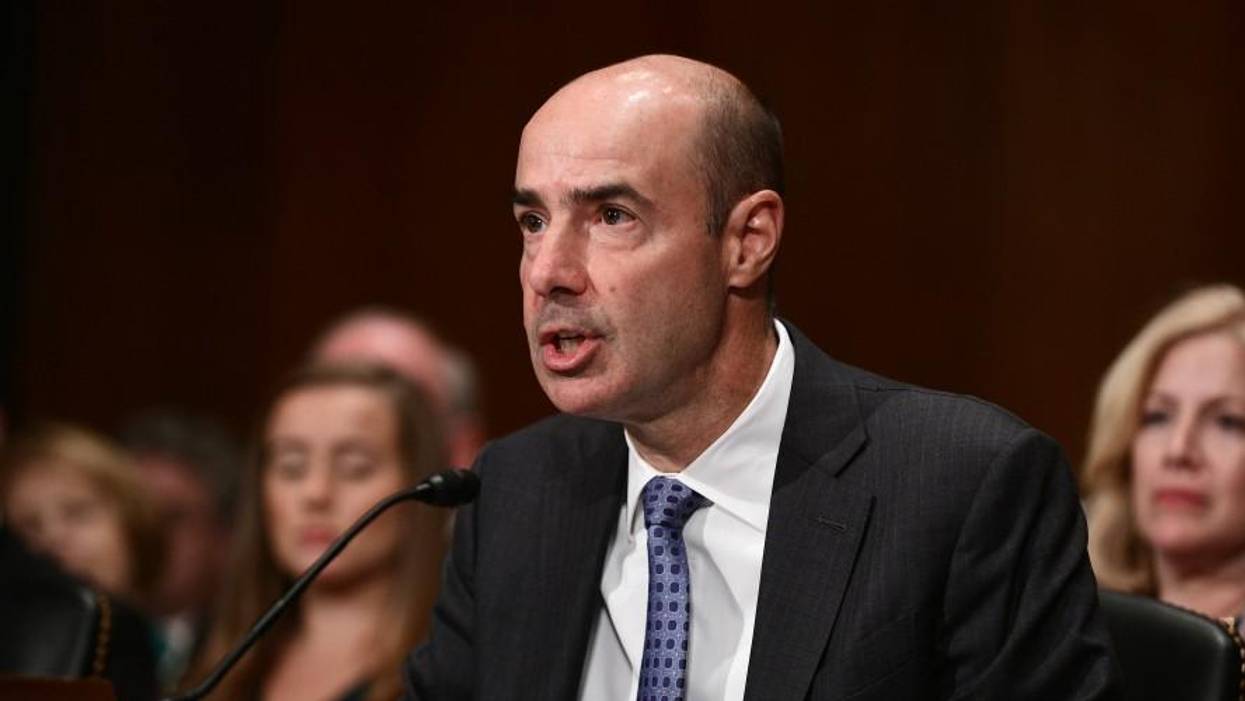
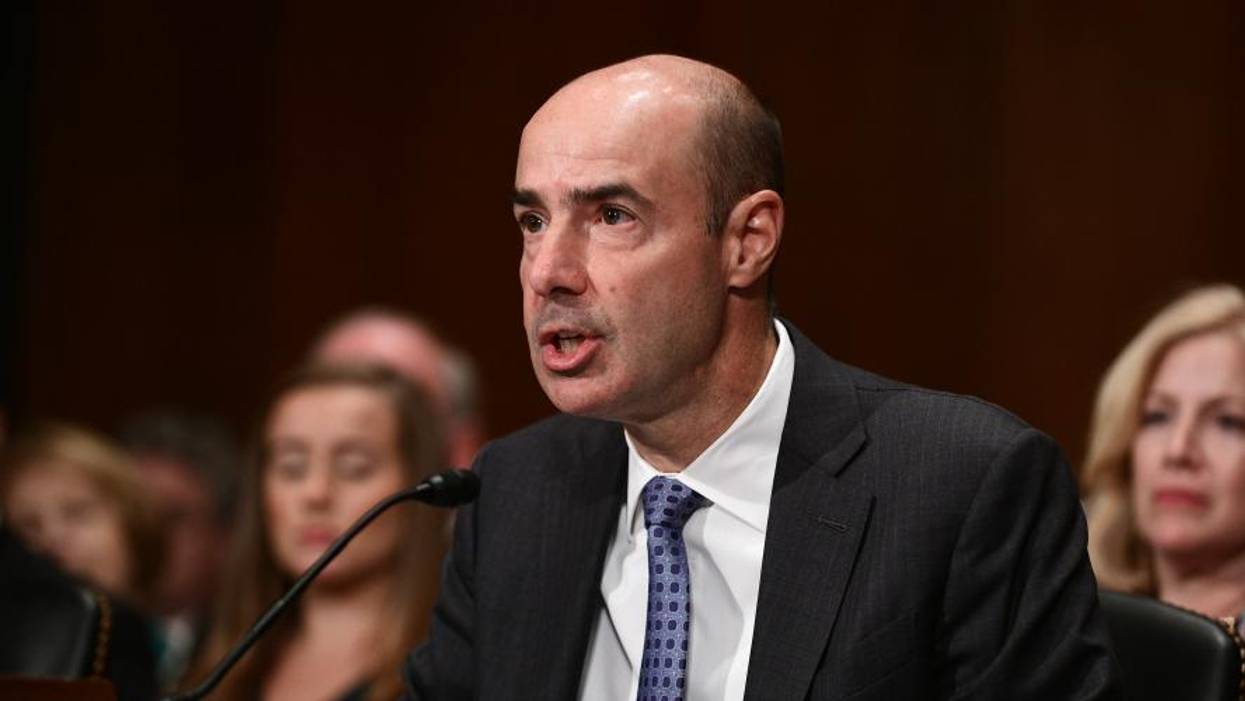
Senate Republicans are under fire from progressive advocacy groups, trade unions, and congressional Democrats for voting Thursday to confirm corporate attorney Eugene Scalia, President Donald Trump's nominee to lead the U.S. Department of Labor.
"For too long, our political system has prioritized the interests of the wealthy at the expense of regular, hardworking Americans," declared Morris Pearl, chair of the Patriotic Millionaires. "Scalia will undoubtedly be yet another stooge for rich and powerful interests at the very agency designed to curb that influence."
"Senate Republicans' decision to confirm him is an absolute betrayal to the American worker," Pearl added.
The new labor secretary, who is the son of late U.S. Supreme Court Justice Antonin Scalia, was confirmed by a 53-44 vote along party lines in the Republican-controlled chamber. Presidential primary candidates Sens. Cory Booker (D-N.J.), Bernie Sanders (I-Vt.), and Elizabeth Warren (D-Mass.) were not present for the vote, but both Sanders and Warren called out their Republican colleagues for approving Scalia, who has spent his career as a private attorney representing big corporations.
Sanders, a longtime advocate for workers, decried Trump's nomination and the Senate's confirmation vote as "obscene."
Warren concurred, tweeting, "This is a disgrace."
Sen. Kamala Harris (D-Calif.), a 2020 White House hopeful who voted against Scalia's confirmation, wrote on Twitter Thursday that "the last person we need in charge of protecting our labor force is someone with a record of putting corporate interests over working people."
Trump nominated Scalia in July, just days after former Labor Secretary Alex Acosta announced his resignation following mass outrage over a sweetheart deal he struck with convicted sex offender Jeffrey Epstein. In the months since then, advocates for workers have raised concerns about Scalia's record as both a partner in the Washington, D.C. office of the corporate law firm Gibson, Dunn & Crutcher as well as the Labor Department's chief legal officer during President George W. Bush's administration.
"Scalia becomes the seventh former lobbyist to hold a Cabinet-level post in the Trump administration," according to The Associated Press. "Disclosure records show Scalia was registered in 2010 and 2011 to lobby for the U.S. Chamber of Commerce."
As Patriotic Millionaires chair Pearl put it: "At every turn, Eugene Scalia has proven himself to be on the side of big corporations and Wall Street."
"He has never advocated for the workers who struggle for basic rights or for the millions of Americans decimated by the 2008 financial crisis," Pearl said. "But as secretary of labor, he will be charged with representing those same interests he's spent nearly two decades ripping apart."
AFL-CIO president Richard Trumka, whose union had implored the Senate to #RejectScalia, said in a statement Thursday that "it is insulting and dangerous that lifelong union-buster Eugene Scalia is the country's top labor official. His track record is well documented, and it's clear he has yet to find a worker protection he supports or a corporate loophole he opposes."
"Making the Labor Department--whose mission is to defend the rights of workers and enforce the law--a satellite office of a corporate right-wing law firm flies in the face of working people's clearly expressed desires," Trumka added.
Emily Martin, vice president for education and workplace justice at the National Women's Law Center, expressed worries about Scalia's oversight of the Labor Department's interpretation and enforcement of anti-discrimination laws.
"Eugene Scalia is charged with protecting working people--yet in his career he has shown no interest in upholding, much less advancing, their rights," said Martin. "For decades he has enabled employers to escape responsibility for protecting workers from discrimination--including sexual harassment, race discrimination, and disability discrimination. He has shown persistent hostility to the worker and consumer protections the Department of Labor is charged to uphold."
Progressive groups and Democratic lawmakers expressed serious concerns Thursday about corporate attorney Eugene Scalia--President Donald Trump's pick to lead the Labor Department--as the Senate Health, Education, Labor, and Pensions Committee met to consider his nomination.
"If there's one consistent pattern in Mr. Scalia's long career, it's hostility to the very workers he would be charged with protecting, and the very laws he would be charged with enforcing."
--Sen. Patty Murray
"Instead of nominating a Secretary of Labor, President Trump has nominated a Secretary of Corporate Interests," declared Sen. Patty Murray (D-Wash.), the committee's ranking member. "If there's one consistent pattern in Mr. Scalia's long career, it's hostility to the very workers he would be charged with protecting, and the very laws he would be charged with enforcing if he were confirmed."
The committee is expected to decide next week whether to advance Scalia, the son of late U.S. Supreme Court Justice Antonin Scalia, to a full Senate vote. Given the Republican majority in the Senate, he is expected to be appointed to the post in Trump's cabinet. However, that has not stopped lawmakers and others from sounding the alarm on Scalia's record as an attorney representing corporate giants like Walmart and the Labor Department's chief legal officer during President George W. Bush's administration.
"Eugene Scalia has demonstrated that he remains committed to protecting corporations over working people and is unfit to lead as Secretary of Labor," Lee Saunders, president of AFSCME, the country's largest trade union, said in a statement after Thursday's hearing.
"In both private practice and as the Labor Department's top attorney, Scalia supported the growth of unchecked corporate power and neglected the welfare of working people," Saunders said. "After the Great Recession, Scalia led financial services industry efforts to challenge the 2010 Dodd-Frank law needed to protect working families."
"He opposed efforts to raise the minimum wage for federal workers and advocated for eliminating the fiduciary rule, which requires financial advisors to work in their customers' best interest," Saunders continued. "Scalia also sided against workers and their unions in lawsuits alleging corporations like Boeing and UPS were retaliating and discriminating against employees."
Urging senators to reject Scalia's nomination, the union leader concluded that "we need a champion for working people in the Department of Labor who will advance standards that protect overtime pay, strengthen workplace safety, and defend workers' rights over corporate interests."
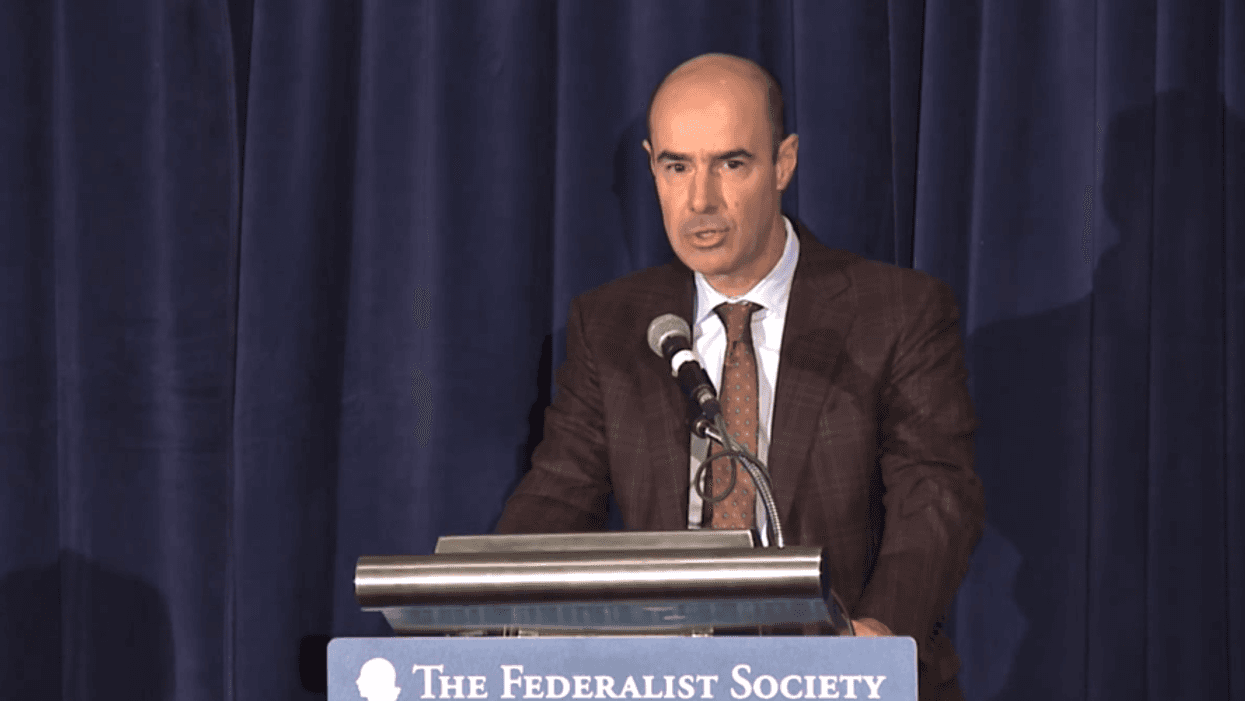
Scalia is a partner in the Washington, D.C. office of the corporate law firm Gibson, Dunn & Crutcher and, like his far-right father, a member of the Federalist Society.
Heidi Hess, co-director of CREDO Action, also released a scathing statement condemning Scalia after the hearing Thursday.
"Eugene Scalia's testimony today proved that if the Senate confirms him as our next Secretary of Labor," she warned, "it would be a huge victory for corporations and an absolute disaster for working families, consumers, and communities of color."
"Scalia cut his teeth as a lawyer by fighting for corporations and making sure big businesses like Walmart, Ford, and UPS made every dollar possible at the expense of workers and consumers," Hess said. "With Scalia in charge, Trump's Department of Labor would go even further down the path of siding with big corporations over workers and the American people."
During the hearing Thursday, Bloomberg Law reported, "Scalia looked to counter Democrat and union criticisms about his representation of many Fortune 500 companies." Several Republicans on the committee indicated that they plan to support his nomination, according to the outlet.
Scalia is preparing to take over the Labor Department at a critical moment in Trump administration workplace policy. An active regulatory agenda is already underway, including a landmark rule to expand overtime pay access that cleared White House review and could be released within the next week.
Lawmakers from both sides of the aisle pressed Scalia on big-ticket ongoing DOL rulemakings that he would inherit if confirmed. But Scalia cited the regulations' incomplete status in avoiding a commitment to take specific actions.
Trump nominated Scalia to the post in July, less than a week after former Labor Secretary Alex Acosta announced his resignation following days of controversy over a sweetheart deal Acosta struck with convicted sex offender Jeffrey Epstein, who killed himself in government custody in August. Some politicians and observers had expected Trump to nominate Deputy Labor Secretary Patrick Pizzella, who has been serving as acting secretary since Acosta's departure.
A well-regulated militia, being necessary to the security of a free State, the right of the People to keep and bear arms shall not be infringed.--Second Amendment to the Constitution of the United States
In the wake of recent mass shootings in El Paso, Texas, and Dayton, Ohio, the biggest obstacle to effective gun control may not be President Trump, Mitch McConnell or even the National Rifle Association (NRA) but the United States Supreme Court.
It's been a long time since the Supreme Court considered a major Second Amendment case. Eleven years ago, the court delivered a landmark victory to the gun-rights lobby in District of Columbia v. Heller--a 5-4 majority decision written by the late Justice Antonin Scalia that ruled, for the first time, the Second Amendment protected an individual right to own and bear firearms.
Heller broke with the great weight of prior scholarship and legal precedent, including the Supreme Court's 1939 decision in United States v. Miller, which held the Second Amendment protected gun ownership only in connection with service in long-since antiquated state militias. And while Heller was technically limited to gun ownership in the nation's capital and other federal venues, the court extended its individual-rights analysis to the states two years later in McDonald v. Chicago, via a 5-4 opinion authored by Justice Samuel Alito.
When the court reconvenes in October, its docket will include a new Second Amendment appeal--New York State Rifle & Pistol Association Inc. v. City of New York--that has the potential to rival or surpass Heller for its impact on gun rights and gun regulation.
At issue is a New York City ordinance adopted in 2001 barring residents from taking their guns outside city limits. The ordinance was challenged in a federal lawsuit filed by the NRA's New York affiliate and three city residents, who argued the regulation was unconstitutional in light of Heller.
The plaintiffs lost at both the district court level and before a three-judge panel of the Second Circuit Court of Appeals, which issued a unanimous decision in February 2018 concluding the ordinance withstood Second Amendment scrutiny under Heller. The Supreme Court agreed in January to review the case.
As the 2nd Circuit noted in its evaluation of the New York ordinance, Heller was technically limited to possession of guns in the home, and by no means precluded reasonable gun legislation outside of it. Scalia wrote in his majority decision:
"Like most rights, the right secured by the Second Amendment is not unlimited. ... Although we do not undertake an exhaustive historical analysis today of the full scope of the Second Amendment, nothing in our opinion should be taken to cast doubt on longstanding prohibitions on the possession of firearms by felons and the mentally ill, or laws forbidding the carrying of firearms in sensitive places such as schools and government buildings, or laws imposing conditions and qualifications on the commercial sale of arms.26"
In footnote 26 of the opinion, placed at the end of the above paragraph, he added:
"We identify these presumptively lawful regulatory measures only as examples; our list does not purport to be exhaustive."
What made Heller and McDonald attractive to the NRA as test cases was that each concerned near-total bans on gun possession by private citizens. Outright prohibitions are rarely easy to justify, and the five-member conservative Supreme Court majority in each instance reinterpreted the Second Amendment to strike down prohibitions.
Like Heller and McDonald, the New York City case presents an outright ban not on ownership, but on the right to bear arms beyond the home.
Realizing it could easily lose before the Supreme Court, New York City announced in June it had amended the transportation ordinance and would henceforth permit licensed gun owners to take their firearms to second homes, businesses or shooting ranges outside city limits. In July, the city filed a formal motion with the Supreme Court, requesting that the case be dismissed because the ordinance was no longer in effect. The court is scheduled to consider the motion in its first closed-door conference of the new term on Oct. 1.
If the Supreme Court consisted of open-minded jurists committed to a fair understanding of the Constitution, the city would likely prevail. Indeed, the case might even offer an opportunity to repudiate Heller as a misguided application of "originalism," the legal theory popularized by Scalia that posits the Constitution should be interpreted according to its meaning for the Founding Fathers.
Along with many other critics of originalism, I believe the Constitution should be read as a "living document," taking into account not only the Constitution's text and history but also giving due consideration to contemporary values, social needs and evolving traditions.
Still, even on strictly originalist grounds, Heller was wrongly decided. As Justice John Paul Stevens explained in his Heller dissent, "the Framers' single-minded focus in crafting the constitutional guarantee 'to keep and bear arms' was on military uses of firearms, which they viewed in the context of service in state militias."
Scalia's majority opinion not only rendered the opening "militia clause" of the Second Amendment meaningless, it also distorted and minimized the historical debate surrounding its inclusion in the Bill of Rights. Those debates, Stevens emphasized, centered on the state militias as antidotes to a burdensome and potentially oppressive permanent standing federal army, not on personal gun ownership.
As Alexander Hamilton argued in Federalist Paper No. 29, militias were seen as "the most natural defense of a free country." Prior to the Constitution's ratification, the Massachusetts militia was called out to quell Shay's Rebellion, the anti-tax protest of farmers in 1786-87 that exposed the weaknesses of the fledgling national government as constructed under the Articles of Confederation. Soon after ratification, the militias of New Jersey, Maryland, Virginia and Pennsylvania were federalized to put down another anti-tax uprising, the Whiskey Rebellion of 1791-94, that had erupted in western Pennsylvania.
In the end, the Second Amendment was worded as a federalist compromise, with the states retaining their right to organize militias and other provisions of the Constitution--for example, Article II, Section 2--clarifying that ultimate control over the militias would vest in the executive branch of the federal government. Personal gun rights were left, as they had been during the colonial period, to the police powers of local government.
Following Heller, historian Jack Rakove of Stanford University panned Scalia's scholarship as an example of shoddy "law-office history," while Fordham University's Saul Cornell called it "a constitutional scam" and "an intellectual shell game in which contemporary political preferences are shuffled around and made to appear part of the Constitution's original meaning."
Tragically for the country, Scalia's revisionist interpretation of the Second Amendment prevailed in Heller, assuming the status of Holy Writ among judges and mainstream politicians.
With the addition of Trump appointees Neil Gorsuch and Brett Kavanaugh, today's Supreme Court may be even more pro-gun than it was when Scalia penned Heller. Should New York City's motion to dismiss be denied, the court could easily extend its decision in radical new directions, imperiling any serious efforts to pass and enforce federal gun control. That prospect should alarm every American anguished by the county's escalating gun violence.
Workers and labor rights advocates expressed outrage after President Donald Trump announced on Twitter late Thursday that he intends to nominate former Walmart attorney Eugene Scalia--son of the late U.S. Supreme Court Justice Antonin Scalia--to replace outgoing Labor Secretary Alex Acosta.
Less than a week after Acosta announced his resignation following days of controversy over a sweetheart plea deal he struck with alleged child rapist Jeffrey Epstein, Trump revealed his nomination plans in a pair of tweets, claiming that Scalia "has led a life of great success in the legal and labor field."
The president's announcement came as a surprise to some politicians and observers who had expected Patrick Pizzella--Acosta's deputy who is temporarily leading the Labor Department--to receive a formal nomination for the role.
Scalia reportedly accepted Trump's offer. The 55-year-old is currently a partner in the Washington, D.C. office of the corporate law firm Gibson, Dunn & Crutcher.
According to The Associated Press:
In private practice, Scalia has been known for his challenges to federal regulations on behalf of corporate clients. Scalia's law firm biography cites his "success bringing legal challenges to federal agency actions."
If confirmed, Scalia will be returning to the department where he previously served as solicitor in President George W. Bush's administration, overseeing litigation and legal advice on rulemakings and administrative law. He has also worked for the U.S. Department of Justice. From 1992-93, Scalia served as a special assistant to Attorney General William Barr during his first stint as attorney general.
Heidi Shierholz, senior economist and director of policy at the Economic Policy Institute, said in a statement Friday that Scalia "has spent his career fighting for the interests of financial firms, corporate executives, and shareholders rather than the interests of working people."
"He actually argued in court against the 'fiduciary' rule, the Department of Labor rule that would have simply required retirement advisers to work in the best interest of their clients--outlawing common practices such as financial advisers steering retirement savers toward investments that provide a good commission, but a lower rate of return," Shierholz pointed out. "This is another fox-guarding-the-hen house selection that defines the Trump cabinet."
Like his infamously far-right father, the younger Scalia "is a member of the Federalist Society, a conservative legal organization that has attained enormous influence within the Trump administration," The New York Times reported Thursday.
"The appointment is likely to be contested by Democrats and labor unions because Mr. Scalia has a long record of representing Walmart and other companies that pushed back against unions and tougher labor laws," the Times noted. "In 2006, he helped Walmart triumph in a prominent fight against a Maryland law that would have required companies with more than 10,000 workers to either spend at least 8 percent of their payroll costs on healthcare, or pay into a state Medicaid fund."
Scalia's history with Walmart--and his broader record as an advocate for corporate interests--sparked swift calls for the Republican-held U.S. Senate to reject his nomination.
"This guy was a management-side attorney for Walmart--one of the most anti-union and anti-worker corporations in our country," tweeted Aryeh Alex, a local public official from Ohio. "The Labor Dept should be a champion for workers, not corporations that pay minimum wages."
Eunic Ortiz, national political communications lead at the Service Employees International Union (SEIU), also referenced the Walmart case in a tweet:
Given his record, critics concluded Scalia "has no business representing working people as your next Secretary of Labor."
"President Trump has again chosen someone who has proven to put corporate interests over those of worker rights," Democratic Senate Minority Leader Chuck Schumer (N.Y.) said Thursday. "Workers and union members who believed candidate Trump when he campaigned as pro-worker should feel betrayed."
This post has been updated with comment from the Economic Policy Institute.