

SUBSCRIBE TO OUR FREE NEWSLETTER
Daily news & progressive opinion—funded by the people, not the corporations—delivered straight to your inbox.
5
#000000
#FFFFFF
To donate by check, phone, or other method, see our More Ways to Give page.
Daily news & progressive opinion—funded by the people, not the corporations—delivered straight to your inbox.
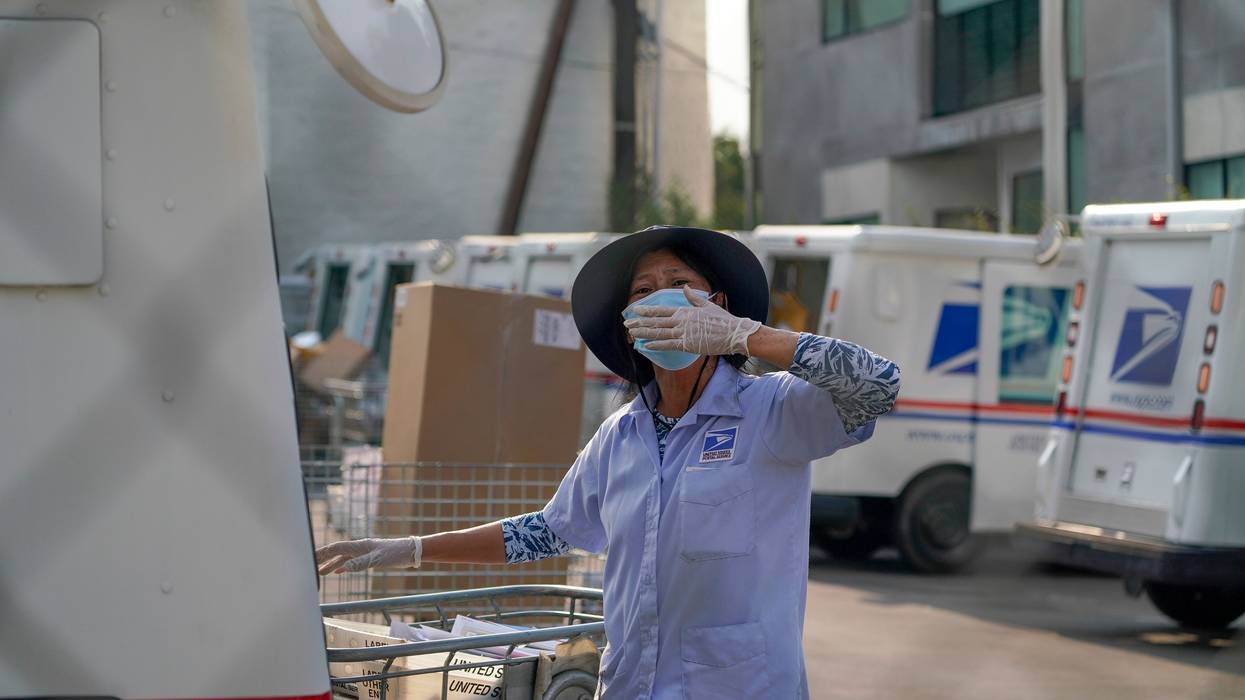
The decision to downgrade postal service standards and eliminate evening collections increases the risk of disenfranchising voters and raising costs for families already struggling to pay their bills.
For over 250 years, Americans have relied on the United States Postal Service for timely processing of their mail, no matter the conditions. After we dropped it in a box or gave it to a letter carrier, we could count on our mail being postmarked on that date so that our bills and tax returns aren’t late and our election ballots are counted.
Unfortunately, this trust is now increasingly risky—since we can no longer rely on USPS to postmark mail on the day it’s collected.
As part of former Postmaster General Louis DeJoy’s broader cost-cutting and restructuring plan, the Postal Service has stopped its practice of picking up mail at the end of every day from all post offices. This means your ballot or bill payment could sit there until the following morning or even longer before being postmarked at a huge processing center.
This gap between mail collection and postmarking is particularly concerning for rural residents, for two main reasons.
To maintain public trust, USPS should restore same-day postmarking and do whatever it takes to protect voting rights for all Americans.
First, the decision to eliminate evening collections applies only to post offices located more than 50 miles from a regional processing center. This raises strong concerns about whether a federal agency with an obligation to provide universal service to all Americans is actively discriminating against rural communities.
Second, rural residents rely especially heavily on our public Postal Service for voting and paying bills. During the 2024 general election, USPS delivered more than 99 million ballots to and from voters. The mail-in option makes voting much easier for rural residents who live long distances from their polling place.
Half of rural county polling sites serve an area larger than 62 square miles, while half of urban polling sites serve an area of less than 2 square miles. Vote by mail is particularly important for seniors, who are more likely to have mobility issues that make it difficult to cast their ballots in person. Americans age 65 or older make up about 20% of all rural residents, compared to just 16% of urban residents.
Older Americans are also more likely to drop a check in the mail rather than paying bills online. According to a USPS survey, 18% of households headed by someone 55 or older paid their bills by mail, compared to just 7% of those aged 18 to 34.
A key reason many rural residents use USPS for bill paying: the digital divide. An Institute for Policy Studies analysis of the 15 most rural states found that only one (North Dakota) had a broadband access rate higher than the national average in 2024. More than 20% of the population lacked broadband access in seven of these states (Alaska, West Virginia, Montana, Alabama, Mississippi, Wyoming, and Iowa).
The decision to downgrade postal service standards and eliminate evening collections increases the risk of disenfranchising voters and raising costs for families already struggling to pay their bills.
These problems are particularly serious as the nation heads into a tense election season. To maintain public trust, USPS should restore same-day postmarking and do whatever it takes to protect voting rights for all Americans, whether they live in the most remote mountain village or the largest city.
Our democracy depends on a strong public Postal Service.
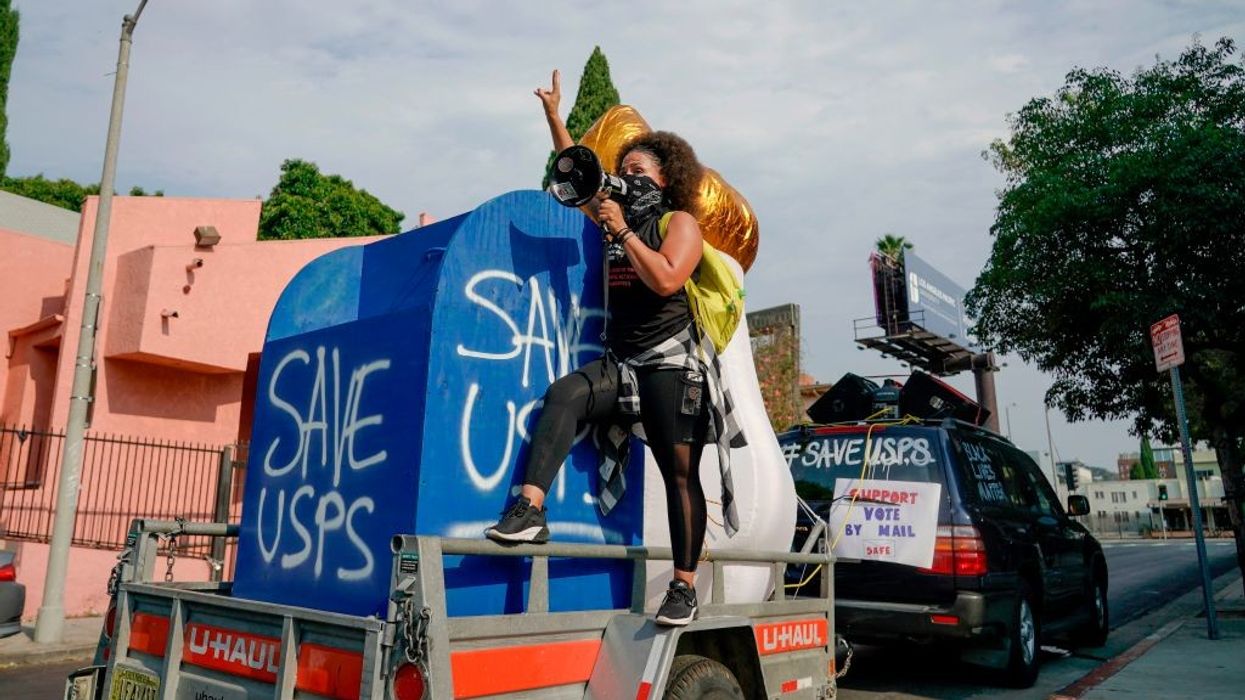
"This is their end goal: the privatization of as much of the U.S. government as possible, enriching the rich and leaving everyone else worse off," warned one progressive.
Elon Musk sparked calls Thursday to fight what one union called an "illegal power grab" after the senior adviser to President Donald Trump and de facto head of the Department of Government Efficiency said that the United States Postal Service and Amtrak, the national passenger rail service, should be privatized.
"I think logically we should privatize anything that can reasonably be privatized," Musk—who is advising Trump on how to eviscerate federal agencies—said while appearing remotely at the Morgan Stanley Technology, Media, and Telecom Conference. "I think we should privatize the post office and Amtrak for example... We should privatize everything we possibly can."
"Basically, something's got to have some chance of going bankrupt, or there's not a good feedback loop for improvement," he opined.
The U.S. Postal Service (USPS) employs more than 600,000 people. Amtrak has more than 21,000 workers.
"Big banks are already drawing up plans for a fire sale of the most profitable parts of our postal network."
Musk called the state of Amtrak "kind of embarrassing" and contrasted the U.S. rail system with the networks of countries including China, where the central government has financed the construction of nearly 30,000 miles (48,200 km) of high-speed lines. The United States has less than 300 miles of high-speed rail.
"Amtrak is a sad situation," Musk asserted. "It's like, if you're coming from another country, please don't use our national rail. It can leave you with a very bad impression of America."
Responding to Musk's remarks, Progressive Mass political director Jonathan Cohn said on social media, "This is their end goal: the privatization of as much of the U.S. government as possible, enriching the rich and leaving everyone else worse off."
Like Musk, Trump has also expressed support for privatizing the USPS, a move recommended by his Office of Management and Budget during his first term. The president also sought to slash Amtrak's funding during his first administration.
Last month, reporting that Trump is seeking to place the USPS under the control of the Commerce Department—which is led by billionaire cryptocurrency banker Howard Lutnick—sparked outrage and allegations of illegality.
"White House sources recently briefed the media that they were planning an illegal power grab of our public Postal Service," the American Postal Workers Union (APWU) said in an email this week responding to ongoing attacks on the USPS. "Such a power grab could allow them to put into action our greatest fear. Stripping our services and selling off our USPS."
"Big banks are already drawing up plans for a fire sale of the most profitable parts of our postal network, raising shipping costs for the public, and leaving taxpayers on the hook to fund the rest," APWU added. "We can't allow this to happen!"
Last month, longtime Postmaster General Louis DeJoy signaled he would step down by asking the United States Postal Service Board of Governors to begin selecting his successor. DeJoy's tenure has been marred by allegations of criminal election obstruction, conflicts of interest, and other corruption. His Delivering for America, a 10-year austerity plan, has been condemned by some critics as a roadmap to privatization.
It's not just the USPS and Amtrak. Key members of the Trump administration and their oligarch allies are pursuing policies and actions opponents argue are ultimately aimed at privatizing a sweeping range of federal agencies and services, from
public education to veterans' healthcare to mortgage lending, Social Security, Medicare, and more.
"The 295,000 active and retired members of the National Association of Letter Carriers have a message to deliver to the White House: Hands off the Postal Service."
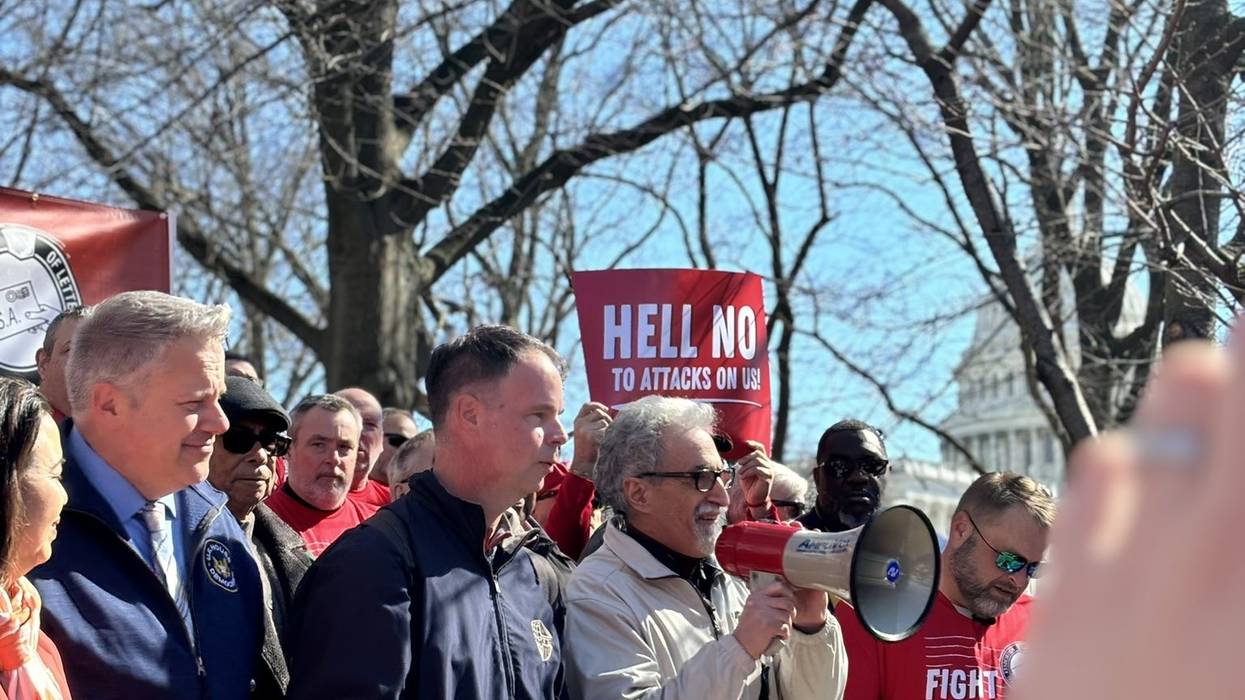
Postal workers and labor movement allies rallied in Washington, D.C. on Monday to protest U.S. President Donald Trump's reported plan to seize control of the independent and beloved Postal Service, a move that could pave the way for full privatization of the country's mail operations.
Monday's rally was organized by the National Association of Letter Carriers (NALC), which said last week that Trump's proposal to bring the Postal Service under the purview of the Commerce Department is "unconstitutional and illegal."
"The 295,000 active and retired members of the National Association of Letter Carriers have a message to deliver to the White House: Hands off the Postal Service," the organization said in a statement after The Washington Post revealed details of the executive order Trump is reportedly preparing to sign.
At Monday's rally, attendees—including letter carriers and union leaders—chanted "Hell no!" and waved signs that read "Fight Like Hell" to display their readiness to oppose any Trump administration takeover of the USPS, which is extremely popular with the American public.
"I want all of my postal worker brothers and sisters to know, this has nothing to do with your performance," Fredrick Redmond, secretary-treasurer of the AFL-CIO, said at the protest. "This has nothing to do with you as workers. You provide the highest level of service to the American people."
"This is about an unmitigated consolidation of power by this administration, power to put more money and more resources in the hands of the billionaires as opposed to spreading the wealth amongst the people who create the wealth every day," Redmond added.
We are standing with @NALC_National today to say #HellNo to dismantling our postal service! We are going to #FightLikeHell to protect our workers and communities! #solidarity pic.twitter.com/Ljr8npqYWL
— Bricklayers & Allied Craftworkers Union (@IUBAC) February 24, 2025
Monday's rally followed protests over the weekend in Portland, Oregon, where postal workers voiced concerns about the future of the USPS under Trump's leadership.
"People in rural areas wouldn't be able to get their medications that they depend on, they might not get mail at all, if it's privatized," Jae Burlingame, a longtime mail carrier, told a local media outlet on Sunday.
According to The Washington Post, Trump is weighing an executive order that would terminate every member of the Postal Service Board of Governors and absorb the USPS into the Commerce Department, which is led by Trump-appointed billionaire Howard Lutnick.
Trump said Friday that Lutnick was "going to look at" potential USPS changes and touted the billionaire's "great business instinct."
"Your reported plans for the Postal Service would put at risk the timely, affordable delivery of life-saving medications, mail-in ballots, important financial documents, and letters from loved ones."
The Postal Service is currently self-funded, relying on the sale of postal services and products such as stamps rather than tax revenue.
CNN noted Friday that "other countries have privatized their postal services in the past. But a plan to privatize the 250-year old service that predates the formation of the United States could dramatically change the way Americans receive deliveries, and even who would be able to get service."
"Current law requires the USPS to deliver to all addresses, even rural ones that are too costly for a private business to serve profitably," the outlet added. "Even many online purchases handled by private companies such as United Parcel Service depend upon the Postal Service to handle the 'last mile' of delivery to homes."
Christy Hoffman, president of the UNI Global Union, said last week that "we have seen the perils of privatizing postal services in Europe, which have led to reduced services, increased prices, job losses, and cut off rural communities where it is unprofitable to deliver mail."
"Instead of privatizing USPS," Hoffman added, "Trump should be supporting the Postal Service to seize opportunities in e-commerce, expand services, particularly to marginalized and remote communities, and safeguard a precious, public-owned, communication network that is ultimately irreplaceable."
In a letter to the U.S. president over the weekend, a group of Democratic lawmakers led by Rep. Gerry Connolly (D-Va.)—who attended Monday's rally—warned that the "unprecedented and reckless plan to dismantle the Postal Service as an independent agency would directly undermine the affordability and reliability of the U.S. postal system."
"Congress prescribed a clear and critical mandate for the Postal Service: to deliver efficient, reliable, and universal service to all Americans," the lawmakers wrote. "Your reported plans for the Postal Service would put at risk the timely, affordable delivery of life-saving medications, mail-in ballots, important financial documents, and letters from loved ones, especially in rural or less-profitable areas that the private sector refuses to service."
"We urge you to immediately withdraw all plans to dismantle one of our nation's most cherished public institutions and uphold the Postal Service's independent status as required by law," they added.
"The fact that Louis DeJoy still has a job is a failure of the Biden administration," said former Ohio state Sen. Nina Turner.
U.S. Postmaster General Louis DeJoy is asking the United States Postal Service Board of Governors to begin selecting his successor, signaling the approaching end of his controversial tenure and stoking fears that, influenced by President Donald Trump—who says he's considering privatizing the federal agency—the Republican-dominated board will choose an even more contentious replacement.
"While there remains much critical work to be done to ensure that the Postal Service can be financially viable as we continue to serve the nation in our essential public service mission, I have decided it is time to start the process of identifying my successor and of preparing the Postal Service for this change," DeJoy said in a statement Tuesday.
"After four-and-a-half years leading one of America's greatest public institutions through dramatic change during unusual times, it is time for me to start thinking about the next phase of my life, while also ensuring that the Postal Service is fully prepared for the future," he added.
In response, U.S. Postal Service (USPS) Board of Governors Chair Amber McReynolds said that DeJoy "has steadfastly served the nation and the Postal Service over the past five years" and hailed "his enduring leadership and his tireless efforts to modernize the Postal Service and reverse decades of neglect."
However, DeJoy's tenure has been marred by allegations of criminal election obstruction, conflicts of interest, and other corruption. Critics also decried Delivering for America, a 10-year austerity plan that opponents said put the USPS on a fast track toward slower service, job cuts, and, ultimately, privatization. The plan also contains the currently delayed consolidation of USPS facilities, a policy opposed by 200,000-member American Postal Workers Union (APWU).
Postmaster General Louis DeJoy has notified the USPS Board of Governors that it's time for them to identify his successor. It remains to be seen if they find someone worse or privatize the USPS. I said it countless times in the hellscape, and I'll repeat it again here: DeJoy deserves deJail.
— The Shallow State ( @ourshallowstate.bsky.social) February 18, 2025 at 7:54 AM
DeJoy—who had no previous USPS experience and came directly to the agency from the board of a privately owned competitor—was a major donor to Trump and the Republican National Committee before being installed as postmaster general in May 2020 by Trump-appointed members of the USPS Board of Governors.
While DeJoy detractors hoped that former President Joe Biden would fire the embattled postmaster general after winning the White House in 2020, he enjoyed a surprising second act during Biden's tenure. He embraced fleet electrification, although he was later accused of "dragging his feet" on the EV rollout and for his efforts to cut tens of thousands of jobs, consolidate operations, and hike customer prices. For example, the price of a first-class postage stamp was 55 cents when DeJoy entered office. Now it's 73 cents.
Trump's return has also brought back the specter of postal privatization. The Republican president has repeatedly said that his administration is considering privatization. During Trump's first term, his Office of Management and Budget recommended that the USPS—a constitutionally sanctioned agency with more than 600,000 employees—be privatized.
Pro-privatization GOP lawmakers have called on Elon Musk's Department of Government Efficiency (DOGE) to find ways to stem USPS financial shortcomings, which approached $10 billion last fiscal year, largely due to mandated pension contributions it is forced to pay each year. But the USPS also raked in $79.5 billion in revenue last year, and pro-privatizers are keen for a piece of that action.
"DOGE is a question of billionaire oligarchs trying to figure out how to get more money into their private profits. So all of this stuff about efficiency is really a cover for that, and that also carries over to those who want to privatize the Post Office," APWU president Mark Dimondstein told Mother Jones' Alex Nguyen in an interview published in the magazine's March-April edition.
"The Post Office takes in about $80 billion a year in revenue," Dimondstein added. "Those on the private side of the industry want their hands on that money because when it's in the public domain, they can't use it to generate private profits."
Some observers questioned the timing of DeJoy's planned departure, while others fear he "will be replaced by someone somehow undoubtedly even worse," as one social media commentator put it.
DeJoy's successor will be chosen by a USPS Board of Governors made up of three Republicans, two Democrats, and one independent member.
Brian Renfroe, president of the National Association of Letter Carriers—which is locked in a contract battle with USPS management—said Tuesday that "in its search for the next USPS leader, NALC urges the Board of Governors to seek out an individual with the necessary experience and expertise to lead the agency at this critical time."
"We need someone who values the workforce and is committed to preserving and improving universal service," the union added. "The Postal Service is older than our country and is mandated in the Constitution. The next postmaster general must guarantee that letter carriers can continue safely performing their constitutionally mandated service in every community nationwide."
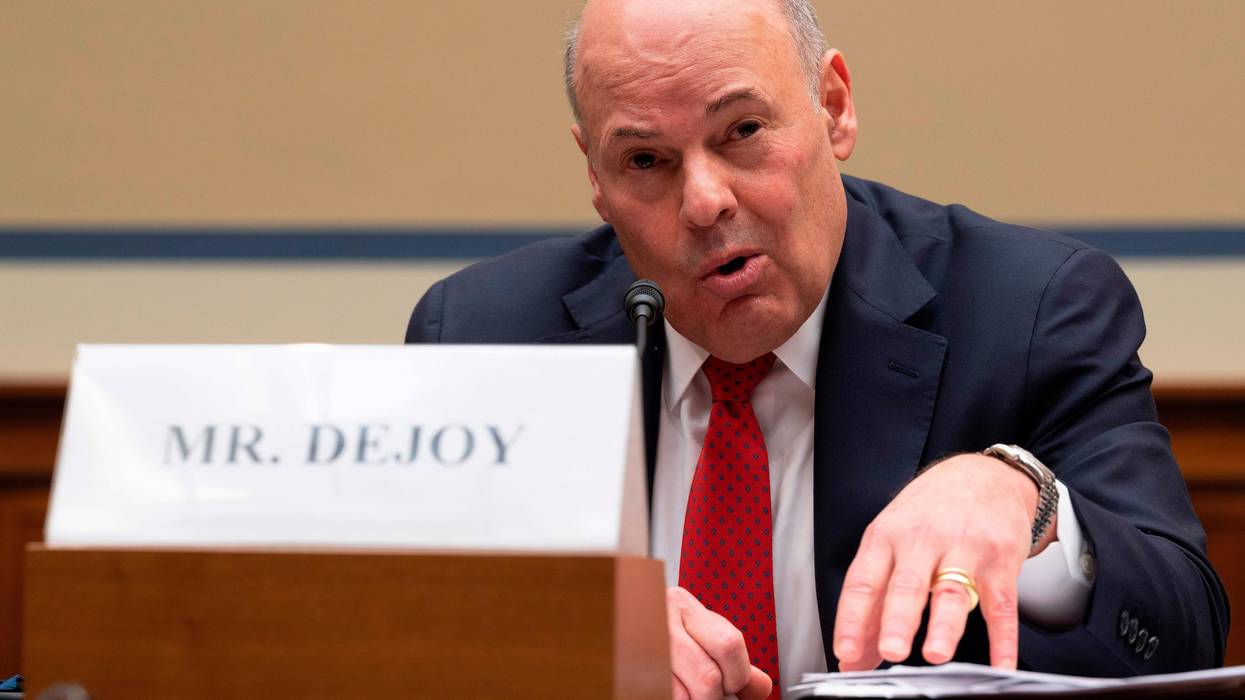
Defenders of the U.S. Postal Service are warning about an austerity plan by the Trump-appointed postmaster general that "will slash jobs and shrink processing centers and post offices."
As the U.S. Postal Service Board of Governors on Thursday held a meeting in Washington, D.C., frustrated USPS workers, customers, and union officials rallied outside to protest a new limit on public comment and the agency's austerity plan.
While the quarterly meetings have previously included an hour of in-person and virtual public testimony, the USPS board has shifted to only taking comments once annually, a move that outraged critics of Postmaster General Louis DeJoy—a GOP donor appointed under former President Donald Trump—and his 10-year "Delivering for America" plan.
"We won't be silenced!" read signs held by protesters on Thursday that urged the board to allow public testimony.
"Let us tell the truth about DeJoy's 10-year plan," the signs added, calling for an end to cuts, closures, and mail delays.
"Thousands of postal jobs will be eliminated, and tens of thousands of employees will be faced with relocating to a new job, possibly a couple of hundred miles away, or ending their careers at the Postal Service."
In a statement about Thursday's protest, an American Postal Workers Union local and Communities and Postal Workers United noted that opponents of the plan have long argued it "will slash jobs and shrink processing centers and post offices."
The groups pointed to recent remarks from Steve Hutkins, a retired New York University English professor who runs the advocacy group and website Save the Post Office.
"Thousands of postal jobs will be eliminated, and tens of thousands of employees will be faced with relocating to a new job, possibly a couple of hundred miles away, or ending their careers at the Postal Service," he told The Guardian in December.
"The consolidations will also create excess space in processing facilities that will then be used to house a sorting and delivery center, which relocates letter carriers away from post offices," Hutkins explained. "The carriers will need to drive 10 or 20 miles to their routes, which will increase costs and pollution."
"And the excess space at the post office, where the carriers used to work, will lead to post office closures and relocations of retail services to smaller spaces," he warned. "In the meantime, postal rates go up, volume goes down, jobs are eliminated, service deteriorates."
There are currently two empty spots on the USPS board. As Common Dreams reported last week, dozens of Democrats led by Congressmen Jamie Raskin (D-Md.) and Raja Krishnamoorthi (D-Ill.) urged U.S. President Joe Biden to "swiftly" fill those seats.
"Despite the passage of the Postal Service Reform Act, the Postal Service still faces a litany of challenges," they wrote. "Five price hikes since 2020, continual service delivery problems, and constant declines in mail volume are all indicators that the business model of the Postal Service needs careful attention."
Welcoming the Democrats' letter, Revolving Door Project senior researcher Vishal Shankar declared that "Americans are fed up with DeJoy's mismanagement of USPS. From his fanatical devotion to price hikes, mail slowdowns, and job cuts to his refusal to build the next-gen postal fleet fully union and electric, Louis DeJoy keeps demonstrating he is grossly unfit to lead USPS."
"America desperately needs a postal board that will end DeJoy's destructive agenda to privatize the post office," Shankar added. "I applaud House Democrats for speaking out at a critical time for USPS—President Biden must stop dragging his feet on these nominations, and take the bipartisan win of saving the people's most treasured public institution. After a yearlong delay, it's past time for the president to fill these seats with public servants who will protect and expand our public Postal Service—not more corporate hacks who will enable DeJoy."
This post has been updated to clarify that Louis DeJoy was appointed under but not by former President Donald Trump.
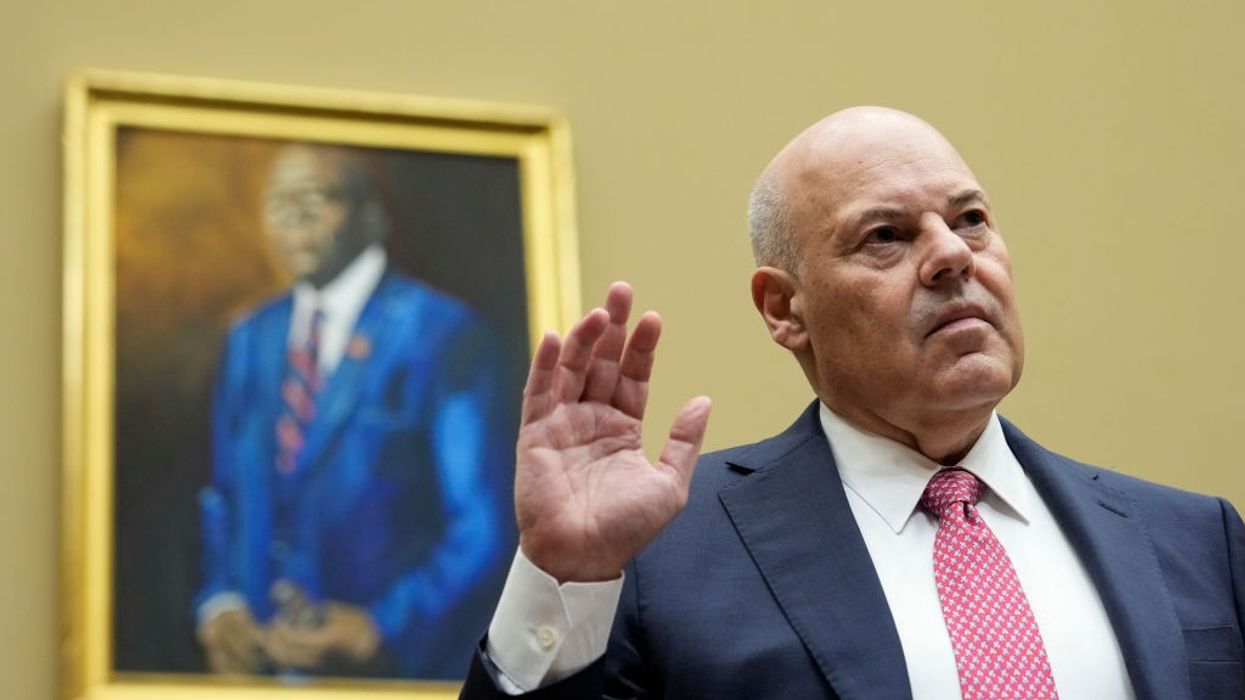
"DeJoy's 10-year plan appears to put the USPS on a fast track towards privatization, job cuts, negatively impacted service operations, and a culture of general dysfunction at one of our country's bedrock institutions."
Citing the concerns of postal employees in her district, U.S. Congresswoman Rashida Tlaib on Thursday asked the head of the United States Postal Service's accountability unit to launch an investigation into the impacts of Postmaster General Louis DeJoy's 10-year plan, an austerity overhaul critics warn could eviscerate one of the federal government's most venerable—and popular—agencies.
"DeJoy's 10-year plan appears to put the USPS on a fast track towards privatization, job cuts, negatively impacted service operations, and a culture of general dysfunction at one of our country's bedrock institutions," Tlaib (D-Mich.) wrote in a letter to U.S. Postal Service Inspector General Tammy Hull.
DeJoy, a major donor to then-President Donald Trump and the Republican National Committee, was installed as postmaster general in May 2020 by Trump-appointed members of the USPS Board of Governors. His appointment came after Trump's Office of Management and Budget recommended that the USPS—a constitutionally sanctioned agency with more than 600,000 employees—be privatized.
"I have spoken with countless USPS employees and managers in my area, all of whom are highly concerned that the 10-year plan poses a serious risk to the fundamental capabilities of the USPS."
The following March, DeJoy unveiled a 58-page 10-year-plan, Delivering for America, that contained austerity measures like reduced hours at some post offices, longer delivery times, consolidation of mail processing operations, and elimination of extra delivery trips. DeJoy said the plan would save the agency $160 billion over 10 years while making the postal service more efficient in the face of stiff competition from private-sector delivery services.
Critics, however, contended that the plan was part of a scheme whose ultimate objective was privatizing the postal service. Rep. Gerry Connolly (D-Va.), who at the time chaired the House Subcommittee on Government Operations, warned that the "draconian" proposal "guarantees the death spiral" of the USPS.
DeJoy has enjoyed a surprising second act during the Biden administration, as he has embraced policies including fleet electrification—although opponents argue he should still be fired for "dragging his feet" on the EV rollout and for his ongoing efforts to cut tens of thousands of jobs, consolidate operations, and hike customer prices.
In her letter, Tlaib asks Hull's office to find the answers to questions including:
"Just as I have a responsibility to advocate for my residents at the federal level, USPS has a responsibility to ensure the highest level of service is provided to the public," Tlaib wrote in her letter. "I have spoken with countless USPS employees and managers in my area, all of whom are highly concerned that the 10-year plan poses a serious risk to the fundamental capabilities of the USPS."

USPS leadership shifted from committing to only 5% electric vehicles at the outset of the project to 62% as of their last announcement; this is certainly movement, but it’s far from the 95% that experts recommended.
For as much as we’ve heard Postmaster General Louis DeJoy talk about the need for “dramatic change” at U.S. Postal Service when it comes to the more disruptive elements of his 10-year plan, he has consistently resisted modernizing the postal fleet to reflect the market shift to electric vehicles. His own words just don’t seem to apply to the long overdue shift from gas guzzlers with the fuel efficiency of a Hummer to a climate-friendly 95% electric fleet built by 100% union labor.
USPS recently released its latest draft supplemental environmental impact statement (SEIS) for Next Generation Delivery Vehicles (NGDV) Acquisitions ahead of a public hearing Wednesday, July 26. This latest draft SEIS is the post office’s second attempt at an environmental impact statement after their first one projected gas prices to be $2 a gallon less in the future and deployed other ludicrous math to make the case for combustible vehicles, only to be sued by several different parties for their wildly inaccurate claims. Due to immense public pressure and some close White House hand-holding over the course of last year, USPS leadership shifted from committing to only 5% electric vehicles at the outset of the project to 62% as of their last announcement.
This is certainly movement, but it’s far from the 95% that experts recommended and that is closer in line with private sector carriers’ plans. Even the Postal Service’s own Inspector General has concluded that at least 95% of postal routes could be serviced by electric vehicles. The IG found that zero-emissions electric trucks would be cheaper for the USPS over the full life cycle of the fleet–costing less to buy, fuel, and maintain than conventional fossil fuel-powered vehicles.
National climate priorities have particular urgency right now when the force of extreme weather is causing so much havoc and loss.
The increase to 62% did not come easily from DeJoy, either: There were a string of lawsuits and consistent calls from the community alongside climate and labor groups. As the Save the Post Office Coalition pointed out in a June 30 statement, this latest draft SEIS “is disappointing, particularly as it comes out of last summer’s hearing where USPS heard loud and clear from postal workers and communities in an overwhelming majority of public comments calling for a union-built, all-electric fleet. Frontline Black and Brown communities are being poisoned by heavy trucks with combustion engines, and mail carriers who drive postal trucks are particularly affected from vehicle idling which releases high levels of localized air pollution.”
Media outlets gave DeJoy a favorable reception last December for USPS’s third move towards a larger share of EVs, even though it falls 33% short of where it needs to be. It is important to note that the current EV commitment is not 75% of the entire fleet as reported; it is only the purpose-built NGDVs—when including all vehicles including commercial off-the-shelf ones, the total share of the fleet that’s electric is just 62%.
This saga has demonstrated again that Louis DeJoy is more focused on short-term cost-cutting than long-term smart solutions for USPS’s future. DeJoy’s leadership approach was to dig his heels in, rather than look to the future, and this is dangerous. National climate priorities have particular urgency right now when the force of extreme weather is causing so much havoc and loss. But it’s also just fundamentally at odds with what the people want for their most treasured public institution: a healthy USPS that changes with the times. Louis DeJoy is proving once again that he’s not able to deliver that.

"Any increase in E.V. acquisition at USPS is in spite of DeJoy, not because of him."
Postmaster General Louis DeJoy's widely praised announcement last week that the Postal Service will buy tens of thousands of electric vehicles in the coming years to help replace its aging delivery fleet should not be enough to save the scandal-plagued USPS chief's job, advocates said, pointing to his refusal to support a more ambitious electrification plan and his ongoing efforts to slash jobs, consolidate mail facilities, and hike prices for consumers.
"The bottom line is that any increase in E.V. acquisition at USPS is in spite of DeJoy, not because of him," Vishal Narayanaswamy of the Revolving Door Project, told The New Republic's Kate Aronoff. "Electrification would be proceeding much faster if we had a board that could fire him."
DeJoy, a Trump and GOP megadonor, was selected to serve as postmaster general in May 2020, and even news last year that he was facing an FBI investigation for potentially unlawful campaign finance activity during his time as a private logistics executive wasn't enough to harm his job security.
The postmaster general is chosen by—and can only be removed by—the USPS Board of Governors, a body composed of nine officials nominated by the president.
In the face of massive pressure to force out DeJoy, Biden has nominated and the narrowly Democratic Senate has confirmed five board governors, giving the president's picks a majority on the postal board and enough votes to remove the postmaster general, who does not serve a fixed term.
While Biden's nominees have raised questions and concerns about DeJoy's 10-year plan to overhaul USPS operations, calling it "strategically ill-conceived" and "dangerous," they have yet to mount a serious push for his removal.
"Electrification would be proceeding much faster if we had a board that could fire him."
Narayanaswamy lamented that the White House, too, appears uninterested in ousting DeJoy. The Biden administration "does not seem to care about replacing DeJoy and has more or less dropped it as a priority," Narayanaswamy told Aronoff, who argued in a column last week that "the potential of the USPS to propel an energy transition will continue to go untapped" as long as DeJoy is at the helm.
Though the new electric vehicle plan is a significant improvement over DeJoy's earlier proposal—which called for the purchase of 90% gas-guzzling trucks—"the USPS only plans to electrify 40% of its fleet" in total, Aronoff noted.
"The newly announced purchases also only represent about 10% of the existing federal fleet of cars, SUVs, and trucks, which is the largest in the world," Aronoff continued. "That means the majority of the fleet will still run on gasoline for the foreseeable future. What's more, the internal combustion engine–powered versions of the USPS's 'Next Generation Delivery Vehicles,' or NGDVs, get just 8.6 miles per gallon."
"The potential for the USPS to act as an engine of decarbonization and set industry-wide standards for electrification is vast. But DeJoy—who's talked repeatedly about downsizing and privatizing the USPS and has lucrative ties to private logistics firms—is unlikely to see things that way," she added. "It's still possible for Biden to replace pro-DeJoy members of the USPS Board of Governors, paving the way for them to replace DeJoy himself."
Two Trump-nominated board members who have defended DeJoy—Donald Moak and William Zollars—are currently in holdover years after their terms expired earlier this month, but Biden has yet to announce any new board picks despite grassroots pressure.
In late October, the Save the Post Office Coalition—a network of more than 300 public interest groups—urged Biden to replace Moak and Zollars with retiring Rep. Brenda Lawrence (D-Mich.) and policy expert Sarah Anderson.
Before her election to Congress, Lawrence worked for the Postal Service for three decades. Anderson, director of the Global Economy Project at the Institute for Policy Studies, has written about and researched the USPS for years, and her grandfather was a Postal Service employee.
"Congresswoman Lawrence and Ms. Anderson are public servants who would bring needed perspectives and expertise to the USPS Board of Governors at a time when the nation is looking to the board to start asking the tough questions of Louis DeJoy," said Porter McConnell, co-founder of the Save the Post Office Coalition.
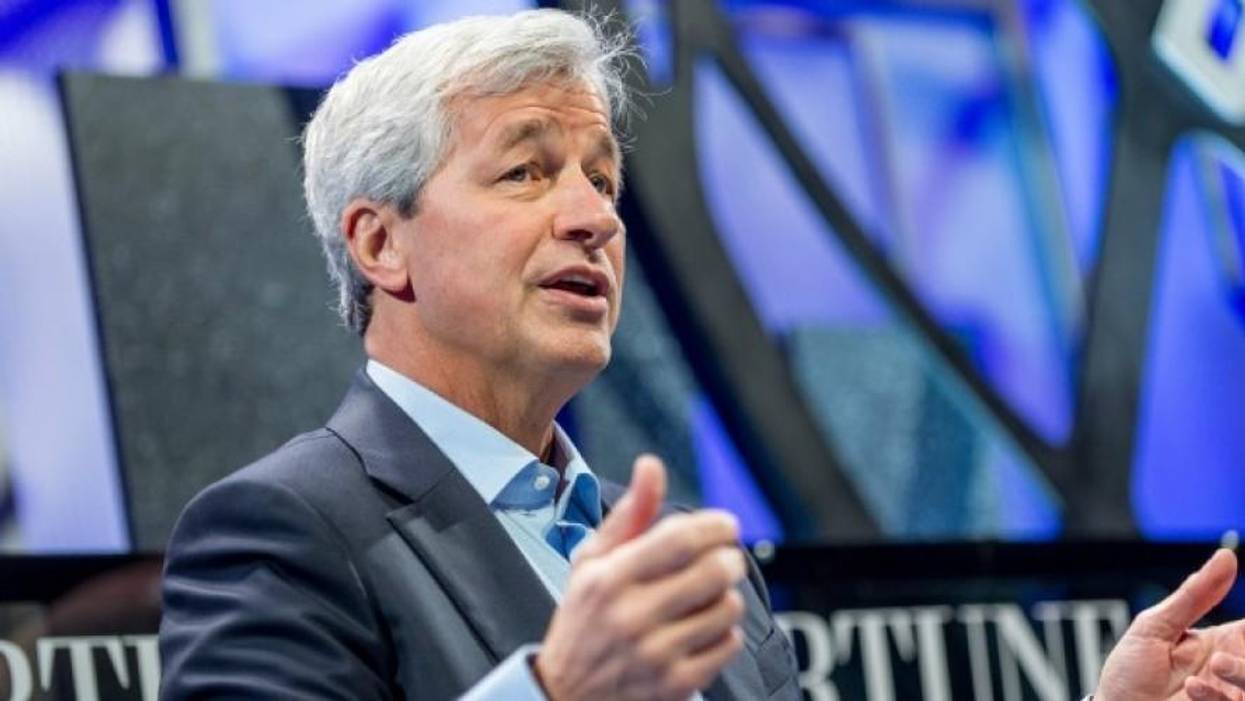
Imagine if activists and elected officials were clamoring for emergency provision of food and McDonald's offered to place a drive-thru window in every post office. Calling it #postalfood. That makes as much sense as JPMorgan Chase's recent attempt to place its own ATMs in every post office and call it #postalbanking.
According to recent reports, JPMorgan Chase -- the largest bank in the United States, with $3.2 trillion of assets -- has offered to lease space from USPS in exchange for the "exclusive right" to solicit postal banking customers.
First off, let's be clear: this is not "postal banking." As Mehrsa Baradaran told Fast Company right after the news broke, "having a private middleman defeats the entire purpose of postal banking, which is a public bank competing against banks like JPMorgan Chase."
Although some advocates have discussed ways private sector entities might facilitate postal banking -- aiding in the provision of savings and checking accounts, electronic money transfers, cash and coin conversion, bill payment services, etc. -- most proposals envision USPS, in conjunction with the Federal Reserve or the Treasury Department, taking the lead and retaining control.
That's because postal banking is about building on the core fact that USPS is legally required to serve everyone at uniform price and quality, without centering the profit motive...like JPMorgan Chase does. Even if this Wall Street bank were to successfully place an ATM in every post office branch, people without the appropriate accounts would still be unable to use them. And people without JPMorgan Chase accounts wouldn't be able to use the ATM without paying higher fees.
Although many advocates envision postal branches housing ATMs, the plan would entail free usage, at least for people using Treasury Direct Express cards and other government payment services. From a financial inclusion standpoint, JPMorgan Chase's proposal accomplishes nothing -- except for giving an already large and powerful bank an unfair advantage.
Secondly, the involvement of a multinational bank complicates the privacy and security dimensions of postal banking. As a general rule, unlike private businesses, USPS only collects information necessary to satisfy a statute or executive order. Legal firewalls prevent USPS from sharing information with other government agencies, to say nothing of third party corporations. But if a private bank has access to the data, these protections collapse.
Finally, experts at the Action Center for Race and the Economy (ACRE), a member of the Take on Wall Street coalition, have pointed out, JPMorgan Chase has a particularly troubling history when it comes to racial discrimination. The bank has historically refused to provide proper branch services in immigrant and low-income neighborhoods of color in major cities. It has been the fossil fuel industry's biggest backer. The trade associations that represent them and other big banks have donated tens of thousands of dollars to the campaigns of white supremacist Congressional candidates.
Private-sector partnerships might save the USPS some money. They might not. But revenue generation is not the primary point of postal banking. The point is the people. Wall Street has consistently opposed the return of postal banking since its destruction in the 1960s. JPMorgan Chase and other nefarious actors are attempting to prevent competition before it even forms. The 2020 Democratic Party Platform and Biden-Sanders Unity Task Force recommendations both call for postal banking. But they also call on policymakers to separate retail banking institutions from more risky investments and protect consumers from high rates, onerous fees, inequitable credit reporting, and other harms. Allowing a multinational megabank like JPMorgan Chase to hawk its own products within public infrastructure only undermines these goals.

JPMorgan Chase, the largest financial institution in the United States, is reportedly in talks with the U.S. Postal Service about a proposal to set up ATMs in post offices in several states across the country--a plan critics warned is an effort to eliminate the possibility of a public postal banking system.
Capitol Forum reported Wednesday that the Postal Service--currently headed by Louis DeJoy, a Republican megadonor to President Donald Trump--is "considering a proposal from JPMorgan Chase (JPM) to offer banking services in post offices in a move that could give the Wall Street giant an exclusive right to solicit postal customers."
"This wouldn't expand services for the unbanked, wouldn't change the terms that put big bank financial services out of reach for poorer people. It's designed just to stop postal banking."
--David Dayen, The American Prospect
A recent internal USPS planning document obtained by Capitol Forum says "the Postal Service is in discussions with JPMorgan Chase concerning a potential limited pilot test of ATM and other banking services located on Postal Service premises in several states." One anonymous source told Capitol Forum that the pilot would involve the Wall Street giant "leasing space from the Postal Service."
Sen. Sherrod Brown (D-Ohio), the top Democrat on the Senate Banking Committee and author of postal banking legislation, slammed the reported plan as yet another destructive Wall Street power-grab.
"What JPMorgan Chase wants to do looks like another attempt for big banks and corporations to privatize our public infrastructure so their shareholders gain while working families suffer," Brown told the New York Times, which confirmed Capitol Forum's reporting on the talks between USPS and JPMorgan Chase.
Times reporter Emily Flitter noted that big banks have long been fervently opposed to the idea of a USPS-provided banking system. "If JPMorgan had ATMs and other facilities in post offices, it could make it harder for postal banking to become a reality," Flitter tweeted Wednesday. "Banks oppose the idea of postal banking because it would represent another source of competition for them."
"A people's post office would offer banking services to compete with JPMorgan and the other big Wall Street (too-big-to-fail) banks, now ripping off Americans with exorbitant fees. Instead, USPS is now considering partnering with JPMorgan to set up its banks inside post offices."
-- Robert Reich
David Dayen, executive editor of The American Prospect, warned that the plan being explored by JPMorgan Chase and the USPS "would be no more than a rental of ATM space in exchange for the elimination of a potential rival before it gets going."
"This wouldn't expand services for the unbanked, wouldn't change the terms that put big bank financial services out of reach for poorer people," said Dayen. "It's designed just to stop postal banking from being offered with an exclusivity agreement. It's more an antitrust violation than a deal."
News of the talks between Wall Street and the USPS comes as DeJoy is facing massive public backlash over changes to mail operations that postal workers believe are designed to pave the way for privatization of the most popular government institution in the country. On Tuesday, DeJoy vowed to suspend--but not reverse--his policy changes until after the November election.
Economist Robert Reich tweeted Wednesday that "a people's post office would offer banking services to compete with JPMorgan and the other big Wall Street (too-big-to-fail) banks, now ripping off Americans with exorbitant fees."
"Instead," Reich wrote, "USPS is now considering partnering with JPMorgan to set up its banks inside post offices."