SUBSCRIBE TO OUR FREE NEWSLETTER
Daily news & progressive opinion—funded by the people, not the corporations—delivered straight to your inbox.
5
#000000
#FFFFFF
To donate by check, phone, or other method, see our More Ways to Give page.
Daily news & progressive opinion—funded by the people, not the corporations—delivered straight to your inbox.
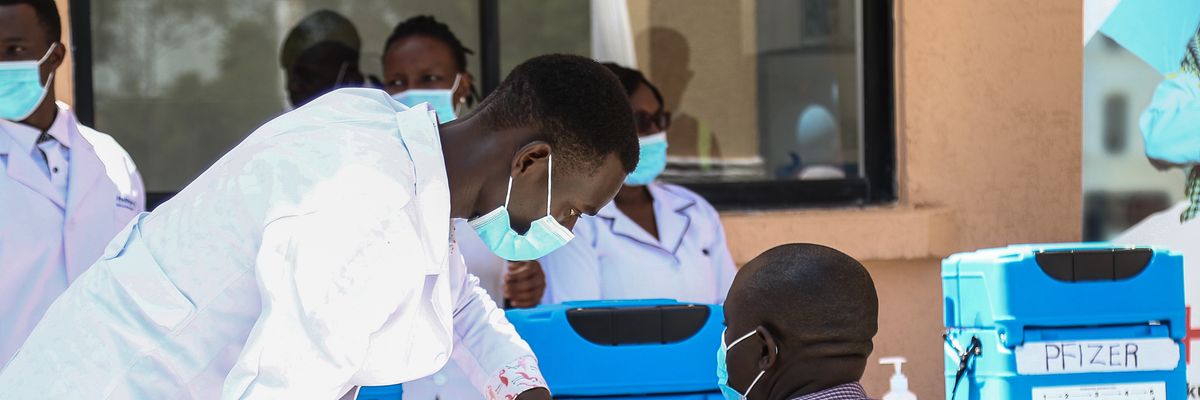
A medical officer administers a Covid-19 vaccine jab to a man at the Nakuru County Referral and Teaching Hospital in Kenya on June 6, 2022.
"The global response to Covid-19 failed the world's most vulnerable, prioritizing windfall profits ahead of public health," said one expert, calling on world leaders to "make structural changes in global health."
The World Health Organization's declaration Friday that Covid-19 is no longer a global health emergency elicited fresh calls for learning from the pandemic and dramatically expanding access to prevention and treatment for diseases in the future.
"Covid-19 may no longer be classified as the highest level of international emergency, but the virus has not gone away," said Dr. Mohga Kamal-Yanni, policy co-lead of the People's Vaccine Alliance, a global coalition working toward equitable access to medical technologies that help to prevent and respond to Covid-19 and future pandemics.
"There are billions of people in developing countries who still cannot access affordable Covid-19 tests and treatments," Kamal-Yanni stressed. "They need action from governments to remove the intellectual property barriers that prevent the widespread production of generic medicines."
"Rich countries behaved shamefully in this pandemic, upholding pharmaceutical monopolies and grabbing vaccines, tests, and medicines for their people, pushing developing countries to the back in the line."
WHO Director-General Tedros Adhanom Ghebreyesus said Friday that while the agency has documented almost 7 million deaths from the virus, "we know the toll is several times higher—at least 20 million." A study published last year in Nature and cited by the People's Vaccine Alliance estimates that 1.3 million fewer people would have died by the end of 2021 if Covid-19 vaccines were equitably distributed.
"Rich countries behaved shamefully in this pandemic, upholding pharmaceutical monopolies and grabbing vaccines, tests, and medicines for their people, pushing developing countries to the back in the line," said Kamal-Yanni. "And pharmaceutical companies are the biggest winners, achieving the biggest profit from a single medical product in history, while people died without access."
Ahead of the WHO announcement but in the wake of the annual general meetings of Johnson & Johnson, Merck, Moderna, and Pfizer, Amnesty International health adviser Tamaryn Nelson on Thursday lamented that the pharmaceutical giants declined to "right their wrongs" by passing resolutions to facilitate the universal distribution of Covid-19 vaccines.
"For the past three years, those at the helm of Big Pharma companies have seen earnings soar, while people in low- and lower-middle-income countries are still struggling to access lifesaving medicines," Nelson noted. "While their efforts to speedily develop Covid-19 vaccines should be recognized, it's clear pharmaceutical companies have failed in their human rights responsibilities when it comes to ensuring equal access—and continue to do so. Why aren't investors holding them to account?"
"With reports that Pfizer and Moderna are considering quadrupling the price of each Covid-19 vaccine in some countries, only 25% of people in low-income countries are now fully vaccinated and millions are still waiting for the first dose," she continued, calling the allocation of the shots "one of the worst examples of global inequality to date."
According to Nelson, "It's time for investors to ensure these companies are making structural changes with immediate effect to ensure the world can withstand future pandemics collectively, without leaving anyone behind."
Kamal-Yanni argued that tackling future crises will require more actively involving people from lower-income nations.
"The institutions set up to support developing countries, like COVAX and ACT-A, failed to involve developing countries in their creation or decision-making, and failed to deliver an equitable response," she said. "For future pandemics, preparation and response must be led by the Global South, instead of creating more global platforms dominated by donors."
"People in developing countries should never again wait for the 'good will' of rich countries, nor charitable actions of pharmaceutical companies," she asserted. "The world needs transformative commitments in the Pandemic Treaty and International Health Regulations to ensure knowledge and technology are shared, remove intellectual property barriers, and to support medical research and manufacturing in developing countries."
Negotiators aim to finalize a draft of the Pandemic Treaty for consideration by the 77th World Health Assembly in 2024.
"Just as with HIV, the global response to Covid-19 failed the world's most vulnerable, prioritizing windfall profits ahead of public health," said Kamal-Yanni. "World leaders must now learn from the last three years, and make structural changes in global health. Or else, we are doomed to repeat the mistakes of this pandemic in the next."
Dr. Uché Blackstock, a former emergency medicine professor who works to end bias and racism in healthcare, tweeted Friday that "it's truly unfortunate that both domestically and globally, other than vaccines—which I'm truly grateful to science for—there have been no significant improvement/investments in our public health infrastructure to keep people and their communities safe."
The Covid-19 crisis could have led to massive investments in health workers, workplace protections, and paid leave, Blackstock said in response to the WHO announcement. The United States could have shifted to universal healthcare and joined other nations of the Global North in promoting vaccine equity.
"It felt like THIS was our opportunity to do better!!" she added, also circulating a graphic shared by Dr. Madhu Pai showing that the 2.3 billion people who remain unvaccinated against Covid-19 are largely concentrated in low- and middle-income countries.
Pai also pointed to an "important" piece published Thursday in Science titled "Cascading Failures in Covid-19 Vaccine Equity."
Noting that "the proliferation of equity rhetoric does not appear to be matched by corresponding rates of progress in reducing global disparities," a trio of U.S.-based experts wrote for Science that "the stark gap between the pervasive rhetoric about equity and the dismal reality of the global vaccine distribution" the past three years "demands a collective reckoning."
"Expansive rhetoric and empty promises have surprising staying power," they added. "If we wish equity to have anything more than allegorical value, we must take the concept more seriously, beginning with a disciplined and deliberate examination of the equity-deficit cascade."
As Common Dreams reported throughout the Covid-19 crisis, experts have warned that preventing future pandemics requires not only improvements in healthcare systems but also global land use reforms—from conservation efforts to changes in agricultural practices—to stop the spillover of diseases from animals to humans.
Dear Common Dreams reader, It’s been nearly 30 years since I co-founded Common Dreams with my late wife, Lina Newhouser. We had the radical notion that journalism should serve the public good, not corporate profits. It was clear to us from the outset what it would take to build such a project. No paid advertisements. No corporate sponsors. No millionaire publisher telling us what to think or do. Many people said we wouldn't last a year, but we proved those doubters wrong. Together with a tremendous team of journalists and dedicated staff, we built an independent media outlet free from the constraints of profits and corporate control. Our mission has always been simple: To inform. To inspire. To ignite change for the common good. Building Common Dreams was not easy. Our survival was never guaranteed. When you take on the most powerful forces—Wall Street greed, fossil fuel industry destruction, Big Tech lobbyists, and uber-rich oligarchs who have spent billions upon billions rigging the economy and democracy in their favor—the only bulwark you have is supporters who believe in your work. But here’s the urgent message from me today. It's never been this bad out there. And it's never been this hard to keep us going. At the very moment Common Dreams is most needed, the threats we face are intensifying. We need your support now more than ever. We don't accept corporate advertising and never will. We don't have a paywall because we don't think people should be blocked from critical news based on their ability to pay. Everything we do is funded by the donations of readers like you. When everyone does the little they can afford, we are strong. But if that support retreats or dries up, so do we. Will you donate now to make sure Common Dreams not only survives but thrives? —Craig Brown, Co-founder |
The World Health Organization's declaration Friday that Covid-19 is no longer a global health emergency elicited fresh calls for learning from the pandemic and dramatically expanding access to prevention and treatment for diseases in the future.
"Covid-19 may no longer be classified as the highest level of international emergency, but the virus has not gone away," said Dr. Mohga Kamal-Yanni, policy co-lead of the People's Vaccine Alliance, a global coalition working toward equitable access to medical technologies that help to prevent and respond to Covid-19 and future pandemics.
"There are billions of people in developing countries who still cannot access affordable Covid-19 tests and treatments," Kamal-Yanni stressed. "They need action from governments to remove the intellectual property barriers that prevent the widespread production of generic medicines."
"Rich countries behaved shamefully in this pandemic, upholding pharmaceutical monopolies and grabbing vaccines, tests, and medicines for their people, pushing developing countries to the back in the line."
WHO Director-General Tedros Adhanom Ghebreyesus said Friday that while the agency has documented almost 7 million deaths from the virus, "we know the toll is several times higher—at least 20 million." A study published last year in Nature and cited by the People's Vaccine Alliance estimates that 1.3 million fewer people would have died by the end of 2021 if Covid-19 vaccines were equitably distributed.
"Rich countries behaved shamefully in this pandemic, upholding pharmaceutical monopolies and grabbing vaccines, tests, and medicines for their people, pushing developing countries to the back in the line," said Kamal-Yanni. "And pharmaceutical companies are the biggest winners, achieving the biggest profit from a single medical product in history, while people died without access."
Ahead of the WHO announcement but in the wake of the annual general meetings of Johnson & Johnson, Merck, Moderna, and Pfizer, Amnesty International health adviser Tamaryn Nelson on Thursday lamented that the pharmaceutical giants declined to "right their wrongs" by passing resolutions to facilitate the universal distribution of Covid-19 vaccines.
"For the past three years, those at the helm of Big Pharma companies have seen earnings soar, while people in low- and lower-middle-income countries are still struggling to access lifesaving medicines," Nelson noted. "While their efforts to speedily develop Covid-19 vaccines should be recognized, it's clear pharmaceutical companies have failed in their human rights responsibilities when it comes to ensuring equal access—and continue to do so. Why aren't investors holding them to account?"
"With reports that Pfizer and Moderna are considering quadrupling the price of each Covid-19 vaccine in some countries, only 25% of people in low-income countries are now fully vaccinated and millions are still waiting for the first dose," she continued, calling the allocation of the shots "one of the worst examples of global inequality to date."
According to Nelson, "It's time for investors to ensure these companies are making structural changes with immediate effect to ensure the world can withstand future pandemics collectively, without leaving anyone behind."
Kamal-Yanni argued that tackling future crises will require more actively involving people from lower-income nations.
"The institutions set up to support developing countries, like COVAX and ACT-A, failed to involve developing countries in their creation or decision-making, and failed to deliver an equitable response," she said. "For future pandemics, preparation and response must be led by the Global South, instead of creating more global platforms dominated by donors."
"People in developing countries should never again wait for the 'good will' of rich countries, nor charitable actions of pharmaceutical companies," she asserted. "The world needs transformative commitments in the Pandemic Treaty and International Health Regulations to ensure knowledge and technology are shared, remove intellectual property barriers, and to support medical research and manufacturing in developing countries."
Negotiators aim to finalize a draft of the Pandemic Treaty for consideration by the 77th World Health Assembly in 2024.
"Just as with HIV, the global response to Covid-19 failed the world's most vulnerable, prioritizing windfall profits ahead of public health," said Kamal-Yanni. "World leaders must now learn from the last three years, and make structural changes in global health. Or else, we are doomed to repeat the mistakes of this pandemic in the next."
Dr. Uché Blackstock, a former emergency medicine professor who works to end bias and racism in healthcare, tweeted Friday that "it's truly unfortunate that both domestically and globally, other than vaccines—which I'm truly grateful to science for—there have been no significant improvement/investments in our public health infrastructure to keep people and their communities safe."
The Covid-19 crisis could have led to massive investments in health workers, workplace protections, and paid leave, Blackstock said in response to the WHO announcement. The United States could have shifted to universal healthcare and joined other nations of the Global North in promoting vaccine equity.
"It felt like THIS was our opportunity to do better!!" she added, also circulating a graphic shared by Dr. Madhu Pai showing that the 2.3 billion people who remain unvaccinated against Covid-19 are largely concentrated in low- and middle-income countries.
Pai also pointed to an "important" piece published Thursday in Science titled "Cascading Failures in Covid-19 Vaccine Equity."
Noting that "the proliferation of equity rhetoric does not appear to be matched by corresponding rates of progress in reducing global disparities," a trio of U.S.-based experts wrote for Science that "the stark gap between the pervasive rhetoric about equity and the dismal reality of the global vaccine distribution" the past three years "demands a collective reckoning."
"Expansive rhetoric and empty promises have surprising staying power," they added. "If we wish equity to have anything more than allegorical value, we must take the concept more seriously, beginning with a disciplined and deliberate examination of the equity-deficit cascade."
As Common Dreams reported throughout the Covid-19 crisis, experts have warned that preventing future pandemics requires not only improvements in healthcare systems but also global land use reforms—from conservation efforts to changes in agricultural practices—to stop the spillover of diseases from animals to humans.
The World Health Organization's declaration Friday that Covid-19 is no longer a global health emergency elicited fresh calls for learning from the pandemic and dramatically expanding access to prevention and treatment for diseases in the future.
"Covid-19 may no longer be classified as the highest level of international emergency, but the virus has not gone away," said Dr. Mohga Kamal-Yanni, policy co-lead of the People's Vaccine Alliance, a global coalition working toward equitable access to medical technologies that help to prevent and respond to Covid-19 and future pandemics.
"There are billions of people in developing countries who still cannot access affordable Covid-19 tests and treatments," Kamal-Yanni stressed. "They need action from governments to remove the intellectual property barriers that prevent the widespread production of generic medicines."
"Rich countries behaved shamefully in this pandemic, upholding pharmaceutical monopolies and grabbing vaccines, tests, and medicines for their people, pushing developing countries to the back in the line."
WHO Director-General Tedros Adhanom Ghebreyesus said Friday that while the agency has documented almost 7 million deaths from the virus, "we know the toll is several times higher—at least 20 million." A study published last year in Nature and cited by the People's Vaccine Alliance estimates that 1.3 million fewer people would have died by the end of 2021 if Covid-19 vaccines were equitably distributed.
"Rich countries behaved shamefully in this pandemic, upholding pharmaceutical monopolies and grabbing vaccines, tests, and medicines for their people, pushing developing countries to the back in the line," said Kamal-Yanni. "And pharmaceutical companies are the biggest winners, achieving the biggest profit from a single medical product in history, while people died without access."
Ahead of the WHO announcement but in the wake of the annual general meetings of Johnson & Johnson, Merck, Moderna, and Pfizer, Amnesty International health adviser Tamaryn Nelson on Thursday lamented that the pharmaceutical giants declined to "right their wrongs" by passing resolutions to facilitate the universal distribution of Covid-19 vaccines.
"For the past three years, those at the helm of Big Pharma companies have seen earnings soar, while people in low- and lower-middle-income countries are still struggling to access lifesaving medicines," Nelson noted. "While their efforts to speedily develop Covid-19 vaccines should be recognized, it's clear pharmaceutical companies have failed in their human rights responsibilities when it comes to ensuring equal access—and continue to do so. Why aren't investors holding them to account?"
"With reports that Pfizer and Moderna are considering quadrupling the price of each Covid-19 vaccine in some countries, only 25% of people in low-income countries are now fully vaccinated and millions are still waiting for the first dose," she continued, calling the allocation of the shots "one of the worst examples of global inequality to date."
According to Nelson, "It's time for investors to ensure these companies are making structural changes with immediate effect to ensure the world can withstand future pandemics collectively, without leaving anyone behind."
Kamal-Yanni argued that tackling future crises will require more actively involving people from lower-income nations.
"The institutions set up to support developing countries, like COVAX and ACT-A, failed to involve developing countries in their creation or decision-making, and failed to deliver an equitable response," she said. "For future pandemics, preparation and response must be led by the Global South, instead of creating more global platforms dominated by donors."
"People in developing countries should never again wait for the 'good will' of rich countries, nor charitable actions of pharmaceutical companies," she asserted. "The world needs transformative commitments in the Pandemic Treaty and International Health Regulations to ensure knowledge and technology are shared, remove intellectual property barriers, and to support medical research and manufacturing in developing countries."
Negotiators aim to finalize a draft of the Pandemic Treaty for consideration by the 77th World Health Assembly in 2024.
"Just as with HIV, the global response to Covid-19 failed the world's most vulnerable, prioritizing windfall profits ahead of public health," said Kamal-Yanni. "World leaders must now learn from the last three years, and make structural changes in global health. Or else, we are doomed to repeat the mistakes of this pandemic in the next."
Dr. Uché Blackstock, a former emergency medicine professor who works to end bias and racism in healthcare, tweeted Friday that "it's truly unfortunate that both domestically and globally, other than vaccines—which I'm truly grateful to science for—there have been no significant improvement/investments in our public health infrastructure to keep people and their communities safe."
The Covid-19 crisis could have led to massive investments in health workers, workplace protections, and paid leave, Blackstock said in response to the WHO announcement. The United States could have shifted to universal healthcare and joined other nations of the Global North in promoting vaccine equity.
"It felt like THIS was our opportunity to do better!!" she added, also circulating a graphic shared by Dr. Madhu Pai showing that the 2.3 billion people who remain unvaccinated against Covid-19 are largely concentrated in low- and middle-income countries.
Pai also pointed to an "important" piece published Thursday in Science titled "Cascading Failures in Covid-19 Vaccine Equity."
Noting that "the proliferation of equity rhetoric does not appear to be matched by corresponding rates of progress in reducing global disparities," a trio of U.S.-based experts wrote for Science that "the stark gap between the pervasive rhetoric about equity and the dismal reality of the global vaccine distribution" the past three years "demands a collective reckoning."
"Expansive rhetoric and empty promises have surprising staying power," they added. "If we wish equity to have anything more than allegorical value, we must take the concept more seriously, beginning with a disciplined and deliberate examination of the equity-deficit cascade."
As Common Dreams reported throughout the Covid-19 crisis, experts have warned that preventing future pandemics requires not only improvements in healthcare systems but also global land use reforms—from conservation efforts to changes in agricultural practices—to stop the spillover of diseases from animals to humans.