SUBSCRIBE TO OUR FREE NEWSLETTER
Daily news & progressive opinion—funded by the people, not the corporations—delivered straight to your inbox.
5
#000000
#FFFFFF
To donate by check, phone, or other method, see our More Ways to Give page.
Daily news & progressive opinion—funded by the people, not the corporations—delivered straight to your inbox.
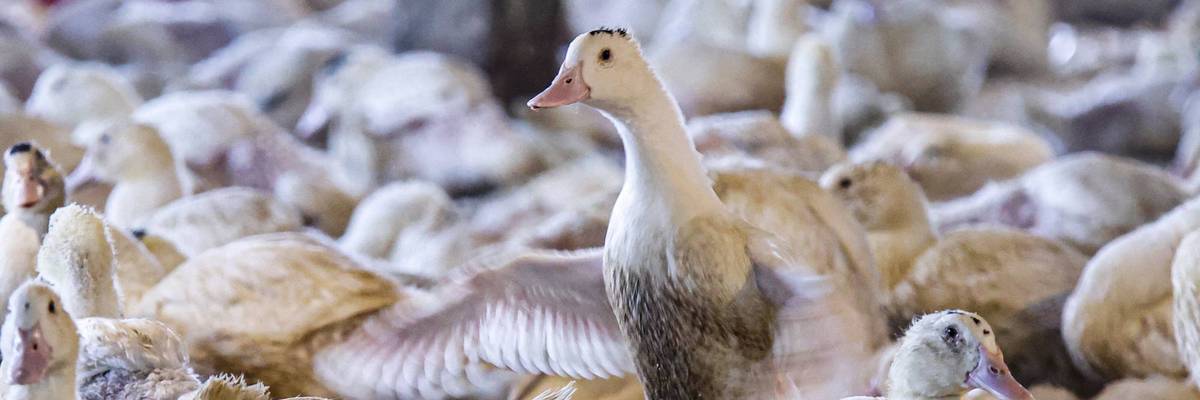
Ducks are pictured at Hudson Valley Foie Gras, in Ferndale, New York, on March 3, 2023.
Last month, a New York appellate court upheld the city’s ban on the sale of foie gras, ending years of legal obstruction that delayed the will of the City Council and the clear moral instincts of New Yorkers.
At long last, New York City can say goodbye to foie gras from force-fed ducks.
Last month, a New York appellate court upheld the city’s ban on the sale of foie gras, ending years of legal obstruction that delayed the will of the City Council and the clear moral instincts of New Yorkers.
The ruling is a long-overdue victory—not just for ducks and geese subjected to force-feeding, but for the democratic process itself.
Back in 2019, the New York City Council voted overwhelmingly to ban the sale of foie gras, a product made by force-feeding ducks and geese until their livers swell to many times their natural size. Council Member Carlina Rivera, who sponsored the legislation, showed tremendous leadership in bringing the issue forward and building broad support among her colleagues.
No civilized society should tolerate the force-feeding of animals like this. And certainly a city that prides itself on compassion and progress should not allow such products to be sold in its restaurants and markets.
The Council’s message was clear: Extreme animal cruelty and the product of that abuse has no place in New York City.
To understand why, it’s important to understand what foie gras actually is.
On foie gras factory farms, ducks and geese are confined and repeatedly restrained while workers force metal or plastic tubes down their throats. Through those tubes, large quantities of grain are pumped directly into their stomachs several times a day. The process is so aggressive that the animals’ livers swell to as much as 10 times their natural size, leaving them struggling to walk, gasping for breath, and suffering from severe organ damage.
The product that results—marketed as a luxury delicacy—is quite literally diseased liver created through deliberate cruelty.
No civilized society should tolerate the force-feeding of animals like this. And certainly a city that prides itself on compassion and progress should not allow such products to be sold in its restaurants and markets.
That is why the City Council acted.
Yet instead of respecting the overwhelming vote of New York City’s elected representatives, the foie gras industry turned to Gov. Kathy Hochul's administration to defend abuse in the courts. For a time, those efforts succeeded when a lower court overturned the law based on legal arguments that strained common sense.
Fortunately, the appellate court saw through them.
In restoring the ban, the court affirmed a basic principle: Cities have the authority to decide what products belong in their communities. New York City regulates countless aspects of commerce in order to protect public health, safety, and shared values.
Drawing the line at food produced through extreme animal abuse is entirely reasonable.
But there is another troubling part of this story.
Throughout this legal fight, Gov. Hochul’s administration used New Yorkers' taxpayer dollars and the state’s attorneys in ways that helped prolong litigation aimed at undermining New York City’s law. In doing so, the state effectively funded and supported efforts that weakened the democratic decision of our city and supported animal abuse.
New Yorkers deserve better than seeing taxpayer dollars spent defending the foie gras industry.
Now that the appellate court has restored the law, Gov. Hochul should end any further attempts to undermine New York City’s authority to protect animals and reflect the values of its residents.
This victory belongs to many people: to Council Member Rivera for championing the legislation, to the council members who voted overwhelmingly to pass it, Voters For Animal Rights who championed the bill, and to the advocates across the city who fought to expose the cruelty behind foie gras.
Their persistence paid off.
And now New York City can finally say what should have been obvious all along: Force-feeding animals is wrong. And foie gras has no place in our great city. Farewell, foie gras!
Dear Common Dreams reader, It’s been nearly 30 years since I co-founded Common Dreams with my late wife, Lina Newhouser. We had the radical notion that journalism should serve the public good, not corporate profits. It was clear to us from the outset what it would take to build such a project. No paid advertisements. No corporate sponsors. No millionaire publisher telling us what to think or do. Many people said we wouldn't last a year, but we proved those doubters wrong. Together with a tremendous team of journalists and dedicated staff, we built an independent media outlet free from the constraints of profits and corporate control. Our mission has always been simple: To inform. To inspire. To ignite change for the common good. Building Common Dreams was not easy. Our survival was never guaranteed. When you take on the most powerful forces—Wall Street greed, fossil fuel industry destruction, Big Tech lobbyists, and uber-rich oligarchs who have spent billions upon billions rigging the economy and democracy in their favor—the only bulwark you have is supporters who believe in your work. But here’s the urgent message from me today. It's never been this bad out there. And it's never been this hard to keep us going. At the very moment Common Dreams is most needed, the threats we face are intensifying. We need your support now more than ever. We don't accept corporate advertising and never will. We don't have a paywall because we don't think people should be blocked from critical news based on their ability to pay. Everything we do is funded by the donations of readers like you. When everyone does the little they can afford, we are strong. But if that support retreats or dries up, so do we. Will you donate now to make sure Common Dreams not only survives but thrives? —Craig Brown, Co-founder |
At long last, New York City can say goodbye to foie gras from force-fed ducks.
Last month, a New York appellate court upheld the city’s ban on the sale of foie gras, ending years of legal obstruction that delayed the will of the City Council and the clear moral instincts of New Yorkers.
The ruling is a long-overdue victory—not just for ducks and geese subjected to force-feeding, but for the democratic process itself.
Back in 2019, the New York City Council voted overwhelmingly to ban the sale of foie gras, a product made by force-feeding ducks and geese until their livers swell to many times their natural size. Council Member Carlina Rivera, who sponsored the legislation, showed tremendous leadership in bringing the issue forward and building broad support among her colleagues.
No civilized society should tolerate the force-feeding of animals like this. And certainly a city that prides itself on compassion and progress should not allow such products to be sold in its restaurants and markets.
The Council’s message was clear: Extreme animal cruelty and the product of that abuse has no place in New York City.
To understand why, it’s important to understand what foie gras actually is.
On foie gras factory farms, ducks and geese are confined and repeatedly restrained while workers force metal or plastic tubes down their throats. Through those tubes, large quantities of grain are pumped directly into their stomachs several times a day. The process is so aggressive that the animals’ livers swell to as much as 10 times their natural size, leaving them struggling to walk, gasping for breath, and suffering from severe organ damage.
The product that results—marketed as a luxury delicacy—is quite literally diseased liver created through deliberate cruelty.
No civilized society should tolerate the force-feeding of animals like this. And certainly a city that prides itself on compassion and progress should not allow such products to be sold in its restaurants and markets.
That is why the City Council acted.
Yet instead of respecting the overwhelming vote of New York City’s elected representatives, the foie gras industry turned to Gov. Kathy Hochul's administration to defend abuse in the courts. For a time, those efforts succeeded when a lower court overturned the law based on legal arguments that strained common sense.
Fortunately, the appellate court saw through them.
In restoring the ban, the court affirmed a basic principle: Cities have the authority to decide what products belong in their communities. New York City regulates countless aspects of commerce in order to protect public health, safety, and shared values.
Drawing the line at food produced through extreme animal abuse is entirely reasonable.
But there is another troubling part of this story.
Throughout this legal fight, Gov. Hochul’s administration used New Yorkers' taxpayer dollars and the state’s attorneys in ways that helped prolong litigation aimed at undermining New York City’s law. In doing so, the state effectively funded and supported efforts that weakened the democratic decision of our city and supported animal abuse.
New Yorkers deserve better than seeing taxpayer dollars spent defending the foie gras industry.
Now that the appellate court has restored the law, Gov. Hochul should end any further attempts to undermine New York City’s authority to protect animals and reflect the values of its residents.
This victory belongs to many people: to Council Member Rivera for championing the legislation, to the council members who voted overwhelmingly to pass it, Voters For Animal Rights who championed the bill, and to the advocates across the city who fought to expose the cruelty behind foie gras.
Their persistence paid off.
And now New York City can finally say what should have been obvious all along: Force-feeding animals is wrong. And foie gras has no place in our great city. Farewell, foie gras!
At long last, New York City can say goodbye to foie gras from force-fed ducks.
Last month, a New York appellate court upheld the city’s ban on the sale of foie gras, ending years of legal obstruction that delayed the will of the City Council and the clear moral instincts of New Yorkers.
The ruling is a long-overdue victory—not just for ducks and geese subjected to force-feeding, but for the democratic process itself.
Back in 2019, the New York City Council voted overwhelmingly to ban the sale of foie gras, a product made by force-feeding ducks and geese until their livers swell to many times their natural size. Council Member Carlina Rivera, who sponsored the legislation, showed tremendous leadership in bringing the issue forward and building broad support among her colleagues.
No civilized society should tolerate the force-feeding of animals like this. And certainly a city that prides itself on compassion and progress should not allow such products to be sold in its restaurants and markets.
The Council’s message was clear: Extreme animal cruelty and the product of that abuse has no place in New York City.
To understand why, it’s important to understand what foie gras actually is.
On foie gras factory farms, ducks and geese are confined and repeatedly restrained while workers force metal or plastic tubes down their throats. Through those tubes, large quantities of grain are pumped directly into their stomachs several times a day. The process is so aggressive that the animals’ livers swell to as much as 10 times their natural size, leaving them struggling to walk, gasping for breath, and suffering from severe organ damage.
The product that results—marketed as a luxury delicacy—is quite literally diseased liver created through deliberate cruelty.
No civilized society should tolerate the force-feeding of animals like this. And certainly a city that prides itself on compassion and progress should not allow such products to be sold in its restaurants and markets.
That is why the City Council acted.
Yet instead of respecting the overwhelming vote of New York City’s elected representatives, the foie gras industry turned to Gov. Kathy Hochul's administration to defend abuse in the courts. For a time, those efforts succeeded when a lower court overturned the law based on legal arguments that strained common sense.
Fortunately, the appellate court saw through them.
In restoring the ban, the court affirmed a basic principle: Cities have the authority to decide what products belong in their communities. New York City regulates countless aspects of commerce in order to protect public health, safety, and shared values.
Drawing the line at food produced through extreme animal abuse is entirely reasonable.
But there is another troubling part of this story.
Throughout this legal fight, Gov. Hochul’s administration used New Yorkers' taxpayer dollars and the state’s attorneys in ways that helped prolong litigation aimed at undermining New York City’s law. In doing so, the state effectively funded and supported efforts that weakened the democratic decision of our city and supported animal abuse.
New Yorkers deserve better than seeing taxpayer dollars spent defending the foie gras industry.
Now that the appellate court has restored the law, Gov. Hochul should end any further attempts to undermine New York City’s authority to protect animals and reflect the values of its residents.
This victory belongs to many people: to Council Member Rivera for championing the legislation, to the council members who voted overwhelmingly to pass it, Voters For Animal Rights who championed the bill, and to the advocates across the city who fought to expose the cruelty behind foie gras.
Their persistence paid off.
And now New York City can finally say what should have been obvious all along: Force-feeding animals is wrong. And foie gras has no place in our great city. Farewell, foie gras!