5
#000000
#FFFFFF
To donate by check, phone, or other method, see our More Ways to Give page.
Daily news & progressive opinion—funded by the people, not the corporations—delivered straight to your inbox.
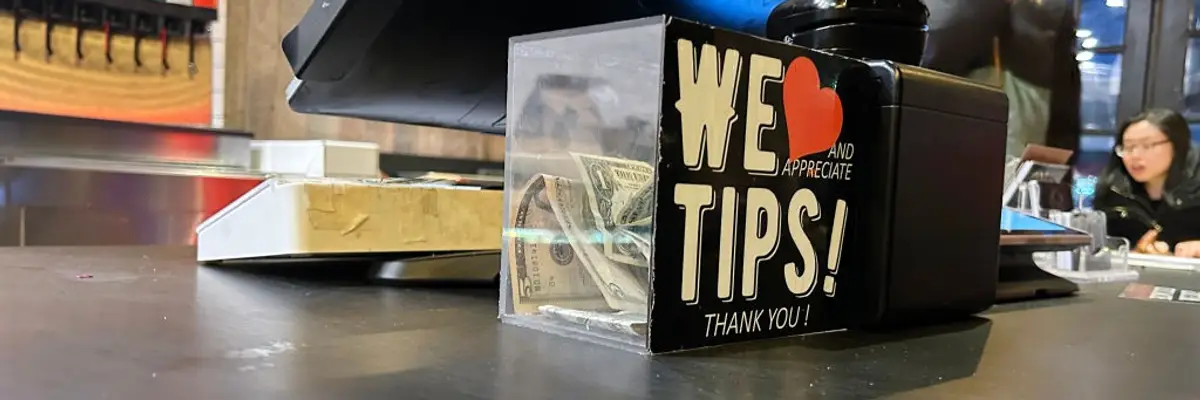
A jar reading, "We appreciate Tips, Thank you," is displayed at Mighty Quinns BBQ restaurant, Queens, New York.
Cutting taxes on some tips for some workers is not a solution. Raising wages—and ending the subminimum wage—is.
During the election, Donald Trump boasted about lowering taxes for working Americans with his “no tax on tips” plan. This tax season, millions of Americans found out it was a scam.
You have to earn money for tax cuts to affect you. A tax deduction only helps if you owe taxes—and most tipped workers earn so little that they barely do. Two-thirds of tipped workers will not even earn enough to benefit. Zero minus zero is still zero. The vast majority of these tax cuts go to the wealthiest taxpayers.
For the workers this policy was supposed to help, the results are already clear.
Take Sherie Cummings, who has poured drinks on the Las Vegas Strip for 20 years. Sherie and her husband, also a bartender, earned $60,000 in tips last year. They expected the full deduction the president promised. They got $25,000 of it. The cap.
Thirteen million tipped workers do not need a tax deduction. They need a raise.
For private jet buyers, the same law delivered something different. Full write-offs on aircraft worth $5 to $10 million. And that write-off is permanent. The tips deduction expires in 2028. The Tax Policy Center projects that 60% of the savings from this law will flow to the top fifth of households—those earning more than $217,000 a year. The wealthiest will save millions. Sherie Cummings is putting her refund into savings because she is afraid of what comes next.
For working people, the real problem was never the tax code. It is wages. The federal subminimum wage for tipped workers has been $2.13 an hour since 1991. It was locked there permanently in 1996 by the National Restaurant Association—what we call “the other NRA.” They spent $2.9 million on federal lobbying in 2020 alone to make sure it stayed there. Which is why tipped workers earn a median income of $15,198 a year. Thirty-seven percent of the national median. Which is why they rely on food stamps at nearly double the rate of other workers. And because workers depend on tips from customers to survive, they put up with what no one should have to. Seventy-one percent of women in the industry report sexual harassment. In subminimum wage states, the rate is double what it is in states that require a full minimum wage with tips on top.
Seven states already require a full minimum wage with tips on top: California, Oregon, Washington, Nevada, Minnesota, Montana, Alaska. It is called One Fair Wage. The restaurant lobby warns that tips would disappear, that restaurants would close, that jobs would vanish. These are scare tactics. The seven states prove them wrong. Tips are the same or higher. Restaurant employment grows faster. Small business growth rates match or beat subminimum wage states.
And restaurant workers have organized and fought for years and won One Fair Wage in Washington, DC, Chicago, and Michigan. The restaurant lobby has fought to block and roll back these wins—in Michigan, they are still trying. But workers keep going. And even where implementation is partial, the numbers are in. DC set an all-time restaurant employment record. Tips grew. Chicago saw more than 850 new restaurant licenses and the fastest pay growth in the country.
Cutting taxes on some tips for some workers is not a solution. Raising wages—and ending the subminimum wage—is. That is why more than 100 labor, community, and civil rights organizations have come together as the Living Wage For All coalition. The fight: Raise the minimum wage to meet the cost of living and end all subminimum wages. In every state. For every worker. Campaigns are active in eight states. Workers have already won. And they will keep winning.
Thirteen million tipped workers do not need a tax deduction. They need a raise. Every shift. Every paycheck. Every year.
Dear Common Dreams reader, It’s been nearly 30 years since I co-founded Common Dreams with my late wife, Lina Newhouser. We had the radical notion that journalism should serve the public good, not corporate profits. It was clear to us from the outset what it would take to build such a project. No paid advertisements. No corporate sponsors. No millionaire publisher telling us what to think or do. Many people said we wouldn't last a year, but we proved those doubters wrong. Together with a tremendous team of journalists and dedicated staff, we built an independent media outlet free from the constraints of profits and corporate control. Our mission has always been simple: To inform. To inspire. To ignite change for the common good. Building Common Dreams was not easy. Our survival was never guaranteed. When you take on the most powerful forces—Wall Street greed, fossil fuel industry destruction, Big Tech lobbyists, and uber-rich oligarchs who have spent billions upon billions rigging the economy and democracy in their favor—the only bulwark you have is supporters who believe in your work. But here’s the urgent message from me today. It's never been this bad out there. And it's never been this hard to keep us going. At the very moment Common Dreams is most needed, the threats we face are intensifying. We need your support now more than ever. We don't accept corporate advertising and never will. We don't have a paywall because we don't think people should be blocked from critical news based on their ability to pay. Everything we do is funded by the donations of readers like you. When everyone does the little they can afford, we are strong. But if that support retreats or dries up, so do we. Will you donate now to make sure Common Dreams not only survives but thrives? —Craig Brown, Co-founder |
During the election, Donald Trump boasted about lowering taxes for working Americans with his “no tax on tips” plan. This tax season, millions of Americans found out it was a scam.
You have to earn money for tax cuts to affect you. A tax deduction only helps if you owe taxes—and most tipped workers earn so little that they barely do. Two-thirds of tipped workers will not even earn enough to benefit. Zero minus zero is still zero. The vast majority of these tax cuts go to the wealthiest taxpayers.
For the workers this policy was supposed to help, the results are already clear.
Take Sherie Cummings, who has poured drinks on the Las Vegas Strip for 20 years. Sherie and her husband, also a bartender, earned $60,000 in tips last year. They expected the full deduction the president promised. They got $25,000 of it. The cap.
Thirteen million tipped workers do not need a tax deduction. They need a raise.
For private jet buyers, the same law delivered something different. Full write-offs on aircraft worth $5 to $10 million. And that write-off is permanent. The tips deduction expires in 2028. The Tax Policy Center projects that 60% of the savings from this law will flow to the top fifth of households—those earning more than $217,000 a year. The wealthiest will save millions. Sherie Cummings is putting her refund into savings because she is afraid of what comes next.
For working people, the real problem was never the tax code. It is wages. The federal subminimum wage for tipped workers has been $2.13 an hour since 1991. It was locked there permanently in 1996 by the National Restaurant Association—what we call “the other NRA.” They spent $2.9 million on federal lobbying in 2020 alone to make sure it stayed there. Which is why tipped workers earn a median income of $15,198 a year. Thirty-seven percent of the national median. Which is why they rely on food stamps at nearly double the rate of other workers. And because workers depend on tips from customers to survive, they put up with what no one should have to. Seventy-one percent of women in the industry report sexual harassment. In subminimum wage states, the rate is double what it is in states that require a full minimum wage with tips on top.
Seven states already require a full minimum wage with tips on top: California, Oregon, Washington, Nevada, Minnesota, Montana, Alaska. It is called One Fair Wage. The restaurant lobby warns that tips would disappear, that restaurants would close, that jobs would vanish. These are scare tactics. The seven states prove them wrong. Tips are the same or higher. Restaurant employment grows faster. Small business growth rates match or beat subminimum wage states.
And restaurant workers have organized and fought for years and won One Fair Wage in Washington, DC, Chicago, and Michigan. The restaurant lobby has fought to block and roll back these wins—in Michigan, they are still trying. But workers keep going. And even where implementation is partial, the numbers are in. DC set an all-time restaurant employment record. Tips grew. Chicago saw more than 850 new restaurant licenses and the fastest pay growth in the country.
Cutting taxes on some tips for some workers is not a solution. Raising wages—and ending the subminimum wage—is. That is why more than 100 labor, community, and civil rights organizations have come together as the Living Wage For All coalition. The fight: Raise the minimum wage to meet the cost of living and end all subminimum wages. In every state. For every worker. Campaigns are active in eight states. Workers have already won. And they will keep winning.
Thirteen million tipped workers do not need a tax deduction. They need a raise. Every shift. Every paycheck. Every year.
During the election, Donald Trump boasted about lowering taxes for working Americans with his “no tax on tips” plan. This tax season, millions of Americans found out it was a scam.
You have to earn money for tax cuts to affect you. A tax deduction only helps if you owe taxes—and most tipped workers earn so little that they barely do. Two-thirds of tipped workers will not even earn enough to benefit. Zero minus zero is still zero. The vast majority of these tax cuts go to the wealthiest taxpayers.
For the workers this policy was supposed to help, the results are already clear.
Take Sherie Cummings, who has poured drinks on the Las Vegas Strip for 20 years. Sherie and her husband, also a bartender, earned $60,000 in tips last year. They expected the full deduction the president promised. They got $25,000 of it. The cap.
Thirteen million tipped workers do not need a tax deduction. They need a raise.
For private jet buyers, the same law delivered something different. Full write-offs on aircraft worth $5 to $10 million. And that write-off is permanent. The tips deduction expires in 2028. The Tax Policy Center projects that 60% of the savings from this law will flow to the top fifth of households—those earning more than $217,000 a year. The wealthiest will save millions. Sherie Cummings is putting her refund into savings because she is afraid of what comes next.
For working people, the real problem was never the tax code. It is wages. The federal subminimum wage for tipped workers has been $2.13 an hour since 1991. It was locked there permanently in 1996 by the National Restaurant Association—what we call “the other NRA.” They spent $2.9 million on federal lobbying in 2020 alone to make sure it stayed there. Which is why tipped workers earn a median income of $15,198 a year. Thirty-seven percent of the national median. Which is why they rely on food stamps at nearly double the rate of other workers. And because workers depend on tips from customers to survive, they put up with what no one should have to. Seventy-one percent of women in the industry report sexual harassment. In subminimum wage states, the rate is double what it is in states that require a full minimum wage with tips on top.
Seven states already require a full minimum wage with tips on top: California, Oregon, Washington, Nevada, Minnesota, Montana, Alaska. It is called One Fair Wage. The restaurant lobby warns that tips would disappear, that restaurants would close, that jobs would vanish. These are scare tactics. The seven states prove them wrong. Tips are the same or higher. Restaurant employment grows faster. Small business growth rates match or beat subminimum wage states.
And restaurant workers have organized and fought for years and won One Fair Wage in Washington, DC, Chicago, and Michigan. The restaurant lobby has fought to block and roll back these wins—in Michigan, they are still trying. But workers keep going. And even where implementation is partial, the numbers are in. DC set an all-time restaurant employment record. Tips grew. Chicago saw more than 850 new restaurant licenses and the fastest pay growth in the country.
Cutting taxes on some tips for some workers is not a solution. Raising wages—and ending the subminimum wage—is. That is why more than 100 labor, community, and civil rights organizations have come together as the Living Wage For All coalition. The fight: Raise the minimum wage to meet the cost of living and end all subminimum wages. In every state. For every worker. Campaigns are active in eight states. Workers have already won. And they will keep winning.
Thirteen million tipped workers do not need a tax deduction. They need a raise. Every shift. Every paycheck. Every year.