SUBSCRIBE TO OUR FREE NEWSLETTER
Daily news & progressive opinion—funded by the people, not the corporations—delivered straight to your inbox.
5
#000000
#FFFFFF
To donate by check, phone, or other method, see our More Ways to Give page.
Daily news & progressive opinion—funded by the people, not the corporations—delivered straight to your inbox.
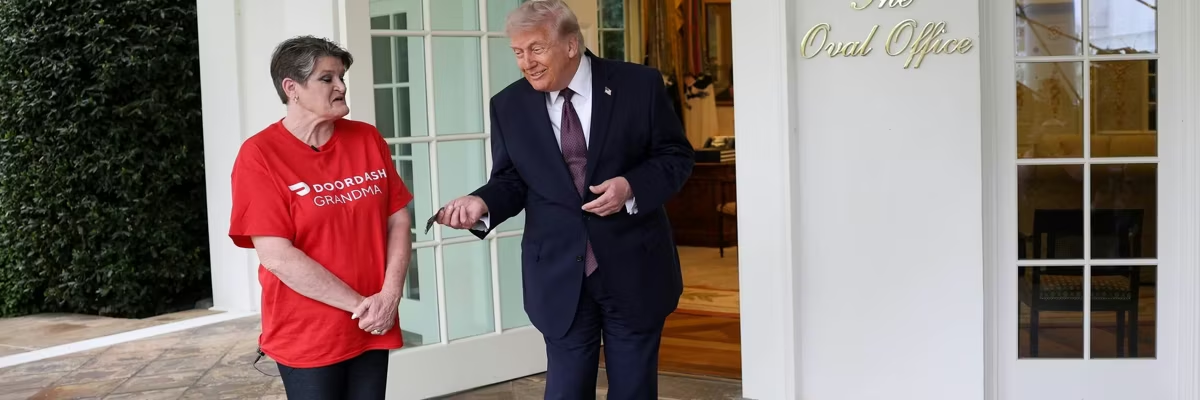
US President Donald Trump tips Sharon Simmons after receiving a DoorDash delivery of McDonald's during an event outside the Oval Office of the White House on April 13, 2026 in Washington, DC.
The staged photo op was actually a good reminder of the gap between the White House’s rhetoric and reality.
There is little doubt that most of the benefits of President Donald Trump’s One Big Beautiful Bill Act flow to the wealthy. But the White House has put considerable effort into promoting the idea that the law benefits working class people too, in particular those who earn tips.
To drive that point home, they staged an April 13 photo op with a DoorDash delivery to the White House. But the stunt was actually a good reminder of the gap between the White House’s rhetoric and reality.
First, it helps to understand that the "no tax on tips" policy applies to very few workers; less than 3% of workers are tipped. And its effects are even narrower than that. The policy is actually a deduction (topping out at $25,000) that can be claimed by tipped workers to lower their taxable income. But many tipped workers—about 1 in 3, or possibly close to 40%—do not earn enough to file taxes, so this deduction does them no good.
Now on to the White House event. When DoorDash driver Sharon Simmons "delivered" his McDonald’s order, President Trump commented that she “picked up an extra $11,000” because of the new policy. As Paul Waldman (and others) noted, this was mathematically dubious, given the $25,000 cap on the deduction. Indeed, Simmons would later explain that she earned $11,000 in tips, not that she saved that amount of money on her taxes. How much she saved on her taxes is unclear; by one high-end estimate, if she were paying a 24% tax rate she would have saved just $2,640.
If the goal of these kinds of policies are to provide some relief for workers—especially those earning a low wage—there are plenty of other options that would apply more broadly. Raising the minimum wage, for example, or eliminating the subminimum "tipped" wage would put more money in more workers’ pockets.
Speaking just after the White House photo op—and at a different "no tax on tips" event—Trump said the photo op was “a little tacky.” Given that Simmons is making DoorDash deliveries to pay for her husband’s cancer treatments, and the fact that his signature tax cut bill slashes food assistance and will cause millions to lose their health insurance coverage, "tacky" is an understatement.
Dear Common Dreams reader, It’s been nearly 30 years since I co-founded Common Dreams with my late wife, Lina Newhouser. We had the radical notion that journalism should serve the public good, not corporate profits. It was clear to us from the outset what it would take to build such a project. No paid advertisements. No corporate sponsors. No millionaire publisher telling us what to think or do. Many people said we wouldn't last a year, but we proved those doubters wrong. Together with a tremendous team of journalists and dedicated staff, we built an independent media outlet free from the constraints of profits and corporate control. Our mission has always been simple: To inform. To inspire. To ignite change for the common good. Building Common Dreams was not easy. Our survival was never guaranteed. When you take on the most powerful forces—Wall Street greed, fossil fuel industry destruction, Big Tech lobbyists, and uber-rich oligarchs who have spent billions upon billions rigging the economy and democracy in their favor—the only bulwark you have is supporters who believe in your work. But here’s the urgent message from me today. It's never been this bad out there. And it's never been this hard to keep us going. At the very moment Common Dreams is most needed, the threats we face are intensifying. We need your support now more than ever. We don't accept corporate advertising and never will. We don't have a paywall because we don't think people should be blocked from critical news based on their ability to pay. Everything we do is funded by the donations of readers like you. When everyone does the little they can afford, we are strong. But if that support retreats or dries up, so do we. Will you donate now to make sure Common Dreams not only survives but thrives? —Craig Brown, Co-founder |
There is little doubt that most of the benefits of President Donald Trump’s One Big Beautiful Bill Act flow to the wealthy. But the White House has put considerable effort into promoting the idea that the law benefits working class people too, in particular those who earn tips.
To drive that point home, they staged an April 13 photo op with a DoorDash delivery to the White House. But the stunt was actually a good reminder of the gap between the White House’s rhetoric and reality.
First, it helps to understand that the "no tax on tips" policy applies to very few workers; less than 3% of workers are tipped. And its effects are even narrower than that. The policy is actually a deduction (topping out at $25,000) that can be claimed by tipped workers to lower their taxable income. But many tipped workers—about 1 in 3, or possibly close to 40%—do not earn enough to file taxes, so this deduction does them no good.
Now on to the White House event. When DoorDash driver Sharon Simmons "delivered" his McDonald’s order, President Trump commented that she “picked up an extra $11,000” because of the new policy. As Paul Waldman (and others) noted, this was mathematically dubious, given the $25,000 cap on the deduction. Indeed, Simmons would later explain that she earned $11,000 in tips, not that she saved that amount of money on her taxes. How much she saved on her taxes is unclear; by one high-end estimate, if she were paying a 24% tax rate she would have saved just $2,640.
If the goal of these kinds of policies are to provide some relief for workers—especially those earning a low wage—there are plenty of other options that would apply more broadly. Raising the minimum wage, for example, or eliminating the subminimum "tipped" wage would put more money in more workers’ pockets.
Speaking just after the White House photo op—and at a different "no tax on tips" event—Trump said the photo op was “a little tacky.” Given that Simmons is making DoorDash deliveries to pay for her husband’s cancer treatments, and the fact that his signature tax cut bill slashes food assistance and will cause millions to lose their health insurance coverage, "tacky" is an understatement.
There is little doubt that most of the benefits of President Donald Trump’s One Big Beautiful Bill Act flow to the wealthy. But the White House has put considerable effort into promoting the idea that the law benefits working class people too, in particular those who earn tips.
To drive that point home, they staged an April 13 photo op with a DoorDash delivery to the White House. But the stunt was actually a good reminder of the gap between the White House’s rhetoric and reality.
First, it helps to understand that the "no tax on tips" policy applies to very few workers; less than 3% of workers are tipped. And its effects are even narrower than that. The policy is actually a deduction (topping out at $25,000) that can be claimed by tipped workers to lower their taxable income. But many tipped workers—about 1 in 3, or possibly close to 40%—do not earn enough to file taxes, so this deduction does them no good.
Now on to the White House event. When DoorDash driver Sharon Simmons "delivered" his McDonald’s order, President Trump commented that she “picked up an extra $11,000” because of the new policy. As Paul Waldman (and others) noted, this was mathematically dubious, given the $25,000 cap on the deduction. Indeed, Simmons would later explain that she earned $11,000 in tips, not that she saved that amount of money on her taxes. How much she saved on her taxes is unclear; by one high-end estimate, if she were paying a 24% tax rate she would have saved just $2,640.
If the goal of these kinds of policies are to provide some relief for workers—especially those earning a low wage—there are plenty of other options that would apply more broadly. Raising the minimum wage, for example, or eliminating the subminimum "tipped" wage would put more money in more workers’ pockets.
Speaking just after the White House photo op—and at a different "no tax on tips" event—Trump said the photo op was “a little tacky.” Given that Simmons is making DoorDash deliveries to pay for her husband’s cancer treatments, and the fact that his signature tax cut bill slashes food assistance and will cause millions to lose their health insurance coverage, "tacky" is an understatement.